
Can High Courts stop ongoing arbitration cases using their special supervisory powers?
Manash Kamal Bezboruah v. M/s Bokahola Tea Company Private Limited & Ors.
Case: Manash Kamal Bezboruah v. M/s Bokahola Tea Company Private Limited & Ors.Citation: 2026 INSC 701Decided on: 14 July 2026
“The Supreme Court ruled that High Courts cannot easily interfere in ongoing arbitration disputes or stop them using their special supervisory powers.”
Story Slides
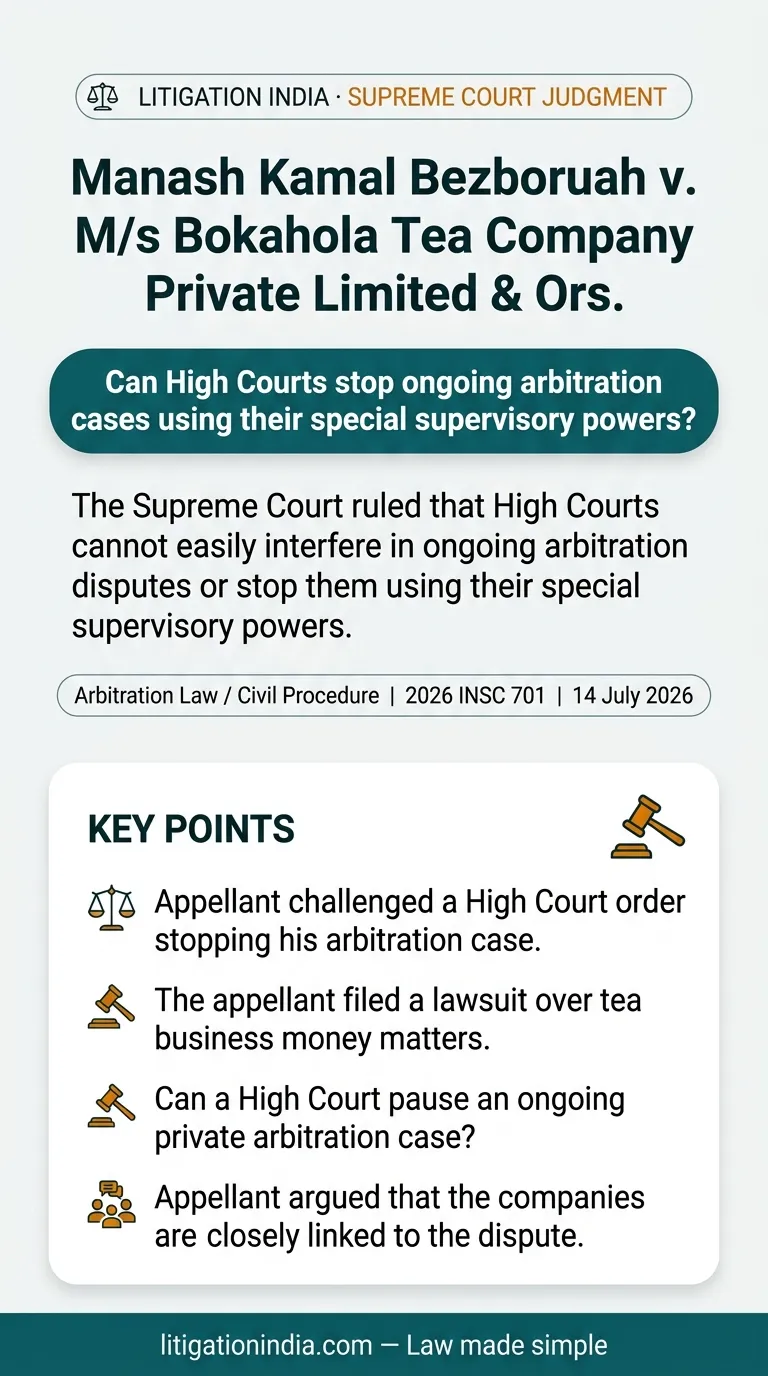
In short
This case arose out of a partnership dispute within a family-run tea company. The appellant, Manash Kamal Bezboruah, filed a lawsuit alleging financial mismanagement. With the consent of parties, the Supreme Court previously referred the disputes to a retired High Court judge as a Sole Arbitrator. During the arbitration, certain family-owned companies (Respondents 1 to 3) argued they should not be part of the case because they never signed the original partnership agreement. The Arbitrator rejected their request to be removed, stating that the Supreme Court's earlier order meant everyone had to participate. The companies then appealed to the Gauhati High Court under Article 227 of the Constitution, which gives High Courts supervisory powers. The High Court stayed the arbitration proceedings against these companies. The appellant challenged this in the Supreme Court. The Supreme Court ruled that the High Court was wrong to interfere. The court emphasized that the Arbitration Act is designed to minimize court interference to ensure fast dispute resolution. Any objection to an arbitrator's jurisdiction must be decided by the arbitrator first. If a party is unhappy, they must wait until the final decision (award) is made and then challenge it under Section 34 of the Act. High Courts can only step in under Article 227 in extremely rare cases showing a patent lack of jurisdiction so severe it requires no argument. The Supreme Court set aside the High Court's orders but told the arbitrator to independently decide if the companies are actually bound by the agreement.
Need clarity on a similar legal issue?
Request free pro bono guidance from a Supreme Court Advocate.
Background
The appellant filed a lawsuit against family-owned tea companies and partners over financial mismanagement. The Supreme Court previously referred the entire dispute to a private arbitrator. However, three companies involved argued they never signed the arbitration agreement and should be excluded.
The Decision
The Supreme Court set aside the High Court's orders that stopped the arbitration. It ruled that High Courts should not interfere in ongoing arbitration unless there is an obvious, undeniable lack of jurisdiction. The Court directed the arbitrator to independently decide if the three companies are bound by the agreement.
Why it matters for you
This judgment ensures that legal disputes decided through private arbitration cannot be easily delayed by filing appeals in traditional courts. It protects the speed and efficiency of the arbitration process for common business owners and partners.
AI-assisted summary, reviewed and verified by our editorial team.
Need help with your case?
Facing a similar legal challenge in the Supreme Court or High Court? Connect with our pro bono volunteer advocates today.
Related Supreme Court services