
All insights

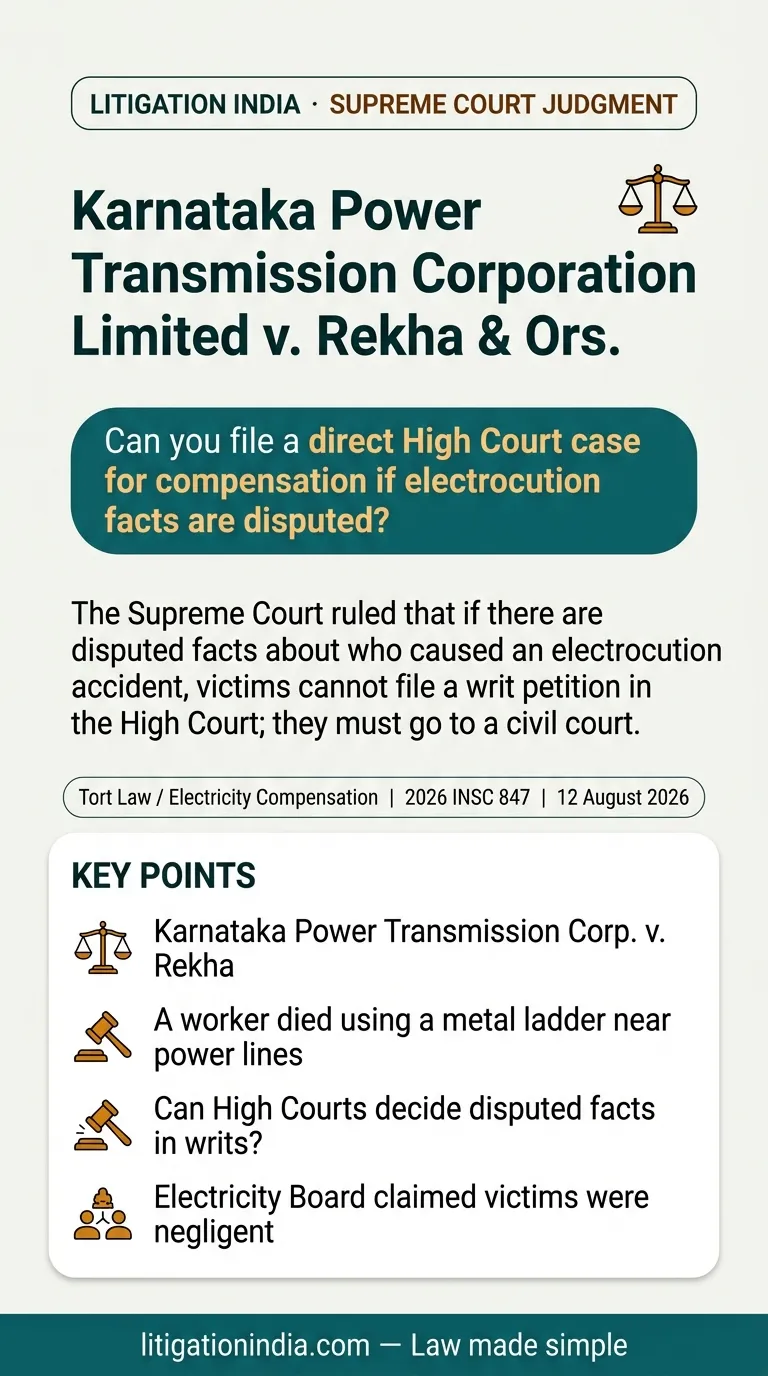
Can you file a direct High Court case for compensation if electrocution facts are disputed?

Karnataka Power Transmission Corporation Limited v. Rekha & Ors.

The Supreme Court ruled that if there are disputed facts about who caused an electrocution accident, victims cannot file a writ petition in the High Court; they must go to a civil court.

Litigation India Editorial 15 August 2026 1 min read 2026 INSC 847

Story

Key points1 / 7

Case at a Glance

  • Karnataka Power Transmission Corp. v. Rekha
  • Electrocution accident compensation claims challenged
  • Decided on 12 August 2026
  • By the Supreme Court of India
Karnataka Power Transmission Corporation Limited v. Rekha & Ors. · 2026 INSC 8472026-08-15T15:11:12.270804+00:00
Key points2 / 7

What Led to the Case?

  • A worker died using a metal ladder near power lines
  • A boy was injured retrieving a cricket ball
  • High Court ordered heavy compensation under writ petitions
  • Electricity board appealed to the Supreme Court
Karnataka Power Transmission Corporation Limited v. Rekha & Ors. · 2026 INSC 8472026-08-15T15:11:12.270804+00:00
Key points3 / 7

The Main Legal Questions

  • Can High Courts decide disputed facts in writs?
  • What liability rule applies to electricity departments?
  • How should electrocution compensation be calculated?
Karnataka Power Transmission Corporation Limited v. Rekha & Ors. · 2026 INSC 8472026-08-15T15:11:12.270804+00:00
Key points4 / 7

The Arguments Made

  • Electricity Board claimed victims were negligent
  • Argued detailed trial is needed to find fault
  • Victims argued electricity departments are absolutely liable
  • Argued direct High Court relief was correct
Karnataka Power Transmission Corporation Limited v. Rekha & Ors. · 2026 INSC 8472026-08-15T15:11:12.270804+00:00
Key points5 / 7

What the Court Decided

  • Writs are not for heavily disputed facts
  • Electricity cases fall under 'strict liability' not 'absolute'
  • Electricity board has a right to defend itself
  • Victims must approach a civil court instead
Karnataka Power Transmission Corporation Limited v. Rekha & Ors. · 2026 INSC 8472026-08-15T15:11:12.270804+00:00
Key points6 / 7

Compensation Rules Clarified

  • Motor Vehicle Act formula cannot be directly used
  • Compensation must be fair, just, and reasonable
  • Already paid Rs. 5 Lakh relief won't be recovered
  • Civil courts must decide cases quickly and independently
Karnataka Power Transmission Corporation Limited v. Rekha & Ors. · 2026 INSC 8472026-08-15T15:11:12.270804+00:00
Key points7 / 7

Key Takeaways for Litigants

  • Direct High Court routes avoid detailed proof stage
  • But disputed accident cases require proper trial
  • Always file civil suits for disputed compensation claims
  • Ensure safety precautions near high-voltage lines
Karnataka Power Transmission Corporation Limited v. Rekha & Ors. · 2026 INSC 8472026-08-15T15:11:12.270804+00:00
Karnataka Power Transmission Corporation Limited v. Rekha & Ors. — infographic summary

What this case means

The Supreme Court ruled that if there are disputed facts about who caused an electrocution accident, victims cannot file a writ petition in the High Court; they must go to a civil court.

What the Supreme Court held

The Supreme Court set aside the High Court's compensation orders, ruling that writ petitions are not proper when facts are highly disputed. It gave the victims liberty to approach the civil court or appropriate forum, and clarified that the interim compensation of Rs. 5 Lakhs already paid will not be recovered.

Case: Karnataka Power Transmission Corporation Limited v. Rekha & Ors. (2026) Citation: 2026 INSC 847

Want the full legal reasoning, citations and case documents?

Read the full judgment analysis
Electrocution
Compensation
Strict Liability
Writ Petition
Disputed Facts
Tort Law / Electricity Compensation
Supreme Court legal news
Supreme Court judgment today
latest Supreme Court news