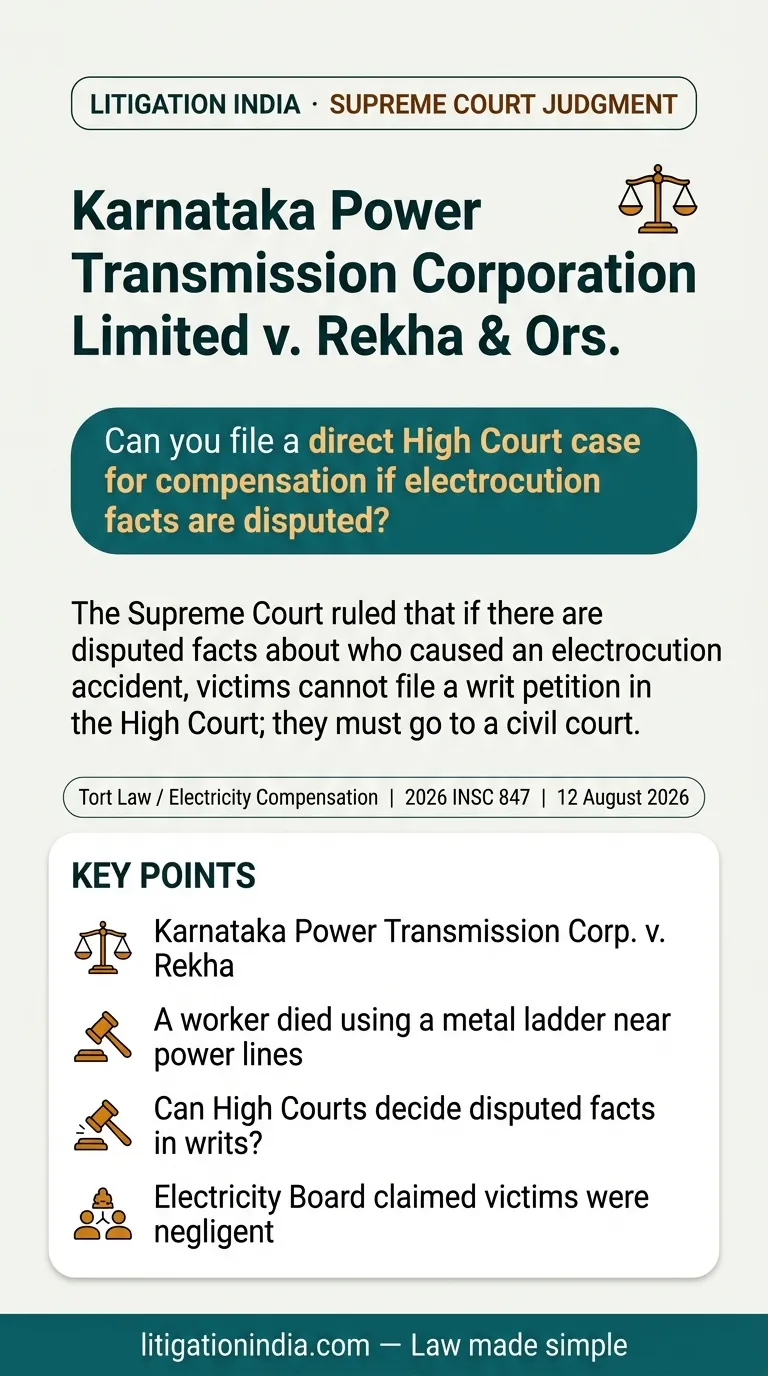
Karnataka Power Transmission Corporation Limited v. Rekha & Ors.
The big legal question
Can you file a direct High Court case for compensation if electrocution facts are disputed?
“The Supreme Court ruled that if there are disputed facts about who caused an electrocution accident, victims cannot file a writ petition in the High Court; they must go to a civil court.”
Story Slides
In short
In this case, the Supreme Court of India clarified the rules for getting compensation in electrocution accidents. The case arose from two separate accidents in Karnataka. In one, a man died after an aluminum ladder he was using in a coffee plantation touched an 11 KV electric wire. In the other, a boy was severely injured after touching a 66 KV wire while retrieving a cricket ball. In both cases, the Karnataka High Court had directly entertained writ petitions and ordered the electricity department to pay large compensation amounts. The High Court applied the rule of 'absolute liability' (where the department is responsible no matter what) and calculated compensation using vehicle accident rules. The Supreme Court overturned the High Court's decision. It held that electrocution cases are governed by 'strict liability,' which allows the electricity department to defend itself if the accident was caused by the victim's own negligence or a stranger's act. Because there were deep disputes about whose mistake actually caused these accidents, the High Court should not have decided the case based on simple affidavits in a writ petition. Instead, the victims must file a regular civil suit where evidence can be properly tested. Additionally, the Court ruled that the formula used for road accidents cannot be directly used for electrocution cases. However, the Court ordered that the Rs 5 lakh already paid as interim relief to the families will not be taken back.
Background
Two families approached the High Court through writ petitions seeking compensation after their loved ones suffered electrocution—one died in a coffee plantation, and another was severely injured while retrieving a cricket ball.
The Decision
The Supreme Court set aside the High Court's compensation orders, ruling that writ petitions are not proper when facts are highly disputed. It gave the victims liberty to approach the civil court or appropriate forum, and clarified that the interim compensation of Rs. 5 Lakhs already paid will not be recovered.
Why it matters for you
This judgment clarifies that electricity departments can raise defenses (like victim's negligence) in accidents, making direct High Court petitions unsuitable if facts are disputed. It ensures that complex accident claims are decided through detailed trials in civil courts rather than quick writ proceedings.
AI-assisted summary, reviewed and verified by our editorial team.
Need help with your case?
Facing a similar legal challenge in the Supreme Court or High Court? Connect with our pro bono volunteer advocates today.
Related Supreme Court services