
All insights

Can a Hindu widow's limited interest become absolute ownership without a formal partition?

Hindu Widow's Limited Interest Converts to Absolute Ownership Under Section 14(1)

This case concerned whether a Hindu widow, Kashibai, acquired absolute ownership of suit properties left by her deceased husband Gangaram, who died in 1949. The Supreme Court held that by operation of

Litigation India Editorial 22 September 2026 1 min read 2026 INSC 1033

Story

Case at a glance1 / 6

Supreme Court of India

Hindu Widow's Limited Interest Becomes Absolute Without Partition

Ganapati (Dead) by his LRs vs Prabhakar & Others — 2026 INSC 1033

Court: Supreme Court of India | Date: September 22, 2026Bench: Justice S.V.N. Bhatti and Justice N.V. AnjariaArea of Law: Hindu Succession / Property Rights of Hindu WidowCivil Appeal No. 660 of 2019 dismissed; High Court judgment upheld
Hindu Widow's Limited Interest Converts to Absolute Ownership Under Section 14(1) · 2026 INSC 10332026-09-22T16:41:36.724820+00:00
The legal question2 / 6

Does a Hindu widow need a formal partition to gain absolute ownership?

The core legal question framed by the High Court

  • Appellant: Kashibai had only a limited interest; oral partition was unproved, so she could not validly execute a Will.
  • Appellant: Mere residence in matrimonial property does not ripen into absolute ownership under Section 14(1).
  • Respondent: Under Section 3(2), Act 1937, Kashibai got equal half share; Section 14(1), Act 1956 converted it to absolute ownership.
  • Respondent: Partition is not a legal requirement for the widow's limited interest to transform into absolute right.
Hindu Widow's Limited Interest Converts to Absolute Ownership Under Section 14(1) · 2026 INSC 10332026-09-22T16:41:36.724820+00:00
Statutory comparison3 / 6

How the Two Acts Govern Hindu Widow's Property Rights

Interplay between Act of 1937 and Act of 1956

Legal SubjectHindu Women's Rights to Property Act, 1937Hindu Succession Act, 1956
Nature of widow's interestLimited interest — Hindu Women's Estate (Section 3(2))Converted to absolute ownership (Section 14(1))
Scope of 'possession'Governed by coparcenary and right to seek partitionWidest amplitude — includes constructive/legal possession backed by title
Is partition required?Widow must claim partition to assert her sharePartition not a sine qua non for absolute ownership
Effect on restrictionsRestriction under Section 3(3) appliesSection 14(1) removes limitations imposed by Section 3(2)
Applicability of exceptionNot applicableSection 14(2) applies only where a new title is created for the first time
Section 14(1) of the Hindu Succession Act, 1956 takes away the effect of Section 3(2) of the Hindu Women's Rights to Property Act, 1937.
Hindu Widow's Limited Interest Converts to Absolute Ownership Under Section 14(1) · 2026 INSC 10332026-09-22T16:41:36.724820+00:00
The Court's reasoning4 / 6

Court's Reasoning: From Limited Interest to Absolute Ownership

Step-by-step legal analysis

  1. 1Step 1: Gangaram died intestate in 1949; Kashibai inherited a limited Hindu Women's Estate under Section 3(2), Act 1937.
  2. 2Step 2: Oral partition was unproved by Defendants, but the Court held this does not defeat Kashibai's statutory right.
  3. 3Step 3: Kashibai's pre-existing right to maintenance (jus ad rem) is recognised under Shastric Hindu law, not merely statutory.
  4. 4Step 4: Section 14(1), Act 1956, upon its commencement, converted Kashibai's limited interest into absolute ownership.
  5. 5Step 5: As absolute owner, Kashibai's Will and Defendant No. 1's subsequent sale to Defendant No. 3 were both legally valid.
Partition is not a sine qua non for a Hindu widow to enjoy the right as an absolute owner.
Hindu Widow's Limited Interest Converts to Absolute Ownership Under Section 14(1) · 2026 INSC 10332026-09-22T16:41:36.724820+00:00
The verdict5 / 6

Supreme Court's Final Verdict

Civil Appeal No. 660 of 2019

  • The Fact: Gangaram died in 1949; Kashibai held the suit properties without a formal partition from Ganapati.
  • The Law: Section 3(2), Act 1937 gave Kashibai a limited interest; Section 14(1), Act 1956 converted it to absolute ownership without requiring partition.
  • The Result: Kashibai's Will was valid; Defendant No. 1's sale to Defendant No. 3 was lawful; Civil Appeal dismissed.
Civil Appeal dismissed; High Court's judgment allowing the Second Appeal upheld; no order as to costs.
Hindu Widow's Limited Interest Converts to Absolute Ownership Under Section 14(1) · 2026 INSC 10332026-09-22T16:41:36.724820+00:00
Why it matters6 / 6

What This Means for Ordinary People

Practical significance of the judgment

  • A Hindu widow living in her husband's property after his death holds it as absolute owner once the Hindu Succession Act, 1956 came into force.
  • She does not need to formally demand or prove partition to become the full owner of her share.
  • A Will or sale deed executed by such a widow is legally valid and her transferee gets good title.
  • Sons or other heirs cannot defeat a widow's ownership merely by claiming partition was never carried out.
A Hindu widow's limited interest automatically becomes absolute ownership under Section 14(1) — no partition needed.
Hindu Widow's Limited Interest Converts to Absolute Ownership Under Section 14(1) · 2026 INSC 10332026-09-22T16:41:36.724820+00:00
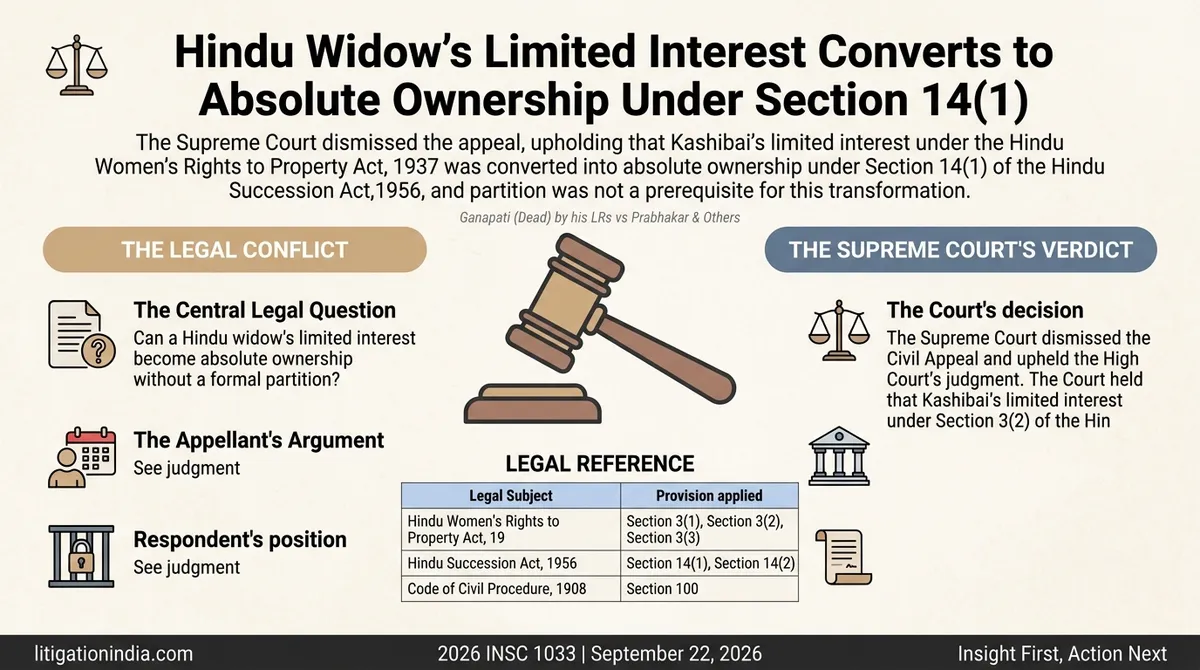
Hindu Widow's Limited Interest Converts to Absolute Ownership Under Section 14(1) — infographic summary

What this case means

This case concerned whether a Hindu widow, Kashibai, acquired absolute ownership of suit properties left by her deceased husband Gangaram, who died in 1949. The Supreme Court held that by operation of Section 3(2) of the Hindu Women's Rights to Property Act, 1937, read with Section 14(1) of the Hindu Succession Act, 1956, Kashibai's limited interest transformed into absolute ownership. The decision confirms that partition is not a precondition for a widow's limited interest to ripen into absolute right.

What the Supreme Court held

The Supreme Court dismissed the Civil Appeal and upheld the High Court's judgment. The Court held that Kashibai's limited interest under Section 3(2) of the Hindu Women's Rights to Property Act, 1937 was converted into absolute ownership under Section 14(1) of the Hindu Succession Act, 1956, without requiring any partition. No order as to costs was made.

Case: Ganapati (Dead) by his LRs vs Prabhakar & Others (2026) Citation: 2026 INSC 1033

Want the full legal reasoning, citations and case documents?

Read the full judgment analysis
Hindu widow absolute ownership
Section 14 Hindu Succession Act 1956
Section 3 Hindu Women's Rights to Property Act 1937
limited interest to absolute right
Mitakshara coparcenary
oral partition
V. Tulasamma
Raghubar Singh
Ganapati vs Prabhakar
2026 INSC 1033
Section 3(1), Section 3(2), Section 3(3), Hindu Women's Rights to Property Act, 1937 (Act XVIII of 1937)
Section 14(1), Section 14(2), Hindu Succession Act, 1956
Section 100, Code of Civil Procedure, 1908
Civil Law / Hindu Succession / Property Rights of Hindu Widow