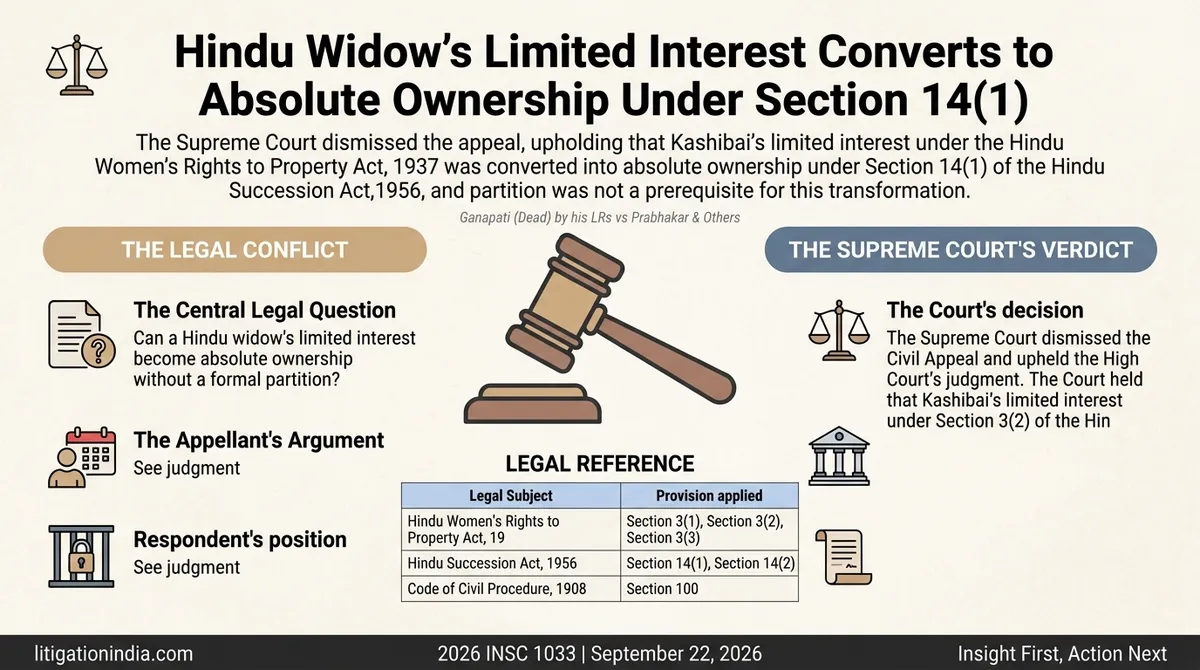
Full text of the judgment
Text extracted from Ganapati (Dead) by his LRs vs Prabhakar & Others. For the authoritative version refer to the Supreme Court of India's official website.
2026 INSC 1033
NON-REPORTABLE
IN THE SUPREME COURT OF INDIA CIVIL APPELLATE JURISDICTION
CIVIL APPEAL NO. 660 OF 2019
GANAPATI (DEAD) BY HIS LRS
… APPELLANT(S)
PRABHAKAR & OTHERS
… RESPONDENT(S)
J U D G M E N T
S.V.N. BHATTI, J. 1. The Appellants, i.e., the Legal Representatives of the Plaintiff, assail the decision dated 19.07.2012 in R.S.A. No. 551 of 2007 of the High Court of Karnataka, Circuit Bench at Dharwad. The Plaintiff filed O.S. No. 9 of 1988 before the Munsiff Court at Banahatti, seeking a declaration and an injunction against the Respondents herein. Subsequently, the Munsiff Court at Banahatti transferred the Suit to the Court of the Principal Civil Judge (Senior Division), Jamkhandi, where it was re-registered as O.S. No. 267 of 1999. The genealogical table showing the relationship between the parties is set out before adverting to their averments in O.S. No. 267 of 1999.
Digitally signed by LOKESH ARORA Date: 2026.09.22 17:53:13 IST Reason: Signature Not Verified
2. The admitted facts are that the propositus Gangaram died in 1949, leaving behind his son Ganapati, the plaintiff, by his first wife. His second wife, Kashibai, had two daughters. The Plaintiff alleges that after the propositus’s demise, he exclusively succeeded to his father’s estate under Hindu law and thus became the absolute owner in possession of the suit properties. The plaint schedule property consists of house properties bearing TMC Nos. 1074 and 1075, situated at Terdal Village, Jamkhandi Taluka, Bagalkot District, Karnataka. 3. The relationship of the Plaintiff with Defendant Nos. 1 and 2 is not in dispute, and it is stated that they are the Plaintiff’s sisters through Gangaram’s second wife, Kashibai. The Suit has been filed because, after Kashibai’s death in 1986, Defendant No. 1 applied for and secured mutation of the suit schedule properties in her name in the municipal records for 1987– Gangaram Ganapati (Plaintiff) (Through the first wife) Kashibai (Second Wife) Shakuntala (Defendant No.1) Tatappa Baburao Burashi (Defendant No. 3/Third Party Purchaser) Kamalavva (Defendant No. 2)
1988, pursuant to the registered Will (Exhibit D-2) executed by Kashibai on 13.10.1984. The Plaintiff’s case is that upon the demise of propositus in 1949, he became the absolute owner, i.e., to the exclusion of Kashibai and her daughters, Defendant Nos. 1 and 2. In view of the change of name in the municipal records, the Plaintiff has filed the Suit for declaration and perpetual injunction. While the Suit was pending, Defendant No. 1 executed a registered Sale Deed (Exhibit D-1) dated 03.08.1995, transferring TMC No. 1074 to Defendant No. 3. Hence, Defendant No. 3, claiming to be a subsequent purchaser after the Suit was filed, has been impleaded as a party. 4. The Defendant Nos. 1 and 2 first resisted the suit on the ground that an oral partition had taken place between the Plaintiff and the late Kashibai. It was contended that, under the oral partition, the suit schedule properties fell to Kashibai’s share. Accordingly, the 1st defendant’s name has been mutated in her right as an owner of the plaint schedule properties. As a consequence of the oral partition, it is also stated that the Plaintiff acquired a house, TMC No. 1410, sold the said property to a third party via a registered Sale Deed on 03.12.1974, and left the village Terdal. Secondly, it is stated that Kashibai has the right to the plaint schedule property as the widow of the late Gangaram. The Trial Court, by Judgment and Decree dated 17.07.2002, partly decreed the Suit, and the findings of the Trial Court are summarised hereunder: A. Since Gangaram died in 1949, before the enactment of the Hindu Succession Act, 1956 (“Act, 1956”), his only son, Ganapati, succeeded to the estate as the sole surviving male coparcener under the prevailing Mitakshara Hindu law.
B. Under Sections 3(1) and 3(3) of the Hindu Women’s Rights to Property Act, 1937 (Act XVIII of 1937) (“Act, 1937”), the widow Kashibai acquired only a limited interest, with a right to seek partition. C. A widow must affirmatively exercise her right to partition and have her share separated. Mere residence in the matrimonial house does not confer proprietary ownership, nor does it ripen into absolute ownership under Section 14(1) of the Act, 1956. Upon her death without claiming partition, the estate devolved entirely on the surviving coparcener by survivorship. D. The 1974 sale, in itself, does not indicate that the Plaintiff and Kashibai effected an oral partition. The Defendants failed to discharge the burden of proving an oral partition under which TMC Nos. 1074 and 1075 were allotted to Kashibai. DW-1’s statement that her mother told her about a partition was rejected as hearsay and was not supported by independent witnesses or contemporaneous records. E. Since Kashibai possessed no disposable title or partitioned share, the registered Will dated 13.10.1984 (Exhibit D-2), executed by her in favour of Defendant No. 1, was void and non-binding on the Plaintiff. Consequently, Defendant No. 1 had no transferable title to convey TMC No. 1074 to Defendant No. 3 by the Sale Deed Exhibit D-1. F. Municipal entries do not confer title but indicate the person from whom the municipal property taxes have to be collected. G. Although the Plaintiff did not specifically seek possession, the court moulded the relief and ordered the Defendants to deliver vacant possession to the Plaintiff to avoid multiplicity of proceedings.
5. The Defendants challenged the Judgment and Decree in O.S. No. 267 of 1999 by filing R.A. No. 19 of 2002 before the Fast Track Court, Jamkhandi. By the Judgment dated 03.01.2007, the Fast Track Court, Jamkhandi, dismissed R.A. No. 19 of 2002, confirming the Judgment and Decree of the Trial Court as follows: A. The Defendants No. 2 and 3 did not specifically plead the date, month, or year of the alleged partition between Smt. Kashibai and the Plaintiff. Nor was there any specific pleading as to whether the said partition was oral or written, and in whose presence it was effected. There was neither any evidence on record in respect of these material aspects, nor was any witness examined in this regard. B. A composite reading of Section 3 of the Act, 1937 makes it clear that when a male Hindu dies intestate, leaving his property, his widow and his son inherit the property, subject to the provisions of Sub-Section (3) of the Act, 1937. Further, a Hindu widow’s interest is a limited interest known as the Hindu Women’s Estate. C. Section 14 of the Act, 1956 provides that any such property acquired by a Hindu widow shall be held by her as the absolute owner. However, under the Act, 1937, if a widow acquires property from her husband along with other coparceners of the family, she must claim partition and assert her right to that property. Thereafter, if the property remains in her possession even after the enactment of the Act, 1956, that right will be enlarged, and she will become the absolute owner of the property and will have every right to deal with it independently, irrespective of whether her sons survive.
D. There is no evidence that the deceased Kashibai claimed partition after she began residing in the suit property as its owner. Mere residence of a Hindu widow in her husband’s residential house will not give her a right to share in the family properties unless she exercises her right by claiming partition. E. The Plaintiff proved his title after Kashibai’s death and succeeded to the suit properties as the sole owner. In the circumstances of the case, it is recorded that the Plaintiff failed to prove possession of the suit properties. 6. The Legal Representatives of Defendant No. 3 filed Regular Second Appeal No. 551 of 2007, and the substantial question of law framed by the High Court reads as follows: “Whether the Courts below were justified in ignoring the vesting of right in Smt. Kashibai- the mother of respondent Nos. 2 and 3 by virtue of Section 3(2) of the Hindu Women’s Right to Properties Act, 1937 read with Section 14(1) of the Hindu Succession Act, 1956?”
7. Through the impugned Judgment, the High Court interfered with the Judgment and Decree of the Trial and Appellate Courts. The High Court, by accepting the admitted circumstances of the case and noting the findings recorded during the oral partition, examined the Plaintiff’s entitlement to the plaint schedule property in terms of the rights of the parties, first arising under the Acts of 1937 and 1956. 8. Before we advert to the contentions canvassed by the Learned Counsel appearing for the parties, the conclusion of the impugned Judgment, particularly on the question of law, is set out:
A. Gangaram died intestate, and by virtue of Section 3(2) of the Act, 1937, Smt. Kashibai and the Plaintiff will have equal shares in the late Gangaram’s properties. B. The suit schedule properties, falling within Gangaram’s share, will devolve upon his wife, Smt. Kashibai, who will thus become the absolute owner of the property by virtue of Section 14(1) of the Act, 1956. The courts below failed to consider this aspect. C. Once the suit schedule property became the absolute property of Smt. Kashibai, she acquired the right to dispose it of as per her will and wish. Thus, by virtue of the Will executed by Smt. Kashibai and the entries in the municipal records, Defendant No. 1 became the absolute owner of the said property. D. Defendant No. 1, as the absolute owner of the suit schedule property, had the right to sell it in favour of Defendant No. 3. E. The Courts below ignored the statutory rights conferred on the deceased Smt. Kashibai under Section 3(2) of the Act, 1937, and Section 14(1) of the Act, 1956, and held that she had no right or title in the property. Accordingly, they held that she could not have executed the Will in favour of her daughter/Defendant No. 1, a finding incorrect in law and fact. 9. We have heard both the sides and perused the record. 10. Mr. Anil Katarki, Counsel for the Appellants, argued that the impugned Judgment committed a serious error of law by confirming Kashibai’s right and then expanding it into an absolute right within the meaning of Section 14(1) of the Act, 1956. The Respondents’ claim rests on the alleged oral partition between the Plaintiff and Kashibai. The Trial Court and the First Appellate
Court found that the plea of oral partition was not made out. Kashibai cannot be said to have enjoyed the plaint schedule in her own right between 1949 and 1956 to convert that right into an absolute right. The decisions relied upon by the High Court are clearly distinguishable, and the Respondents’ claim for title to the plaint schedule is unfounded. The learned Counsel assailed the impugned Judgment primarily by relying on the findings recorded by the Trial and the First Appellate Court. 11. Mr. Shanthkumar V. Mahale, learned Senior Counsel for the Respondents, relies on the impugned Judgment and argues that the relationship between the parties is admitted. The death of the propositus is a crucial factor in determining the devolution of the right first to Kashibai and its subsequent transformation into an absolute right. In the case at hand, Gangaram died in 1949, leaving the Plaintiff and Kashibai as persons entitled to one half of the property in the plaint schedule. It is argued that, as the son of the propositus, the Plaintiff is entitled to a half share in the estate left behind by the late Gangaram and Kashibai, under Section 3 of the Act, 1937, and has stepped into the shoes of the propositus. Kashibai, in her right, has enjoyed the properties. There is no requirement in law that the transformation of this right into an absolute right occurs only upon partition between the Plaintiff and the late Kashibai. He relies on the ratio of the following judgments: (1) Potti Lakshmi Perumallu v. Potti Krishnavenamma1: The precise quantum of a widow’s interest must be determined with reference to the date
1 1964 SCC OnLine SC 35.
on which she actually seeks to enforce partition, not the date on which her husband died. (2) V. Tulasamma & Others v. Sesha Reddy2: A widow’s right to maintenance is a pre-existing legal right. Therefore, her limited interest becomes full ownership. (3) Raghubar Singh & Ors. v. Gulab Singh & Ors.3: A widow’s right to maintenance arises from Shastric Hindu law and is not merely a statutory creation under the Act, 1937. Consequently, instruments recognising this pre-existing right attract Section 14(1), conferring absolute ownership, rather than restricting her estate under Section 14(2) of the Act, 1956. 12. We have heard the parties and perused the record. 13. The decisions on the point are to the effect that a Hindu widow, stepping into her husband’s shoes, holds the properties by satisfying the requirement of Section 14(1) of the Act, 1956. Even assuming the Defendants have failed to prove the factum of the oral partition pleaded by them, the necessary corollary in law under the Act, 1937, read with Section 14(1) of the Act, 1956, remains intact and unaffected. The consistent view of this Court is to recognise the right of a Hindu widow as blossoming into an absolute right, except in cases that fall under Section 14(2) of the Act, 1956. Kashibai held her husband’s interest subject to the restrictions of Section 3(2) of the Act, 1937. Section 14(1) of the Act, 1956 takes away the effect of Section 3(2) of the Act, 1937.
2 (1977) 3 SCC 99. 3 (1998) 6 SCC 314.
14. The interplay and expansion between Section 3(2) of the Act, 1937, and Section 14(1) of the Act, 1956, are no longer res integra, and the following precedents are closer to the controversy in issue in this Appeal. 14.1 In V. Tulasamma (supra), the issue was whether property allotted to a Hindu widow in lieu of maintenance, under a compromise decree with a restriction on alienation, vests in absolute ownership under Section 14(1) of the Act, 1956. This Court held that a widow’s right to maintenance is a preexisting legal right. Accordingly, her limited interest transforms into absolute ownership. The following is the gist of the observations: i. A Hindu woman’s right to maintenance is a tangible, pre-existing legal right against property (jus ad rem), not an illusory claim granted as a matter of grace or generosity. When property is transferred or allotted to a widow in lieu of maintenance, the instrument merely recognises, endorses, or confirms her pre-existing right. It does not confer a new title or right. ii. Section 14(1) and its Explanation must be construed liberally in favour of Hindu females to advance the socio-economic objective of the Act, 1956, which was to convert limited interests into absolute ownership. The expression “possessed by” has the widest possible amplitude, denoting the state of owning property, including constructive or legal possession, provided the woman’s possession is backed by some vestige of title and not that of a mere trespasser. iii. Section 14(2) is strictly a proviso or exception to Section 14(1) and cannot be interpreted in a manner that frustrates legislative intent.
Where an instrument merely declares or recognises a pre-existing right, such as a claim to maintenance, Section 14(2) has no application, and any restrictive conditions in the document are wiped out by Section 14(1). 14.2 In Raghubar Singh (supra), it was held that a widow’s right to maintenance arises under Shastric Hindu law and is not merely a statutory imprimatur under the Act, 1937. Consequently, instruments recognising this pre-existing right attract Section 14(1), which confers absolute ownership, rather than restricting her estate under Section 14(2). The following is the gist of the observations: i. A Hindu widow’s right to maintenance is a pre-existing right that arises from the spiritual, social, and temporal relationship of marriage under Shastric Hindu law. Statutes such as the Act, 1937, or the Act, 1956 did not create this right. They merely provided statutory recognition to rights that already existed. ii. The term “possessed by” in Section 14(1) of the Act, 1956, has the widest possible amplitude. It encompasses ownership of property even without actual or physical possession, provided possession is held under some vestige of a claim, right, or title. iii. Where a document, decree, or instrument merely declares, recognises, or confirms a Hindu female’s pre-existing right to maintenance, her limited interest automatically becomes an absolute right under Section 14(1) of the Act, 1956. Any restrictions contained in such a document must be disregarded.
iv. Section 14(2) of the Act, 1956, operates as a proviso and applies only to instruments, decrees, awards, or gifts that create an independent or entirely new title in favour of the female for the first time. It does not apply where the instrument merely endorses or recognises a preexisting right.
15. The Appellants distinguish by contending that Kashibai cannot be said to have enjoyed a right under Section 3(2) of the Act, 1937. This argument has been canvassed to overcome the binding precedents on the point. Section 3(2) confers on the widow, on the principle of devolution and subject to the limitation in Section 3(3) of the Act, 1937, the right of her husband. This may be termed a confirmation by the Legislature of a right for a person to obtain the property of another on the latter’s death in certain circumstances. It is not that the property will devolve on another only by survivorship or inheritance; it can also be through an Act of the Legislature. In the first instance, Kashibai has a right under Section 3(1) of the Act, 1937. Similarly, by operation of Section 14(1) of the Act, 1956, Kashibai becomes an absolute owner of the property devolved in her favour upon the demise of the prepositus Gangaram. The partition between the Plaintiff and Kashibai, as is well settled, is not a sine qua non for continuing to enjoy the right as an independent or absolute owner of the property left behind by the prepositus. Even assuming, without deciding the said argument, that a partition has not occurred in the undivided property, the shares in the coparcenary are subject to fluctuation but not to denial of a right.
16. For the above reasons, the impugned Judgment has applied the admitted circumstances to the precedents nearer to the case at hand and has allowed the Second Appeal. The High Court’s exercise of jurisdiction further conforms to the grounds available under Section 100 of the Code of Civil Procedure, 1908. 17. For the above discussion, the Civil Appeal fails and is dismissed. 18. No order as to costs. Pending application, if any, shall be disposed of accordingly.
..……….…………………J. [S.V.N. BHATTI]
..…………………………J. [N.V. ANJARIA]
New Delhi; September 22, 2026.