
All insights

Can a powder sold at counter be taxed as a beverage based on intended end use?

GRD Powder Taxed as Powder, Not Beverage, at Point of Sale

The case concerned whether 'GRD Powder' and 'GRD Mix' should be taxed as non-alcoholic drinks at 10% or under the residuary entry at 8% under the M.P. Commercial Tax Act, 1994. The Supreme Court held

Litigation India Editorial 5 October 2026 1 min read 2026 INSC 1078

Story

Case at a glance1 / 6

Supreme Court of India

GRD Powder: Taxed by Form at Sale, Not End Use

Addl. Commr. Commercial Tax & Ors. vs. Cadila Health Care Ltd & Anr. | 2026 INSC 1078

Court: Supreme Court of India; Date: October 5, 2026Bench: Justice Manmohan and Justice Arun PalliArea of Law: Commercial Tax / Classification of GoodsGRD Powder sold as powder; Revenue sought 10% beverage tax; Court upheld 8% residuary rate
GRD Powder Taxed as Powder, Not Beverage, at Point of Sale · 2026 INSC 10782026-10-05T16:49:36.379662+00:00
The legal question2 / 6

Can powder sold at counter be classified as a beverage for tax?

The core classification dispute under M.P. Commercial Tax Act, 1994

  • Appellant: Packaging instructs consumers to mix with milk/water; functional character is a health drink, not food.
  • Appellant: Tea and coffee in powder form are classified as beverages; same principle applies.
  • Respondent: Goods are sold as powder and biscuit; end use cannot determine tax classification.
  • Respondent: Entry 20(ii) refers only to liquids; goods not fitting specific entry fall in residuary entry at 8%.
GRD Powder Taxed as Powder, Not Beverage, at Point of Sale · 2026 INSC 10782026-10-05T16:49:36.379662+00:00
Statutory comparison3 / 6

Competing Tax Entries: Beverage vs. Residuary

Schedule II, M.P. Commercial Tax Act, 1994

ProvisionWhat it coversTax Rate Applied
Entry 20(ii), Part IVAll kinds of non-alcoholic drinks and beverages including syrups, cordials, distilled juices, ark and essences sold in sealed/capsuled/cork bottles or jars10% (claimed by Revenue)
Entry 1, Part VII (Residuary)All other goods not included in Schedule I or any other part of this Schedule8% (upheld by Court)
GRD Powder sold as powder at point of sale; cannot be forced into beverage entry merely due to intended end use.
GRD Powder Taxed as Powder, Not Beverage, at Point of Sale · 2026 INSC 10782026-10-05T16:49:36.379662+00:00
The Court's reasoning4 / 6

Court's Reasoning: From Taxable Event to Classification

Step-by-step legal analysis

  1. 1Step 1: Taxing statutes must be strictly construed; no intention can be implied beyond plain language.
  2. 2Step 2: The taxable event is the act of supply; classification is by the form of the good at the point of sale.
  3. 3Step 3: Ejusdem generis — Entry 20(ii) lists only liquids; 'beverages' must mean liquid substances, not powders.
  4. 4Step 4: Entry 20(ii) does not refer to end use; physical form at sale is the determinative factor.
  5. 5Step 5: GRD Powder sold in powder form; falls under residuary entry at 8%, not beverage entry at 10%.
GRD Powder Taxed as Powder, Not Beverage, at Point of Sale · 2026 INSC 10782026-10-05T16:49:36.379662+00:00
The verdict5 / 6

Supreme Court's Final Decision

Civil Appeal Nos. 9788-9789 of 2013 dismissed

  • The Fact: GRD Powder and GRD Mix were sold in powder and biscuit form at the counter during AY 1997-1998.
  • The Law: Under M.P. Commercial Tax Act, 1994, tax classification is by physical form at sale; powders are not beverages under Entry 20(ii).
  • The Result: High Court's order upheld; goods correctly taxed at 8% under residuary entry; Revenue's appeal dismissed.
Appeals dismissed; GRD Powder taxed at 8% under residuary entry, not 10% as non-alcoholic beverage.
GRD Powder Taxed as Powder, Not Beverage, at Point of Sale · 2026 INSC 10782026-10-05T16:49:36.379662+00:00
Why it matters6 / 6

What This Means for Businesses and Taxpayers

Practical significance of the ruling

  • Goods sold as powders or solids are taxed based on their form at sale, not on how consumers use them.
  • Manufacturers of health drink powders cannot be taxed at higher beverage rates based on packaging instructions.
  • Tax authorities cannot force goods into a specific entry to levy higher tax if the goods do not match that entry's physical description.
  • If a legislature wants powders to be treated as beverages, it must expressly say so in the tax entry, as seen in Pioma Industries.
Tax on goods is levied on what is sold, not on what consumers make from it after purchase.
GRD Powder Taxed as Powder, Not Beverage, at Point of Sale · 2026 INSC 10782026-10-05T16:49:36.379662+00:00
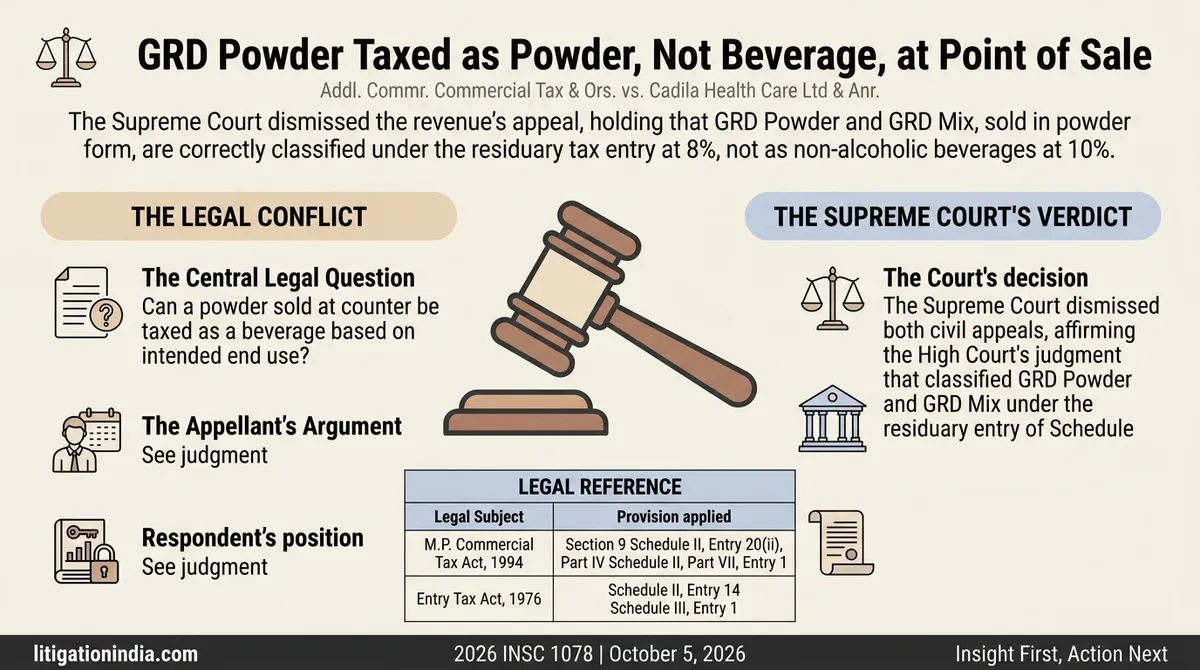
GRD Powder Taxed as Powder, Not Beverage, at Point of Sale — infographic summary

What this case means

The case concerned whether 'GRD Powder' and 'GRD Mix' should be taxed as non-alcoholic drinks at 10% or under the residuary entry at 8% under the M.P. Commercial Tax Act, 1994. The Supreme Court held that tax classification is determined by the physical form of the good at the point of sale, not its intended end use. Since the goods were sold as powder, they fell under the residuary entry at 8%, not the beverages entry.

What the Supreme Court held

The Supreme Court dismissed both civil appeals, affirming the High Court's judgment that classified GRD Powder and GRD Mix under the residuary entry of Schedule II of the M.P. Commercial Tax Act, 1994, at 8% tax. The Court held that since the goods exist in powder form at the point of sale, they cannot be treated as beverages under Entry 20(ii). All pending applications were also disposed of.

Case: Addl. Commr. Commercial Tax & Ors. vs. Cadila Health Care Ltd & Anr. (2026) Citation: 2026 INSC 1078

Want the full legal reasoning, citations and case documents?

Read the full judgment analysis
GRD Powder
GRD Mix
non-alcoholic beverages
residuary entry
M.P. Commercial Tax Act 1994
classification of goods
taxable event
ejusdem generis
Cadila Health Care
health drink powder
Entry Tax Act 1976
commercial tax classification
Section 9; Schedule II, Entry 20(ii), Part IV; Schedule II, Part VII, Entry 1, M.P. Commercial Tax Act, 1994
Schedule II, Entry 14; Schedule III, Entry 1, Entry Tax Act, 1976