Full text of the judgment
Text extracted from Addl. Commr. Commercial Tax & Ors. vs. Cadila Health Care Ltd & Anr.. For the authoritative version refer to the Supreme Court of India's official website.
2026 INSC 1078 Civil Appeal Nos.9788-9789 of 2013 Page 1 of 12 REPORTABLE IN THE SUPREME COURT OF INDIA CIVIL APPELLATE JURISDICTION
CIVIL APPEAL NOs._9788-9789 OF 2013
ADDL. COMMR. COMMERCIAL TAX & ORS. ….APPELLANTS
CADILA HEALTH CARE LTD & ANR. ....RESPONDENTS
J U D G M E N T
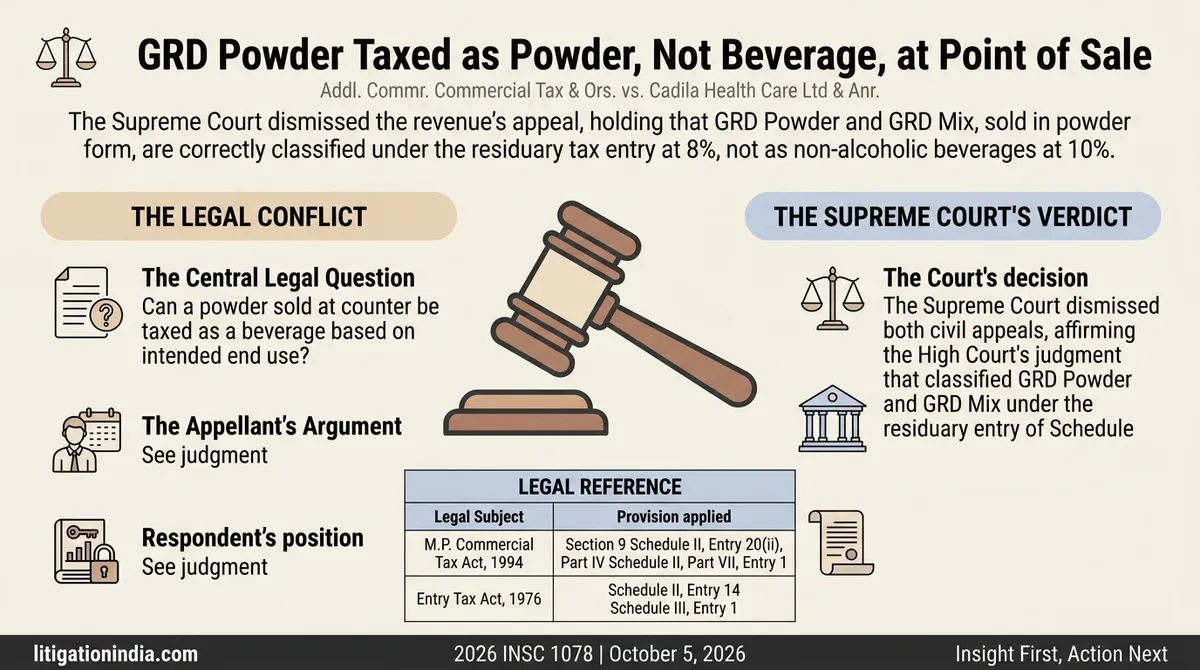
MANMOHAN, J. 1. These appeals have been filed challenging the judgment and order dated 3rd August 2011 passed by the High Court of Madhya Pradesh in Writ Petitions bearing W.P. Nos. 3020 of 2003 and 4633 of 2003. By the said judgment, the High Court upheld the classification of ‘GRD Powder’ and ‘GRD Mix’, manufactured and marketed by the Respondent, under the residuary entry of Schedule II to the M.P. Commercial Tax Act, 1994 (“1994 Act”), thereby subjecting them to tax at the rate of eight per cent (8%) for the Assessment Year 1997-1998. RELEVANT FACTS 2. The Appellants assert that the indications on the goods ‘GRD Powder’ and ‘GRD Mix’, both in terms of graphical representation and the accompanying instructions, require the consumer to dilute the good with milk or water. Consequently, it is urged that the goods are classifiable as ‘Non-Alcoholic Drinks Digitally signed by SACHIN KUMAR SRIVASTAVA Date: 2026.10.05 17:52:33 IST Reason: Signature Not Verified
Civil Appeal Nos.9788-9789 of 2013 Page 2 of 12 and Beverages’ falling under Entry 20(ii), Part IV, Schedule II of the 1994 Act, thereby attracting tax at the rate of ten per cent (10%). The Respondents, however, contend that the said goods being sold across the counter in the form of powder and biscuit, are exigible to tax at the rate of eight per cent (8%) under the residuary entry. 3. The relevant entries which fall for consideration in the present appeals are delineated as under:- Schedule II of the M.P. Commercial Tax Act, 1994 Entry Particulars Tax (%)
20(ii) All kinds of non-alcoholic drinks and beverages including syrups, cordials, distilled juices, ark and essences when sold in sealed or capsuled or cork bottles or jars 10
1 All other goods not included in Schedule I or any other part of this Schedule 8
4. This Court finds that during the Assessment Year 1997-1998 under the Entry Tax Act 1976, there were three distinct phases governed by different tax slabs. In the first phase, between 1st April and 30th April, 1997, the only applicable entry under which the Respondents’ goods could be classified was the residuary entry, attracting tax at the rate of one per cent (1%). In the second phase, spanning May to September 1997, the Respondents’ goods were not amenable to Entry Tax, as there existed no entry in the Schedule dealing with such goods. In the third
Civil Appeal Nos.9788-9789 of 2013 Page 3 of 12 phase, between 1st October, 1997 and 31st March, 1998, two competing entries became relevant for classification of the Respondents’ goods, namely, Entry No. 14 and the residuary entry under Schedule III. The said entries are reproduced hereinbelow:- Schedule II of the Entry Tax Act, 1976 Entry Entry Entry 14. All kinds of non-alcoholic drinks and beverages, ice-cream, kulfi and ice candy. 2%
SCHEDULE – III (See Sections 3, 4, 6, 8, 9 and 11) S. No. Description of goods Rate of tax (%) (1) (2) (3) 1 All goods other than those specified in schedule – I and Schedule II 1
5. Consequently, the issues which arise for consideration in the present appeals are:- (i) What is the taxable event and whether the taxing authorities are required to levy tax based on the form of the good at the time of sale or on end product? (ii) Whether the goods ‘GRD Powder’ and ‘GRD Mix’ can be classified as Non-Alcoholic Drinks and Beverages or will they fall in residuary entry?
Civil Appeal Nos.9788-9789 of 2013 Page 4 of 12 ARGUMENTS ON BEHALF OF THE APPELLANTS 6. Mr. Akraj Kumar, learned counsel for the Appellants submitted that taxing entries must be construed in their natural sense and not in a hyper technical manner. He stated that the packaging of the goods in the present instance itself encourages the consumer to ‘enjoy the preparation either hot or cold’ with clear instructions to mix it with milk or water. He emphasised that demonstration and imagery of the concerned good is that of a health drink rather than health food. He contended that tea and coffee, though sold in powder form, have consistently been classified as beverages for the purpose of taxation. 7. He further submitted that where two competing entries arise, the Court must apply three well-recognised tests to determine the appropriate classification. The first is the ‘common use and functional character test’, which requires the Court to ascertain how the good is identified by those who deal with or consume it. Reliance was placed on the judgment of this Court in Atul Glass Industries (Pvt.) Ltd Vs. Collector of Excise, (1986) 3 SCC 480. The second test, he urged, is to determine the ‘basic nature of the good’, independent of the process of manufacture, since the process is susceptible to change. In support, reliance was placed on Indian Aluminum Cables Ltd. Vs. Union of India & Ors., (1985) 3 SCC 284. The third test, according to him, is the ‘popular meaning or common parlance test’ which this Court has repeatedly applied, holding that the common parlance meaning of an entry must prevail.
Civil Appeal Nos.9788-9789 of 2013 Page 5 of 12 8. On the strength of the Atul Glass (supra) principle, learned counsel contended that the functional character of the goods in question is that of ‘Non- Alcoholic Drinks and Beverages’, albeit with health benefits. 9. Reliance was also placed on Pioma Industries Vs. State of Kerala, (2008) 12 SCC 695, wherein the issue was whether ‘Rasna’ in powder form was classifiable as a non-alcoholic drink/beverage or as a food preparation. In that case, Entry 87 specifically included Horlicks, Boost and Bournvita, which are well-known health drink powders belonging to the same class of goods as the Respondents’ ‘GRD Powder’ and ‘GRD Mix’. It was thus submitted that the said judgment supports the Revenue’s stand that goods of this nature are understood in common parlance as beverages. 10. Further, reliance was placed on Hamdard (Wakf) Laboratories Vs. Commissioner, Commercial Tax, U.P., 2026 SCC OnLine SC 306, wherein this Court held that resort to the residuary entry is impermissible where a specific entry employs the expression ‘including’, as such expression expands the scope of the entry without quantitative or form threshold. It was pointed out that Entry 20(ii) in the present case contains the expression ‘including’, thereby enlarging the ambit of ‘Non-Alcoholic Drinks and Beverages’ by illustrative enumeration. 11. Lastly, reliance was placed on S.Samuel M.D., Harrisons Malayalam Vs. Union of India, (2004) 1 SCC 256, wherein this Court held that an undefined term must be construed in its common parlance or commercial sense, and that
Civil Appeal Nos.9788-9789 of 2013 Page 6 of 12 ‘tea’ is not a foodstuff, thereby affirming the settled distinction between food and drink. ARGUMENTS ON BEHALF OF THE RESPONDENTS 12. Per contra, Mr. Vivek Sarin, learned senior counsel for the Respondents stated that a plain reading of the scheme of the 1994 Act makes it evident that the levy under the said Act is confined to the sale of goods expressly specified therein. Section 2 (d) defines ‘Commerce’ and ‘Commercial’ to mean sale and purchase of goods. Section 9 of the 1994 Act stipulates that tax shall be payable by the dealer under this Act ‘relating to the goods specified in Schedule II’. Thus, the charging provision itself restricts the levy to goods enumerated in Schedule II. Any attempt to bring within its ambit a commodity not specifically mentioned would amount to enlarging the scope of the taxing statute beyond its express language, which is impermissible in law. 13. He contended that goods which do not fall within a specific entry necessarily travel to the residuary entry and cannot be forced into an inapposite specific entry merely to attract a higher rate of tax. He further pointed out that Entry 20(ii) makes no reference to use or adaptation, and therefore, the end use of a good cannot be read into the entry. In support of his submission, he relied upon the judgment in Dunlop India Ltd. vs. Union of India (1976) 2 SCC 241, wherein this Court has held that end use of an article is absolutely irrelevant for classification purposes.
Civil Appeal Nos.9788-9789 of 2013 Page 7 of 12
14. Learned counsel for the Respondents further submitted that this Court in Hamdard Wakf Laboratories vs. Collector of Central Excise (1999) 6 SCC 617, has held that beverages, broadly speaking, are liquids for drinking, other than water, which may be consumed neat or after dilution. It was urged that, therefore, for any goods to be classified as a beverage, it is essential that they exist in liquid form at the time of the taxable event.
TAXING STATUTES ARE TO BE STRICTLY CONSTRUED 15. It is settled law that taxing statutes are to be strictly construed. The Court cannot assume any intention beyond what is manifest in the plain language of the provision. Nothing can be read in or implied from the statute and unless the language suffers from any ambiguity or absurdity, the Court must adopt a literal interpretation1.
1 In Mathuram Agrawal v. State of Madhya Pradesh, (1999) 8 SCC 667, the Supreme Court has held, “….The intention of the legislature in a taxation statute is to be gathered from the language of the provisions particularly where the language is plain and unambiguous. In a taxing Act it is not possible to assume any intention or governing purpose of the statute more than what is stated in the plain language. It is not the economic results sought to be obtained by making the provision which is relevant in interpreting a fiscal statute. Equally impermissible is an interpretation which does not follow from the plain, unambiguous language of the statute. Words cannot be added to or substituted so as to give a meaning to the statute which will serve the spirit and intention of the legislature. The statute should clearly and unambiguously convey the three components of the tax law i.e. the subject of the tax, the person who is liable to pay the tax and the rate at which the tax is to be paid. If there is any ambiguity regarding any of these ingredients in a taxation statute then there is no tax in law. Then it is for the legislature to do the needful in the matter.”
Civil Appeal Nos.9788-9789 of 2013 Page 8 of 12
TAXING INCIDENCE IS THE NATURE OF THE GOOD AS IT IS SOLD 16. This Court is further of the opinion that the taxable event is the act of supply and the incidence of taxation is determined by the nature of the good in the form in which it is sold2. 17. Undoubtedly, tax rates vary depending on whether the good is classified as a powder, concentrate or beverage. However, the tax authorities are bound to levy tax based on the form of the good at the time of sale. The tax authorities are bound to look at what is supplied and not at what is the ‘end use’ of the good. For instance, if a powder mix such as protein powder is sold, the tax applicable to powders alone can be levied. Conversely, if a ready-to-drink beverage such as bottled cold coffee or a packaged proteins shake is sold, the tax applicable to beverages must be imposed. 18. The subsequent use by the consumer in mixing the powder with water or milk to prepare a drink does not alter the taxable event, for liability is determined at the point of supply. It is equally conceivable that protein powder may be consumed in liquid form after mixing with milk or water, or alternatively, it may
2 The Supreme Court in Commissioner of Central Excise, Delhi v. Carrier Aircon Ltd. (2006) 5 SCC 596 has held, ‘End use to which the product is put to by itself cannot be determinative of the classification of the product… There are number of factors which have to be taken into consideration for determining the classification of a product. For the purposes of classification the relevant factors inter alia are statutory fiscal entry, the basic character, function and use of the goods. When a commodity falls within a tariff entry by virtue of the purpose for which it is put to (sic produced), the end use to which the product is put to, cannot determine the classification of that product.’
Civil Appeal Nos.9788-9789 of 2013 Page 9 of 12 be used in the preparation of an Indian milk-based fudge (barfi) and consumed in solid form. 19. Consequently, the classification which determines the applicable rate of tax must be based on the form of the good at the time of sale and not on the manner in which the consumer may later choose to use it.
COMMON THREAD RUNNING THROUGH ALL THE ITEMS IN ENTRY 20(ii) IS THAT THEY ARE LIQUIDS
20. In Entry 20(ii), the expression ‘beverages’ is followed by ‘syrups, cordials, distilled juice, ark and essences’, all of which denote liquids or liquid preparations. The common thread running through these enumerated items is that they are liquid substances capable of being bottled, stored and consumed or otherwise utilised in liquid form.
ENTRY 20(ii) DOES NOT MAKE ANY REFERENCE TO THE USE OF GOODS
21. Further, Entry 20(ii) does not make any reference to the ‘end use´ of the goods. Consequently, what has been specified by the legislature is classification of goods not by reference to its end use, but by reference to their physical characteristic and form. Accordingly, this Court is of the view that the identity of the goods at the time of taxable event, namely, sale, must be the determinative factor for the purpose of classification under the taxing statute.
Civil Appeal Nos.9788-9789 of 2013 Page 10 of 12 COMMON PARLANCE TEST, FUNCTIONAL CHARACTER TEST OR BASIC NATURE TEST CANNOT BE APPLIED TO IMPORT END USER CONCEPT IN PRESENT APPEALS
22. This Court is of the opinion that common parlance test, functional test or basic nature test cannot be applied to import end use concept to override or bypass explicit or implicit statutory guidance, particularly, where the language of the entry is clear and unambiguous-like in the present appeals.
RULE OF EJUSDEM GENERIS 23. The rule of ejusdem generis requires a general word to be construed in the context of specific words accompanying it. The expression ‘beverages’ must derive its meaning from the class constituted by these associated words and cannot be interpreted in isolation so as to encompass goods of an altogether different character or physical form. 24. Consequently, this Court is in agreement with the submission of learned senior counsel for the Respondents that the goods which do not answer the description of a specific entry must necessarily fall within the residuary entry. They cannot be forced into an inapposite specific entry merely to attract a higher rate of tax.
JUDGMENTS CITED BY APPELLANTS ARE INAPPLICABLE 25. This Court is of the view that the judgments in Pioma Industries (supra) and S. Samuel M.D (supra) are clearly distinguishable and inapplicable to the facts of the present case.
Civil Appeal Nos.9788-9789 of 2013 Page 11 of 12 26. In Pioma Industries (supra), the issue was whether ‘Rasna’ is taxable as a ‘beverage’ or ‘non-alcoholic drink’. However, there was no adjudication as to whether ‘Rasna’ was classifiable as a beverage as the matter was remanded to the Tribunal. Moreover, the Entry in question, namely, Entry 87 contained an explanation which specifically included ‘powders, tablets and concentrates used for the preparation of non-alcoholic drinks’. It is thus evident that the Legislature, despite being aware that powders could be expressly included in the category of non-alcoholic beverages by way of deeming fiction, chose not to do so in the present case. 27. In S. Samuel M.D (supra), there was no competing entries. The issue was whether ‘tea’ is a foodstuff or not. In that context, this Court held that tea is a beverage produced by steeping tea leaves in boiled water and that tea is not food. This Court in S. Samuel M.D (supra) did not adjudicate whether ‘tea leaves’, existing in the form of granules/powder, could themselves be classified as a beverage. 28. In Hamdard (Wakf) Laboratories Vs. Commissioner, Commercial Tax, U.P., 2026 SCC OnLine SC 306, the sharbat existed in liquid form and not powder form. It was, therefore, possible to classify the same under the entry of beverage, which is not the case here. In any event the expression ‘including’ cannot be taken to mean ‘all encompassing’ and covering ‘all and sundry goods’. As mentioned hereinabove, the expression ‘beverages’ must be construed in the
Civil Appeal Nos.9788-9789 of 2013 Page 12 of 12 context of specific words accompanying it and cannot be interpreted so as to encompass goods of an altogether different character or physical form.
CONCLUSION 29. From the aforesaid, it is apparent that the goods in the present case, at the time of taxable event, exist in the form of powder and biscuit. While it is possible that the goods may ultimately be used to make a beverage or a solid preparation, at the point of taxable event, they remain in powder form. Consequently, they do not fall within the expression ‘beverage’. 30. Before parting with the present appeals, this Court places on record its appreciation for the assistance rendered by all the learned counsel, who appeared, in particular, Mr. Vivek Sarin, learned senior counsel, Mr. Arkaj Kumar, learned counsel and Mr. Bhargava V. Desai, learned counsel. 31. The appeals are, accordingly, dismissed. 32. Pending application(s), if any, shall stand disposed of.
……………………J. [MANMOHAN]
…………………J. [ARUN PALLI]
New Delhi; October 5, 2026