
All insights

Can a foreign divorce on unrecognised grounds shield a husband from bigamy charges in India?

Foreign Divorce Decree Cannot Shield Husband from Bigamy Prosecution in India

A husband who failed to get divorce in India then obtained a UK divorce on irretrievable breakdown grounds and remarried abroad. The Supreme Court held that such a foreign decree, granted on a ground

Litigation India Editorial 3 November 2026 1 min read 2026 INSC 1191

Story

Case at a glance1 / 7

Supreme Court of India

Foreign Divorce Cannot Nullify an Indian Hindu Marriage

N. Sridhar Reddy v. State of A.P. & Ors. | 2026 INSC 1191

Court: Supreme Court of India | Date: November 03, 2026Bench: Justice Prashant Kumar Mishra and Justice Shree ChandrashekharArea of law: Criminal Law — Bigamy, Foreign Matrimonial Decrees, Private International LawHusband obtained UK divorce on unrecognised ground and remarried; bigamy prosecution upheld
Foreign Divorce Decree Cannot Shield Husband from Bigamy Prosecution in India · 2026 INSC 11912026-11-03T12:02:54.821090+00:00
The legal question2 / 7

Can a Foreign Divorce Shield a Husband from Bigamy Liability in India?

Core legal issue before the Supreme Court

  • Appellant: UK divorce decree valid; husband was British citizen; second marriage abroad; IPC does not apply under Section 4; FIR delayed.
  • Appellant: First wife submitted to UK court's jurisdiction; decree presumed valid under Section 14 CPC.
  • Respondent: Marriage solemnized in India under Hindu law; dissolution must follow Hindu Marriage Act, 1955.
  • Respondent: Irretrievable breakdown is not a ground under Hindu Marriage Act; first wife objected to UK court's jurisdiction.
Foreign Divorce Decree Cannot Shield Husband from Bigamy Prosecution in India · 2026 INSC 11912026-11-03T12:02:54.821090+00:00
Statutory comparison3 / 7

When Is a Foreign Divorce Recognised in India?

Section 13 CPC conditions vs. facts of this case

Condition for Recognition (Y. Narasimha Rao)Satisfied in This Case?
Foreign court had jurisdiction under the parties' matrimonial lawNo — UK court lacked jurisdiction under Hindu Marriage Act
Relief granted on a ground available under the matrimonial lawNo — irretrievable breakdown not recognised under Hindu Marriage Act, 1955
Respondent voluntarily and effectively submitted to foreign forumNo — first wife filed objections to UK court's jurisdiction
Respondent domiciled or habitually resident in foreign forumNot established — first wife was in India
Foreign decree failed every condition under Section 13 CPC; it cannot be recognised in India.
Foreign Divorce Decree Cannot Shield Husband from Bigamy Prosecution in India · 2026 INSC 11912026-11-03T12:02:54.821090+00:00
The Court's reasoning4 / 7

Court's Reasoning: Step by Step

From foreign decree to bigamy liability

  1. 1Step 1: Marriage solemnized in India under Hindu rites — governed by Hindu Marriage Act, 1955.
  2. 2Step 2: UK divorce granted on irretrievable breakdown — not a ground under Hindu Marriage Act; fails Section 13 CPC.
  3. 3Step 3: First wife objected to UK court's jurisdiction — no voluntary submission; decree not binding on her.
  4. 4Step 4: Change of nationality and second marriage abroad cannot defeat liability arising from subsisting Indian marriage.
  5. 5Step 5: Bigamy is a continuing offence — FIR delay irrelevant; criminal proceedings against husband must continue.
Foreign Divorce Decree Cannot Shield Husband from Bigamy Prosecution in India · 2026 INSC 11912026-11-03T12:02:54.821090+00:00
Key points5 / 7

Relatives and Second Wife: Liability Requires Overt Acts, Not Just Knowledge

Court's distinction between awareness and criminal conspiracy

  • Parents (accused 2 and 3): No overt act in chargesheet linking them to the second marriage ceremony.
  • Mere knowledge that a second marriage occurred does not establish common intention or conspiracy under Section 120B IPC.
  • Second wife (accused 4): Apart from cohabitation, no evidence she knew first marriage was still subsisting.
  • Criminal liability must be established separately for each accused; proceedings against parents and second wife quashed.
Awareness of a second marriage, without active participation or facilitation, is insufficient for conspiracy liability.
Foreign Divorce Decree Cannot Shield Husband from Bigamy Prosecution in India · 2026 INSC 11912026-11-03T12:02:54.821090+00:00
The verdict6 / 7

The Verdict

Three appeals, differentiated outcomes

  • The Fact: Husband obtained UK divorce on irretrievable breakdown — not recognised under Hindu Marriage Act, 1955 — and remarried.
  • The Law: Foreign decree failing Section 13 CPC cannot dissolve a Hindu marriage; bigamy under Section 494 IPC remains attracted; continuing offence negates delay defence.
  • The Result: Husband's appeal dismissed — trial to proceed. Parents' and second wife's appeals allowed — criminal proceedings quashed for lack of overt acts.
Criminal proceedings against the husband for Section 494 IPC are sustained; proceedings against parents and second wife quashed.
Foreign Divorce Decree Cannot Shield Husband from Bigamy Prosecution in India · 2026 INSC 11912026-11-03T12:02:54.821090+00:00
Why it matters7 / 7

What This Means for Ordinary People

Practical significance of the judgment

  • A Hindu marriage in India can only be dissolved on grounds recognised by the Hindu Marriage Act, 1955 — foreign courts cannot override this.
  • Getting a foreign citizenship or marrying abroad does not help a person escape bigamy liability if the first Indian marriage still subsists.
  • Women in Hindu marriages are protected: a foreign divorce obtained by the husband behind their back or on objection cannot end the marriage legally in India.
  • Relatives will not face criminal liability for bigamy conspiracy unless there is specific evidence they actively helped arrange the second marriage.
You cannot escape an Indian marriage by 'forum shopping' in a foreign court — Indian matrimonial law follows the parties.
Foreign Divorce Decree Cannot Shield Husband from Bigamy Prosecution in India · 2026 INSC 11912026-11-03T12:02:54.821090+00:00
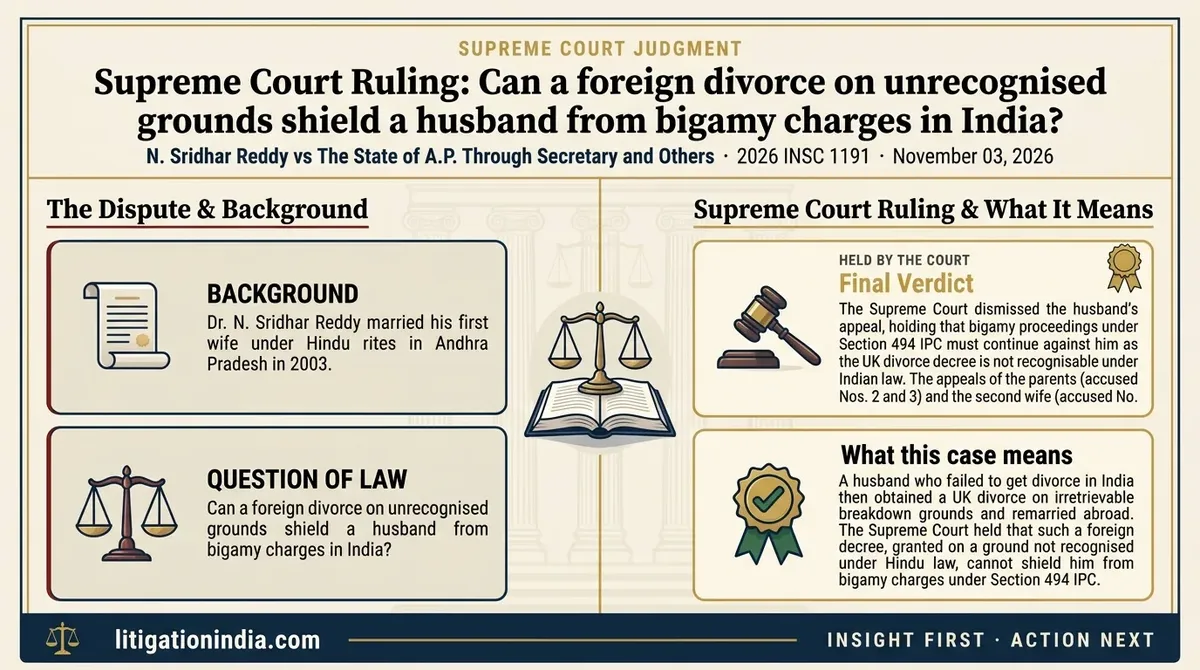
Foreign Divorce Decree Cannot Shield Husband from Bigamy Prosecution in India — infographic summary

What this case means

A husband who failed to get divorce in India then obtained a UK divorce on irretrievable breakdown grounds and remarried abroad. The Supreme Court held that such a foreign decree, granted on a ground not recognised under Hindu law, cannot shield him from bigamy charges under Section 494 IPC. However, his parents and second wife were discharged for lack of evidence of active participation.

What the Supreme Court held

The Supreme Court dismissed the husband's appeal, holding that bigamy proceedings under Section 494 IPC must continue against him as the UK divorce decree is not recognisable under Indian law. The appeals of the parents (accused Nos. 2 and 3) and the second wife (accused No. 4) were allowed and criminal proceedings against them were quashed for lack of evidence of overt acts establishing conspiracy or conscious knowledge.

Case: N. Sridhar Reddy vs The State of A.P. Through Secretary and Others (2026) Citation: 2026 INSC 1191

Want the full legal reasoning, citations and case documents?

Read the full judgment analysis
bigamy
foreign divorce decree
Section 494 IPC
Section 13 CPC
Hindu Marriage Act
matrimonial forum shopping
irretrievable breakdown of marriage
Section 482 CrPC
Y. Narasimha Rao
Cambridge County Court
quashing of FIR
criminal conspiracy
Sections 494, 120B, 34, 4, Indian Penal Code, 1860
Sections 13 and 14, Code of Civil Procedure, 1908