
All insights

Was the electricity subsidy received by Mepco Industries a capital or revenue receipt?

Electricity Subsidy from Pondicherry Government Held a Taxable Revenue Receipt

Mepco Industries received electricity subsidy from the Government of Pondicherry and claimed it was a non-taxable capital receipt. The Supreme Court held it was a revenue receipt taxable under the Inc

Litigation India Editorial 7 October 2026 1 min read 2026 INSC 1090

Story

Case at a glance1 / 6

Supreme Court of India

Electricity Subsidy: Capital or Revenue Receipt?

M/S. Mepco Industries Ltd. vs. Commissioner of Income Tax, Madurai — 2026 INSC 1090

Court: Supreme Court of India; Date: October 07, 2026Bench: Justice Prashant Kumar Mishra and Justice Shree ChandrashekharArea of law: Income Tax — classification of government subsidy receiptsSubsidy of Rs. 16,20,745 from Government of Pondicherry for Assessment Year 1997-98
Electricity Subsidy from Pondicherry Government Held a Taxable Revenue Receipt · 2026 INSC 10902026-10-07T12:51:06.472001+00:00
The legal question2 / 6

Does the Purpose Test Determine Subsidy's Tax Character?

Core legal dispute before the Supreme Court

  • Appellant: Subsidy was to foster industrial growth in backward areas, hence a capital receipt not taxable.
  • Appellant: Broad object of scheme was to encourage establishment of new industries.
  • Respondent: Subsidy was calculated on actual electricity charges after production commenced, reducing operating costs.
  • Respondent: No requirement to apply subsidy towards any capital asset; purely operational assistance.
Electricity Subsidy from Pondicherry Government Held a Taxable Revenue Receipt · 2026 INSC 10902026-10-07T12:51:06.472001+00:00
Statutory comparison3 / 6

Capital Subsidy vs. Revenue Subsidy: The Purpose Test

How the Court distinguishes subsidies under Sahney Steel and Ponni Sugars

FeatureCapital SubsidyRevenue Subsidy
Object of schemeSet up new unit or substantially expand existing unitEnable business to run more profitably
Application of fundsTowards capital asset, plant, machinery or capital borrowing repaymentReduces operational cost such as electricity charges
TimingNot determinative by itselfNot determinative by itself
Example from case lawChaphalkar Brothers — multiplex construction schemeMepco Industries — electricity charge subsidy; Sahney Steel
Tax treatmentCapital receipt — not taxableRevenue receipt — taxable under IT Act, 1961
The form, source and timing of a subsidy are immaterial; only its operative purpose determines taxability.
Electricity Subsidy from Pondicherry Government Held a Taxable Revenue Receipt · 2026 INSC 10902026-10-07T12:51:06.472001+00:00
The Court's reasoning4 / 6

How the Court Applied the Purpose Test Step by Step

Reasoning from scheme analysis to final conclusion

  1. 1Step 1: Identify the governing test — the 'purpose test' from Sahney Steel and Ponni Sugars, not form or timing.
  2. 2Step 2: Examine the Pondicherry scheme as a whole — subsidy tied to actual electricity charges incurred during production.
  3. 3Step 3: Find no requirement to apply subsidy towards capital assets, plant, machinery or capital borrowing.
  4. 4Step 4: Reject broad policy argument — general object of 'fostering industry' cannot override operative mechanism of scheme.
  5. 5Step 5: Conclude — subsidy directly reduces operating electricity cost; it is a revenue receipt and taxable.
Electricity Subsidy from Pondicherry Government Held a Taxable Revenue Receipt · 2026 INSC 10902026-10-07T12:51:06.472001+00:00
The verdict5 / 6

Supreme Court's Final Verdict

Civil Appeal No. 8694 of 2012 dismissed

  • The Fact: Mepco Industries received Rs. 16,20,745 as electricity subsidy, calculated on actual power charges after production commenced.
  • The Law: Purpose test governs; a subsidy that reduces operational electricity cost is a revenue receipt taxable under the Income-tax Act, 1961.
  • The Result: Concurrent findings of Assessing Officer, CIT (Appeals), ITAT and High Court affirmed; appeal dismissed.
Appeal dismissed; electricity subsidy of Rs. 16,20,745 is a revenue receipt taxable under the Income-tax Act, 1961.
Electricity Subsidy from Pondicherry Government Held a Taxable Revenue Receipt · 2026 INSC 10902026-10-07T12:51:06.472001+00:00
Why it matters6 / 6

What This Judgment Means for Businesses

Practical significance of the purpose test

  • A government subsidy is not automatically tax-free just because the scheme broadly promotes industrial development.
  • If subsidy reduces an ongoing operating cost like electricity, it is taxable as a revenue receipt regardless of its label.
  • Only if the subsidy is directed at creating or expanding capital assets is it a non-taxable capital receipt.
  • Businesses must examine the actual mechanism of each subsidy scheme to correctly report it in their tax returns.
What matters is not what the government calls the subsidy, but what it actually does in the hands of the recipient.
Electricity Subsidy from Pondicherry Government Held a Taxable Revenue Receipt · 2026 INSC 10902026-10-07T12:51:06.472001+00:00
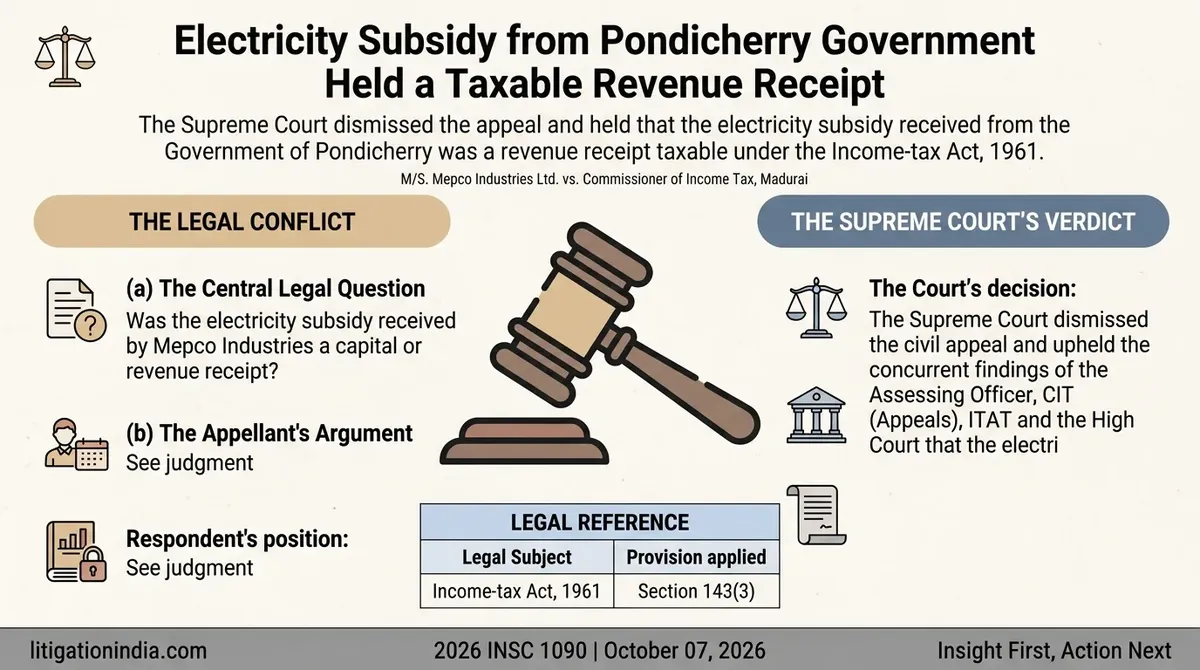
Electricity Subsidy from Pondicherry Government Held a Taxable Revenue Receipt — infographic summary

What this case means

Mepco Industries received electricity subsidy from the Government of Pondicherry and claimed it was a non-taxable capital receipt. The Supreme Court held it was a revenue receipt taxable under the Income-tax Act, 1961, because it was calculated on actual electricity charges incurred during production and merely reduced an operating cost. This case reaffirms the 'purpose test' for classifying government subsidies.

What the Supreme Court held

The Supreme Court dismissed the civil appeal and upheld the concurrent findings of the Assessing Officer, CIT (Appeals), ITAT and the High Court that the electricity subsidy was a revenue receipt. The Court held that since the subsidy was calculated as a percentage of actual electricity charges incurred after commencement of production and was not directed towards creation of any capital asset, it was operational assistance and taxable under the Income-tax Act, 1961. No interference with the High Court's judgment was warranted.

Case: M/S. Mepco Industries Ltd. vs. Commissioner of Income Tax, Madurai (2026) Citation: 2026 INSC 1090

Want the full legal reasoning, citations and case documents?

Read the full judgment analysis
Mepco Industries
electricity subsidy
capital receipt
revenue receipt
purpose test
Income-tax Act 1961
Sahney Steel
Ponni Sugars
Chaphalkar Brothers
power subsidy
Government of Pondicherry
assessment year 1997-98
Section 143(3), Income-tax Act, 1961
Income Tax / Subsidy — Capital vs. Revenue Receipt