Full text of the judgment
Text extracted from M/S. Mepco Industries Ltd. vs. Commissioner of Income Tax, Madurai. For the authoritative version refer to the Supreme Court of India's official website.
2026 INSC 1090 CIVIL APPEAL NO. 8694 OF 2012 Page 1 of 12
REPORTABLE IN THE SUPREME COURT OF INDIA CIVIL APPELLATE JURISDICTION CIVIL APPEAL NO. 8694 OF 2012 M/S. MEPCO INDUSTRIES LTD. … APPELLANT(S) VERSUS
COMMISSIONER OF INCOME TAX, MADURAI ... RESPONDENT(S)
J U D G M E N T
PRASHANT KUMAR MISHRA, J.
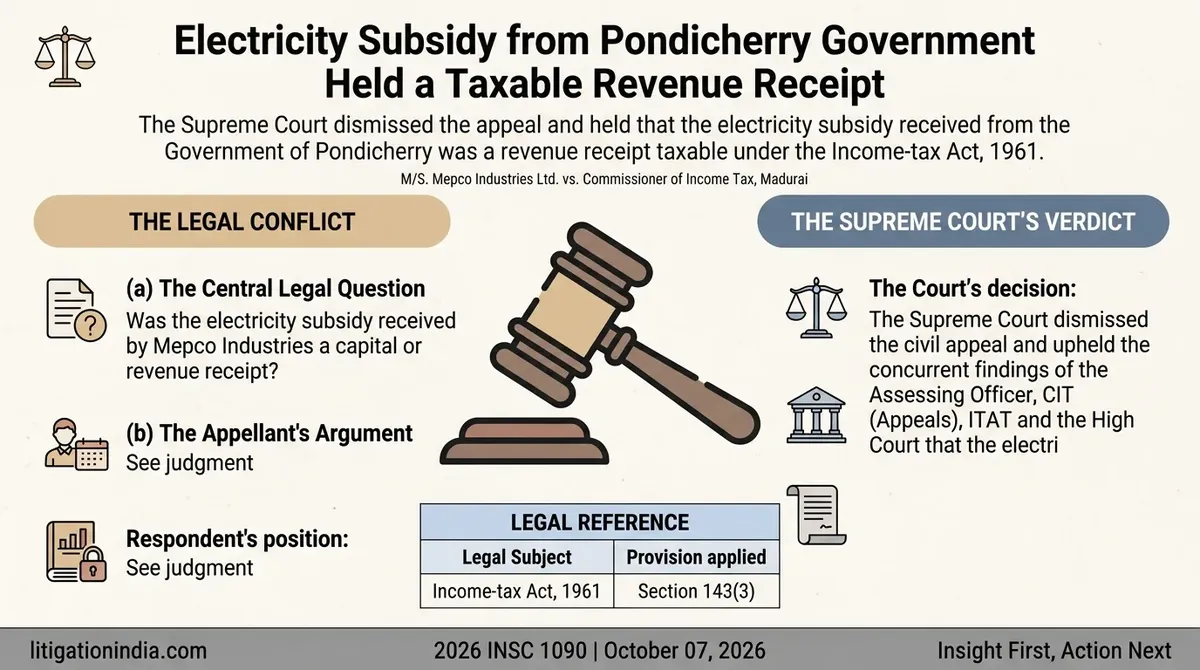
1. The present Appeal concerns the nature of the electricity subsidy of Rs. 16,20,745/- received by the appellant-assessee, M/s. Mepco Industries Ltd., from the Government of Pondicherry for the Assessment Year 1997-98, and the question whether the said subsidy constituted a capital receipt, as claimed by the appellant, or a revenue receipt liable to tax under the Incometax Act, 19611, as held by the Courts below. The appellant is a limited company engaged in the manufacture of potassium chlorate. For the relevant assessment year, it received the aforesaid amount as electricity subsidy and treated the same as a capital receipt. 2. The subsidy was granted under the Scheme of Power Subsidy2 of the Government of Pondicherry, which had been in operation since 27.11.1975. The scheme was framed with the object of fostering industrial growth in the
1 For short ‘IT Act’ 2 Hereinafter referred as ‘Scheme’ Digitally signed by NISHA KHULBEY Date: 2026.10.07 17:13:00 IST Reason: Signature Not Verified
CIVIL APPEAL NO. 8694 OF 2012 Page 2 of 12
Union Territory and, under the relevant pattern, provided subsidy on power charges for a specified period after commencement of production. The rate of subsidy was 33⅓% of the power charges for the first three years, 20% for the fourth year and 10% for the fifth year, subject to the applicable ceiling. The appellant's case was that the scheme was intended to encourage the establishment of new industries in backward areas, whereas on the other hand, the Revenue Authorities have treated the subsidy as assistance towards the cost of power consumed in the course of the existing business. 3. The appellant filed its return of income on 27.11.1997. In the return, it claimed the electricity subsidy of Rs. 16,20,745/- as a capital receipt not liable to tax. The assessment was thereafter taken up for scrutiny and completed under Section 143(3) of the IT Act, by the Joint Commissioner of Income Tax, Special Range-II, Madurai3, by order dated 31.03.2000. The Assessing Officer treated the subsidy as a revenue receipt and included the amount of Rs. 16,20,745/- in the taxable income. In doing so, it was held that the subsidy was given towards revenue expenditure and, while relying upon the judgment of this Court in Sahney Steel & Press Works Ltd., Hyderabad vs. Commissioner of Income Tax, A.P.-I, Hyderabad4, treated it as revenue in character. 4. Aggrieved by the assessment, the appellant approached the Commissioner of Income Tax (Appeals), Madurai5. Vide order dated 12.03.2002, the CIT (Appeals) dismissed the appeal and had sustained the
3 Hereinafter referred as ‘Assessing Officer’ 4 (1997) 7 SCC 764 5 Hereinafter referred as ‘CIT (Appeals)’
CIVIL APPEAL NO. 8694 OF 2012 Page 3 of 12
treatment of the subsidy as a revenue receipt. On examining the terms of the subsidy, it noted that the subsidy was calculated with reference to the power charges, and concluded that its effect was to reduce the cost of power consumed by the assessee and consequently assist the profitability of the business. The addition made by the Assessing Officer on this account was accordingly confirmed. 5. The appellant thereafter preferred ITA No. 857 (MDS)/2002 before the Income Tax Appellate Tribunal, Chennai6. By order dated 28.07.2005, the ITAT dismissed the appeal, and proceeded on the basis that the subsidy was available only after the industrial unit had been set up and production had commenced and that it was granted with reference to the cost of electricity. Placing reliance on the decision in Sahney Steel (supra), ITAT regarded the subsidy in the instant case as assistance in carrying on the business rather than as a contribution towards the capital outlay of the industrial undertaking. ITAT further held that there was no case that the subsidy was granted for bringing any new asset into existence. Consequently, it held that the power subsidy, being assistance received after commencement of production and operating to reduce the cost of electricity consumed by the appellant, was revenue in character. 6. Aggrieved, the appellant preferred Tax Case (Appeal) No. 1614 of 2005 before the High Court of Judicature at Madras. Vide its judgment dated 09.07.2012, the High Court dismissed the appeal and had affirmed the view taken by Courts below. Essentially, the High Court followed its earlier decision
6 Hereinafter referred as ‘ITAT’
CIVIL APPEAL NO. 8694 OF 2012 Page 4 of 12
in Commissioner of Income-tax vs. Karaikal Chlorates Ltd.7, concerning the nature of the power subsidy under the same scheme, and held the receipt to be revenue in character, thereby taxable under the IT Act. 7. It is against these concurrent findings, the appellant-assessee has preferred the present Appeal. 8. We have heard the learned counsel appearing for the appellant and the learned ASG appearing for the respondent and have perused the materials on record. 9. The short question which arises now is whether the electricity subsidy of Rs.16,20,745/- received by the appellant under the scheme of the Government of Pondicherry is a capital receipt or a revenue receipt. The answer must necessarily depend upon the true character and purpose of the subsidy scheme under which the amount was granted. It is in this context that the decision of this Court in Sahney Steel (supra), on which complete reliance has been placed by the Courts below, needs to be examined and understood. 10. In Sahney Steel (supra), this Court examined the nature of various incentives granted under the Andhra Pradesh Government's scheme, including relief in electricity and water charges and other concessions available to new industries. The Court noticed that the said subsidies were available only after the industry had been set up and production had commenced, and were intended to assist the assessee in carrying on its
7 2011 SCC OnLine Mad 2604 [The Madras High Court has relied on the decision of this Court in Sahney Steel (supra)].
CIVIL APPEAL NO. 8694 OF 2012 Page 5 of 12
business. They were not granted for bringing into existence any new capital asset or as a contribution towards the capital outlay of the industrial undertaking. The Court, therefore, characterised them as operational assistance and held them to be revenue receipts. Some of the important observations of this Court in Sahney Steel (supra) are reproduced hereinbelow: “10. … The amount paid to the assessee in the instant case is in the nature of subsidy from public funds. The funds were made available to the assessee to assist it in carrying on its trade or business. In our view, having regard to the scheme of the notification, there can be little doubt that the object of various assistances under the subsidy scheme was to enable the assessee to run the business more profitably. *** 13. In the case before us, payments were made only after the industries have been set up. Payments are not being made for the purpose of setting up of the industries. But the package of incentives was given to the industries to run more profitably for a period of five years from the date of the commencement of production. In other words, a helping hand was being provided to the industries during the early days to enable them to come to a competitive level with other established industries. *** 17. This precisely is the question raised in this case. By no stretch of imagination can the subsidies whether by way of refund of sales tax or relief of electricity charges or water charges be treated as an aid to setting up of the industry of the assessee. As we have seen earlier, the payments were to be made only if and when the assessee commenced its production. The said payments were made for a period of five years calculated from the date of commencement of production in the assessee's factory. The subsidies are operational subsidies and not capital subsidies.” (emphasis supplied) 11. The decision in Sahney Steel (supra) examines the substance of the assistance and draws the distinction between a subsidy which assists an assessee in setting up or completing its capital structure and one which assists it in carrying on the business which has already been established. In the latter situation, the subsidy bears the character of a revenue receipt. Thus
CIVIL APPEAL NO. 8694 OF 2012 Page 6 of 12
understood, Sahney Steel (supra) does not lay down that every subsidy linked to production or electricity consumption is invariably revenue in nature, rather it requires the character of the particular assistance to be determined in the light of the scheme under which it is granted.8 12. This understanding was specifically reaffirmed by this Court in Commissioner of Income Tax, Madras vs. Ponni Sugars and Chemicals Limited9, where the decision in Sahney Steel (supra) was described to have laid down the basic test for determining the character of a subsidy and held that the character of the receipt must be determined with reference to the purpose for which the subsidy is given. The Court termed this the “purpose test” and clarified that the point of time at which the subsidy is paid, its source and its form are not decisive, but the decisiveness is on the object sought to be achieved by the scheme. Where the object is to enable the assessee to run its business more profitably, the receipt is held to be on revenue account, and where the object is to enable the assessee to set up a new unit or substantially expand an existing unit, the receipt is on capital account. The relevant observation of this Court is reproduced hereinbelow: “14. The importance of the judgment of this Court in Sahney Steel case [Sahney Steel & Press Works Ltd., Hyderabad vs. Commissioner of Income Tax, A.P.-I, Hyderabad, (1997) 7 SCC 764 : (1997) 228 ITR 253] lies in the fact that it has discussed and analysed the entire case law and it has laid down the basic test to be applied in judging the character of a subsidy. That test is that the character of the receipt in the hands of the assessee has to be determined with respect to the purpose for which the subsidy is given. In other words, in such cases, one has to apply the purpose test. The point of time at which the subsidy is paid is not relevant. The source is immaterial. The form of subsidy is immaterial. The main eligibility condition in the Scheme with which we are concerned in this case is that the incentive must be utilised for repayment
8 Sahney Steels (supra) at Para 10, 13, 17, 19, 23 to 26, 32, 33. 9 (2008) 9 SCC 337 at Para 14.
CIVIL APPEAL NO. 8694 OF 2012 Page 7 of 12
of loans taken by the assessee to set up new units or for substantial expansion of existing units. On this aspect there is no dispute. If the object of the Subsidy Scheme was to enable the assessee to run the business more profitably then the receipt is on revenue account. On the other hand, if the object of the assistance under the Subsidy Scheme was to enable the assessee to set up a new unit or to expand the existing unit then the receipt of the subsidy was on capital account. Therefore, it is the object for which the subsidy/assistance is given which determines the nature of the incentive subsidy. The form of the mechanism through which the subsidy is given is irrelevant.” (emphasis supplied) 13. Following the decisions in Sahney Steel (supra) and Ponni Sugars (supra), this Court in Commissioner of Income Tax-I, Kolhapur vs. Chaphalkar Brothers, Pune10 had applied the “purpose test” by examining the object of the scheme. The subsidy there took the form of exemption from entertainment duty, but the Court looked beyond the form of the incentive and found that the object of the scheme was to encourage the setting up of highly capital-intensive multiplex theatre complexes. Therefore, the subsidy was consequently held to be capital in nature with the Court specifically reiterating that the time of payment, source and form of the subsidy are not determinative as there is no straightjacket formula for determining whether an incentive is capital or revenue in nature. 14. Thus, the jurisprudence developed post Sahney Steel (supra) makes it clear that the “purpose test” is the governing test, but the purpose has to be ascertained from the scheme as a whole and not merely from a general statement of policy or from the nomenclature employed by the Government. The fact that a scheme of subsidy is intended to encourage industrial growth, employment or development of a backward area cannot, by itself, conclude
10 (2018) 13 SCC 358 at Para 18
CIVIL APPEAL NO. 8694 OF 2012 Page 8 of 12
the character of the receipt, and the Court must examine the manner in which the incentive actually operates and the benefit which it is designed to confer upon the recipient. 15. Tested on this principle, the subsidy scheme referred in the present case assumes considerable significance. The original scheme, published in the Gazette dated 27.11.1975, provided for power subsidy to new industries, both LT and HT consumers, with the stated object of fostering industrial growth in the Union Territory. More importantly, the subsidy itself was tied to power charges, and the scheme itself contemplated that the consumer would pay the electricity charges and claim subsidy with reference to the electricity consumed for the manufacturing process. The revised pattern approved on 09.12.1985 makes the operational character of this assistance even clearer, wherein the subsidy was to be paid for five years from the date the unit went into production and was quantified at 33⅓% of the actual energy charges paid during the first three years, 20% during the fourth year and 10% during the fifth year. The Government of Pondicherry, by G.O.Ms. No. 47/87 dated 12.08.1987, similarly described the measure as a power subsidy to industrial units on a tapering basis from the date of commencement of production. 16. A perusal to the scheme for subsidy would reveal that it required the industrial consumer to establish the electricity consumed for the manufacturing process and the electricity charges paid, and the subsidy was quantified on that basis. The subsequent arrangement authorised deductions from the current consumption bills of eligible industrial units towards the power subsidy. Thus, it can be clearly seen that the subsidy was not an
CIVIL APPEAL NO. 8694 OF 2012 Page 9 of 12
independent grant calculated with reference to the capital invested in the industrial undertaking, rather its quantum moved directly with the electricity charges incurred in the course of production. According to us, this aspect would squarely fall within the principles in Sahney Steel (supra) as there too, this Court was concerned with incentives connected with the running of an industrial undertaking, including relief in electricity charges. The decisive circumstance was that the assistance was not a contribution towards the creation of a capital asset or capital outlay but was available in the course of carrying on the business. Therefore, this Court had held such assistance to be a revenue receipt. 17. Learned counsel for the appellant had placed considerable emphasis on the fact that the broader object of the scheme of subsidy was to encourage industrial growth and the establishment of industries in a backward area. We are of the view that this object cannot be viewed in isolation since an industrial incentive may undoubtedly have the broad economic objective of encouraging industrialisation, employment or development of a backward region, while the particular financial assistance granted under the scheme may nevertheless be intended to meet an operational cost of an industry which has already commenced production. Therefore, the relevant inquiry is not whether the scheme, viewed at a high level, seeks to promote industry, but what the particular subsidy provided by the scheme is intended to achieve in the hands of the recipient. 18. In the present case, the answer emerges from the scheme itself as the benefit is calculated as a specified percentage of the actual energy charges,
CIVIL APPEAL NO. 8694 OF 2012 Page 10 of 12
and it is available for a limited period commencing with production, and its immediate and direct effect is to reduce the electricity cost incurred in the manufacturing process. The scheme does not require the subsidy to be applied towards acquisition of plant or machinery, construction of the factory, repayment of a capital borrowing, or creation of any other capital asset. The record before us does not disclose that the amount received by the appellant was earmarked for any such capital purpose. On the contrary, the very basis of quantification is the expenditure on power consumed in production. 19. Moreover, the circumstance that the appellant may have taken steps towards establishing the industrial unit before commencement of production does not alter this conclusion. The scheme makes commencement of production the point from which the five-year subsidy period runs, and the amount thereafter depends upon the actual energy charges incurred. Equally, the fact that the subsidy was released only after commencement of production cannot be regarded as the sole reason for treating it as revenue. The decision of this Court in Ponni Sugars (supra) makes it clear that the point of time of payment is not itself determinative, but once the purpose and mechanism of the scheme are examined, the commencement-of-production condition assumes significance as one part of the overall scheme. 20. Similarly, this Court in Chaphalkar Brothers (supra) examined the issue of subsidy against the background of a scheme specifically designed to encourage the construction of highly capital-intensive multiplex complexes, with the incentive directed towards facilitating their establishment. This Court, therefore, in that case, found a capital purpose. However, the scheme
CIVIL APPEAL NO. 8694 OF 2012 Page 11 of 12
in the present case, in contrast, gives a quantified concession against electricity charges incurred after the industrial undertaking has commenced production. The two schemes, therefore, lead to different results precisely because the “purpose test” requires the scheme in each case to be examined on its own terms. 21. We are also unable to accept the contention of the appellant that the expression “to foster the growth of industries” occurring in the subsidy scheme, by itself, determines the character of the receipt. The “purpose test” cannot be applied by isolating one general object clause while disregarding the operative provisions of the scheme. The scheme must be read as a whole, and when so read, the general object of industrial development is implemented through a specific subsidy on power charges, calculated with reference to actual energy charges and available only for a defined period after production commences. It is this immediate and operative purpose of the financial assistance that determines its character in the hands of the assessee. 22. Another aspect which goes against the appellant-assessee is that the subsidy does not lose its revenue character merely because, as a matter of business economics, reduction in electricity expenditure may leave more funds available with the assessee for its business. The relevant inquiry is whether the Government intended to make a contribution towards the capital structure or capital assets of the undertaking. A perusal of the record would reveal no such feature in the scheme. Rather, the subsidy substitutes for, or reduces, a part of an expense which the assessee incurs in the ordinary
CIVIL APPEAL NO. 8694 OF 2012 Page 12 of 12
course of manufacturing operations. This is the very distinction which Sahney Steel (supra) draws between an operational subsidy and assistance towards capital outlay. 23. In light of the above analysis, we find that the Assessing Officer, CIT (Appeals) and ITAT had correctly appreciated the nature of subsidy as a revenue receipt and as being given after the establishment of the industrial unit and commencement of production; that it was calculated with reference to power charges; that it reduced the cost of electricity consumed by the appellant-assessee; and that it was not shown to be a contribution towards bringing any new capital asset into existence. 24. More so, the High Court was, in our view, equally correct in affirming the above conclusion. Therefore, no interference is called for. Accordingly, the Appeal is dismissed. ………………………………………J. (PRASHANT KUMAR MISHRA)
………………………………………J. (SHREE CHANDRASHEKHAR)
NEW DELHI; OCTOBER 07, 2026.