
All insights

Can an electricity company demand old dues after the limitation period has expired?

Electricity distributor's time-barred MCGC demand rightly set aside by Ombudsman

A power distribution company raised a demand of over Rs. 57 lakhs as Minimum Consumption Guarantee Charges for a period in 1998, but only issued the bill in 2007. The Supreme Court upheld the Electric

Litigation India Editorial 10 September 2026 1 min read 2026 INSC 985

Story

Key points1 / 7

Case at a Glance

  • Distributor raised Rs. 57.74 lakh MCGC demand in 2007 for events of 1998.
  • Consumer had declined the additional 2000 KVA load offered in 1998.
  • Electricity Ombudsman and High Court set aside the demand.
  • Supreme Court dismissed the distributor's appeal in 2026.
Electricity distributor's time-barred MCGC demand rightly set aside by Ombudsman · 2026 INSC 9852026-09-10T17:57:03.067491+00:00
Key points2 / 7

What Happened

  • Consumer applied for 4000 KVA; only 2000 KVA granted initially in 1997.
  • Distributor offered additional 2000 KVA in January 1998; consumer declined in September 1998.
  • No bill for additional load was raised at the time.
  • Nine years later, in 2007, distributor demanded MCGC for the 1998 period.
Electricity distributor's time-barred MCGC demand rightly set aside by Ombudsman · 2026 INSC 9852026-09-10T17:57:03.067491+00:00
Key points3 / 7

The Legal Question

  • Was the 2007 MCGC demand barred by limitation under Section 56(2) of the Electricity Act, 2003?
  • Can a distributor claim MCGC for a load the consumer never accepted or received?
  • Were Clauses 8.1 and 8.2 of UPERC Regulations 2007 ultra vires Section 42(6) of the Act?
Electricity distributor's time-barred MCGC demand rightly set aside by Ombudsman · 2026 INSC 9852026-09-10T17:57:03.067491+00:00
Key points4 / 7

Arguments Before Court

  • Distributor argued it was ready to supply additional 2000 KVA, so MCGC was payable.
  • Consumer argued it never consented to or received the additional load.
  • High Court found no evidence that additional 2000 KVA was ever released to consumer.
  • Distributor's counsel did not seriously press the challenge to Regulation 8.
Electricity distributor's time-barred MCGC demand rightly set aside by Ombudsman · 2026 INSC 9852026-09-10T17:57:03.067491+00:00
Key points5 / 7

What the Court Decided

  • Supreme Court dismissed the appeal, upholding the Ombudsman and High Court.
  • Demand of 2007 for 1998 events held barred by limitation under Section 56(2).
  • Electricity charges become 'first due' only when the bill is issued to the consumer.
  • Consumer's liability arises only when electricity is actually released to him.
Electricity distributor's time-barred MCGC demand rightly set aside by Ombudsman · 2026 INSC 9852026-09-10T17:57:03.067491+00:00
Key points6 / 7

Why It Matters

  • Consumers cannot be burdened with old electricity demands raised after many years.
  • Distributors must raise bills promptly at the time the charge becomes due.
  • Two-year limitation under Section 56(2) protects consumers from stale claims.
  • MCGC cannot be charged for electricity never accepted or received by the consumer.
Electricity distributor's time-barred MCGC demand rightly set aside by Ombudsman · 2026 INSC 9852026-09-10T17:57:03.067491+00:00
Key points7 / 7

Key Takeaways

  • Electricity charges are 'first due' only on issuance of the bill, not on consumption.
  • Ombudsman under Section 42(6) is accessible only to consumers, not licensees.
  • Distributor can raise supplementary demand after two years but cannot disconnect supply.
  • This ruling follows the precedent in Ajmer Vidyut Vitran Nigam v. Rahamatullah Khan (2020).
Electricity distributor's time-barred MCGC demand rightly set aside by Ombudsman · 2026 INSC 9852026-09-10T17:57:03.067491+00:00
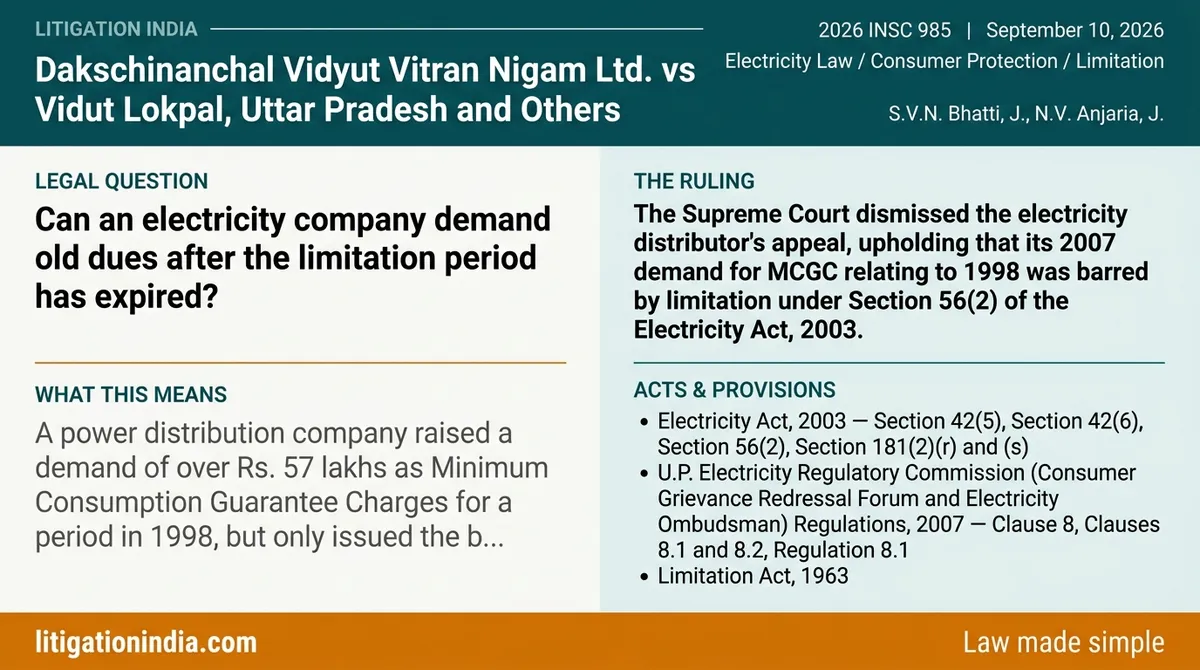
Electricity distributor's time-barred MCGC demand rightly set aside by Ombudsman — infographic summary

What this case means

A power distribution company raised a demand of over Rs. 57 lakhs as Minimum Consumption Guarantee Charges for a period in 1998, but only issued the bill in 2007. The Supreme Court upheld the Electricity Ombudsman's and High Court's finding that this demand was barred by limitation under Section 56(2) of the Electricity Act, 2003. This decision makes clear that electricity companies cannot raise old dues after the permitted time period has passed.

What the Supreme Court held

The Supreme Court dismissed the Civil Appeal, affirming the High Court's judgment which had upheld the Electricity Ombudsman's order setting aside the distributor's demand. The Court held that the demand raised in 2007 for events of 1998 was barred by limitation under Section 56(2) of the Electricity Act, 2003, as electricity charges become 'first due' only when a bill is issued. All pending applications were also disposed of accordingly.

Case: Dakschinanchal Vidyut Vitran Nigam Ltd. vs Vidut Lokpal, Uttar Pradesh and Others (2026) Citation: 2026 INSC 985

Want the full legal reasoning, citations and case documents?

Read the full judgment analysis
Dakschinanchal Vidyut Vitran Nigam
Electricity Ombudsman
Minimum Consumption Guarantee Charges
Section 56(2) Electricity Act 2003
limitation period electricity bills
Consumer Grievance Redressal Forum
UPERC Regulations 2007
distribution licensee
MCGC demand
electricity connection KVA load
Section 42(5), Section 42(6), Section 56(2), Section 181(2)(r) and (s), Electricity Act, 2003
Clause 8, Clauses 8.1 and 8.2, Regulation 8.1, U.P. Electricity Regulatory Commission (Consumer Grievance Redressal Forum and Electricity Ombudsman) Regulations, 2007
Limitation Act, 1963
Section 5-A, U.P. Government Electrical Undertaking (Dues Recovery) Act, 1958