
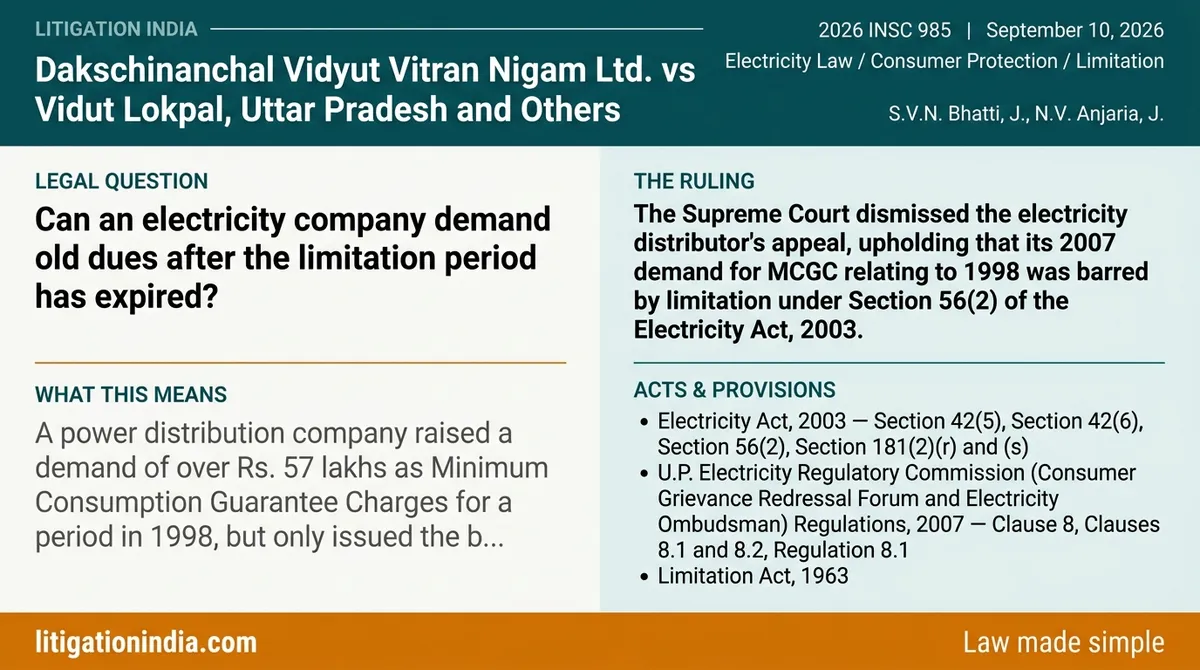
Can an electricity company demand old dues after the limitation period has expired?
Electricity distributor's time-barred MCGC demand rightly set aside by Ombudsman
Case: Dakschinanchal Vidyut Vitran Nigam Ltd. vs Vidut Lokpal, Uttar Pradesh and OthersCitation: 2026 INSC 985Decided on: September 10, 2026
What this case means
A power distribution company raised a demand of over Rs. 57 lakhs as Minimum Consumption Guarantee Charges for a period in 1998, but only issued the bill in 2007. The Supreme Court upheld the Electricity Ombudsman's and High Court's finding that this demand was barred by limitation under Section 56(2) of the Electricity Act, 2003. This decision makes clear that electricity companies cannot raise old dues after the permitted time period has passed.
“The Supreme Court dismissed the electricity distributor's appeal, upholding that its 2007 demand for MCGC relating to 1998 was barred by limitation under Section 56(2) of the Electricity Act, 2003.”
Story Slides
In short
This Civil Appeal was filed by Dakschinanchal Vidyut Vitran Nigam Ltd. (a Distribution Licensee) against the Electricity Ombudsman, Uttar Pradesh, and others, arising from a High Court order dated 06.01.2012 that dismissed the distributor's Writ Petition. The dispute originated from an electricity connection agreement dated 24.02.1997, under which the distributor initially sanctioned 2000 KVA load to Respondent No. 3 instead of the applied 4000 KVA. In January 1998, the distributor offered the additional 2000 KVA, but the consumer declined in September 1998. Nearly a decade later, on 13.02.2007, the distributor raised a demand of Rs. 57,74,164/- as Minimum Consumption Guarantee Charges for the period February 1998 to September 1998, claiming the consumer should pay for the additional load it had offered but which was not accepted. The consumer challenged this demand before the Consumer Grievance Redressal Forum, which gave a split verdict. The Electricity Ombudsman then set aside the demand on two grounds: the consumer had not consented to the additional load, and the demand was barred by limitation under Section 56(2) of the Electricity Act, 2003. The High Court upheld this, additionally finding Clauses 8.1 and 8.2 of the UPERC Regulations 2007 partly ultra vires, as Section 42(6) of the Act allows only a consumer (not a licensee) to approach the Ombudsman. The Supreme Court dismissed the appeal, relying on its earlier judgment in Assistant Engineer (D1), Ajmer Vidyut Vitran Nigam Limited v. Rahamatullah Khan, which held that electricity charges become 'first due' only when the bill is issued, and the two-year limitation under Section 56(2) runs from that date. Since no bill for the additional 2000 KVA was raised contemporaneously, the 2007 demand was time-barred.
Need clarity on a similar legal issue?
Request free pro bono guidance from a Supreme Court Advocate.
Background
Respondent No. 3 applied for a 4000 KVA electricity connection but was initially given only 2000 KVA under an agreement dated 24.02.1997. In January 1998, the distributor offered the additional 2000 KVA but the consumer declined in September 1998. Nearly nine years later, in February 2007, the distributor raised a demand of Rs. 57,74,164/- as Minimum Consumption Guarantee Charges for the period February to September 1998 relating to the additional load that the consumer had refused.
The Decision
The Supreme Court dismissed the Civil Appeal, affirming the High Court's judgment which had upheld the Electricity Ombudsman's order setting aside the distributor's demand. The Court held that the demand raised in 2007 for events of 1998 was barred by limitation under Section 56(2) of the Electricity Act, 2003, as electricity charges become 'first due' only when a bill is issued. All pending applications were also disposed of accordingly.
Why it matters for you
This judgment protects electricity consumers from sudden old demands raised years after the relevant period without any contemporaneous billing. It confirms that a distributor cannot claim Minimum Consumption Guarantee Charges for a load the consumer never accepted or received. Ordinary consumers can rely on the two-year limitation rule to resist stale and arbitrary electricity demands.
Relevant Legal Provisions
Key Acts and sections cited or relied upon in this judgment
“Section 42(5) provides for consumer grievance redressal forums; Section 42(6) allows only a consumer to approach the Electricity Ombudsman; Section 56(2) prescribes a two-year limitation period for raising electricity bills, which was held to bar the distributor's demand raised in 2007 for events of 1998; Section 181(2)(r) and (s) empowered UPERC to promulgate the Regulations 2007.”
“These Regulations govern the Consumer Grievance Redressal Forum and Electricity Ombudsman; Clauses 8.1 and 8.2 were challenged as ultra vires Section 42(6) of the Act, 2003, and the High Court held them to be inconsistent with that provision to the extent they gave remedy to the distribution licensee before the Ombudsman.”
“The High Court applied the Limitation Act, 1963 and found that even under it, the limitation period at best would be three years, making the demand of 2007 for events of 1998 time-barred.”
“Section 5-A prescribed a six-year limitation period for filing a suit relating to UPSEB dues; the High Court found that even applying this extended period, the demand raised on 13.02.2007 for the period February 1998 to September 1998 was barred by limitation.”
AI-assisted summary, reviewed and verified by our editorial team.
In the Court's words
“The liability to pay arises on the consumption of electricity. The obligation to pay would arise when the bill is issued by the licensee company, quantifying the charges to be paid.”
“Electricity charges would become 'first due' only after the bill is issued to the consumer, even though the liability to pay may arise on the consumption of electricity.”
“The Consumer's liability arises only when the agreed quantum of electricity is released to him, and not before.”
“Section 56(2), however, does not preclude the licensee company from raising a supplementary demand after the expiry of the limitation period of two years. It only restricts the right of the licensee to disconnect electricity supply due to non-payment of dues after the period of limitation of two years has expired.”
Need help with your case?
Facing a similar legal challenge in the Supreme Court or High Court? Connect with our pro bono volunteer advocates today.
Related Supreme Court services