
All insights

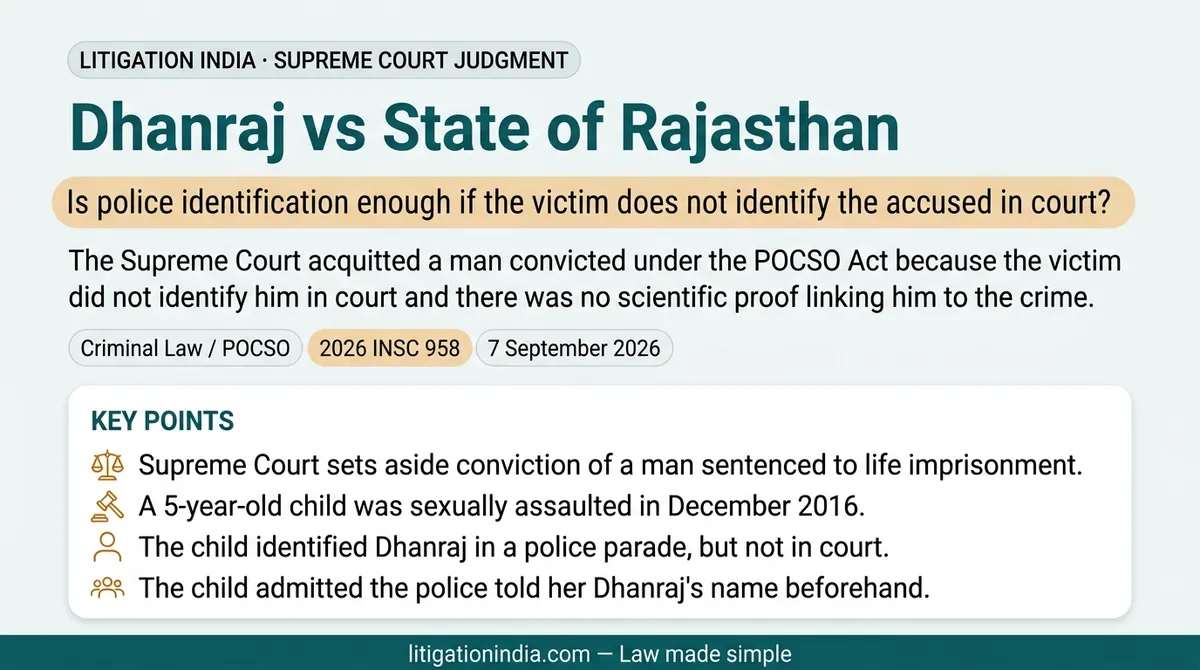
Is police identification enough if the victim does not identify the accused in court?

Dhanraj vs State of Rajasthan

The Supreme Court acquitted a man convicted under the POCSO Act because the victim did not identify him in court and there was no scientific proof linking him to the crime.

Litigation India Editorial 7 September 2026 1 min read 2026 INSC 958

Story

Key points1 / 7

Dhanraj vs State of Rajasthan (2026)

  • Supreme Court sets aside conviction of a man sentenced to life imprisonment.
  • Accused spent over 9 years in prison before getting justice.
  • Judgment highlights major errors in police investigation and courtroom trial.
Dhanraj vs State of Rajasthan · 2026 INSC 9582026-09-07T17:24:02.983788+00:00
Key points2 / 7

What Happened in the Case?

  • A 5-year-old child was sexually assaulted in December 2016.
  • The police registered an FIR against an unknown attacker.
  • Two months later, police arrested Dhanraj based on a secret informer's tip.
Dhanraj vs State of Rajasthan · 2026 INSC 9582026-09-07T17:24:02.983788+00:00
Key points3 / 7

Courtroom Identification Was Missed

  • The child identified Dhanraj in a police parade, but not in court.
  • Police identification is only supportive, not primary proof of guilt.
  • Primary proof requires identifying the accused in the courtroom witness box.
  • The prosecutor and trial judge failed to perform this key step.
Dhanraj vs State of Rajasthan · 2026 INSC 9582026-09-07T17:24:02.983788+00:00
Key points4 / 7

Why the Police Parade Failed

  • The child admitted the police told her Dhanraj's name beforehand.
  • The accused was shown to her before the official identification parade.
  • This made the police identification parade completely unreliable and doubtful.
Dhanraj vs State of Rajasthan · 2026 INSC 9582026-09-07T17:24:02.983788+00:00
Key points5 / 7

No Scientific Evidence

  • No DNA test linked the accused to the crime.
  • Medical report showed injuries were 5-7 days old, contradicting the FIR.
  • A sketch prepared by the victim was hidden by the police.
Dhanraj vs State of Rajasthan · 2026 INSC 9582026-09-07T17:24:02.983788+00:00
Key points6 / 7

Supreme Court's Final Judgment

  • Supreme Court set aside the trial court and High Court judgments.
  • Accused Dhanraj was acquitted of all charges due to lack of proof.
  • Court ordered his immediate release from jail.
Dhanraj vs State of Rajasthan · 2026 INSC 9582026-09-07T17:24:02.983788+00:00
Key points7 / 7

Crucial Lessons for Citizens

  • An accused cannot be convicted on weak identification or assumptions.
  • Courtroom identification is mandatory when the accused is initially unknown.
  • Judges must actively guide trials to prevent unfair convictions.
Dhanraj vs State of Rajasthan · 2026 INSC 9582026-09-07T17:24:02.983788+00:00
Dhanraj vs State of Rajasthan — infographic summary

What this case means

The Supreme Court acquitted a man convicted under the POCSO Act because the victim did not identify him in court and there was no scientific proof linking him to the crime.

What the Supreme Court held

The Supreme Court set aside the conviction and ordered the immediate release of Dhanraj. The Court ruled that the prosecution failed to establish his identity in court and that the medical evidence contradicted the timing of the alleged crime.

Case: Dhanraj vs State of Rajasthan (2026) Citation: 2026 INSC 958

Want the full legal reasoning, citations and case documents?

Read the full judgment analysis
supreme court pocso acquittal
test identification parade value
dock identification importance
courtroom identification mandatory
no dna evidence pocso
delay in lodging fir
child witness identification
benefit of doubt acquittal
Criminal Law / POCSO
Supreme Court legal news
Supreme Court judgment today
latest Supreme Court news