Dhanraj vs State of Rajasthan
The big legal question
Is police identification enough if the victim does not identify the accused in court?
“The Supreme Court acquitted a man convicted under the POCSO Act because the victim did not identify him in court and there was no scientific proof linking him to the crime.”
Story Slides
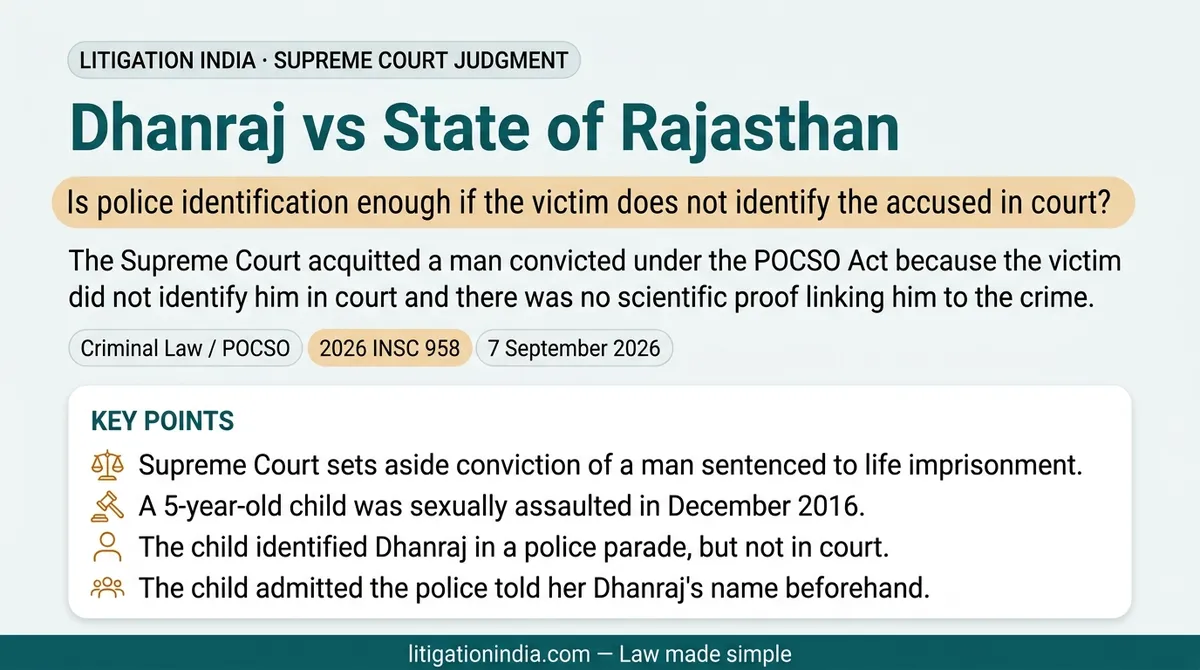
In short
This is a landmark judgment explaining the importance of 'dock identification' (identifying an accused inside the courtroom) and scientific evidence in criminal trials. In this case, a 5-year-old child was sexually assaulted in 2016. The police arrested Dhanraj two months later. Though the child identified him in a Test Identification Parade (TIP) organized by the police, she was never asked to point him out in the courtroom during her trial testimony. The Supreme Court highlighted that police identification is not primary proof; it only supports the main trial. The real, primary proof is identifying the accused while standing in the courtroom witness box. Here, both the Public Prosecutor and the Trial Judge failed to ask the victim to identify the accused, even though he was present in court. Furthermore, the victim admitted during cross-examination that the police had told her Dhanraj's name beforehand. The Court also pointed out major gaps in the investigation. First, the medical report stated the child's injuries were 5 to 7 days old with pus and maggots, which completely contradicted the prosecution's claim that the incident happened just two days before the examination. Second, no DNA profiling or forensic testing was done to link the accused to the crime. Third, the police hid a sketch of the attacker that they had prepared earlier. Because of these serious lapses, the Supreme Court held that the prosecution failed to prove the case beyond reasonable doubt, set aside the life imprisonment sentence, and ordered the immediate release of the appellant, who had already spent over nine years in jail.
Background
In December 2016, a five-year-old girl went missing in a Rajasthan village and was found bleeding after being sexually assaulted. The police registered an FIR against an unknown person, and two months later, arrested Dhanraj based on an informer's tip. The trial court and the High Court sentenced Dhanraj to life imprisonment, relying mainly on the victim identifying him during a police identification parade.
The Decision
The Supreme Court set aside the conviction and ordered the immediate release of Dhanraj. The Court ruled that the prosecution failed to establish his identity in court and that the medical evidence contradicted the timing of the alleged crime.
Why it matters for you
This judgment clarifies that police identification parades are not final proof of guilt; an accused must be identified by the witness inside the courtroom. It also reminds judges and prosecutors that they must actively participate in trials to ensure crucial identification procedures are not skipped.
AI-assisted summary, reviewed and verified by our editorial team.
In the Court's words
“The identification during police investigation, it may be recalled, is not substantive evidence in law and it can only be used for corroborating or contradicting evidence of the witness concerned as given in Court.”
“The role of the Court is not confined to passively recording the evidence as presented by the parties; it is required to ensure that the material evidence necessary for a just adjudication is properly brought on record.”
Need help with your case?
Facing a similar legal challenge in the Supreme Court or High Court? Connect with our pro bono volunteer advocates today.
Related Supreme Court services