
All insights

Can a lender with pervasive contractual control over a corporate debtor be excluded from its Committee of Creditors as a related party?

Debenture Holder with Pervasive Control Over Corporate Debtor Excluded from Committee of Creditors as Related Party

ECL Finance Ltd., a debenture holder and lender, and its trustee IDBI Trusteeship Services Ltd. were excluded from the Committee of Creditors of Palm Developers Pvt. Ltd. because their agreements gave

Litigation India Editorial 27 October 2026 1 min read 2026 INSC 1159

Story

Case at a glance1 / 6

Supreme Court of India

Lender's Contractual Control Over Debtor: Related Party Bar in Insolvency

ECL Finance Ltd. & Anr. vs Abhinaw Mukherjee & Ors. | 2026 INSC 1159

Court: Supreme Court of India | Date: October 27, 2026Bench: Justice J. B. Pardiwala and Justice K. Vinod ChandranArea of Law: Insolvency and Bankruptcy Law — Related Party Exclusion from Committee of CreditorsBoth civil appeals and contempt petitions dismissed
Debenture Holder with Pervasive Control Over Corporate Debtor Excluded from Committee of Creditors as Related Party · 2026 INSC 11592026-10-27T11:59:44.110293+00:00
The legal question2 / 6

Can contractual control over a debtor make a lender a 'related party' excluded from the CoC?

Core legal issue under Section 5(24)(m)(i) read with Section 21(2) of the IBC

  • Appellant: ECL and ITSL are financial creditors with legitimate security interests, not related parties under Section 5(24)(m)(i).
  • Appellant: Corporate guarantee not invoked before CIRP; no financial debt owed by the corporate debtor.
  • Respondent: Agreements gave ECL pervasive control over the corporate debtor's management and policy decisions.
  • Respondent: Individual homebuyer has locus to challenge inclusion of related parties in the CoC.
Debenture Holder with Pervasive Control Over Corporate Debtor Excluded from Committee of Creditors as Related Party · 2026 INSC 11592026-10-27T11:59:44.110293+00:00
Statutory comparison3 / 6

Two Standards of Control Under the IBC

Section 29A vs Section 5(24)(m)(i) — how the Court distinguished them

ProvisionStandard of Control RequiredHow the Court Applied It
Section 29A(c) & (g), IBC — Resolution Applicant disqualificationProactive, positive de jure or de facto control; must be 'in the driving seat'Higher bar; mere restrictive/negative power insufficient — per Arcelor Mittal (2019) 2 SCC 1
Section 5(24)(m)(i), IBC — Related party definitionParticipation in policy making processes; a 'navigational role' sufficesLower bar applied: ECL's powers under AoA, Trust Deed, Facility Agreement and POA met this standard
Participating in policy making — not just being in the driving seat — is enough to be a related party under Section 5(24)(m)(i).
Debenture Holder with Pervasive Control Over Corporate Debtor Excluded from Committee of Creditors as Related Party · 2026 INSC 11592026-10-27T11:59:44.110293+00:00
The Court's reasoning4 / 6

How the Court Reached Its Conclusion

Step-by-step legal reasoning

  1. 1Step 1: Corporate guarantee constitutes financial debt under Section 5(8) IBC even if not invoked before CIRP — per China Development Bank (2025) 7 SCC 729.
  2. 2Step 2: Individual homebuyer has locus to challenge inclusion of related parties in CoC; no res judicata from earlier NCLT order — per Phoenix ARC (2021) 3 SCC 475.
  3. 3Step 3: Standard for Section 5(24)(m)(i) is 'participation in policy making' — lower than 'proactive positive control' under Section 29A — navigational role suffices.
  4. 4Step 4: AoA Clause 7.1, amended Debenture Trust Deed Clause 10, Facility Agreement Clause 6.8, Sanction Letter Clause 21 and Power of Attorney gave ECL pervasive policy-level control over the corporate debtor.
  5. 5Step 5: Post-CIRP assignment by ECL to the second appellant was not bona fide; assignee also treated as related party under Section 21(2) first proviso.
Debenture Holder with Pervasive Control Over Corporate Debtor Excluded from Committee of Creditors as Related Party · 2026 INSC 11592026-10-27T11:59:44.110293+00:00
The verdict5 / 6

The Court's Final Decision

Section 5(24)(m)(i) and Section 21(2) first proviso, IBC applied

  • The Fact: ECL Finance and IDBI Trusteeship held sweeping contractual powers over the corporate debtor's management, policy decisions, staffing, and revenues.
  • The Law: Section 5(24)(m)(i) IBC requires only participation in policy making; Section 21(2) first proviso bars such related parties from the CoC entirely.
  • The Result: Both appeals dismissed; ECL Finance and IDBI Trusteeship rightly excluded from CoC; post-CIRP debt assignment also void as related party evasion.
The appeals stand dismissed. The Contempt Petitions stand closed. Pending application(s), if any, shall stand rejected.
Debenture Holder with Pervasive Control Over Corporate Debtor Excluded from Committee of Creditors as Related Party · 2026 INSC 11592026-10-27T11:59:44.110293+00:00
Why it matters6 / 6

What This Means for Ordinary People

Practical significance of the judgment

  • Homebuyers in stalled real estate projects can individually challenge a powerful lender's participation in the insolvency committee, even without the class's Authorised Representative acting.
  • A lender who controls a debtor's daily operations, staffing, budgets and sales cannot also sit on the insolvency committee that decides the debtor's fate.
  • Assigning a debt to a third party after insolvency begins will not help a related-party lender escape exclusion if the assignment appears designed to defeat the law.
  • The resolution of insolvent companies is better protected when those who controlled the debtor are kept out of the decision-making committee.
A lender with pervasive policy control over a debtor is a related party — and cannot sit on the committee that decides the debtor's insolvency resolution.
Debenture Holder with Pervasive Control Over Corporate Debtor Excluded from Committee of Creditors as Related Party · 2026 INSC 11592026-10-27T11:59:44.110293+00:00
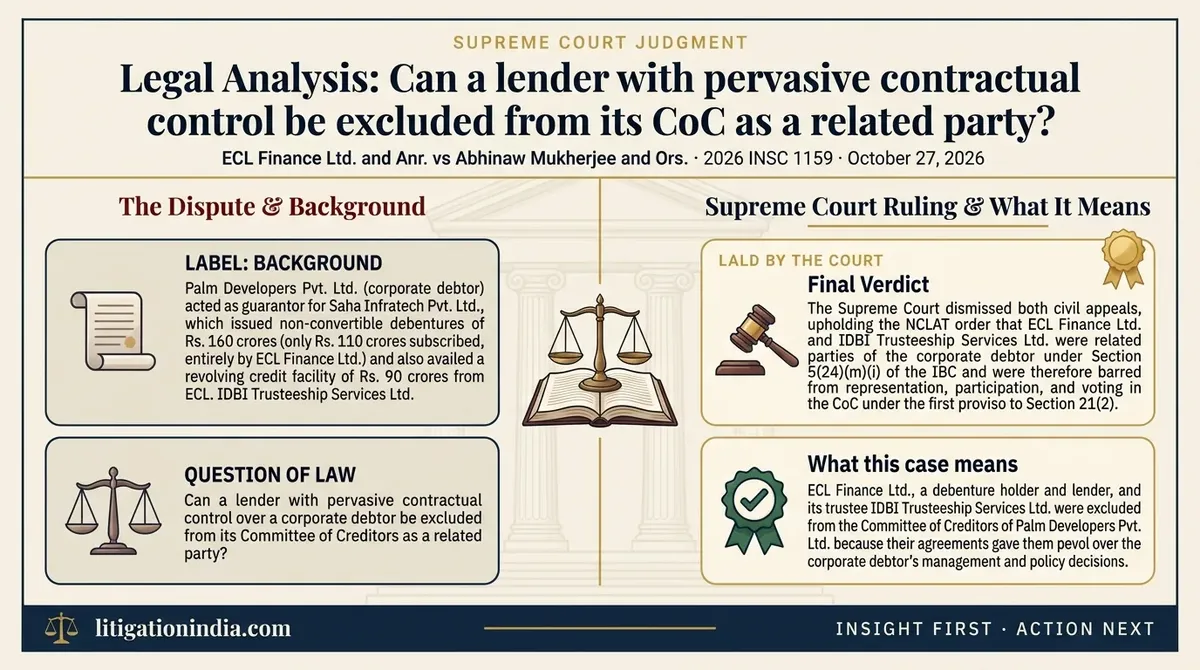
Debenture Holder with Pervasive Control Over Corporate Debtor Excluded from Committee of Creditors as Related Party — infographic summary

What this case means

ECL Finance Ltd., a debenture holder and lender, and its trustee IDBI Trusteeship Services Ltd. were excluded from the Committee of Creditors of Palm Developers Pvt. Ltd. because their agreements gave them pervasive control over the corporate debtor's management and policy decisions. The Supreme Court held that such control made them a 'related party' under Section 5(24)(m)(i) of the Insolvency and Bankruptcy Code, 2016, barring their participation. This ruling clarifies that even lenders with extensive contractual controls over a debtor's business can be treated as related parties and excluded from insolvency proceedings.

What the Supreme Court held

The Supreme Court dismissed both civil appeals, upholding the NCLAT order that ECL Finance Ltd. and IDBI Trusteeship Services Ltd. were related parties of the corporate debtor under Section 5(24)(m)(i) of the IBC and were therefore barred from representation, participation, and voting in the CoC under the first proviso to Section 21(2). The contempt petitions were closed and pending applications were rejected.

Case: ECL Finance Ltd. and Anr. vs Abhinaw Mukherjee and Ors. (2026) Citation: 2026 INSC 1159

Want the full legal reasoning, citations and case documents?

Read the full judgment analysis
ECL Finance
related party
Committee of Creditors
Insolvency and Bankruptcy Code 2016
Section 5(24)
Section 21
Debenture Trustee
IDBI Trusteeship Services
NCLT
NCLAT
corporate guarantee
financial creditor exclusion
Section 5(24)(m)(i), Insolvency and Bankruptcy Code, 2016
Section 21(1), Section 21(2) first proviso, Section 21(6A), Insolvency and Bankruptcy Code, 2016