
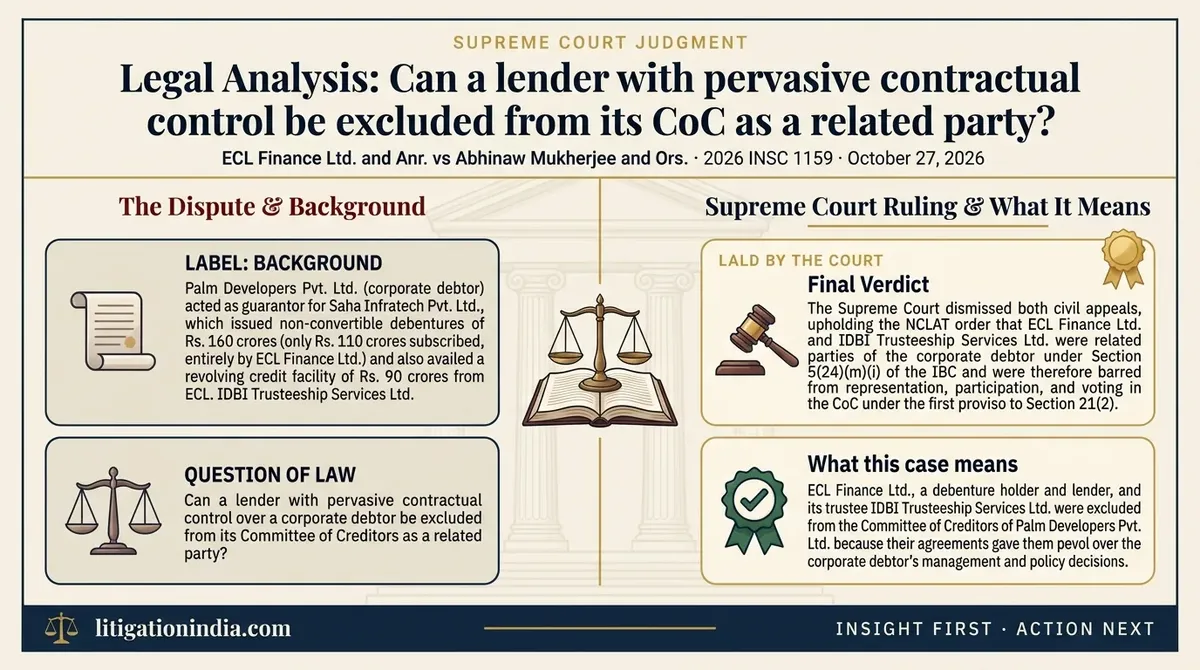
Full text of the judgment
Text extracted from ECL Finance Ltd. and Anr. vs Abhinaw Mukherjee and Ors.. For the authoritative version refer to the Supreme Court of India's official website.
2026 INSC 1159 Civil Appeal No.6268 of 2022 etc. Page 1 of 25
IN THE SUPREME COURT OF INDIA CIVIL APPELLATE JURISDICTION
Civil Appeal No.6268 of 2022
ECL Finance Ltd. and Anr. ...Appellant(s)
Abhinav Mukherjee and Ors. ...Respondent(s)
With Civil Appeal No.6273 of 2022
Contempt Petition (C) No.730 of 2023 in Civil Appeal No.6268 of 2022
Contempt Petition (C) No.731 of 2023 in Civil Appeal No.6273 of 2022
J U D G M E N T K.VINOD CHANDRAN, J.
There are two appeals before us; one by the Debenture Trustee and the other by the Debenture Holder/Lender, who are aggrieved with the order of the National Company Law Appellate Tribunal (NCLAT), which affirmed the order of the Adjudicating Authority; National Company Law Tribunal (NCLT) finding the appellants to be Digitally signed by CHANDRESH Date: 2026.10.27 17:03:21 IST Reason: Signature Not Verified
Civil Appeal No.6268 of 2022 etc. Page 2 of 25
‘related party’ to the Corporate Debtor (CD) under Section 5(24) of the Insolvency and Bankruptcy Code, 2016 (IBC), and thus, not liable to included or participated as a financial creditor in the Committee of Creditors (CoC) constituted under Section 21 of the IBC. 2. Heard Sri Gaurav Mitra, learned Senior Counsel for the appellants and Sri Jayant Mehta & Sri Arijit Prasad, learned Senior Counsel for the respondents. 3. The Debenture Trustee is the IDBI Trusteeship Services Limited (ITSL) and the Debenture Holder/Lender is the ECL Finance Limited (ECL), who were treated as an undifferentiated monolith by the NCLAT. However, there is a subtle distinction between both, by virtue of the ECL having two distinct status, in its relationship with the CD. Hence for convenience, we refer to the facts from the order of the NCLT. 4. The claims arose from a Debenture Trust Deed dated 13.05.2016 and a Facility Agreement dated 22.09.2017. The CD is Palm Developers Private Limited, who acted as Guarantor to one Saha Infratech Private Limited (SIPL), who issued the debentures and availed the Term Loan Facility. In June 2016, SIPL, augmenting their resources to generate
Civil Appeal No.6268 of 2022 etc. Page 3 of 25
funds for developing their various projects, proposed issuance of non-convertible debentures having face value of Rs.1 Crore each, for an aggregate amount of Rs.160 Crores in two tranches. The first tranche was proposed as 110 debentures and the second tranche comprising 50 debentures. SIPL appointed ITSL as the trustee for the holders of the debentures vide Debenture Trustee Agreement dated 18.05.2016. As per the Debenture Trust Deed, a part of the debenture subscription amount was to be used for funding the construction ‘Project Encore’ situated at Greater Noida, Uttar Pradesh. Only the first tranche of Rs.110 Crores was subscribed and the entire debentures are now held by ECL. By the Debenture Trust Deed, the SIPL and the CD guaranteed the performance of all the terms and conditions of the Debenture Trust Deed, which was secured inter alia by an unconditional and irrevocable corporate guarantee by the CD. In addition, first charge and mortgage over the lands and buildings of ‘Project Encore’ along with hypothecation of the ‘Project Encore’ receivables and creation of an escrow account for the revenue generated from ‘Project Encore’, were stipulated in the Debenture Trust Deed.
Civil Appeal No.6268 of 2022 etc. Page 4 of 25
5. Meanwhile SIPL approached ECL for availing revolving credit facility to an extent of Rs.90 Crores vide letter dated 13.06.2017, and on the sanction of the said facility, the SIPL as Principal Borrower entered into a Facility Agreement dated 22.09.2017 with ECL along with the CD as Obligor No.5; i.e., Guarantor. The Facility Agreement also required the Principal Borrower along with the Obligors to create securities in favour of ECL on various properties including first charge and mortgage over the various projects existing and intended, as also furnishing of personal as well as corporate guarantees including an irrevocable and unconditional corporate guarantee from the CD and a pledge of its shares held by the shareholders in favour of ECL to secure the due performance of all conditions of the Facility Agreement by a separate guarantee agreement dated 22.09.2017. 6. Hence, we observed at the outset, that ECL in its relationship with SIPL, has two status. One, the Lender to SIPL and two, the Debenture Holder of SIPL, both intended at development of the projects of SIPL; the due satisfaction of both having been guaranteed by the CD. The CD, thus, had
Civil Appeal No.6268 of 2022 etc. Page 5 of 25
a dual obligation to secure the interest of ECL; as a Debenture Holder and as Lender. 7. The Corporate Insolvency Resolution Process (CIRP) of the CD was commenced when the petition under Section 7 was admitted on 27.01.2020. On 10.02.2020, ITSL claimed Rs.131,17,23,044/- as on 29.02.2020 in its capacity as Debenture Trustee, from the CD. Likewise, ECL claimed an amount of Rs.139,02,83,168.68/- as amounts due as per the Term Loan Facility Agreement. Both the entities were treated as financial creditors and included in the CoC, which was objected to by one of the financial creditors, a Homebuyer, individually, as distinguished from agitating it through the Authorized Representative (AR) of the class of creditors; herein the Homebuyers. The NCLT found the claims of the appellants to be not a financial credit, since there was no financial debt incurred by the CD, no direct disbursal of amounts to the CD having been occasioned and it also found that both the appellants were related party, as defined under Section 5(24)(m)(i) of the IBC. The locus of the single Homebuyer was accepted.
Civil Appeal No.6268 of 2022 etc. Page 6 of 25
8. The NCLAT found that the ratio of Anuj Jain, Interim Resolution Professional for Jaypee Infratech Ltd. v. Axis Bank Limited and Others1 is not applicable. We are also of the opinion that the NCLT misread Anuj Jain1 to find that since the CD was not the principal borrower and was a guarantor that would not be a financial debt under Section 5 (8) especially when the extracted portion from the cited decision itself spoke of “… it may also include any liability in respect of a guarantee or indemnity for any of the items referred to in subclauses (a) to (h) …’ (sic para 46). 9. However, we find the NCLAT to have erred in finding that the appellants’ claim cannot be entertained for reason of the corporate guarantee not being invoked prior to the commencement of CIRP. We are fortified in taking that view by the decision in China Development Bank v. Doha Bank Q.P.S.C. and Others2. The appellant therein had sought inclusion as a financial creditor in the CoC, which was challenged by one another financial creditor. The appellants relied on the Deeds of Hypothecation (DoH) executed jointly by the group companies, collectively referred to as ‘Rcom
1 (2020) 8 SCC 401 2 (2025) 7 SCC 729
Civil Appeal No.6268 of 2022 etc. Page 7 of 25
entities’; one of whom was the CD. The Rcom entities had also entered into a Master Security Trustee Agreement with Axis Trustees Services Limited, who had executed the DoH on behalf of the appellants and the other Lenders, wherein the Rcom entities including the CD agreed to provide their common pooled assets as security for the loans availed by them. The specific contention taken up was that no default under the DoH had occasioned, which was rejected, with reference to the definition of ‘financial debt’ under Section 5(8) of the IBC. It was held that there was no requirement under Section 5(8), that a facility qualifies as financial debt only when a default occurs. Section 5(7) of the IBC was also noticed to find that any person to whom financial debt is owed, becomes a financial creditor, even if there is no default in payment of debt. The definition of ‘default’ under Section 3(12), it was held, assumes relevance only when Section 7(1) of IBC is invoked and a CIRP is sought to be initiated by the financial creditor. It was noticed from the DoH that it is a contingent contract, wherein the contingent event is the shortfall between realization and expenses. The contract itself becomes impossible of enforcement, owing to the
Civil Appeal No.6268 of 2022 etc. Page 8 of 25
moratorium imposed; prohibiting the sale of hypothecated properties, and thus, the shortfall cannot be shown to arise. Hence, on establishing that there is a financial debt under Section 5(8); which does not speak of a contingent default, the claim arises for the creditor to approach the IRP/RP, which has to be submitted on the public announcement of the CIRP. 10. The NCLAT, however, held in favour of the individual financial creditor as distinguished from a financial creditor in class, who had approached the NCLT, and upheld his locus relying on Phoenix ARC Private Limited v. Spade Financial Services Limited and Others3, which also answers effectively the question as to whether the corporate guarantee could be termed to be a financial debt, despite the guarantee not having been invoked prior to commencement of CIRP, affirmatively. On the locus, the Tribunal referred to its own decision in Aashray Social Welfare Society & Ors. v. Saha Infratech Pvt. Ltd. & Ors.4 as to the role of the ‘Authorized Representative’ (AR) of the creditors in a class. It was held therein that the AR under the statutory scheme
3 (2021) 3 SCC 475 4 Company Appeal (AT) (Insolvency) No. 904 of 2021
Civil Appeal No.6268 of 2022 etc. Page 9 of 25
represents the financial creditors i.e., the Homebuyers in a class, for a limited purpose i.e., for attending meetings of the CoC and voting on behalf of the financial creditors in a class. It cannot be said that since the AR has not himself approached the Adjudicating Authority with the application, the appellants who themselves are Homebuyers, had no right to participate in the adjudication. 11. Phoenix ARC Private Limited3 also considered a similar objection, wherein the NCLT allowed two entities, who claimed their status as financial creditors, to re-submit their claims with a direction to the IRP to consider such claims. This was projected as res judicata when two other financial creditors objected to their inclusion. This Court found that when the NCLT allowed resubmission of claims as financial creditors, none of the creditors of the CoC were represented in the proceedings. When the order was passed without hearing the financial creditors, who had challenged their inclusion subsequently, it does not bring in res judicata. The financial creditors were held to be legitimately within their rights in seeking a direction for exclusion of the two entities from the CoC as related parties; which dictum
Civil Appeal No.6268 of 2022 etc. Page 10 of 25
squarely applies to the present case where an individual financial creditor had, before the NCLT, objected to the inclusion of the appellants in the CoC, being related parties. 12. What remains is only the question as to whether the appellants were related parties of the CD within the meaning of Section 5(24) of the IBC and were resultantly liable to be excluded from the CoC under the first proviso to Section 21(2) of the IBC. We extract hereunder Section 5(24)(m)(i), sub-sections (1) & (2); its first proviso and (6A) of Section 21: ‘Section 5(24) “related party” in relation to a corporate debtor, means--xxx xxx xxx (m)- any person who is associated with the corporate debtor on account of — (i) participation in policy making processes of the corporate debtor; or’
‘Section 21(1) The interim resolution professional shall after collation of all claims received against the corporate debtor and determination of the financial position of the corporate debtor, constitute a committee of creditors. (2) The committee of creditors shall comprise all financial creditors of the corporate debtor:
Provided that a financial creditor or the authorised representative of the financial creditor referred to in sub-section (6) or subsection (6A) or subsection (5) of section 24, if it is a related party of the corporate debtor shall not have any right of representation, participation or voting in a meeting of the committee of creditors.’
Civil Appeal No.6268 of 2022 etc. Page 11 of 25
‘(6A)- Where a financial debt-
(a) is in the form of securities or deposits and the terms of the financial debt provide for appointment of a trustee or agent to act as authorised representative for all the financial creditors, such trustee or agent shall act on behalf of such financial creditors; (b) is owed to a class of creditors exceeding the number as may be specified, other than the creditors covered under clause (a) or sub-section (6), the interim resolution professional shall make an application to the Adjudicating Authority along with the list of all financial creditors, containing the name of an insolvency professional, other than the interim resolution professional, to act as their authorised representative who shall be appointed by the Adjudicating Authority prior to the first meeting of the committee of creditors; (c) is represented by a guardian, executor or administrator, such person shall act as authorised representative on behalf of such financial creditors, and such authorised representative under clause (a) or clause (b) or clause (c) shall attend the meetings of the committee of creditors, and vote on behalf of each financial creditor to the extent of his voting share.’
13. The Tribunal looked at the various documents, including the Debenture Trust Deed as also the Facility Agreement to find the appellants to be related party, especially relying on the judgment of this Court in Arcelor Mittal India Private Limited v. Satish Kumar Gupta and
Civil Appeal No.6268 of 2022 etc. Page 12 of 25
Others5. Therein the issue considered was the disqualification of a Resolution Applicant under Section 29A (c). The disqualifications under clause (c) of Section 29A leading to ineligibility to submit a Resolution Plan, being any one of the three things detailed therein; which are disjunctive, must be established. The disqualifications are that ‘the Corporate Debtor may be under the management of the person referred to in Section 29A, the Corporate Debtor may be a person under the control of such person, or the Corporate Debtor may be a person, of whom such person is a promoter’. 14. Referring to the expression ‘control’ as defined in the Companies Act, 2013; Section 2(27), it was held so in paragraph 50 as under: ‘50. The expression “control” is therefore defined in two parts. The first part refers to de jure control, which includes the right to appoint a majority of the Directors of a company. The second part refers to de facto control. So long as a person or persons acting in concert, directly or indirectly, can positively influence, in any manner, management or policy decisions, they could be said to be “in control”. A management decision is a decision to be taken as to how the corporate body is to be run in its day-to-day affairs. A policy decision would be a decision that would be beyond running dayto-day affairs i.e. long-term decisions. So long as
5 (2019) 2 SCC 1
Civil Appeal No.6268 of 2022 etc. Page 13 of 25
management or policy decisions can be, or are in fact, taken by virtue of shareholding, management rights, shareholders agreements, voting agreements or otherwise, control can be said to exist.’
15. It was held that the ‘control’ in Section 29A(c) denotes positive control, which means that a mere power to block special resolutions of the company, cannot amount to control. Finding ‘control’ to be the power to drive actual management or policy decisions, reference was approvingly made to a judgment of the Securities Appellate Tribunal in Subhkam Ventures (I) Private Limited v. Securities and Exchange Board of India6 and the following paragraph was extracted: ‘Control — The direct or indirect power to direct the management and policies of a person or entity, whether through ownership of voting securities, by contract, or otherwise; the power or authority to manage, direct, or oversee.” [Black’s Law Dictionary –Eighth Edition]
Control, according to the definition, is a proactive and not a reactive power. It is a power by which an acquirer can command the target company to do what he wants it to do. Control really means creating or controlling a situation by taking the initiative. Power by which an acquirer can only prevent a company from doing what the latter wants to do is by itself not control. In that event, the acquirer is only reacting rather than taking the initiative. It is a positive power and not a negative power. In a board managed company, it is the board of directors that is in control. If an acquirer
6 2010 SCC OnLine SAT 35
Civil Appeal No.6268 of 2022 etc. Page 14 of 25
were to have power to appoint majority of directors, it is obvious that he would be in control of the company but that is not the only way to be in control. If an acquirer were to control the management or policy decisions of a company, he would be in control. This could happen by virtue of his shareholding or management rights or by reason of shareholders agreements or voting agreements or in any other manner. The test really is whether the acquirer is in the driving seat. To extend the metaphor further, the question would be whether he controls the steering, accelerator, the gears and the brakes. If the answer to these questions is in the affirmative, then alone would he be in control of the company. In other words, the question to be asked in each case would be whether the acquirer is the driving force behind the company and whether he is the one providing motion to the organization. If yes, he is in control but not otherwise. In short control means effective control.’
16. Thus, there was a distinction drawn of a positive or a proactive control, as opposed to a mere negative or a reactive control. Reference was also made to Clause (g), which too refers to ‘the management or control of a Corporate Debtor’, the words ‘management’ and ‘control’ taking colour from each other on the principle of noscitur a sociis. It was categorically declared in paragraph 53 that ‘what is referred to Clauses (c) and (g) is de jure or de facto proactive and positive control and not mere negative control, as distinguished from an expansive reading of the definition
Civil Appeal No.6268 of 2022 etc. Page 15 of 25
of the word ‘control’ contained in Section 2(27) of the Companies Act, 2013, which is exclusive and not exhaustive in nature’ (sic). 17. We must immediately notice that a reading of Section 5(24) with the first proviso of sub-section (2) and sub-section (6A) of Section 21, does not indicate a requirement of a proactive control as would the rigour of the word ‘control’ in Section 29A (c) & (g) would bring forth. Sub-section (24) of Section 5, by sub-clause (m)(i), only requires an association with the CD by way of participation in policy making process of the CD. First proviso to Section 21, as extracted hereinabove, restricts a financial creditor or an AR of a financial creditor, inter alia referred to in sub-section (6A), if it is a related party of the CD, from the right of representation, participation or voting in a meeting of the CoC. Admittedly, the status of ECL as a Debenture Holder, which interest ITSL as a Debenture Trustee seeks to protect, falls under subsection (6A) (a) of Section 21. We are, hence, only looking at whether the association with the CD by the ECL, in its status as a Debenture Holder; which alone we would as of now consider, brings in a participation in policy making of the
Civil Appeal No.6268 of 2022 etc. Page 16 of 25
Corporate Debtor. The rigour to find a financial creditor to be a related party under Section 21 read with the second proviso and sub-section (6A)(a), is a tad lesser than that required to find ‘control’ under Section 29A (c) and (g). The requirement would not be to the extent of being in the driving seat, but a role of navigation would suffice, in determining policy and channelising business interests. 18. With this in mind, we look at the order of the NCLAT. The financial creditor, the Homebuyer, raised the following issues to prohibit the participation of the appellants in the CoC. We extract hereunder, for brevity, the specific points as extracted in paragraph 37 of the impugned order: ‘Control over the decisions of the Board of Directors. • Final say in any decision at a Board Meeting or at a shareholders meeting or on any other matter in the event of a deadlock. • Control over the appointment and removal of key managerial personnel of the 'Corporate Debtor'. • Control over the approval and modifications of the business plans of the 'Corporate Debtor'. • Control over the modalities of sale of units in the projects. • Control over the sale of units to prospective customers and registration of units before the Registrar. • Control over all revenue and other accounts of the 'Corporate Debtor'. • Selling partner of the 'Corporate Debtor'.’
Civil Appeal No.6268 of 2022 etc. Page 17 of 25
19. The Tribunal looked at the Sanction Letter, the Articles of Association (AoA), the Facility Agreement and the Builder- Buyer Agreement. We will deal separately with the aspects concerning the Debenture Trust Deed and the Facility Agreement; which are two separate aspects of the matter, both giving rise to separate claims, of amounts due on the debentures held and the term loan outstanding. Insofar as the Debenture Holder is concerned, Clause 7.1 of the AoA was extracted, which we deem it proper to extract: "7.1. Without prejudice to the other rights of the Debenture Holders and the lenders under these Articles and the loan documentation and debenture trust deed and under applicable Laws, the Debenture Holders and/ or the lenders shall upon occurrence of an event of default have the right to appoint a nominee director on the Board of the Company. The Promoters of the Company shall take all necessary steps, including passing necessary resolutions at the Board and Shareholder meetings and filing necessary forms with the RoC, to enable the Debenture Holders and/ or the lenders to exercise the aforesaid right. Notwithstanding anything contained in these Articles and, or, in the Transaction Documents, the Promoters and the Company shall in the event there is a deadlock on any matter/decision at a board meeting and, or, at a shareholders meeting amongst the directors or the Promoters, such matter/ decision shall be referred to the nominee director of the Debenture Holder and/ or the lenders and, or, to the Debenture Holders or the lenders for final
Civil Appeal No.6268 of 2022 etc. Page 18 of 25
decision. Any decision by such director of the Debenture Holders and/ or lenders and, or, the Debenture Holders and/or the lenders shall be final and binding on the Promoters of the Company."
20. The amendments to the Debenture Trust Deed on 16.01.2017 incorporated the following clause: ‘10. Business Plan, Project Cost and Quarterly Budget Approval Mechanism 5) The Debenture Trustee/ Monitoring Agent may approve the Quarterly Construction Budget or may advise the Issuer and/ or Security Providers to make modification as mutually decided. The Issuer and/ or Security Providers will revise/ modify the respective Quarterly Construction Budget if so advised by the Debenture Trustee/ Monitoring Agent. The Quarterly Construction Budget once approved by the Debenture Trustee/ Monitoring Agent ("Approved Quarterly Construction Budget”) shall be applicable to for the quarter for which the same is approved and the amount from the Escrow Account to meet the construction cost shall during such quarter will be released as per the Approved Quarterly Construction Budget subject to availability of the amount in the Escrow Accounts. The Debenture Trustee/ Monitoring Agent may in suitable circumstances and at the request of the Issuer and/ or Security Providers approve such modification/ revisions in the respective Approved Quarterly Construction Budget as may be deemed necessary by the Debenture Trustee/ Monitoring Agent.’
Civil Appeal No.6268 of 2022 etc. Page 19 of 25
This clearly confers a proactive role on the debenture holder and the Trustee in steering the Company, SIPL, through difficult times; but also, the CD, who is the security provider. 21. Insofar as the Facility Agreement, the special conditions in the Sanction Letter indicate absolute right to appoint a Director on the Board of the Borrower and such nominee Director, being insulated from any liability, as indemnified by the Borrower. The nominee Director also would be a member of all the Committees appointed by the Board of Directors of the Borrower/Security Providers, and the Lender has the right to appoint an Observer on the Board of the Borrower and/or Management of the Security Providers, who shall forward a copy of all the Notices/Resolutions/Agenda of the respective Board meeting to such Observer. Clause 6.8 of the Facility Agreement, with the nominal heading ‘Management’ was also extracted by the Tribunal, which prohibits removal of any managerial personnel, of either the Borrower or Obliger, having substantial managerial powers and who are available at the time of the execution of the Facility Agreement, without the consent of the Lender. The Borrower and the Obligor
Civil Appeal No.6268 of 2022 etc. Page 20 of 25
were also required to appoint and change, to the satisfaction of the Lender, suitable, technical, financial and executive staff in key posts, if the Borrower or the Obligor fail to adhere to the business plan and meet the requirement of project milestones as provided in the Facility Agreement. The Lender also retains with itself the right to appoint, whenever necessary, any person, firm, company or association of persons engaged in technical, management or consultancy business to inspect and examine the working of the Borrower and/or Obligor, as also conduct examination of the financial or Cost Accounting Systems, through Cost Accountants/Chartered Accounts, the fees of which will have to be borne by the Borrower and/or Obligor. 22. Clause 21 of the Sanction Letter indicates controlling power on ECL to appoint Real Estate Agents/Distributing Agents on behalf of the CD for sale of specific residential unit/inventory of the total saleable area in the various projects of the promoters. There was also a Power of Attorney executed by the Borrower and/or Obligor, which conferred sweeping powers on the ECL in the construction of the projects, enabling sanctions and approvals from statutory
Civil Appeal No.6268 of 2022 etc. Page 21 of 25
authorities, matters related to supply of raw materials, appointing labour and construction of the project itself, communication with the purchasers and entering into transactions, to carry out the finalization of the sales made and to ensure the proceeds of the sale to be retained in escrow accounts. Clause 4.1 of the AoA was extracted in paragraph 53 to find that the project revenues including the payments made by the allotees of the CD, is in the direct control of the appellant/ECL. 23. From the above, it is crystal clear that ECL has an allpervasive control, insofar as the projects of the principal Borrower are concerned, for facilitating which the debentures were issued and the Term Loan Facility extended. The AoA of the CD, a Guarantor, also indicated such control being exercised by the debenture holder/lender on its management and it cannot be said to be a mere restrictive or negative control exercised. That the said control was never put in place, cannot at all be countenanced, since the policy implementation and the business carried out, were under the overall supervision of ECL, both as a Debenture Holder, the powers being
Civil Appeal No.6268 of 2022 etc. Page 22 of 25
exercised by the Debenture Trustee, the ITSL, and as a Term Loan Lender. If the ECL is found to be a related party, as coming forth from Section 24(5)(m)(i), then it cannot participate in the proceedings of the CoC, nor can it be included. If the ECL cannot be included as a Debenture Holder, since admittedly the entire debentures are held by the ECL, the Debenture Trustee who seeks to secure the interest of the Debenture Holder also cannot participate in the CoC, nor can it be included. 24. We have also found that the Facility Agreement, as also the AoA, enables overall supervision of the activities of both the Borrower and the Guarantor by the financial creditor. ECL, the Lender who has the status of the Debenture Holder, in accordance with the Debenture Trust Deed; enabled overall supervision in the policy implementation and the business carried out of development of projects, who cannot be participated in the CoC, even as a Lender. If the status was only of a financial creditor, not coming within the ambit of sub-section (6) or (6A) of Section 21 or authorising any insolvency professional under sub-section (5) of Section 24 who is not a related party, ECL would not have been
Civil Appeal No.6268 of 2022 etc. Page 23 of 25
disqualified under the first proviso to Section 21(2). However, ECL having the status of the Debenture Holder is disabled from being represented, participating and voting in the CoC as the Debenture Holder due to the explicit terms in the Debenture Trust Deed and by reason of that, disabled even in the status of a lender. The pervasive control conferred on the sole Debenture Holder also disables the Debenture Trustee, the ITSL, who is protecting the interest of the Debenture Holder, from being included in the CoC. 25. Though not specifically argued, we also notice that the ECL has assigned its rights as per the Facility Agreement to the 2nd appellant in its appeal. Phoenix ARC Private Limited3 specifically ruled on such assignees being excluded from the definition of a related party, if they have legitimately taken over the debt of related parties or where the related party entity had stopped being a related party ‘long ago’. Reliance was also placed on the Insolvency Law Committee Report, 2020, which cautioned that in order to prevent any misuse prior to including an assignee of a related party-financial creditor, within the CoC, the Resolution Professional should verify that the assignee is not a related party of the CD and in
Civil Appeal No.6268 of 2022 etc. Page 24 of 25
cases where it may be proved that a related party had assigned or transferred its debt to a third party in bad faith or with a fraudulent intent to vitiate the proceedings under the Code, the assignee should be treated akin to a related party-financial creditor, under the first proviso to Section 21(2). 26. In the present case, we already noticed that it was the ECL who raised the claim before the RP and later the assignment was made long after the CIRP process was commenced. The assignment is not ‘long ago’ and is very recent. It can only be considered as one intended to defeat the rigour of the proviso to Section 21(2) to participate in the CoC, reckoning also the report of the Forensic Audit conducted, specifically noticed by the Tribunal. The Tribunal referred to the Forensic Audit report, wherein it has been stated that the CD, who was the Corporate Guarantor, was fraudulently used as a vehicle to transfer funds from SIPL to two other entities, which are companies controlled by the promoters of the CD, and over which ECL has complete charge of their assets. The extract from the report also speaks of the very project of ‘Meghdutam Encore’ having been
Civil Appeal No.6268 of 2022 etc. Page 25 of 25
initiated fraudulently, without any intention to complete it, to defraud the Homebuyers and to mortgage it for availing loan facilities from financial creditors, which funds would be diverted to other connected entities. The assignment hence fails the test of a bona fide assignment, and the 2nd appellant too cannot be participated. 27. We find absolutely no question of law arising from the order of the NCLAT and we find no perversity insofar as the analysis of facts leading to the conclusion of the appellants being related party under Section 5(24). No valid ground vitiates the impugned order, and we find no reason to cause interference. 28. The appeals stand dismissed. 29. The Contempt Petitions stand closed. 30. Pending application(s), if any, shall stand rejected.
.......…….……………………. J.
(J. B. PARDIWALA)
....……….……………………. J.
(K. VINOD CHANDRAN) NEW DELHI; OCTOBER 27, 2026.