
All insights

Daughters have equal rights in ancestral property by birth, regardless of when their father died

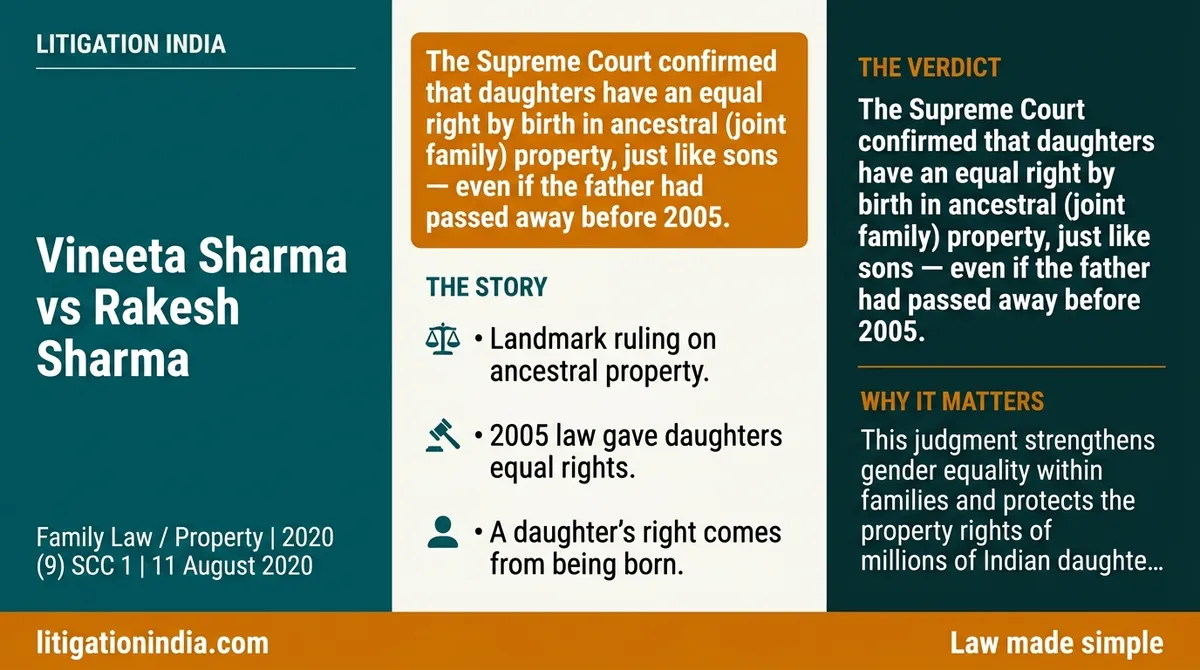
This case resolved whether daughters need their father to be alive in 2005 to claim equal ancestral property rights. The Supreme Court decided that a daughter gets this right by birth, so the father's

Litigation India Editorial 26 June 2026 1 min read 2020 (9) SCC 1

Story

Key points1 / 5

Daughters Are Equal Owners

  • Landmark ruling on ancestral property.
  • Daughters get the same rights as sons.
  • Vineeta Sharma vs Rakesh Sharma (2020).
Daughters have equal rights in ancestral property by birth, regardless of when their father died · 2020 (9) SCC 12026-06-26T21:02:33.335194+00:00
Key points2 / 5

The Old Confusion

  • 2005 law gave daughters equal rights.
  • But did the father need to be alive in 2005?
  • Courts had given conflicting answers.
Daughters have equal rights in ancestral property by birth, regardless of when their father died · 2020 (9) SCC 12026-06-26T21:02:33.335194+00:00
Key points3 / 5

Right By Birth

  • A daughter's right comes from being born.
  • It does not depend on when the father died.
  • Same rights, same responsibilities as a son.
Daughters have equal rights in ancestral property by birth, regardless of when their father died · 2020 (9) SCC 12026-06-26T21:02:33.335194+00:00
Key points4 / 5

What the Court Decided

  • Daughter is a coparcener by birth.
  • Earlier conflicting judgment overruled.
  • Equality confirmed for all daughters.
Daughters have equal rights in ancestral property by birth, regardless of when their father died · 2020 (9) SCC 12026-06-26T21:02:33.335194+00:00
Key points5 / 5

Why It Matters For You

  • Protects property rights of crores of daughters.
  • Strengthens equality inside families.
  • Old unequal customs cannot deny your share.
Daughters have equal rights in ancestral property by birth, regardless of when their father died · 2020 (9) SCC 12026-06-26T21:02:33.335194+00:00
Daughters have equal rights in ancestral property by birth, regardless of when their father died — infographic summary

What this case means

This case resolved whether daughters need their father to be alive in 2005 to claim equal ancestral property rights. The Supreme Court decided that a daughter gets this right by birth, so the father's death date does not matter. This ensures crores of Indian women cannot be denied their fair and equal share in family property.

What the Supreme Court held

The Court ruled that a daughter is a coparcener by birth with equal rights, regardless of whether the father was alive on the date of the 2005 amendment. The earlier conflicting decision (Prakash vs Phulavati) was overruled.

Case: Vineeta Sharma vs Rakesh Sharma (2020) Citation: 2020 (9) SCC 1

Want the full legal reasoning, citations and case documents?

Read the full judgment analysis
Daughters' Rights
Coparcenary
Hindu Succession Act
Equality
Ancestral Property
Section 6(1), Hindu Succession Act, 1956 (as amended by the Hindu Succession (Amendment) Act, 2005)
Section 6(5), Hindu Succession Act, 1956 (as amended by the Hindu Succession (Amendment) Act, 2005)
Article 14 and Article 15, Constitution of India, 1950
Family Law / Property
Supreme Court legal news
Supreme Court judgment today
latest Supreme Court news