Daughters have equal rights in ancestral property by birth, regardless of when their father died
Vineeta Sharma vs Rakesh Sharma
What this case means
This case resolved whether daughters need their father to be alive in 2005 to claim equal ancestral property rights. The Supreme Court decided that a daughter gets this right by birth, so the father's death date does not matter. This ensures crores of Indian women cannot be denied their fair and equal share in family property.
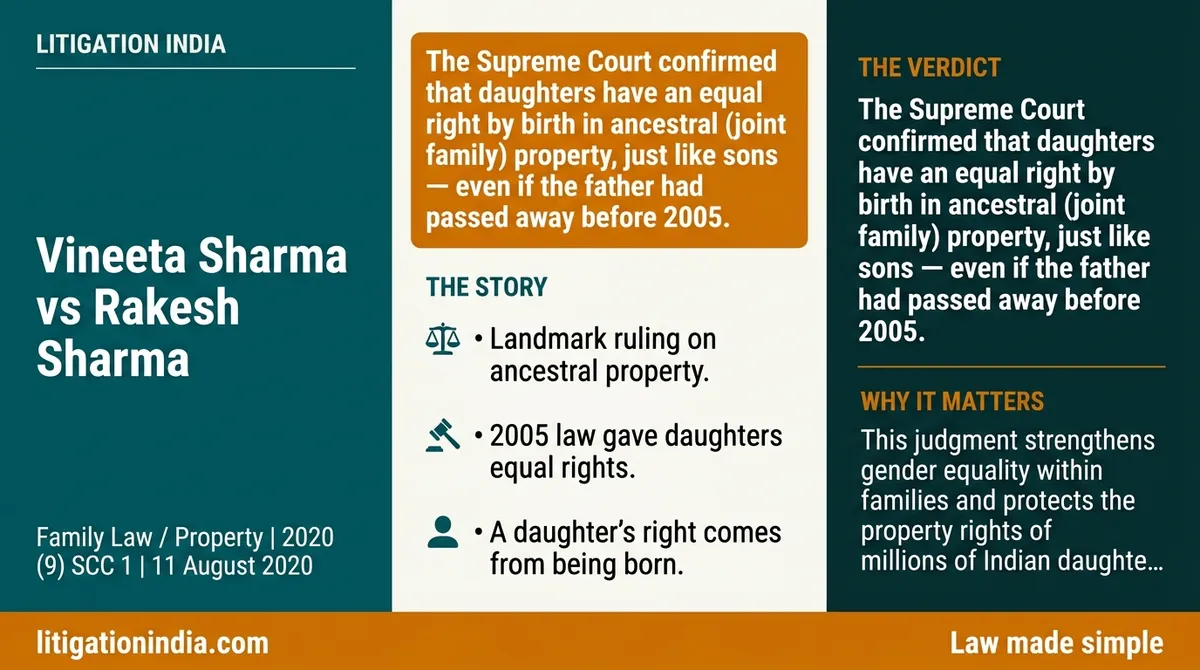
“The Supreme Court confirmed that daughters have an equal right by birth in ancestral (joint family) property, just like sons — even if the father had passed away before 2005.”
Story Slides
In short
For a long time, daughters were treated unequally in Hindu joint family property. A 2005 change in the law gave daughters equal rights as coparceners (joint owners by birth). But confusion remained: did this apply only if the father was alive on the date of the 2005 amendment? Different benches of the Supreme Court had given conflicting answers, leaving thousands of families unsure. In this case, a three-judge bench settled the issue for good. The Court held that a daughter's right is by BIRTH, not dependent on whether her father was alive in 2005. So a daughter is a coparcener (joint owner) in the same way a son is, with the same rights and the same responsibilities. It does not matter when the father died. The Court explained that the right flows from being born into the family, and the 2005 amendment only recognised and confirmed this equality. The judgment removed years of uncertainty and ensured that daughters cannot be denied their fair share in ancestral property simply because of old, unequal customs.
Background
After the 2005 amendment to the Hindu Succession Act gave daughters equal property rights, courts disagreed on whether the father needed to be alive in 2005 for a daughter to claim the right. This three-judge bench was set up to finally resolve the conflict.
The Decision
The Court ruled that a daughter is a coparcener by birth with equal rights, regardless of whether the father was alive on the date of the 2005 amendment. The earlier conflicting decision (Prakash vs Phulavati) was overruled.
Why it matters for you
This judgment strengthens gender equality within families and protects the property rights of millions of Indian daughters. If you are a daughter, you cannot be denied your equal share in ancestral property based on outdated rules.
Relevant Legal Provisions
Key Acts and sections cited or relied upon in this judgment
“This provision states that in a joint Hindu family, the daughter of a coparcener shall by birth become a coparcener in her own right in the same manner as the son. The Supreme Court used this to clarify that a daughter's right is created by birth, meaning it does not depend on whether her father was alive when the amendment was passed in 2005.”
“This section protects any registered partition of property or partition done by a court decree that took place before December 20, 2004, from being reopened. The Court ruled that while daughters have retroactive rights, valid partitions completed before this cut-off date cannot be disturbed to maintain legal certainty. However, the partition must have been done properly through a registered deed or a formal court order.”
“These articles guarantee equality before the law and prohibit the state from discriminating against any citizen on grounds of sex. The Supreme Court relied on these fundamental rights to strike down discriminatory interpretations of property laws, emphasizing that gender bias in inheritance violates the constitutional promise of equality.”
AI-assisted summary, reviewed and verified by our editorial team.
Need help with your case?
Facing a property, eviction, or landlord-tenant dispute? Consult our property lawyers for a free initial review.
Related Supreme Court services