All insights
Legal News
Criminal Law

Courts cannot use a dead witness's old statement without a formal absconding order

This case was about using a dead witness's old statement to convict an accused arrested after 18 years. The Supreme Court ruled that such old statements cannot be used unless a formal order was passed

Litigation India Editorial 1 August 2026 1 min read 2026 INSC 775

Story

Key points1 / 6

A Fair Trial Is Non-Negotiable

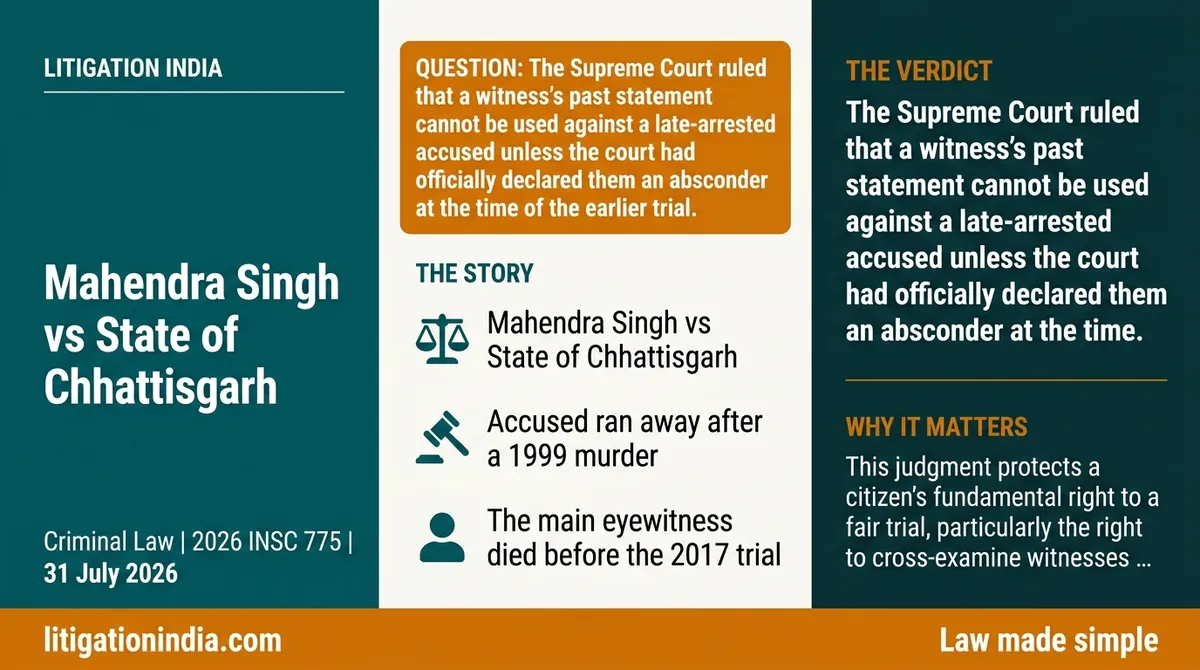
  • Mahendra Singh vs State of Chhattisgarh
  • Supreme Court rules on using old evidence
  • Protects the right to cross-examine witnesses
Courts cannot use a dead witness's old statement without a formal absconding order · 2026 INSC 7752026-08-01T20:23:11.011569+00:00
Key points2 / 6

An 18-Year Delay in Arrest

  • Accused ran away after a 1999 murder
  • Co-accused was tried and acquitted back then
  • Accused was finally caught in 2017
Courts cannot use a dead witness's old statement without a formal absconding order · 2026 INSC 7752026-08-01T20:23:11.011569+00:00
Key points3 / 6

Can Old Statements Be Reused?

  • The main eyewitness died before the 2017 trial
  • Can his 1999 statement be used today?
  • What does Section 299 of CrPC require?
Courts cannot use a dead witness's old statement without a formal absconding order · 2026 INSC 7752026-08-01T20:23:11.011569+00:00
Key points4 / 6

The Conflict of Rules

  • State argued the accused's flight caused the delay
  • State wanted to use the dead witness's words
  • Defense argued there was no proper legal order
Courts cannot use a dead witness's old statement without a formal absconding order · 2026 INSC 7752026-08-01T20:23:11.011569+00:00
Key points5 / 6

What the Court Decided

  • A formal 'absconder' order is strictly mandatory
  • No such order was passed in 1999
  • Deceased witness's statement cannot be used
Courts cannot use a dead witness's old statement without a formal absconding order · 2026 INSC 7752026-08-01T20:23:11.011569+00:00
Key points6 / 6

Why This Judgment Matters

  • No shortcuts are allowed in criminal justice
  • Every accused has the right to cross-examine
  • Without strict process, convictions cannot stand
Courts cannot use a dead witness's old statement without a formal absconding order · 2026 INSC 7752026-08-01T20:23:11.011569+00:00
Courts cannot use a dead witness's old statement without a formal absconding order — infographic summary

What this case means

This case was about using a dead witness's old statement to convict an accused arrested after 18 years. The Supreme Court ruled that such old statements cannot be used unless a formal order was passed years ago declaring the accused as hiding. This protects ordinary people by ensuring they get a fair trial and can cross-examine witnesses.

What the Supreme Court held

The Supreme Court acquitted Mahendra Singh, ruling that the deceased witness's 1999 statement could not be used against him. The Court found that the trial court in 1999 had not passed a formal order declaring Mahendra an absconder, which is a mandatory legal requirement under Section 299 of the CrPC to preserve and use such evidence later.

Case: Mahendra Singh vs State of Chhattisgarh (2026) Citation: 2026 INSC 775

Want the full legal reasoning, citations and case documents?

Read the full judgment analysis
Absconding Accused
Deceased Witness
Right to Cross-Examine
Section 299 CrPC
Fair Trial
Section 299, Code of Criminal Procedure, 1973
Article 21, Constitution of India
Section 33, Indian Evidence Act, 1872
Criminal Law
Supreme Court legal news
Supreme Court judgment today
latest Supreme Court news

More in Criminal Law