Courts cannot use a dead witness's old statement without a formal absconding order
Mahendra Singh vs State of Chhattisgarh
What this case means
This case was about using a dead witness's old statement to convict an accused arrested after 18 years. The Supreme Court ruled that such old statements cannot be used unless a formal order was passed years ago declaring the accused as hiding. This protects ordinary people by ensuring they get a fair trial and can cross-examine witnesses.
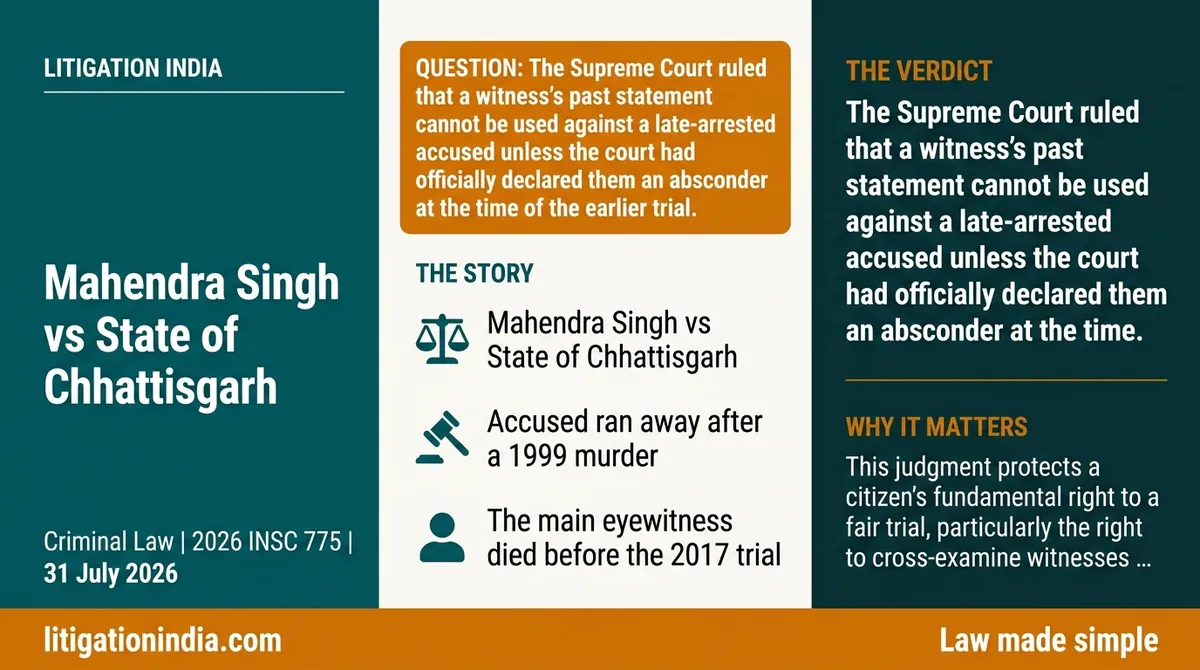
“The Supreme Court ruled that a witness's past statement cannot be used against a late-arrested accused unless the court had officially declared them an absconder at the time of the earlier trial.”
Story Slides
In short
In this case, a man named Mahendra Singh was accused of a murder committed in 1999. He ran away (absconded) while the co-accused was tried and acquitted. He was arrested 18 years later, in 2017. By then, the main eyewitness (PW1) had died, and other witnesses had either turned hostile or could not identify him. The trial court and the High Court convicted him by relying on the statement of the deceased witness (PW1) recorded during the 1999 trial of the co-accused. The Supreme Court set aside this conviction. It explained that under Section 299 of the CrPC, a court can use a deceased witness's past statement against an absconding accused only if a specific order was passed during the earlier trial. This order must conclusively prove two facts: first, that the accused is hiding (absconding), and second, that there is no immediate hope of arresting him. Since no such order was passed in 1999, the past statement of the deceased witness could not be legally used. Depriving an accused of the right to cross-examine a witness is a major step that requires strict legal procedures. Since there was no other reliable evidence, the Supreme Court allowed the appeal and acquitted Mahendra Singh.
Background
In 1999, Mahendra Singh allegedly strangled a man to death and then ran away to avoid arrest, while his co-accused was tried and acquitted. Mahendra was finally arrested 18 years later, in 2017, and put on trial. However, by this time, the main eyewitness had died, and other witnesses refused to support the prosecution's case.
The Decision
The Supreme Court acquitted Mahendra Singh, ruling that the deceased witness's 1999 statement could not be used against him. The Court found that the trial court in 1999 had not passed a formal order declaring Mahendra an absconder, which is a mandatory legal requirement under Section 299 of the CrPC to preserve and use such evidence later.
Why it matters for you
This judgment protects a citizen's fundamental right to a fair trial, particularly the right to cross-examine witnesses who speak against them. It highlights that the police and courts must strictly follow legal procedures; they cannot use shortcuts or bypass safeguards to convict someone, even in serious cases like murder.
Relevant Legal Provisions
Key Acts and sections cited or relied upon in this judgment
“This section allows a court to record and preserve a witness's statement if the accused person has run away and cannot be found immediately. However, this old statement can only be used in a later trial if the court had passed a specific, written order during the earlier stage confirming that the accused was actively hiding. In this case, since no such formal order was passed in 1999, the Supreme Court ruled that the dead witness's statement could not be used against Mahendra.”
“This Article guarantees every citizen the fundamental right to life and personal liberty, which the courts have interpreted to include the right to a fair trial. A fair trial requires that an accused person must have a genuine opportunity to cross-examine or question the witnesses who are giving evidence against them. The Supreme Court relied on this principle to rule that using a dead witness's statement without strict procedural safeguards violates the accused's right to a fair trial.”
“This section states that evidence given by a witness in a previous judicial proceeding can only be used in a subsequent proceeding if the witness is dead, cannot be found, or is incapable of giving evidence. Crucially, it requires that the adverse party in the first proceeding must have had the right and opportunity to cross-examine the witness. Since Mahendra was absconding during the 1999 trial, he never got the chance to cross-examine the witness, making the statement inadmissible under this section without meeting the strict exceptions under criminal procedure.”
AI-assisted summary, reviewed and verified by our editorial team.
Need help with your case?
Facing a similar legal challenge in the Supreme Court or High Court? Connect with our pro bono volunteer advocates today.
Request Free Callback