
All insights

Can a court deny stay of conviction to co-convicts on identical evidentiary footing?

Court extends stay of conviction to co-convicts denied parity by High Court

Three family members were convicted together for a birth certificate fraud conspiracy. The High Court suspended all their sentences but stayed only Mohammad Azam Khan's conviction, denying the same re

Litigation India Editorial 17 November 2026 1 min read 2026 INSC 1231

Story

Case at a glance1 / 6

Supreme Court of India

Parity in Stay of Conviction for Co-Convicts of Same Conspiracy

State of U.P. vs. Mohammad Azam Khan & Ors. | 2026 INSC 1231

Court: Supreme Court of India; decided 17 November 2026Bench: Justice Dipankar Datta and Justice Sheel NaguArea of law: Criminal Law — stay of conviction, revisional jurisdiction, Article 14 parityThree family members convicted under IPC Sections 120-B, 420, 467, 468, 471 for birth certificate fraud
Court extends stay of conviction to co-convicts denied parity by High Court · 2026 INSC 12312026-11-17T12:17:39.174378+00:00
The legal question2 / 6

Can a court treat co-convicts of the same conspiracy differently on stay of conviction?

The core legal issue before the Supreme Court

  • Appellant (State): High Court exceeded its jurisdiction by staying Mohammad Azam Khan's conviction, as only suspension of sentence was prayed for.
  • Appellant (State): High Court did not separately record reasons for granting stay of conviction distinct from reasons for suspension of sentence.
  • Appellant (Mohammad Abdullah Azam Khan & Dr. Tazeen Fatma): Denial of stay of conviction was arbitrary; all three stood on identical evidentiary and legal footing under the same conspiracy charge.
  • Respondent (State, in connected appeals): Cases of Mohammad Azam Khan and his son/wife were distinguishable, justifying differential treatment.
Court extends stay of conviction to co-convicts denied parity by High Court · 2026 INSC 12312026-11-17T12:17:39.174378+00:00
Statutory comparison3 / 6

Suspension of Sentence vs. Stay of Conviction under Section 389(1) CrPC

Key distinction drawn by the Court

Legal SubjectSuspension of SentenceStay of Conviction
What it doesDefers execution of the penal sanction during pendency of appeal or revisionKeeps in abeyance the legal disability attached to a judicial finding of guilt
StandardAvailable on suspension of sentence application under Section 389(1)Exceptional remedy requiring distinct, compelling judicial justification
Effect of reversalSentence resumes if appeal/revision failsIf conviction is ultimately set aside, years of social stigma cannot be monetarily restituted
Constitutional dimensionPrimarily liberty under Article 21Personal dignity, public reputation, and moral standing under Article 21
Stay of conviction is exceptional; suspension of sentence is the norm under Section 389(1) CrPC.
Court extends stay of conviction to co-convicts denied parity by High Court · 2026 INSC 12312026-11-17T12:17:39.174378+00:00
The Court's reasoning4 / 6

How the Court Reached Its Decision

Step-by-step reasoning

  1. 1Step 1: Rejected procedural objection — all three had separately prayed for stay of conviction before the High Court.
  2. 2Step 2: Upheld stay of conviction for Mohammad Azam Khan — High Court's reasons (age, custody period, absence of direct forgery evidence) justified the relief; no manifest perversity under Article 136.
  3. 3Step 3: Applied Article 14 parity — all three co-convicted under identical Section 120-B IPC conspiracy; High Court gave no intelligible differentia for denial to son and wife.
  4. 4Step 4: Applied Article 21 dignity — conviction causes irreversible social stigma; if later acquitted, harm cannot be restituted.
  5. 5Step 5: Extended stay of conviction to Mohammad Abdullah Azam Khan and Dr. Tazeen Fatma; dismissed State's appeals.
Court extends stay of conviction to co-convicts denied parity by High Court · 2026 INSC 12312026-11-17T12:17:39.174378+00:00
The verdict5 / 6

The Supreme Court's Final Order

What was decided and why

  • The Fact: High Court suspended sentences of all three but stayed conviction only of Mohammad Azam Khan, giving no reasoned basis for the distinction.
  • The Law: Parity under Article 14 demands equal treatment of co-convicts on identical footing; Article 21 protects dignity from irreversible harm of conviction during revision.
  • The Result: State's appeals dismissed; appeals of Mohammad Abdullah Azam Khan and Dr. Tazeen Fatma allowed; conviction of all three stayed during revision petitions.
Conviction of all three shall remain stayed during pendency of their criminal revision petitions before the High Court.
Court extends stay of conviction to co-convicts denied parity by High Court · 2026 INSC 12312026-11-17T12:17:39.174378+00:00
Why it matters6 / 6

What This Judgment Means for Ordinary People

Practical significance

  • If you are convicted alongside family members or associates under the same charge, courts cannot give one of you a stay of conviction while silently denying it to others without giving a reason.
  • A criminal conviction harms your dignity and reputation immediately — courts must weigh this irreversible harm when deciding whether to stay a conviction during an appeal or revision.
  • Courts will not grant a stay of conviction merely because someone has political influence or upcoming elections — the law applies equally regardless of a person's public position.
  • Co-accused who served similar time in custody, face the same charges, and play similar roles are entitled to expect the same interim relief from courts.
Courts must treat co-convicts equally: same charges, same evidence, same interim relief — or give clear reasons for any difference.
Court extends stay of conviction to co-convicts denied parity by High Court · 2026 INSC 12312026-11-17T12:17:39.174378+00:00
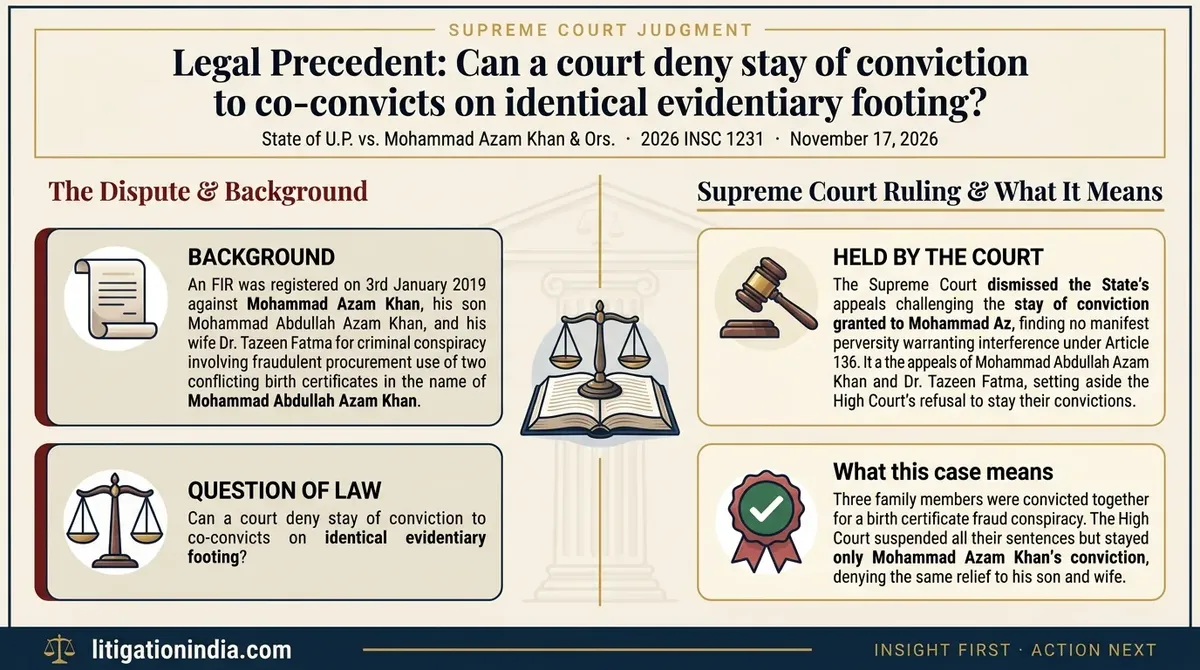
Court extends stay of conviction to co-convicts denied parity by High Court — infographic summary

What this case means

Three family members were convicted together for a birth certificate fraud conspiracy. The High Court suspended all their sentences but stayed only Mohammad Azam Khan's conviction, denying the same relief to his son and wife. The Supreme Court held this was arbitrary discrimination violating Article 14 and extended the stay of conviction to all three.

What the Supreme Court held

The Supreme Court dismissed the State's appeals challenging the stay of conviction granted to Mohammad Azam Khan, finding no manifest perversity warranting interference under Article 136. It allowed the appeals of Mohammad Abdullah Azam Khan and Dr. Tazeen Fatma, setting aside the High Court's refusal to stay their convictions. The conviction of all three shall remain stayed during the pendency of their criminal revision petitions before the High Court.

Case: State of U.P. vs. Mohammad Azam Khan & Ors. (2026) Citation: 2026 INSC 1231

Want the full legal reasoning, citations and case documents?

Read the full judgment analysis
Mohammad Azam Khan
stay of conviction
suspension of sentence
Section 389 CrPC
parity doctrine
Article 14
Article 21
criminal conspiracy
birth certificate fraud
Allahabad High Court revision
Section 389(1), Sections 397 and 401, Code of Criminal Procedure, 1973
Article 14, Constitution of India
Article 21, Constitution of India
Article 136, Constitution of India