
Full text of the judgment
Text extracted from State of U.P. vs. Mohammad Azam Khan & Ors.. For the authoritative version refer to the Supreme Court of India's official website.
2026 INSC 1231 Page 1 of 12 NON-REPORTABLE
IN THE SUPREME COURT OF INDIA CRIMINAL APPELLATE JURISDICTION
CRIMINAL APPEAL NOS. OF 2026 [ARISING OUT OF SLP (CRL.) NOS. 11030-11032 OF 2025]
STATE OF U.P.
… APPELLANT
MOHAMMAD AZAM KHAN & ORS.
… RESPONDENTS
CRIMINAL APPEAL NO. OF 2026 [ARISING OUT OF SLP (CRL.) NO. 15970 OF 2025]
MOHAMMAD ABDULLAH AZAM KHAN
… APPELLANT
STATE OF U.P.
… RESPONDENT
CRIMINAL APPEAL NO. OF 2026 [ARISING OUT OF SLP (CRL.) NO. 15969 OF 2025]
DR. TAZEEN FATMA
… APPELLANT
STATE OF U.P.
… RESPONDENT
J U D G M E N T DIPANKAR DATTA, J. 1. Leave granted. Digitally signed by rashmi dhyani pant Date: 2026.11.17 16:41:46 IST Reason: Signature Not Verified
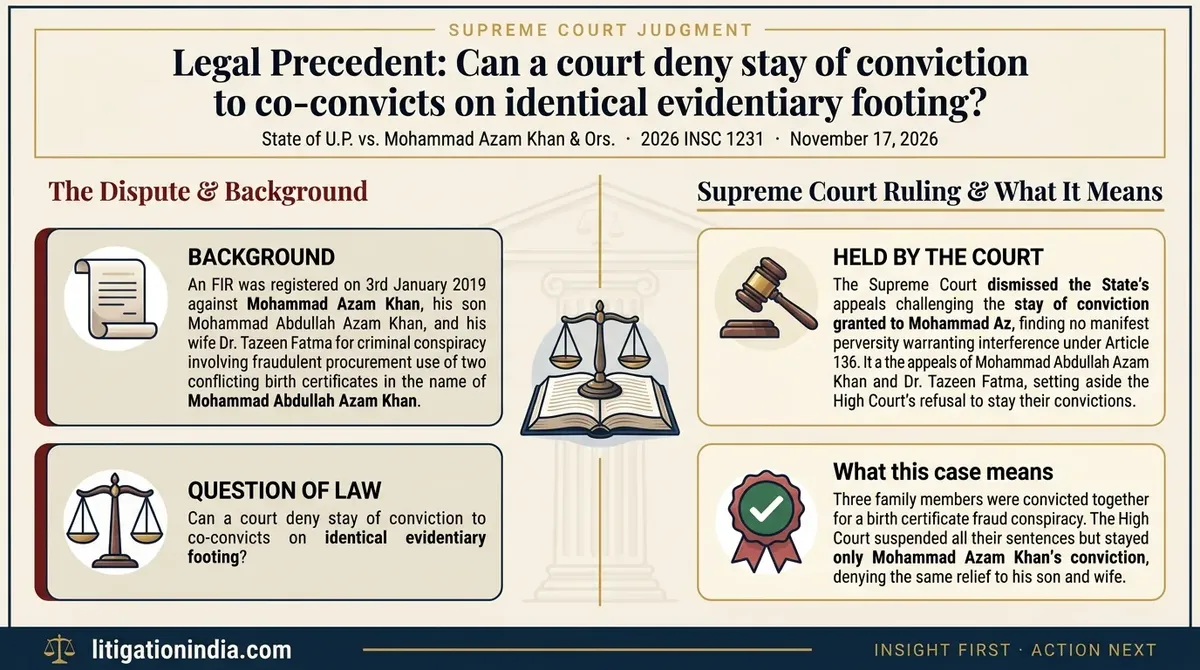
Page 2 of 12 2. The State of Uttar Pradesh and a couple of convicts, through a cluster of interconnected appeals, have invoked the extraordinary powers of this Court under Article 136 of the Constitution. All the appeals are directed against the common judgment and order dated 24th May, 20241 of the High Court of Judicature at Allahabad2. The State of Uttar Pradesh is aggrieved because the High Court, in exercise of revisional jurisdiction, stayed/suspended the conviction of Mohammad Azam Khan under Section 389(1) read with Sections 397/401 of the Code of Criminal Procedure, 19733, while at the same time suspending the sentences imposed on the co-convicts Mohammad Abdullah Azam Khan and Dr. Tazeen Fatma4 (son and wife of Mohammad Azam Khan, respectively). Having been denied similar relief, Mohammad Abdullah Azam Khan and Dr. Tazeen Fatma have separately challenged the selfsame impugned judgment to the extent that the High Court, while suspending their substantive sentences of imprisonment and enlarging them on bail, declined to extend a corresponding stay of conviction. 3. The genesis of the underlying criminal proceedings traces back to a written information lodged by the complainant on 17th December, 2018, culminating in the registration of a First Information Report5 on 03rd January, 2019 at Police Station Ganj, District Rampur, Uttar Pradesh. The gravamen of the prosecution case against the three co-
1 impugned judgment 2 High Court 3 Cr. PC 4 referred to as Dr. Tanzeen Fatima in the proceedings before the High Court and in the impugned judgment; hereafter referred to as Dr. Tazeen Fatma in this judgment. 5 Case Crime No. 04 of 2019 under Sections 120-B, 420, 467, 468, and 471 of the Indian Penal Code, 1860 (hereafter IPC).
Page 3 of 12 accused—Mohammad Azam Khan, Mohammad Abdullah Azam Khan, and Dr. Tazeen Fatma—revolves around an alleged criminal conspiracy involving the fraudulent procurement and deliberate use of two distinct, conflicting birth certificates issued in the name of Mohammad Abdullah Azam Khan. 4. Mr. K. M. Nataraj, learned Additional Solicitor General, representing the State, has addressed us at considerable length pertinently to the extent that the impugned judgment grants stay of conviction of Mohammad Azam Khan. Per contra, Mr. Kapil Sibal, learned senior counsel appearing for all three family members/convicts, has also advanced detailed arguments. 5. We have been taken through the impugned judgment, which has adequately and lucidly set out the facts; hence, it is unnecessary to reiterate them herein. 6. Having carefully evaluated the rival submissions, the materials on record, the statutory mechanics of Section 389(1), Cr. PC, and the constitutional imperatives of Article 21, we now proceed with determination of the questions arising out of these consolidated appeals. 7. What called for our attention is the apparent legal dichotomy in the impugned judgment. While the substantive sentences of imprisonment were suspended and all three co-accused enlarged on bail, the High Court also granted a stay/suspension of Mohammad Azam Khan’s conviction. The applications for a grant of stay of conviction preferred
Page 4 of 12 by Mohammad Abdullah Azam Khan and Dr. Tazeen Fatma were turned down, even though their roles in the crime were not dissimilar to those of Mohammad Azam Khan. 8. The starkly selective grant of interim relief is of paramount concern that confronts this Court: whether the High Court was justified in applying a different and seemingly contradictory standard while exercising discretionary powers under Section 389(1), read with Sections 397/401, Cr. PC, for Mohammad Abdullah Azam Khan and Dr. Tazeen Fatma, who are jointly charged and convicted under an identical matrix of criminal conspiracy. 9. In analysing the statutory mechanics of Section 389(1), Cr. PC, an appellate or revisional court must keep in view the qualitative distinction between suspension of sentence and stay/suspension of conviction. While suspension of sentence merely defers the execution of the penal sanction during the pendency of a legal challenge either in an appeal or a revision, a stay of conviction keeps in abeyance the legal disability attached to a judicial finding of guilt. By settled jurisprudence, stay of conviction is an exceptional remedy requiring distinct, compelling judicial justification. Nonetheless, when evaluating a prayer for a stay of conviction, the court is duty-bound to maintain logical consistency among co-convicts who stand on identical evidentiary footing. 10. We had referred to Mr. Sibal to the Record of Proceedings dated 24th July, 2025, whereby a coordinate Bench issued notice on the State’s
Page 5 of 12 special leave petition. The submission of Mr. Nataraj that there was a crucial procedural irregularity in the proceedings before the High Court had been accepted by the said Bench, namely, that in the prayer clause of his revision petition before the High Court, Mohammad Azam Khan had only explicitly prayed for suspension of sentence, yet the High Court granted him a stay of conviction ex mero motu. We have given our earnest consideration to the forceful argument of Mr. Nataraj that a revisional court cannot grant relief beyond the explicit prayer clause of a revision petition without recording extraordinary reasons. 11. Mr. Sibal drew our attention to paragraph 5 of the impugned judgment. It is recorded therein by the High Court that all three convicts/revisionists had separately prayed for stay of conviction by filing individual applications, which were connected with the applications filed under Section 389(1) read with Sections 397/401 Cr. PC with prayer for interim relief of suspension of sentence. 12. It is, therefore, not a case where the High Court travelled beyond the prayer clauses and granted an interim relief which was never prayed. There is, thus, no merit in Mr. Nataraj’s first objection, which stands overruled. 13. Moving ahead, we need to consider Mr. Nataraj’s second objection regarding the grant of stay of conviction. According to him, the High Court did assign reasons for the grant of suspension of sentence in the case of Mohammad Azam Khan but did not separately record reasons for the grant of stay of conviction.
Page 6 of 12 14. This objection too, in our view, is equally unmeritorious. 15. The role of Mohammad Azam Khan and the evidence on record regarding his complicity in the crime appear to have been discussed by the High Court under several sub-paragraphs of paragraph 21 as well as paragraphs 22 to 25 of the impugned judgment. The High Court, taking into consideration the substantial period of custody already undergone by Mohammad Azam Khan, the advanced stage of his life, and the absence of direct evidence proving that he personally executed the forged signatures on the municipal registers, exercised its discretion to suspend his sentence. Although the High Court did not record extensive reasons for staying the conviction of Mohammad Azam Khan, the reasons which weighed with the High Court for granting a stay of suspension of sentence imposed on him, in our view, do constitute valid grounds for granting a stay of conviction. 16. The ultimate exercise of discretion in staying Mohammad Azam Khan’s conviction does not suffer from any manifest perversity, and we find no compelling ground to interfere under Article 136 of the Constitution. 17. The criminal appeal of the State, thus, has to fail. 18. Turning to the criminal appeals of Mohammad Abdullah Azam Khan and Dr. Tazeen Fatma, we find that the High Court failed to articulate any coherent legal reason why similar relief, as granted to Mohammad Azam Khan, was denied, even though all three were convicted under the self-same charge of conspiracy. It is considered appropriate to
Page 7 of 12 reproduce hereinbelow the relevant findings returned by the High Court: 28. Apart from merit of the case, I also find that:-
i) That alleged offence against the revisionists are not a heinous offence.
ii) Revisionists were on bail during trial and they did not misuse the liberty.
iii) Revisionist – Dr. Tanzeen Fatima is aged about 72 years and revisionist Mohammad Azam Khan is aged about 74 years and are suffering from several old aged diseases.
iv) There is no possibility of absconding of the revisionists.
v) Till date, out of maximum sentence of seven years, they have already served following sentence with remission:
a) Dr. Tanzeen Fatima has served more than 01 year and 04 months,
b) Mohammad Azam Khan has served more than 02 years and 05 months,
c) Mohammad Abdullah Azam Khan has served more than 01 year and 04 months.
29. In view of the above, considering the facts and circumstances of the case in totality, nature of allegations, role attributed to the revisionists, material evidence on the record, submissions advances on behalf of the parties concerned and reasons as noted above, this Court is of the view that the application under Section 389(1) Cr.P.C. of the revisionists for suspension of their sentence dated 18.10.2023 (affirmed by the order dated 23.12.2023 of the appellate court) during pendency of above mentioned Criminal Revisions is liable to be allowed.
30. As a fallout and consequence of the above discussion, the impugned order dated 18.10.2023 of sentence of sentence, as noted above is hereby suspended during pendency of these Criminal Revisions.
31. Accordingly, the revisionists namely, Dr. Tanzeen Fatima, Mohammad Azam Khan and Mohammad Abdullah Azam Khan who have been convicted and sentenced by the impugned judgment and order dated 18.10.2023, be released on bail on their furnishing a personal bond and two reliable sureties each in the like amount to
Page 8 of 12 the satisfaction of Court concerned during pendency of these Criminal Revisions.
32. On acceptance of their bail bonds, the trial court shall transmit the photo copies thereof to this Court for being kept on record of these Criminal Revisions.
33. Considering the nature of allegations, role attributed to the revisionists and evidence on record against the revisionists, I find that the case of revisionist Mohammad Azam Khan is distinguishable from the case of Dr. Tanzeen Fatima and Mohammad Abdullah Azam Khan. Accordingly, the judgment and order of conviction qua Mohammad Azam Khan shall remain stayed/suspended during pendency of his criminal revision, but prayer for stay of judgment and order of conviction qua Dr. Tanzeen Fatima and Mohammad Abdullah Azam Khan is rejected.
34. Three separate applications all bearing Application No.1 dated 23.02.2024 U/s 389(1) r/w 397/401 Cr.P.C., which have been moved for stay the impugned judgment and order dated 18.10.2023 of conviction as affirmed by appellate Court vide its judgment and order dated 23.12.2023 stands disposed of accordingly.
19. Where several convicts standing on the same footing seek stay/suspension of conviction, it is legitimate for them to expect similar treatment by the court. Their treatment should not be affected by any legal dichotomy. Parity being a facet of Article 14 of the Constitution, equals ought to be treated equally unless, of course, an intelligible differentia having a rational nexus with the object of the order distinguishes one from the others. Though differential treatment is not forbidden, an unreasoned differential treatment cannot be sustained. If the court grants a stay/suspension of conviction to one convict while similar relief to other similarly situated convicts is denied, the distinguishing feature on the record must be identified and expressly stated as the reason for the departure from parity. An order silent on that point is, by itself, arbitrary. It is axiomatic that same footing ought to yield same treatment, unless a stated reason justifies the departure.
Page 9 of 12 Without that reason, the dichotomy is not judicial discretion, but arbitrariness. 20. Furthermore, it is equally important to highlight that a criminal conviction inflicts an immediate, profound impact on an individual’s constitutional right to live with personal dignity under Article 21. A conviction imposes severe, irreversible social stigma, moral opprobrium, and irremediable prejudice to an individual’s personal standing and public reputation. If a revisional court ultimately sets aside the conviction on merits, the years spent under the crushing shadow of societal disgrace and moral condemnation cannot be restituted in monetary terms or retroactively repaired. 21. This jurisprudential paradigm shift finds authoritative grounding in the view expressed by this Court in Afjal Ansari v. State of U.P.6, wherein the majority, speaking through Hon’ble Surya Kant, J. (as the Chief Justice then was), elucidated the statutory framework of Section 389(1) Cr. PC. in the following words: 19. This Court has on several occasions opined that there is no reason to interpret Section 389(1) CrPC in a narrow manner, in the context of a stay on an order of conviction, when there are irreversible consequences. Undoubtedly, Ravikant S. Patil v. Sarvabhouma S. Bagali [Ravikant S. Patil v. Sarvabhouma S. Bagali, (2007) 1 SCC 673, para 15 : (2007) 1 SCC (Cri) 417] , holds that an order granting a stay of conviction should not be the rule but an exception and should be resorted to in rare cases depending upon the facts of a case. However, where conviction, if allowed to operate would lead to irreparable damage and where the convict cannot be compensated in any monetary terms or otherwise, if he is acquitted later on, that by itself carves out an exceptional situation. Having applied the specific criteria outlined hereinabove to the present factual matrix, it is our considered view that the appellant’s case warrants an order of stay on his award of conviction, though partially. ***
6 (2024) 2 SCC 187
Page 10 of 12 21. We say so primarily for the reason that the potential ramifications of declining to suspend such a conviction are multifaceted. On the one hand, it would deprive the appellant’s constituency of its legitimate representation in the legislature, since a bye-election may not be held given the remainder tenure of the current Lok Sabha. Conversely, it would also impede the appellant’s ability to represent his constituency based on the allegations, the veracity whereof is to be scrutinised on a reappraisal of the entire evidence in the first criminal appeal pending before the High Court. This would potentially lead to de facto incarceration of the appellant for a period of four years under the U.P. Gangsters Act and an additional six-year disqualification period, even if he is eventually acquitted, which would effectively disqualify him from contesting elections for a period of ten years. *** 25. Having said so, we hasten to hold that societal interest is an equally important factor which ought to be zealously protected and preserved by the courts. The literal construction of a provision such as Section 389(1)CrPC may be beneficial to a convict but not at the cost of legitimate public aspirations. It would thus be appropriate for the courts to balance the interests of protecting the integrity of the electoral process on one hand, while also ensuring that constituents are not bereft of their right to be represented, merely consequent to a threshold opinion, which is open to further judicial scrutiny. (emphasis ours)
22. Personal standing, public reputation, and human dignity are integral components of the right to life guaranteed under Article 21; their destruction during the pendency of a bona fide statutory revision could constitute irreparable prejudice. Consequently, judicial discretion of the nature permitted under Section 389(1), Cr. PC must be cautiously exercised by striking a balance between the grave and irreversible consequences of conviction for the convict and the sanctity that must attach to a conviction till it is set aside in appeal/revision. 23. However, in delineating the jurisprudential standard for staying a conviction under Section 389(1) Cr. PC, it is deemed vital to recalibrate the governing principles. We unequivocally disavow and reject any plea that seeks a stay of conviction anchored purely on political expediency, electoral ambitions, or the exigencies of upcoming election campaigns.
Page 11 of 12 Courts of law cannot permit statutory powers to be leveraged to suit political calendars or electoral ambitions. 24. Addressing the appeal filed by the State challenging the stay of conviction granted to Mohammad Azam Khan, we have noted why appellate interference under Article 136 is not called for. 25. As a direct logical corollary, the High Court’s refusal to grant identical interim relief to Mohammad Abdullah Azam Khan and Dr. Tazeen Fatma constitutes a violation of the doctrine of parity and is a patent error of jurisdiction. The entire prosecution matrix rests upon a single, unified charge of criminal conspiracy under Section 120B, IPC, tied to the same documentary evidence, namely, the two conflicting birth certificates issued at Rampur and Lucknow. 26. No distinct overt act of manual forgery is individually attributed to Mohammad Abdullah Azam Khan or Dr. Tazeen Fatma beyond their joint status as co-conspirators and alleged beneficiaries. Where the evidentiary foundation, the statutory offences, and the conspiracy matrix bind all three of the family to an identical legal fate, according favourable treatment to the patriarch while denying a stay of conviction to his son and wife (who also happens to be a septuagenarian) constitutes an arbitrary differentiation. Both face the same irremediable prejudice, severe moral opprobrium, and irreversible loss of constitutional dignity during the pendency of their revision petitions.
Page 12 of 12 27. Therefore, for the foregoing reasons, we allow the criminal appeals of Mohammad Abdullah Azam Khan and Dr. Tazeen Fatma. The impugned judgment, to the extent the same denies relief of stay/suspension of conviction, is set aside. The judgment and order of conviction dated 18th October, 2023, of the Trial Court, as affirmed by the appellate judgment and order dated 23rd December, 2023, shall also remain stayed in respect of Mohammad Abdullah Azam Khan and Dr. Tazeen Fatma during the pendency of their criminal revision petitions before the High Court. The criminal appeals filed by the State are thus dismissed. 28. The High Court will proceed to hear and decide the criminal revision petitions on their individual merits in accordance with law, completely uninfluenced by any observations made herein, as expeditiously as possible. We record that the parties have agreed to cooperate with the roster bench for facilitating early disposal thereof. 29. Pending application(s), if any, shall also stand disposed of accordingly.
…………………………….J. (DIPANKAR DATTA)
…………………………….J. (SHEEL NAGU) NEW DELHI; NOVEMBER 17, 2026.