
All insights

Can the High Court under Section 11 extend an arbitral mandate under Section 29A?

Court clarifies which court can extend arbitral mandate under Section 29A

A dispute arose over whether a sole arbitrator could continue instead of a three-member tribunal as per the agreement, and whether the High Court could extend the arbitral mandate under Section 29A. T

Litigation India Editorial 28 October 2026 1 min read 2026 INSC 1165

Story

Case at a glance1 / 6

Supreme Court of India

Who Can Extend an Arbitral Mandate Under Section 29A?

South Bihar Power Distribution Co. Ltd. vs India Power Corporation Ltd. — 2026 INSC 1165

Court: Supreme Court of India; Date: October 28, 2026Bench: Justice Ujjal Bhuyan and Justice Atul S. ChandurkarArea of law: Arbitration law — composition of tribunal, extension of mandate, IBC moratoriumDispute arose from a power distribution franchisee agreement requiring a three-member arbitral tribunal
Court clarifies which court can extend arbitral mandate under Section 29A · 2026 INSC 11652026-10-28T18:55:52.882545+00:00
The legal question2 / 6

Three Core Legal Questions the Court Answered

Appellant challenged the sole arbitrator, the IBC party's standing, and the High Court's Section 29A jurisdiction

  • Appellant: Consent to sole arbitrator was invalid; agreement required three arbitrators; no waiver occurred.
  • Appellant: Corporate debtor undergoing CIRP has no locus standi to continue arbitration.
  • Appellant: High Court under Section 11 has no jurisdiction to extend mandate under Section 29A.
  • Respondent: Consent and participation constituted waiver; proceedings should continue to avoid prejudice.
  • Respondent: IBC moratorium bars suits against the debtor, not proceedings by the debtor to recover dues.
Court clarifies which court can extend arbitral mandate under Section 29A · 2026 INSC 11652026-10-28T18:55:52.882545+00:00
Statutory comparison3 / 6

Which Court Has Power Under Section 29A?

High Court under Section 11 vs Court under Section 2(1)(e)

Legal SubjectHigh Court under Section 11Court under Section 2(1)(e)
RoleAppoints arbitrators when parties fail to do soDecides all applications under Part I of the 1996 Act
Jurisdiction after appointmentExhausted once arbitral tribunal is constitutedContinues throughout arbitral proceedings
Power under Section 29A(4)NO — not the 'court' as definedYES — principal civil court or High Court with original civil jurisdiction
Section 42 applicabilityDoes not apply to Section 11 applicationsApplies; first court to receive application retains jurisdiction
Section 11 jurisdiction is exhausted on constitution of the tribunal; no residual supervisory power remains with the High Court.
Court clarifies which court can extend arbitral mandate under Section 29A · 2026 INSC 11652026-10-28T18:55:52.882545+00:00
The Court's reasoning4 / 6

How the Court Reached Its Decision on Waiver

Step-by-step reasoning on the three-member tribunal objection

  1. 1Step 1: Agreement Clause 17.2.5 required three arbitrators for dispute resolution.
  2. 2Step 2: Appellant's counsel expressly consented twice before the High Court to appointment of a sole arbitrator.
  3. 3Step 3: Arbitrator's Procedural Order No. 1 recorded no objection by any party to the sole arbitrator.
  4. 4Step 4: Appellant filed counter-claims and supplementary counter-claims before the sole arbitrator — clear acquiescence.
  5. 5Step 5: Under Section 4 read with Section 16(2), belated objection is deemed waived; appointing orders unappealed and final.
Court clarifies which court can extend arbitral mandate under Section 29A · 2026 INSC 11652026-10-28T18:55:52.882545+00:00
The verdict5 / 6

The Supreme Court's Final Decision

Civil appeals dismissed; arbitrator directed to pass award within six weeks

  • The Fact: Appellant consented twice to a sole arbitrator, participated fully, and raised objection only at extension stage.
  • The Law: Section 4 and Section 16(2) deem such belated objection waived; Section 29A power vests only in court under Section 2(1)(e), not the High Court under Section 11.
  • The Result: High Court's findings on waiver and IBC upheld; High Court's assumption of Section 29A jurisdiction set aside but with no practical effect.
Embargo on passing the award lifted; arbitrator to conclude proceedings within six weeks from October 28, 2026.
Court clarifies which court can extend arbitral mandate under Section 29A · 2026 INSC 11652026-10-28T18:55:52.882545+00:00
Why it matters6 / 6

What This Means for Businesses and Parties in Arbitration

Practical lessons from this judgment

  • Consent to arbitral proceedings is binding: participate without objection and you lose the right to challenge tribunal composition later.
  • Only the principal civil court in the district (or a High Court with original civil jurisdiction) can extend an arbitral mandate — not the High Court that appointed the arbitrator.
  • A company undergoing corporate insolvency resolution can still pursue arbitration to recover money owed to it, provided the resolution professional authorises it.
  • Parties should raise any objection to tribunal composition at the earliest opportunity — at the latest, with the statement of defence.
Once you consent to and participate in arbitration, you cannot undo it later — waiver under Section 4 is strict and final.
Court clarifies which court can extend arbitral mandate under Section 29A · 2026 INSC 11652026-10-28T18:55:52.882545+00:00
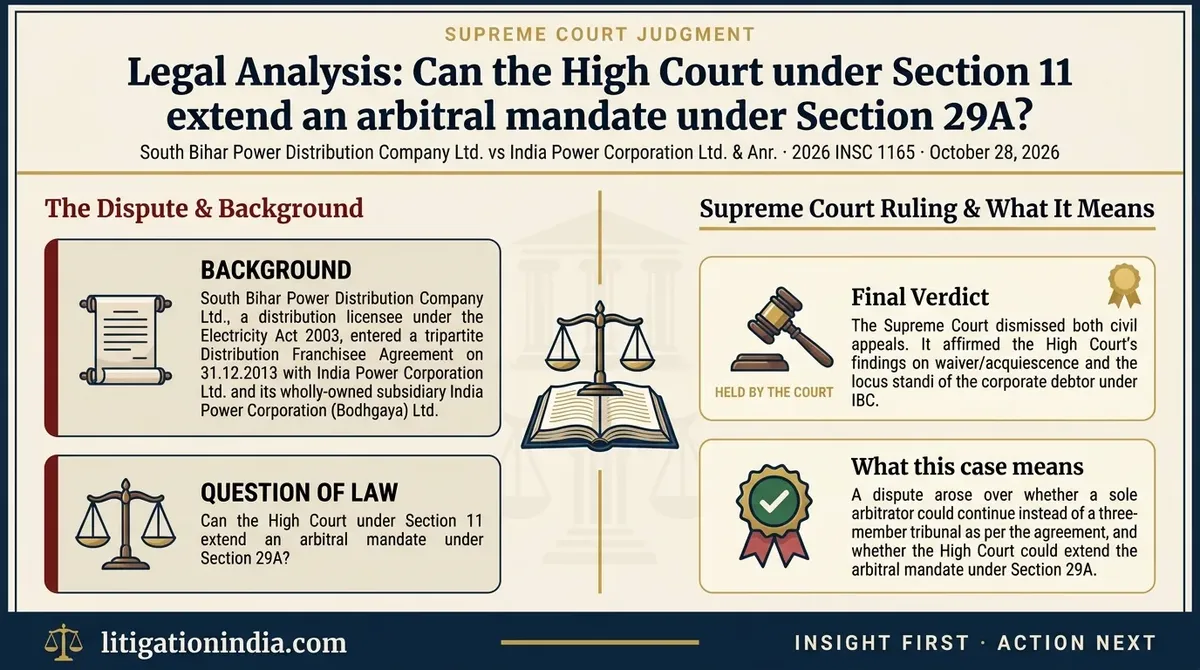
Court clarifies which court can extend arbitral mandate under Section 29A — infographic summary

What this case means

A dispute arose over whether a sole arbitrator could continue instead of a three-member tribunal as per the agreement, and whether the High Court could extend the arbitral mandate under Section 29A. The Supreme Court held that the appellant had waived its right to object by consenting and acquiescing, and clarified that only the court defined in Section 2(1)(e) — the principal civil court or a High Court with original civil jurisdiction — can extend time under Section 29A, not the High Court acting under Section 11.

What the Supreme Court held

The Supreme Court dismissed both civil appeals. It affirmed the High Court's findings on waiver/acquiescence and the locus standi of the corporate debtor under IBC. It set aside the High Court's finding that it had jurisdiction under Section 29A — clarifying that only the court under Section 2(1)(e) holds that power — but noted this had no practical effect since the District Court had already extended the mandate. The embargo on passing the award was lifted and the arbitrator was directed to conclude proceedings within six weeks.

Case: South Bihar Power Distribution Company Ltd. vs India Power Corporation Ltd. & Anr. (2026) Citation: 2026 INSC 1165

Want the full legal reasoning, citations and case documents?

Read the full judgment analysis
South Bihar Power Distribution Company
India Power Corporation
Section 29A Arbitration
extension of arbitral mandate
sole arbitrator vs three-member tribunal
waiver acquiescence arbitration
Section 4 Arbitration Act
Section 2(1)(e) court definition
IBC moratorium arbitration
Arbitration and Conciliation Act 1996
Section 29A (sub-sections 1, 3, 4, 5, 6, 7, 8, 9), Arbitration and Conciliation Act, 1996
Section 2(1)(e), Arbitration and Conciliation Act, 1996
Section 4, Arbitration and Conciliation Act, 1996
Section 16(2), Arbitration and Conciliation Act, 1996