
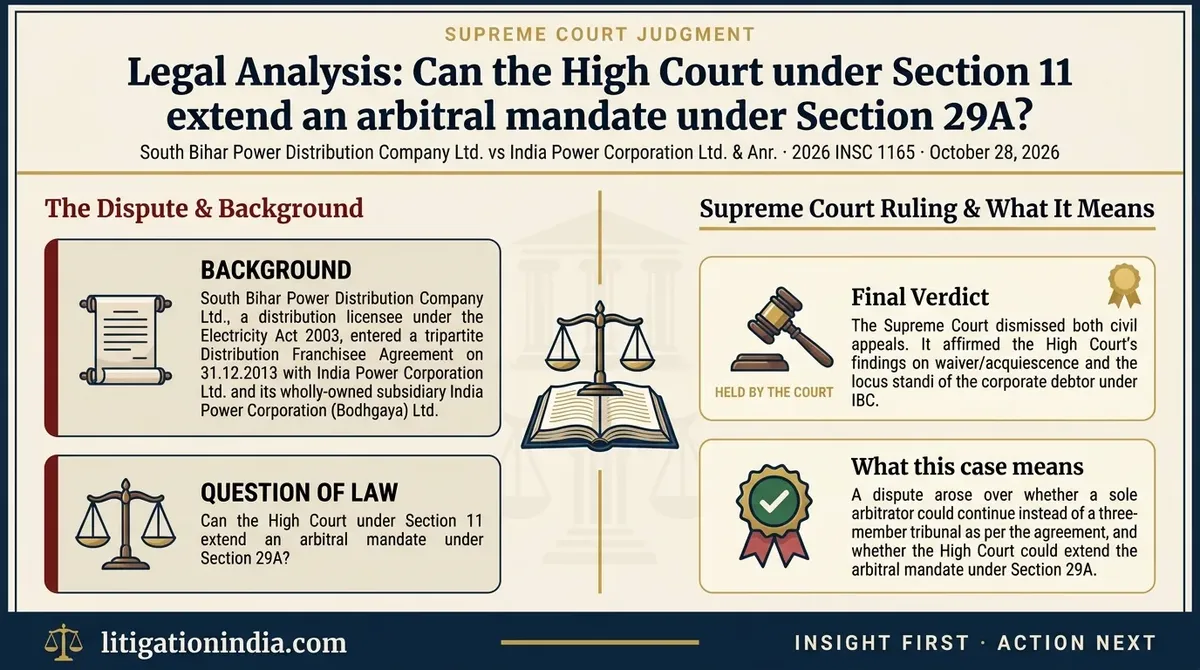
Full text of the judgment
Text extracted from South Bihar Power Distribution Company Ltd. vs India Power Corporation Ltd. & Anr.. For the authoritative version refer to the Supreme Court of India's official website.
2026 INSC 1165 REPORTABLE IN THE SUPREME COURT OF INDIA CIVIL APPELLATE JURISDICTION
CIVIL APPEAL NO. 9313 OF 2026 (Arising out of Special Leave Petition (Civil) No. 27403 of 2023)
SOUTH BIHAR POWER DISTRIBUTION COMPANY LTD. APPELLANT(S)
INDIA POWER CORPORATION RESPONDENT(S) LTD. & ANR.
CIVIL APPEAL NO. 9325 OF 2026 (Arising out of Special Leave Petition (Civil) No. 24988 of 2026)
J U D G M E N T
UJJAL BHUYAN, J.
Facts of both the appeals being inter-related and parties being the same, those were heard together and are being disposed of by this common judgment and order. 2.
The two appeals take exception to the judgment and order dated 15.09.2023 passed by the High Court of Judicature Digitally signed by IRAMNAZ Date: 2026.10.28 16:08:34 IST Reason: Signature Not Verified
at Patna (briefly ‘the High Court’ hereinafter) in Request Case No. 78 of 2022 and Request Case No. 36 of 2021. 3.
By the aforesaid judgment and order dated 15.09. 2023 (‘impugned judgment and order’ hereinafter), High Court held that the jurisdiction to extend the period of time has to be exercised by the High Court under Section 29A of the Arbitration and Conciliation Act, 1996 (briefly ‘the 1996 Act’ hereinafter). Accordingly, the High Court directed that there shall be an extension of the mandate of the arbitral tribunal by four months starting from the date of appearance of the parties before the arbitral tribunal as per the extension granted by the High Court. Consequently Request Case No. 36 of 2021 was allowed and Request Case No. 78 of 2022 was rejected. 4.
Relevant facts may be briefly noted. 5.
Appellant i.e. South Bihar Power Distribution Company Ltd. is a company incorporated under the Companies Act, 1956. Electricity Act, 2003 provides for a distribution licensee and contemplates appointment of a distribution franchisee by a distribution licensee. Appellant is a distribution
licensee under the provisions of the Electricity Act, 2003. It has the license to supply electricity in four electric supply areas i.e. (i) Patna Electric Supply Unit, (ii) Central Electric Supply Area, (iii) Magadh Electric Supply Area, and (iv) Bhagalpur Electric Supply Area within the State of Bihar. For facilitating such supply of electricity, appellant is also entitled to act through a franchisee. 5.1. A competitive bidding process was initiated by the appellant for selecting a franchisee pursuant to which India Power Corporation Ltd., a company also incorporated under the Companies Act, 1956, came out as the successful bidder. As per the terms of the letter of intent, the successful bidder through a special purpose vehicle was required to enter into a distribution franchisee agreement with the appellant. India Power Corporation (Bodhgaya) Ltd. was accordingly incorporated as a 100% subsidiary of India Power Corporation Ltd. to act as a special purpose vehicle whereafter a tripartite agreement was entered into between the three companies i.e. the successful bidder, the special purpose vehicle and the
distribution licensee, called the Distribution Franchisee Agreement, dated 31.12.2013. 5.2. India Power Corporation (Bodhgaya) Ltd. i.e. the special purpose vehicle was to undertake and perform the obligations under the distribution franchisee agreement entered into by the parties with the first respondent i.e. India Power Corporation Ltd. to act as the confirming party. 5.3. In the implementation of the franchisee agreement, disputes arose which led the first respondent i.e. India Power Corporation Ltd. to issue arbitration notice to the appellant dated 09.11.2016 in accordance with Article 17 of the distribution franchisee agreement. Since no arbitrator was appointed, the special purpose vehicle i.e. the second respondent approached the High Court under Section 11 of the 1996 Act vide Request Case No. 77 of 2018. The said request case was disposed of with the consent of the parties vide the order dated 04.04.2018 whereby the High Court appointed a retired Judge of the said High Court Mr. Justice Shashank Kumar Singh as the sole arbitrator.
5.4. The arbitration proceedings commenced on 12.04.2018 and proceeded upto the stage of recording of evidence whereafter the learned arbitrator could not continue further. In the meanwhile, the sole arbitrator had rejected the application filed by the appellant under Section 13 read with Section 16(1) of the 1996 Act vide the order dated 12.05.2018 as not pressed. Appellant thereafter filed counter claim on 02.02.2019 and supplementary counter claim on 28.03.2019 before the sole arbitrator. 5.5. In the meanwhile, the National Company Law Tribunal, Kolkata (NCLT) admitted an application under Section 9 of the Insolvency and Bankruptcy Code, 2016 (briefly referred to as ‘IBC’ hereinafter) for initiating corporate insolvency resolution process against respondent No. 2. Vide the order dated 08.11.2019, NCLT admitted the said application and also appointed an interim resolution professional (IRP). Though the interim resolution professional made a public announcement on 28.05.2020 regarding initiation of corporate insolvency resolution process, appellant did not file its claim before the interim resolution professional as per provisions of the IBC.
5.6. Respondents approached the High Court again vide Request Case No. 14 of 2020 for appointment of another arbitrator. Once again, with the consent of the parties, the High Court vide the order dated 10.03.2021 appointed a former Chief Justice of India, who was also a former Chief Justice of the High Court, Mr. Justice Dipak Misra, as the new arbitrator. 5.7. Arbitral proceedings commenced under the new arbitrator and proceeded from the stage where the earlier arbitrator had left. A procedural order was passed by the new arbitrator on 07.04.2021 whereby it was recorded that the parties had no objection to the composition of the arbitral tribunal or the sole arbitrator arbitrating the dispute between the parties. However, within a period of one year, the arbitration proceedings could not be completed. Therefore, after expiry of one year, time was extended by another six months in accordance with the 1996 Act, again on the consent of the parties. But the arbitration proceedings could not be completed even within the extended period. As the extended period was expiring on 07.08.2021, respondents filed Request Case No. 36
of 2021 before the High Court seeking extension of four months for completion of the arbitration proceedings. 5.8. Appellant resisted the request on the ground that the High Court had no jurisdiction to extend the time and also challenged the arbitration proceedings initiated by the sole arbitrator when the distribution franchisee agreement specifically mentions of an arbitral tribunal comprising of three arbitrators. Appellant also questioned the consent given before the High Court for waving the condition of the agreement which required an arbitral tribunal comprising of three arbitrators. In this regard, appellant filed Request Case No. 78 of 2022 for appointment of an arbitral tribunal as contemplated under the distribution franchisee agreement. 5.9. In the meanwhile, following the corporate insolvency resolution process of respondent No. 2, the consortium of creditors in its meeting held on 13.02.2021 approved the resolution plan of Rankini Power Generation Private Limited. This was approved by the NCLT vide its judgment dated 18.07.2022.
5.10. Consequently, the name of the second respondent was changed to Vikriti Power Limited on and from 28.08.2023. 5.11. By the impugned judgment and order dated 15.09.2023, the High Court held that there was proper consent by the appellant to the appointment of a sole arbitrator which constituted waiver of the special condition of the agreement for appointment of an arbitral tribunal of three members; further conduct of the appellant amounted to acquiescence to the arbitral proceedings conducted by the sole arbitrator. The High Court rejected the objection of the appellant that respondent No. 2 i.e. the special purpose vehicle undergoing corporate insolvency resolution process had no locus standi to initiate the arbitration proceedings. The High Court also held that it has the jurisdiction to extend the time of the learned arbitrator under Section 29A of the 1996 Act and exercising such jurisdiction, the High Court extended the mandate of the learned arbitrator by four months. Consequently, Request Case No. 36 of 2021 was allowed while Request Case No. 78 of 2022 was rejected.
This Court vide the order dated 12.02.2024 permitted continuance of the arbitral proceedings before the learned arbitrator but directed that the award should not be declared by the learned arbitrator. 7.
It appears that during the pendency of SLP(C) No. 27403 of 2023 out of which Civil Appeal No. 9313 of 2026 arises, an application under Section 29(5) of the 1996 Act was filed by the respondents before the Court of the Principal District Judge-cum-Commercial Court, Patna seeking extension of mandate of the arbitral tribunal by 6(six) months, which was registered as Arbitration Case No. 54 of 2024. 8.
On 21.01.2026, an order was passed by this Court directing the District Court to consider the said application on its own merit and in accordance with law within a period of two months from 24.01.2026 which was stated to be the hearing date of Arbitration Case No. 54 of 2024. This Court clarified that decision on the extension application would be irrespective of the fact that the special leave petition is pending before this Court.
Thereafter, the Principal District Judge-cum- Commercial Court, Patna passed judgment and order dated 23.03.2026 allowing the application filed under Section 29A(5) of the 1996 Act by extending the mandate of the sole arbitrator for a further period of 6(six) months to be reckoned from the date of the judgment to enable completion of the arbitral proceedings. 10. Mr. Sundaram, learned senior counsel for the appellant has referred to clauses 17.2.5 and 17.2.6 of the distribution franchise agreement and submits that it is clear therefrom that under the provisions of the aforesaid agreement, any dispute can only be gone into by an arbitral tribunal comprising three arbitrators. Therefore, the High Court was not justified in rejecting the contention of the appellant for appointment of a three-member arbitral tribunal. 10.1. The High Court also committed an error in not taking into consideration the fact that the first respondent is only a proforma party. Contesting parties are the appellant and the second respondent. Therefore, its consent is really not material. Now, the corporate debtor i.e. respondent No. 2 has ceased to
exist. Therefore, there cannot be any arbitration with regard to the claim of any non-existent party. 10.2. The High Court ought to have considered that no claim was ever raised by the first respondent against the appellant. First respondent is only a proforma party. Therefore, notwithstanding the alleged consent, the dispute could not have been referred to an arbitral tribunal having a solitary member during the subsistence of the distribution franchisee agreement. By the impugned judgment and order, the High Court has caused serious prejudice to the appellant in as much as the fora for adjudication of the dispute as provided under the distribution franchise agreement has been taken away; instead of a three-member arbitral tribunal, the High Court has foisted a solitary arbitrator on the appellant. 10.3. In any view of the matter, the impugned judgment and order of the High Court cannot be sustained and the same should be set aside and quashed. Parties should be relegated to a new arbitral tribunal comprising of three arbitrators, he submits.
11. Mr. Raju Ramachandran, learned senior counsel appearing for the appellant in the connected appeal has supported the submissions of Mr. Sundaram and seeks relegation of the parties to a new arbitral tribunal comprising of three arbitrators after setting aside the impugned judgment and order of the High Court. 12. Per contra, Mr. Atmaram Nadkarni, learned senior counsel appearing for respondent No. 2 has supported the impugned judgment of the High Court and submits that no case for interference is made out. Sufficient progress has been made by the learned arbitrator within the extended period. If the same is aborted now, serious prejudice will be caused to the respondents. He, therefore, seeks dismissal of the civil appeals. 13. Submissions made by learned counsel for the parties have received the due consideration of the Court. 14. At the outset, let us consider the relevant provisions of the distribution franchisee agreement dated 31.12.2013. From a perusal of the recital of the agreement it is seen that the agreement is primarily between the appellant and the second
respondent with the first respondent entering into the agreement in its capacity as the confirming party. Clause 17 of the agreement deals with the governing law and dispute resolution. Clause 17.2 provides for amicable settlement. As per clauses 17.2.1 to 17.2.4, either party is entitled to raise any dispute or difference of any nature arising out of or in connection with the distribution franchisee agreement including the existence of its validity by giving a written notice to the other party. The parties are mandated to constitute a permanent dispute resolution body having equal representation from each of the parties. The disputes or differences shall be referred to this body for resolution which shall communicate its decision within 30 days. In case of non-settlement of such disputes or differences by the permanent dispute resolution body, such disputes or differences shall be referred for decision to a high-powered body constituted by the Chairman/Managing Director of the distribution licensee and the head of the distribution franchisee which shall communicate its decision preferably within a period of 15 days.
14.1. Clause 17.2.5 of the agreement is relevant and is extracted hereunder: 17.2.5. Any dispute arising out of, in connection with or with respect to this agreement, the subject matter hereof, the performance or non performance of any obligation hereunder, which cannot be resolved by negotiation between the parties and the dispute resolution procedure as stated in the foregoing articles, shall be exclusively submitted to arbitration at the request of either party upon written notice to that effect to the other party and the proceedings shall be conducted subject to the provisions of the Arbitration and Conciliation Act, 1996 (the Arbitration Act) by a panel consisting of three arbitrators.
14.2. From a perusal of the above, it is seen that if the disputes or differences are still not resolved in the manner provided for in clauses 17.2.1 to 17.2.4, the same shall be exclusively submitted to arbitration at the request of either party upon written notice to that effect to the other party. The arbitration proceedings shall be conducted as per provisions of the 1996 Act by a panel consisting of three arbitrators. 15. We have noticed from the narration of facts that initially Justice Shashank Kumar Singh was appointed as the
sole arbitrator, who commenced the arbitration proceedings on 12.04.2018. However, the learned arbitrator could not continue beyond the stage of recording of evidence. Leaving aside for a moment the intervening developments before the NCLT under the IBC pertaining to the corporate insolvency resolution process of respondent No.2, we find that with the consent of the parties, the High Court appointed Mr. Justice Dipak Mishra, a former Chief Justice of India, as the new arbitrator. The arbitral proceedings under the new arbitrator commenced from the stage where the earlier arbitrator had left the proceedings. Within the statutory period of one year, the arbitration proceedings could not be concluded. On consent of the parties, the time period for arbitration was extended by six months. However, the arbitration proceedings could not be completed even within the extended period. Before expiry of the extended period, respondents filed Request Case No. 36 of 2021 before the High Court seeking extension of four months for completion of the arbitral proceedings. Appellant not only resisted the request but also instituted Request Case No. 78 of 2022 for appointment of an arbitral tribunal as contemplated under the
distribution franchisee agreement. Vide the impugned judgment and order dated 15.09.2023, the High Court held that it has the jurisdiction to extend the time of the arbitrator under Section 29A of the 1996 Act. Exercising such jurisdiction, the High Court extended the mandate of the learned arbitrator by four months. 16. In these circumstances, as noticed above, Section 29A of the 1996 Act assumes significance. Section 29A, as it stands now, is extracted hereunder: 29-A. Time limit for arbitral award.— (1) The award in matters other than international commercial arbitration shall be made by the arbitral tribunal within a period of twelve months from the date of completion of pleadings under sub-section (4) of Section 23. Provided that the award in the matter of international commercial arbitration may be made as expeditiously as possible and endeavour may be made to dispose of the matter within a period of twelve months from the date of completion of pleadings under sub-section (4) of Section 23. (2) If the award is made within a period of six months from the date the arbitral tribunal enters upon the reference,
the arbitral tribunal shall be entitled to receive such amount of additional fees as the parties may agree. (3) The parties may, by consent, extend the period specified in sub-section (1) for making award for a further period not exceeding six months. (4) If the award is not made within the period specified in sub-section (1) or the extended period specified under subsection (3), the mandate of the arbitrator(s) shall terminate unless the court has, either prior to or after the expiry of the period so specified, extended the period: Provided that while extending the period under this sub-section, if the court finds that the proceedings have been delayed for the reasons attributable to the arbitral tribunal, then, it may order reduction of fees of arbitrator(s) by not exceeding five per cent for each month of such delay: Provided further that where an application under sub-section (5) is pending, the mandate of the arbitrator shall continue till the disposal of the said application: Provided also that the arbitrator shall be given an opportunity of being heard before the fees is reduced. (5) The extension of period referred to in sub-section (4) may be on the application of any of the parties and may be granted only for sufficient cause and on such terms and conditions as may be imposed by the court.
(6) While extending the period referred to in sub-section (4), it shall be open to the court to substitute one or all of the arbitrators and if one or all of the arbitrators are substituted, the arbitral proceedings shall continue from the stage already reached and on the basis of the evidence and material already on record, and the arbitrator(s) appointed under this section shall be deemed to have received the said evidence and material. (7) In the event of arbitrator(s) being appointed under this section, the arbitral tribunal thus reconstituted shall be deemed to be in continuation of the previously appointed arbitral tribunal. (8) It shall be open to the court to impose actual or exemplary costs upon any of the parties under this section. (9) An application filed under sub-section (5) shall be disposed of by the court as expeditiously as possible and endeavour shall be made to dispose of the matter within a period of sixty days from the date of service of notice on the opposite party. 17. Before we analyse the provisions of Section 29A, it would be apposite to see as to how this Court has examined the aforesaid provisions. There are two recent judgments of this Court dealing with Section 29A though in somewhat different contexts.
18. Rohan Builders (India) (P) Ltd. Vs. Berger Paints (India) Ltd.1 is a two-Judge Bench decision of this Court where the question for consideration was whether an application for extension of time under Section 29A of the 1996 Act can be filed after the expiry of the period for making of the arbitral award? It was in that context that this Court analyzed the contours of Section 29A. Adverting to Section 29A(1) and Section 29A(3), this Court observed that two time limits for making of an arbitral award are provided for under the aforesaid provisions. As per the first provision i.e. Section 29A(1), the award is required to be made by the arbitral tribunal within a period of 12 months. The second provision i.e. Section 29A(3), stipulates that the parties by consent can extend the time for making the award beyond 12 months, upto an additional period of 06 months. Under Section 29A(4), where the award is not made within the specified period of 12 months or 18 months, as the case may be, the mandate of the arbitral tribunal will terminate. However, this provision does not apply if the court has extended the period either before or after the expiry of the initial period or the
1 (2025) 10 SCC 802
extended term. This Court held that Section 29A(4) empowers the court to extend the period for making of the arbitral award beyond the period of 12 months or 18 months, as the case may be. To be more specific, this Court has held that an application for extension of time for passing an arbitral award under Section 29A(4) read with Section 29A(5) is maintainable even after the expiry of the 12 months or the extended 6 months period, as the case may be. 19. Section 29A was again examined by a two-Judge Bench of this Court in C. Velusamy Vs. K. Indhera2. This Court referred to the amendment which inserted Section 29A in the 1996 Act with effect from 23.10.2015 to effectively deal with delays in arbitral proceedings. In this connection, the Bench examined the statement of objects and reasons necessitating such amendment. The objective was to make arbitration more user friendly, cost effective and expeditious. Accordingly, time limit of 12 months was fixed with liberty to the parties to extend the said period by a further period of six months; any further extension beyond such period being permissible only by order
2 (2026) 5 SCC 340
of the court on sufficient cause being shown. This Court also noted that upon further amendment of Section 29A with effect from 30.08.2019, it has been made explicitly clear that where an application seeking extension of time under sub-section (5) of Section 29A is pending, the mandate of the arbitrator shall continue until such application is finally decided. This Court held thus: 18. It is in the above-referred background that the Arbitration Act was amended with retrospective effect from 23-10-2015 to effectively deal with delays in arbitral proceedings by inserting Section 29-A. The Statement of Objects and Reasons records that practical difficulties had arisen, necessitating amendments to make arbitration more user-friendly, cost-effective, and expeditious. Accordingly, provision was made requiring the Arbitral Tribunal to render the award within twelve months from the date it enters upon the reference, with liberty to the parties to extend the period by a further six months, any extension thereafter being permissible only by order of the Court on sufficient cause being shown. Thereafter, the 1996 Act was further amended w.e.f. 30- 8-2019 to provide, inter alia, that, where an application seeking extension of time under sub-section (5) of Section 29-A is pending, the mandate of the arbitrator shall continue until such application is finally decided.
19.1. After threadbare analysis of each of the sub-sections of Section 29A, this Court recorded its conclusions qua assessment of Section 29A in the following manner: 21. Section 29-A, as explained in recent decisions of this Court in Rohan Builders, Lancor Holdings [Lancor Holdings Ltd. Vs. Prem Kumar Menon, (2026) 4 SCC 392] and Jagdeep Chowgule Vs. Sheela Chowgule [Jagdeep Chowgule Vs. Sheela Chowgule, (2026) 5 SCC 667 : 2026 SCC OnLine SC 124 : 2026 INSC 92] can be formulated as under: 21.1. Sub-section (1) of Section 29-A mandates that the award shall be made within 12 months of the completion of pleadings before the Arbitral Tribunal. While subsection (2) incentivises expeditious making of the award, proviso to sub-section (4) and sub-section (8) authorises the Court to impose penalty for delay in making the award. 21.2. Sub-section (3) enables parties, by consent, to extend the period of 12 months for making the award by a further period not exceeding 6 months. 21.3. If the award is not made within the stipulated period of 12 months or the extended period of 6 months, the mandate of the arbitrator(s) shall terminate. 21.4. This termination is subject to the power of the Court to extend the period. *
21.6. There is no statutory prescribed time-limit for the Court to exercise the power under Section 29-A(4) for extending the period, except for its own discretion. The Court can exercise the power before or after the expiry of the period under sub-sections 29-A(1) or (3). Further, there is no prescription of an outer limit for extending the time for the conclusion of arbitral proceedings. Given this power, the Court will exercise it with circumspection, balancing the remedy with the rights of other stakeholders. 21.7. The power of the Court to extend the time under sub-section (4) may be exercised on an application by any of the parties. Once such an application for extension of time is pending, the mandate of the arbitrator shall continue till the disposal of such application under subsection (9). The Court shall endeavour to dispose of such an application within 60 days. 21.8. Delay in the delivery of an arbitral award, by itself, is not sufficient to set aside that award. It is only when the effect of the undue delay in the delivery of an arbitral award is explicit and adversely reflects on the findings therein, such delay and, more so, if it remains unexplained, can be construed to result in the award being in conflict with the public policy of India. 21.9. Under Section 29-A(6), while exercising the power of extension, it shall be open to the Court to substitute one or all the arbitrators. This is a discretionary power that the Court would exercise in the facts and circumstances of the case. Upon substitution, the
reconstituted Tribunal shall be deemed to be in continuation of the previously appointed Tribunal as per Section 29-A(7) and shall continue from the stage already reached and on the basis of evidence already on record. The newly appointed arbitrators shall be deemed to have received the evidence and materials.
20. Before proceeding further, it would be apposite to examine the impugned judgment and order of the High Court. In the factual backdrop narrated supra, the High Court posed three questions for its consideration. We will proceed our analysis question wise. 21. The first question framed by the High Court was whether there was a proper consent by the appellant so as to constitute waiver of the specific condition of the agreement for appointment of an arbitral tribunal of three members? If the answer to this question was in the negative, the High Court posed the further question as to whether it could not be presumed that there was acquiescence on the part of the appellant who had participated in the arbitration proceedings for about 18 months and thereafter has raised the objection as to the coram of the arbitral tribunal?
21.1. The High Court referred to clause 17.2.5 which provides for arbitration by an arbitral tribunal consisting of three arbitrators and also referred to its earlier proceedings in Request Case No. 77 of 2018 in which appellant had appeared through counsel and his consent was specifically recorded for appointing a retired Judge of the High Court as the sole arbitrator. High Court also referred to the subsequent Request Case No. 14 of 2020 which was also disposed of in the presence of the counsel for the appellant whereby and whereunder a new arbitrator was appointed to continue with the arbitration proceedings from the stage of recording of evidence. In the proceedings of Request Case No. 14 of 2020, it was specifically recorded that appreciable efforts were put in by the learned counsel appearing for both the parties whereafter the matter was amicably resolved and it was agreed that the dispute would be adjudicated through the new arbitrator. High Court noted that the arbitrator so appointed had completed 18 months including the extended period of six months consented to by both the parties. Now the respondents have requested for continuance of the arbitral proceedings under the arbitrator so
appointed for a further period of four months to which objection regarding consent and constitution of arbitral tribunal was raised by the appellant. 21.2. In the aforesaid context, the High Court referred to the procedural order No. 1 passed by the learned arbitrator which clearly stated that counsel and representatives of all the parties stated that they had no objection on any ground whatsoever to the composition of the arbitral tribunal or to the learned arbitrator acting as the sole arbitrator to arbitrate the dispute between the parties. 21.3. The High Court also noted that appellant had argued before the learned arbitrator that there was neither a consent given by the appellant nor any acquiescence could be inferred before the sole arbitrator; there was no question of waiver of the specific terms of the agreement which required a three-member arbitral tribunal to be appointed. In so far consent is concerned, the learned arbitrator held that not once but twice the appellant had appeared through counsel and had consented to the appointment and continuance of the sole arbitrator which would be evident from the orders of the High Court and of the
arbitrator. The High Court further noted that the arbitrator had referred to Section 4 of the 1996 Act to find that the specific condition in the agreement requiring appointment of a threemember arbitral tribunal was waived by the appellant. That apart, the objection as to constitution of the arbitral tribunal was not raised within the time prescribed in Section 16(2) of the 1996 Act which again constitutes a deemed waiver but High Court noted that the arbitrator had rejected the application of the appellant filed under Section 13 read with Section 16(1) of the 1996 Act in this regard. In the aforesaid backdrop, the High Court held that the appellant could not assail the consent given by it earlier, the consent is evident and acquiescence is clearly discernible. The High Court held thus: 14. On the facts, as noticed by the Arbitral Tribunal, I am convinced that there is no sustainable ground raised by the respondent to assail the consent given before the High Court, which is further buttressed by the acquiescence before the Tribunal, as recorded by the Tribunal. The consent is evident and acquiescence is clearly indicated which operates as a waiver under Section 4 of the Act of 1996.
22. There is one more aspect which we need to point out. The first order of the High Court dated 04.04.2018 appointing Justice Shashank Kumar Singh as the sole arbitrator as well as the second order of the High Court dated 10.03.2021 appointing Justice Dipak Misra as the new arbitrator were not assailed by the appellant. Consequently, those orders have attained finality and are binding on the parties. 23. On the question of waiver and acquiescence, we may refer to Section 4 of the 1996 Act which reads as under: 4. Waiver of right to object.—A party who knows that— (a) any provision of this Part from which the parties may derogate, or (b) any requirement under the arbitration agreement, has not been complied with and yet proceeds with the arbitration without stating his objection to such noncompliance without undue delay or, if a time limit is provided for stating that objection, within that period of time, shall be deemed to have waived his right to so object.
23.1. As per this provision, a party who knows that any requirement under the arbitration agreement has not been complied with and yet proceeds with the arbitration without stating his objection to such compliance without undue delay
or if a time limit is provided for stating that objection, within that period of time, he shall be deemed to have waived his right to so object. 24. We may also refer to Section 16 of the 1996 Act which deals with competence of an arbitral tribunal to rule on its jurisdiction. Sub-section (2) provides that a plea that the arbitral tribunal does not have jurisdiction shall be raised not later than the submission of the statement of defence; however, a party shall not be precluded from raising such a plea merely because he has appointed or participated in the appointment of an arbitrator. 25. A careful examination of the aforesaid provisions coupled with the analysis of the High Court would make it abundantly clear that by its conduct, the appellant had clearly waived its right to object to the composition of the arbitral tribunal within the time limit provided by the statute. As the appellant had continued to participate in the arbitral proceedings before the sole arbitrator, including consenting for the extended period of arbitration, it amounts to acquiescence. That apart, appellant had filed counter claim and
supplementary counter claim before the sole arbitrator. Such conduct amounts to clear acquiescence on the part of the appellant to the arbitral proceedings conducted by the sole arbitrator. This being the position, it was not open to the appellant to have questioned the appointment of the sole arbitrator as opposed to a three-member arbitral tribunal provided for in the agreement at the very belated stage of the respondents seeking further extension of the arbitral proceedings under Section 29A(4) of the 1996 Act. 26.
In Union of India Vs. Pam Development Private Limited3, the arbitral proceedings were conducted by a sole arbitrator appointed by the High Court of Calcutta under Section 11(6) of the 1996 Act. Appellant duly participated in the arbitration proceedings. After the award was passed accepting the claims of the respondent, appellant challenged the same first under Section 34 of the 1996 Act and thereafter under Section 37. On being unsuccessful, the matter came up before this Court. On behalf of the appellant it was contended that the High Court had committed an error of jurisdiction by appointing a
3 (2014) 11 SCC 366
sole arbitrator when the contractual conditions provided for a three-member arbitration panel. It was in that context, this Court observed that the order of the High Cout appointing the sole arbitrator was not challenged by the appellant. Therefore, the same had become final and binding. This Court held that since the appellant had participated in the arbitral proceedings, it would be deemed to have waived the requirement under the agreement in view of the provisions contained in Section 4 read with Section 16 of the 1996 Act. This Court adverted to Section 16(2) and observed that the said provision mandates that a plea that the arbitral tribunal does not have jurisdiction shall be raised not later than submission of the statement of defence. This Court also relied upon Section 4 which provides that a party who knows that any requirement under the arbitration agreement has not been complied with and yet proceeds with the arbitration without stating his objection to such non-compliance without undue delay shall be deemed to have waived his right to do so. This Court held thus: 16. As noticed above, the appellant not only filed the statement of defence but also raised a counterclaim against the respondent. Since the appellant has not
raised the objection with regard to the competence/jurisdiction of the Arbitral Tribunal before the learned arbitrator, the same is deemed to have been waived in view of the provisions contained in Section 4 read with Section 16 of the Arbitration Act, 1996. 17. Section 16 of the Arbitration Act, 1996 provides that the Arbitral Tribunal may rule on its own jurisdiction. Section 16 clearly recognises the principle of kompetenz-kompetenz. Section 16(2) mandates that a plea that the Arbitral Tribunal does not have jurisdiction shall be raised not later than the submission of the statement of defence. Section 4 provides that a party who knows that any requirement under the arbitration agreement has not been complied with and yet proceeds with the arbitration without stating his objection to such non-compliance without undue delay shall be deemed to have waived his right to so object. 27. We, therefore, do not find any error or infirmity in the view taken by the High Court in so far the first issue is concerned and, accordingly, affirm the same. 28. The second issue considered by the High Court was whether the special purpose vehicle i.e. respondent No. 2 is competent to request for arbitration, especially when the letter
of intent was issued to the first respondent and the dispute includes claims by the appellant against the first respondent. In that context, the High Court also considered whether provisions of the IBC initiated against the second respondent would disable the second respondent from continuing with the request for extension of time of the sole arbitrator. 28.1. Rejecting the contention that the second respondent has no locus standi to initiate the arbitration proceeding, the High Court analyzed the character of the two respondents. Both are separate legal entities and are parties to the tripartite agreement alongwith the appellant. Both the respondents were parties before the High Court. As to initiation and pendency of proceedings under the IBC against the second respondent, the High Court observed that Section 14 of the IBC prohibits initiation and continuation of any suit or proceeding including execution against the corporate debtor after the insolvency commencement date. The High Court reasoned that this does not necessarily prohibit the corporate debtor from proceeding with the recovery due to it, which in essence, is the arbitration
proceeding initiated by the second respondent. The High Court noted that the respondents had specifically pleaded in their reply to the objection filed by the appellant before the arbitrator that the resolution professional appointed by the NCLT had authorized the signatories to appear before the arbitral tribunal which was also approved by the committee of creditors in compliance with Section 28(1)(h) of the IBC. In such circumstances, the High Court held that there was no infirmity in the proceedings initiated by the second respondent on the ground that there was moratorium under the IBC. 28.2. Insofar initiation of arbitration is concerned, though the letter of intent was issued to the first respondent, the responsibility for implementation of the terms of the agreement squarely falls within the ambit of the second respondent which is a special purpose vehicle formed in terms of the agreement. The second respondent is also a subsidiary of the first respondent and incorporated exclusively for the purpose of implementation of the agreement. 28.3. The High Court proceeded to hold that such a dispute has to be decided by the arbitrator and not by the courts. The
obligation of the first respondent to ensure due implementation as also to satisfy the obligation of and under the award is one of the issues framed by the learned arbitrator. In such circumstances, the argument regarding the second respondent having no locus standi to initiate the arbitration has been rejected by the High Court. 29. We agree with the view taken by the High Court that Section 14 of the IBC does not necessarily prohibit the corporate debtor from initiating proceedings for recovery of its dues, which, as in the present case, would include an arbitral proceeding. The moratorium provided for in Section 14 of the IBC is intended to prohibit debt recovery action against the corporate debtor so as not to adversely impact the insolvency process; however, it would not impair any claim by the corporate debtor, such as, an arbitral claim, which if successful, would only bolster the financial health thereby enhancing the value of the corporate debtor. 30. That apart, the resolution professional has authorized the signatories of the second respondent to pursue the arbitral proceeding which has been approved by the
committee of creditors in compliance with Section 28(1)(h) of the IBC, which is the best authority to assess the financial position of the corporate debtor. 31. We, therefore, concur with the view taken by the High Court qua the second issue and hold that the High Court has rightly decided this issue. 32. The third question framed by the High Court for its consideration was whether the Chief Justice of the High Court or his designate empowered under Section 11 of the 1996 Act to consider a request for arbitration, can grant extension of time as required under Section 29A of the 1996 Act or is it the principal civil court of original jurisdiction in the concerned district or the High Court having original civil jurisdiction alone which will be empowered to exercise the power under Section 29A of the 1996 Act? 32.1. The High Court referred to Section 2 of the 1996 Act and the decisions of different High Courts and came to the conclusion that the jurisdiction to extend the period of time has to be exercised by the High Court under Section 29A of the 1996 Act.
33. Let us examine the relevant provisions of the 1996 Act and a few judgments of this Court to analyse whether the view taken by the High Court is legally correct or not. 34. There are two parts to Section 2(1)(e). We are concerned with the first part i.e. Section 2(1)(e)(i) which defines ‘court’ in the case of an arbitration other than international commercial arbitration to mean the principal civil court of original jurisdiction in a district and includes the High Court in the exercise of its ordinary original civil jurisdiction, having the jurisdiction to decide the questions forming the subject matter of the arbitration if the same had been the subject matter of a suit; but it does not include any civil court of a grade inferior to such principal civil court or any court of small causes. This definition of ‘court’ permeates through Part I of the 1996 Act which deals with domestic arbitration. Reference to the Supreme Court or to the High Court in Sections 11(3A), (4) & (6) do not in any manner impact the definition of ‘court’ in terms of Section 2(1)(e)(i). This is because of the specific role assigned to the Supreme Court or to the High Court in sub-sections (3A), (4) & (6) of Section 11 i.e. where the parties fail to appoint the
arbitrator or the two arbitrators (one each appointed by one party) fail to agree on a third arbitrator, then the aforesaid provisions come into play. In other words, these provisions deal with appointment of an arbitral tribunal; nothing more should be read into it. Therefore, the Supreme Court or the High Court referred to in Section 11 cannot be deemed to be the ‘court’ as defined in Section 2(1)(e). 35. Section 42 of the 1996 is included in Part I thereof. It deals with jurisdiction. Section 42 starts with a non obstante clause. As per Section 42, nothing contained in Part I of the 1996 Act or in any other law for the time being in force, where with respect to an arbitration agreement any application under Part I has been made in a court, that court alone shall have jurisdiction over the arbitral proceedings and all subsequent applications arising out of that agreement and the arbitral proceedings shall be made in that court and in no other court. 36. Question is whether the ‘court’ referred to in Section 42 would be the ‘court’ as defined in Section 2(1)(e) of the 1996 Act?
37. In State of West Bengal Vs. Associated Contractors4, the specific question before a three-Judge Bench of the Supreme Court was, which court will have the jurisdiction to entertain and decide an application under Section 34 of the 1996 Act? In that context, the Bench analysed Section 2(1)(e) and Section 42 of the 1996 Act. It concurred with an earlier decision of this Court that the provisions of the 1996 Act leave no room for any doubt that it is the superior most court exercising original jurisdiction which has been chosen to adjudicate disputes arising out of arbitration agreements. Proceeding further, this Court observed that it is obvious that Section 11 applications are not to be moved before the ‘court’ as defined but before the Chief Justice either of the High Court or of the Supreme Court, as the case may be, or their delegates. This is despite the fact that the Chief Justice or his delegate have now to decide judicially and not administratively. Referring to Section 42, it has been held that it would not apply to applications made before the Chief Justice or his delegate for the simple reason that the Chief Justice or his delegate is not
4 (2015) 1 SCC 32
‘court’ as defined by Section 2(1)(e). Interestingly, this Court held that if an application were to be preferred to a court which is not a principal civil court of original jurisdiction in a district or a High Court exercising original jurisdiction to decide questions forming the subject matter of an arbitration if the same had been the subject matter of a suit, then obviously such application would be outside the four corners of Section 42. If such an application were to be made to a court which is not the principal civil court or to a High Court which has no original jurisdiction or to a court which has no subject matter jurisdiction, it would be outside Section 42; it would not debar subsequent applications from being filed in a court other than such a court. 37.1. After a threadbare analysis, the three-Judge Bench recorded its conclusions on Sections 2(1)(e) and Section 42 as under: 25. Our conclusions therefore on Section 2(1)(e) and Section 42 of the Arbitration Act, 1996 are as follows: (a) Section 2(1)(e) contains an exhaustive definition marking out only the Principal Civil Court of Original Jurisdiction in a district or a High Court having original civil jurisdiction in the State, and no
other court as ‘court’ for the purpose of Part I of the Arbitration Act, 1996. (b) The expression ‘with respect to an arbitration agreement’ makes it clear that Section 42 will apply to all applications made whether before or during arbitral proceedings or after an award is pronounced under Part I of the 1996 Act. (c) However, Section 42 only applies to applications made under Part I if they are made to a court as defined. Since applications made under Section 8 are made to judicial authorities and since applications under Section 11 are made to the Chief Justice or his designate, the judicial authority and the Chief Justice or his designate not being court as defined, such applications would be outside Section 42. (d) Section 9 applications being applications made to a court and Section 34 applications to set aside arbitral awards are applications which are within Section 42. (e) In no circumstances can the Supreme Court be ‘court’ for the purposes of Section 2(1)(e), and whether the Supreme Court does or does not retain seisin after appointing an arbitrator, applications will follow the first application made before either a High Court having original jurisdiction in the State or a Principal Civil Court having original jurisdiction in the district, as the case may be.
(f) Section 42 will apply to applications made after the arbitral proceedings have come to an end provided they are made under Part I. (g) If a first application is made to a court which is neither a Principal Court of Original Jurisdiction in a district or a High Court exercising original jurisdiction in a State, such application not being to a court as defined would be outside Section 42. Also, an application made to a court without subject-matter jurisdiction would be outside Section 42.
38. A two-Judge Bench of this Court in SLP(C) No. 10544 of 2024 (Chief Engineer (NH) PWD (Roads) Vs. M/s. BSC & C and C JV), decided on 13.05.2024, held that the power under subsection (4) of Section 29A of the 1996 Act vests in the court as defined in Section 2(1)(e). It is the principal civil court of original jurisdiction in a district which includes a High Court provided the High Court has ordinary original civil jurisdiction. In the facts of that case it has been held that the High Court does not have the ordinary original civil jurisdiction. The power under sub-section (6) of Section 29A is only a consequential power vesting in the court which is empowered to extend the time; the said power has to be exercised by the court which is empowered
to extend the time as provided in sub-section (4) of Section 29A of the 1996 Act. 39. In Jagdeep Chowgule Vs. Sheela Chowgule5, the question before this Court was if an arbitral tribunal appointed by the High Court or by the parties concerned does not complete the proceedings within the required time frame or within the extended time limit, can an application to extend the time limit under Section 29A of the 1996 Act be filed before the High Court or before the civil court? While answering this question, this Court interpreted the expression ‘court’ appearing in Section 2(1)(e) of the 1996 Act. The Bench clarified that Section 11 will have no bearing on the working of the provisions in Chapter V and VI where Section 29A is located and held that the power under sub-section (4) of Section 29A vests in the ‘court’ as defined in Section 2(1)(e) of the 1996 Act. It is the principal civil court of original jurisdiction in a district or a High Court provided the High Court has ordinary original civil jurisdiction. This Court clarified that exercise of jurisdiction under Section 11 stands exhausted upon the constitution of the arbitral
5 (2026) 5 SCC 667
tribunal. There is no residual supervisory or controlling power left with the High Court or the Supreme Court over the arbitral proceedings after the appointment is made. Turning its attention to Section 42, this Court clarified that solely because a superior court appoints the arbitrator, it cannot be regarded as a court of first instance for the purpose of Section 42. In the facts of that case, this Court set aside the order of the High Court granting extension of time to the arbitral tribunal under Section 29A while granting liberty to the parties to move the commercial court for further extension under Section 29A(5) for exercising the court’s power under Section 29(A)(4). 40. This Court in C. Velusamy endorsed the view taken in Jagdeep Chowgule and held as follows: 21.5. The ‘Court’ under Section 29-A shall be the civil court of ordinary original jurisdiction in a district and includes the High Court in exercise of its original civil jurisdiction under Section 2(1)(e), and shall not be the High Court or the Supreme Court under Section 11(6) of the Act. Section 42 of the Act relating to jurisdiction for applications will also not apply to Section 11 of the Act. [ 40.1. Elaborating further, the Bench clarified that vesting of the power of substitution under Section 29A(6) is on the
‘court’ and this court is the ‘court’ as defined in Section 2(1)(e). The text as well as the context for identifying the court in Section 29A(6) as well as in Section 29A(4) is the court in Section 2(1)(e). The expression court appearing in other provisions of the 1996 Act must be guided by the meaning given in Section 2(1)(e). 41. In Rohan Builders, this Court observed that Section 29A intends to ensure the timely completion of arbitral proceedings. While the section allows the courts the flexibility to grant extensions when warranted, the Bench however cautioned against giving a narrow and restrictive meaning to Section 29A(4) of the 1996 Act. This Court observed that if we do so, we would be indulging in judicial legislation by incorporating a negative stipulation of a bar or limitation which has a severe annulling effect. A restrictive interpretation would lead to rigour, impediments and complexities. Narrow interpretation presents an additional challenge by relegating a faultless party to a fresh reference or appointment of an arbitrator under the 1996 Act, thereby impeding arbitration rather than facilitating it. This Court went on to observe that
the legislature vide the 2015 amendment envisioned arbitration as a litigant centric process by expediting disposal of cases and reducing the cost of litigation. A narrow interpretation will be counter-productive. This Court further observed that while interpreting a statute, like Section 29A of the 1996 Act, we must strive to give meaningful life to an enactment or rule and avoid cadaveric consequences that result in unworkable or impracticable scenarios. In the facts of that case and in the context of the question framed, this Court held that an application for extension of the time period for passing an arbitral award under Section 29A(4) read with Section 29A(5) of the 1996 Act is maintainable even after the expiry of the 12 months or the extended 6 months period, as the case may be; of course, adjudication of such extension application would be guided by the principle of sufficient cause. 42. In the case of C. Velusamy, while endorsing the decision in Rohan Builders, this Court held that Section 29A(4) is intended to enable the court to extend the period of arbitration before or after the expiry of the mandate. After analysing the various provisions of Section 29A, this Court
observed that intention of Parliament is to secure the arbitral proceedings and to ensure that these are taken to the logical conclusion of passing of an award as is evident from the various provisions contained in Section 29A itself. These provisions make it evident that the intention of Parliament is to safeguard the conduct and conclusion of arbitral proceedings. This Court declared that there is no automatic extension of time. The court will and must exercise its discretion only after evaluating the facts and circumstances after close scrutiny. Thereafter, the Court declared that the following are the empowerments which flow from Section 29A: 28.1. Court has the power to extend the time before or after the expiry of the statutorily stipulated period. 28.2. Court is empowered to take measures to reduce the fee of the arbitrators if the Court is of the opinion that the proceedings are delayed for the reasons attributable to the arbitrators. 28.3. Court can grant an extension of the time period upon a finding that there is sufficient cause for such extension. 28.4. Court, while extending the mandate even when there is sufficient cause, is empowered to impose such terms and conditions as it thinks fit for efficiency and integrity of the arbitral proceedings.
28.5. Courts are specifically empowered to substitute any one or all the arbitrators, if in the opinion of the Court the facts demand. This is a discretion that the Court would exercise with caution and circumspection. 28.6. The Court is empowered not only to grant costs but also to impose exemplary and actual costs upon any of the parties, if the situation so demands.
42.1. Based on the above analysis, this Court opined that provisions of the 1996 Act, particularly Section 29A, must not be interpreted to infer a threshold bar for an application under Section 29A(5) for extension of the mandate of the arbitrator even when an award is passed though after expiry of the mandate. Therefore, this Court answered the question framed by holding that an application under Section 29A(5) for extension of the mandate of the arbitrator would be maintainable even after the expiry of the time under Sections 29A(1) and (3) and even after rendering of an award during that time. If the mandate is extended, the arbitral tribunal will pick up the thread from where it was left and seamlessly continue the proceedings from the stage at which the mandate had expired and conclude the arbitration within the time granted.
43. Based on our above discussion and analysis, we hold that the view taken by the High Court in so far the third question is concerned i.e. the Chief Justice of the High Court or his designate empowered under Section 11 of the 1996 Act can grant extension of time under Section 29A(4) is clearly unsustainable in law. The conclusion reached by the High Court that the jurisdiction to extend the period of time has to be exercised by the High Court under Section 29A of the 1996 Act is not correct and is accordingly set aside. 44. However, in view of the legal position clarified by this Court in Associated Contractors, M/s BSC & C and C JV, Jagdeep Chowgule and in C. Velusamy as well as the order of this Court passed in the present proceeding on 21.01.2026 directing the District Court to consider the extension application following which the Principal District Judge-cum- Commercial Court, Patna passed the judgment and order dated 23.03.2026 extending the mandate of the sole arbitrator for a further period of 6(six) months, setting aside of the impugned judgment and order of the High Court on this issue would have
no bearing and would not materially affect the outcome of this proceeding. 45. In the circumstances, we uphold and affirm the impugned judgment and order of the High Court dated 15.09.2023 in so far question Nos. 1 and 2 are concerned. As regards question No. 3, we set aside the impugned decision of the High Court. 46. Thus having regard to the facts and circumstances of the case and considering all aspects of the matter, the embargo imposed by this Court vide the order dated 12.02.2024 stands lifted. The learned arbitrator shall now conclude the arbitral proceedings by passing the award within a period of 6(six) weeks from today. 47. Civil appeals are accordingly dismissed. 48. No costs.
…...…………………………J.
[UJJAL BHUYAN]
…..….………………………J. [ATUL S. CHANDURKAR]
NEW DELHI; OCTOBER 28, 2026.