
All insights

Can constructive res judicata bar a title suit over land never disputed in earlier proceedings?

Constructive Res Judicata Cannot Extinguish Undisputed Property Rights Not Previously in Contest

A property owner challenged earlier sale deeds made by a GPA holder, not asserting his broader title over the remaining land. The Supreme Court held that constructive res judicata did not bar his late

Litigation India Editorial 1 November 2026 1 min read 2026 INSC 636

Story

Case at a glance1 / 6

Supreme Court of India

Constructive Res Judicata Cannot Bar Rights Never Previously in Dispute

Makardhwaj Ram vs Jagdish Rai (Dead) Thr. LRs. & Anr. — 2026 INSC 636

Court: Supreme Court of India; Date: June 11, 2026Bench: Justice Sanjay Karol and Justice Nongmeikapam Kotiswar SinghArea of Law: Civil Law — Property Disputes / Res JudicataKey Issue: Whether earlier suits for cancellation of sale deeds bar a later title suit under constructive res judicata
Constructive Res Judicata Cannot Extinguish Undisputed Property Rights Not Previously in Contest · 2026 INSC 6362026-11-01T13:16:58.929393+00:00
The legal question2 / 6

Did Constructive Res Judicata Bar the Suit for Declaration of Title?

Core legal dispute between the parties

  • Appellant: Earlier suits challenged specific sale deeds; this suit concerns the remaining land never alienated or disputed.
  • Appellant: For res judicata to apply, cause of action must be same and plaintiff must have had occasion to seek the same relief.
  • Respondent: The ownership claim under the 1960 deed was available in earlier suits but not raised; it was intentionally given up.
  • Respondent: No need to file earlier pleadings when the judgment itself reflects the same cause of action.
Constructive Res Judicata Cannot Extinguish Undisputed Property Rights Not Previously in Contest · 2026 INSC 6362026-11-01T13:16:58.929393+00:00
Statutory comparison3 / 6

Section 11 CPC: Res Judicata vs Constructive Res Judicata

How both limbs were analysed in this judgment

ProvisionWhat it saysHow the Court applied it
Section 11, CPC 1908Bars re-litigation of matters directly and substantially in issue in a former suit between same parties.Court found the subject matter of the title suit was different from the earlier sale deed cancellation suits.
Explanation IV, Section 11, CPC 1908Matters that might and ought to have been raised in earlier proceedings are deemed to have been in issue.Court held that asserting title over land never in dispute in earlier suits did not fall within 'might and ought'; no occasion arose to raise it.
'Might and ought' apply cumulatively — both conditions must be satisfied for constructive res judicata to operate.
Constructive Res Judicata Cannot Extinguish Undisputed Property Rights Not Previously in Contest · 2026 INSC 6362026-11-01T13:16:58.929393+00:00
The Court's reasoning4 / 6

Court's Reasoning: Why Constructive Res Judicata Did Not Apply

Step-by-step path from question to conclusion

  1. 1Step 1: Appellant held 95.80 acres under the 1960 deed; ownership was undisputed and rested in his favour.
  2. 2Step 2: Earlier suits only challenged two specific sale deeds by Rambhajan — covering 55.19 acres sold to third parties.
  3. 3Step 3: The remaining land was never in dispute; there was no occasion to assert title over it in those earlier suits.
  4. 4Step 4: Rambhajan's revenue mutation application over the entire property created a fresh cause of action for the 1986 suit.
  5. 5Step 5: Applying constructive res judicata to extinguish the appellant's title would be unjust and offensive to law and equity.
Constructive Res Judicata Cannot Extinguish Undisputed Property Rights Not Previously in Contest · 2026 INSC 6362026-11-01T13:16:58.929393+00:00
The verdict5 / 6

The Supreme Court's Verdict

Fact, Law, Result

  • The Fact: Appellant had undisputed title under 1960 deed; earlier suits only challenged specific sale deeds over portions of that land.
  • The Law: Constructive res judicata under Explanation IV requires that matters 'might and ought' cumulatively have been raised; no such occasion existed here.
  • The Result: Civil appeal allowed; High Court judgment set aside; Trial Court and First Appellate Court decrees restored.
Appeal allowed; High Court judgment set aside; parties to bear their own costs.
Constructive Res Judicata Cannot Extinguish Undisputed Property Rights Not Previously in Contest · 2026 INSC 6362026-11-01T13:16:58.929393+00:00
Why it matters6 / 6

What This Judgment Means for Ordinary People

Practical significance

  • If you challenge a wrongful sale of part of your land, you are not automatically barred from later protecting the rest of it.
  • Courts must examine whether there was a real occasion to raise a claim in earlier proceedings, not just whether it was theoretically possible.
  • Judges should not apply procedural rules like constructive res judicata mechanically when doing so would cause gross injustice, especially in family disputes.
  • Property given to a person and held undisputed for decades cannot be taken away on a technicality.
You cannot lose rights over land you never had occasion to fight for in earlier proceedings.
Constructive Res Judicata Cannot Extinguish Undisputed Property Rights Not Previously in Contest · 2026 INSC 6362026-11-01T13:16:58.929393+00:00
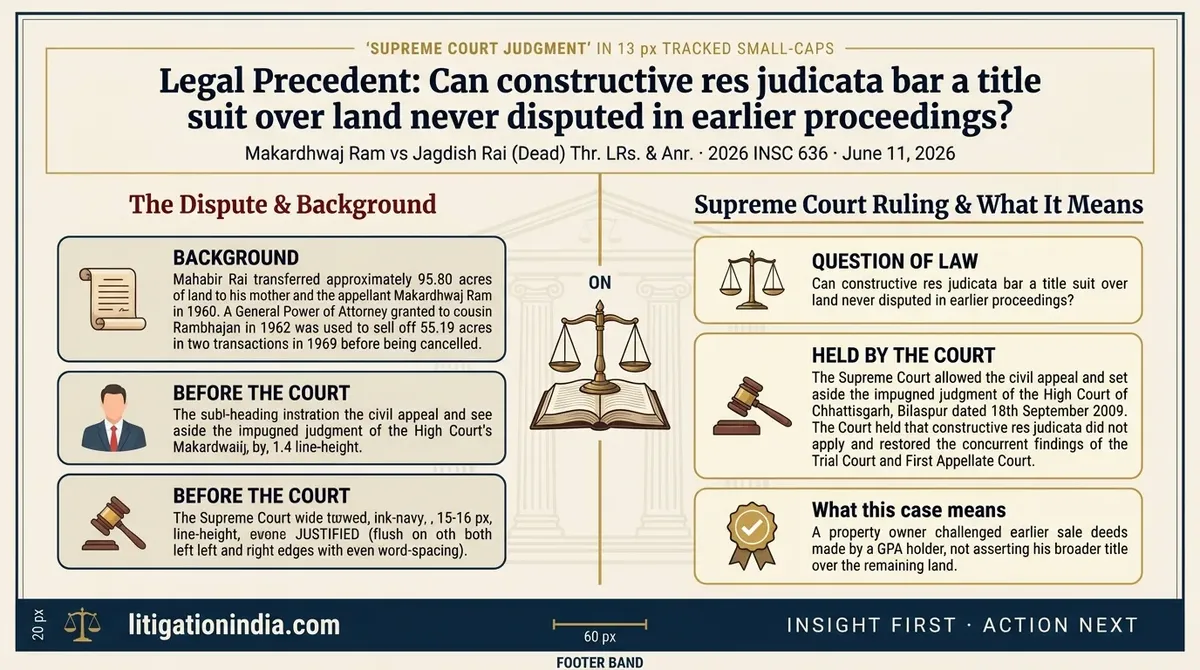
Constructive Res Judicata Cannot Extinguish Undisputed Property Rights Not Previously in Contest — infographic summary

What this case means

A property owner challenged earlier sale deeds made by a GPA holder, not asserting his broader title over the remaining land. The Supreme Court held that constructive res judicata did not bar his later suit for declaration of title over the remaining property, as there was no occasion in the earlier suits to assert that undisputed ownership. Applying this harsh doctrine to deprive him of his entire property would be unjust and inequitable.

What the Supreme Court held

The Supreme Court allowed the civil appeal and set aside the impugned judgment of the High Court of Chhattisgarh, Bilaspur dated 18th September 2009. The Court held that constructive res judicata did not apply and restored the concurrent findings of the Trial Court and First Appellate Court. The parties were directed to bear their own costs.

Case: Makardhwaj Ram vs Jagdish Rai (Dead) Thr. LRs. & Anr. (2026) Citation: 2026 INSC 636

Want the full legal reasoning, citations and case documents?

Read the full judgment analysis
Makardhwaj Ram
Jagdish Rai
constructive res judicata
Section 11 CPC
property dispute
declaration of title
General Power of Attorney
Code of Civil Procedure 1908
Explanation IV
land rights
Section 11 and Explanation IV, Code of Civil Procedure 1908
Article 226 and Article 32, Constitution of India
Civil Law / Property Disputes / Res Judicata
Supreme Court legal news