
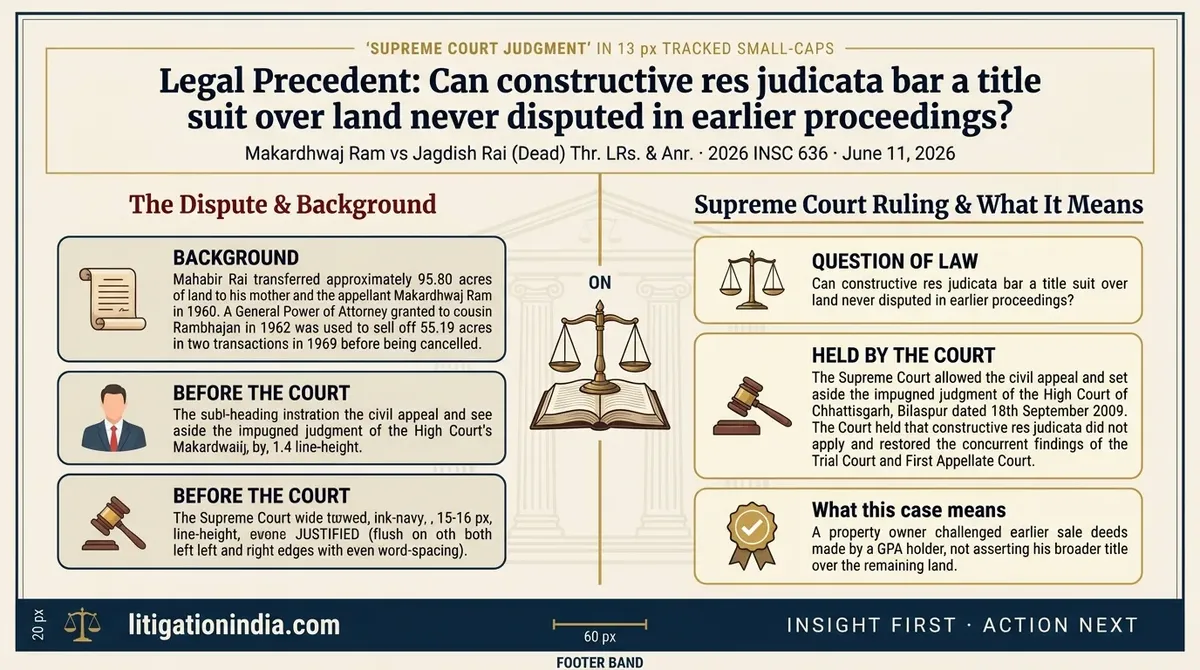
Full text of the judgment
Text extracted from Makardhwaj Ram vs Jagdish Rai (Dead) Thr. LRs. & Anr.. For the authoritative version refer to the Supreme Court of India's official website.
2026 INSC 636 Civil Appeal No.2950 of 2011 Page 1 of 12
IN THE SUPREME COURT OF INDIA CIVIL APPELLATE JURISDICTION
CIVIL APPEAL NO. 2950 OF 2011
MAKARDHWAJ RAM
… APPELLANT(S)
JAGDISH RAI (DEAD) TH. LRS. & ANR. …RESPONDENT(S)
J U D G M E N T
SANJAY KAROL, J. 1. This Civil Appeal has been preferred by the original plaintiffs laying challenge to judgment and order dated 18th September 2009 passed by the High Court of Chhattisgarh, Bilaspur in Second Appeal No. 617 of 1996. At hand is a long-standing property dispute that began somewhere in the 1960s. The parties in the dispute are in one way or another related to one Gokul Rai. A family chart shall be useful in contextualising the parties and the facts: Digitally signed by MINI Date: 2026.06.11 13:49:36 IST Reason: Signature Not Verified
Civil Appeal No.2950 of 2011 Page 2 of 12
2. The properties in question belonged to the grandson of said Gokul Rai i.e., Mahabir Rai. On 27th July 1960, Mahabir Rai, transferred a portion of his property totalling to 95.80 acres in favour of his mother, Raj Mohani @Roopjhari and his son, the present appellant, Makardhwaj. On 23rd April 1962, Mahabir Rai, his wife Gulmati, and mother Raj Mohani @ Rupjhari, executed a General Power of Attorney1 in favour of Rambhajan, who is Mahabir Rai’s cousin that is the son of Baldeo’s sister-Dhanmati. In 1969 on two separate occasions i.e., 27th January 1969 and 4th February 1969, Rambhajan, using the said GPA sold 21.43 acres land to one Prem Prakash, and 33.76 acres to one Chandra Sao. The said GPA was
Civil Appeal No.2950 of 2011 Page 3 of 12
cancelled by the grantors on 25th June 1969. Thereafter, Mahabir Rai, filed a suit seeking cancellation of sale deed qua the transfer of 21.43 acres of land dated 27th January 1969. Said suit was eventually dismissed by the Civil Judge, Class II, Jaishpor Nagar, vide judgment dated 21st October 1989 on the ground that the present appellant, successor-in-interest of the original plaintiff Mahabir Rai, could not establish his position as his successor-in-interest. The second transfer of 33.76 acres was challenged by Gulmati, as legal guardian of her minor children which too was dismissed by judgment dated 31st July 1975. In the year 1985 Rambhajan applied for mutating his name in the Revenue Records which was dismissed at the first instance but allowed on appeal. This mutation pushed the plaintiff, Makardhwaj, the appellant herein to file yet another civil suit. It is this proceeding that has culminated into the present appeal.
3. The suit2 has been filed for declaration of title and possession against Rambhajan. By judgment dated 7th May 1993, the suit was partly decreed. As against the claim of 95.8 acres the plaintiff was held to be entitled to 43.69 acres. Aggrieved thereof successor- in-interest of Rambhajan i.e., Jagdish Rai, further represented through LRs, appealed to the Additional District Judge, Raigarh, which came to be dismissed on 11th March 1996. Still aggrieved, he took the matter to the High Court, where, in terms of the impugned judgment, the judgment and decree of the Courts below were set aside, dismissing the suit as being barred by constructive res judicata.
4. The case of the appellant is that there is a difference between the two rounds of litigation regarding the properties since the earlier suits were filed on the basis of sale deeds seeking to recover the lands lost as a result thereof and the latter have been filed seeking a declaration of title and possession in respect of the land that remained after the alienations that have been made. In other words,
2 Civil Suit No.195A/87
Civil Appeal No.2950 of 2011 Page 4 of 12
the subject matter of the suit is separate and distinct from the earlier suits. With reference to Nagabhushanammal v. C. Chandikeswaralingam3, it is submitted that for res judicata to apply, it has to be shown that not only the cause of action was the same, but also that the plaintiff had the occasion to seek the same relief in the earlier proceedings. As a secondary argument, it is submitted that the question of res judicata is a mixed question of law and fact and while the defendants did take the plea, but they did not file the requisite documents such as the plaint, written statement and other documents to establish their claim.
5. Per contra, the respondents contend that there is no requirement of furnishing plaint, written statement and other documents to plead res judicata, when the judgment in the case reflects same and similar cause of action. It is further submitted that if the sale deed of 1960 was indeed the source of claim of the plaintiff, that ought to have been pleaded as the main ground and that the ground of being the exclusive owner of the lands in question by virtue of 1960 sale deed was although available, not taken. The same was also available to them to challenge the subsequent authorization/alienation (to Rambhajan through GPA) but was not taken and as such, while claiming right over the land based on inheritance, such ground was intentionally given up and is thus barred.
6. Section 11 of the Code of Civil Procedure 19084 deals with res judicata. It reads as under: “11. Res judicata.—No Court shall try any suit or issue in which the matter directly and substantially in issue has been directly and substantially in issue in a former suit between the same parties, or between parties under whom they or any of them claim, litigating under the same title, in a Court competent to try such subsequent suit or the suit in which such issue has been subsequently raised, and has been heard and finally decided by such Court.”
3 (2016) 4 SCC 434 4 CPC
Civil Appeal No.2950 of 2011 Page 5 of 12
Explanation IV thereof provides for rule of constructive res judicata which is as follows: “Explanation IV.—Any matter which might and ought to have been made ground of defence or attack in such former suit shall be deemed to have been a matter directly and substantially in issue in such suit.”
7. The concept of constructive res judicata has been extensively dealt with by this Court as also the Privy Council in its judgments. Some of those judgments are referred to hereinbelow to facilitate an understanding:
7.1 Morris LJ in Kameswar Pershad v. Rajkumari Ruttun Koer5, observed: …That it “might” have been, made a ground of attack is clear. That it “ought” to have been, appears to their Lordships to depend upon the particular fact of each case. Where matters are so dissimilar that their union might lead to confusion, the construction of the word “ought” would become important… 7.2 In Daryao v. State of U.P.6, it was held that the principle of res judicata applies to writ proceedings as well. Regarding the nature of the rule, it has been observed as follows: “9. But, is the rule of res judicata merely a technical rule or is it based on high public policy? If the rule of res judicata itself embodies a principle of public policy which in turn is an essential part of the rule of law then the objection that the rule cannot be invoked where fundamental rights are in question may lose much of its validity. Now, the rule of res judicata as indicated in Section 11 of the Code of Civil Procedure has no doubt some technical aspects, for instance the rule of constructive res judicata may be said to be technical; but the basis on which the said rule rests is founded on considerations of public policy. It is in the interest of the public at large that a finality should attach to the binding decisions pronounced by Courts of competent jurisdiction, and it is also in the public interest that individuals should not be vexed twice over with the same kind of litigation. If these two principles form the foundation of the general rule of res judicata they cannot be treated as irrelevant or inadmissible even in dealing with fundamental rights in petitions filed under Article 32.” (emphasis supplied)
5 1892 SCC OnLine PC 16 6 1961 SCC OnLine SC 21
Civil Appeal No.2950 of 2011 Page 6 of 12
7.3 In State of Karnataka v. All India Manufacturers Organisation7, B.N. Srikrishna J., writing for the Court, while dealing with this issue referred to a number of English judgments in the following manner: “38. The spirit behind Explanation IV is brought out in the pithy words of Wigram, V.C. in Henderson v. Henderson [(1843-60) All ER Rep 378 : (1843) 3 Hare 100 : 67 ER 313] as follows: (All ER pp. 381 I-382 A) “The plea of res judicata applies, except in special case (sic), not only to points upon which the court was actually required by the parties to form an opinion and pronounce a judgment, but to every point which properly belonged to the subject of litigation and which the parties, exercising reasonable diligence, might have brought forward at the time.” [Ibid., at pp. 381-82] 39. In Greenhalgh v. Mallard [(1947) 2 All ER 255 (CA)] (hereinafter “Greenhalgh [(1947) 2 All ER 255 (CA)] ”), Somervell, L.J. observed thus: “I think that on the authorities to which I will refer it would be accurate to say that res judicata for this purpose is not confined to the issues which the court is actually asked to decide, but that it covers issues or facts which are so clearly part of the subjectmatter of the litigation and so clearly could have been raised that it would be an abuse of the process of the court to allow a new proceeding to be started in respect of them.” [Ibid., at p. 257 H (emphasis supplied)]
40. The judgment in Greenhalgh [(1947) 2 All ER 255 (CA)] was approvingly referred to by this Court in State of U.P. v. Nawab Hussain [(1977) 2 SCC 806 at p. 809, para 4 : 1977 SCC (L&S) 362] . Combining all these principles, a Constitution Bench of this Court in Direct Recruit Class II Engg. Officers' Assn. v. State of Maharashtra [(1990) 2 SCC 715 : 1990 SCC (L&S) 339 : (1990) 13 ATC 348] expounded on the principle laid down in Forward Construction Co. [(1986) 1 SCC 100] by holding that:
“[A]n adjudication is conclusive and final not only as to the actual matter determined but as to every other matter which the parties might and ought to have litigated and have had (sic) decided as incidental to or essentially connected with (sic)
7 (2006) 4 SCC 683
Civil Appeal No.2950 of 2011 Page 7 of 12
subject-matter of the litigation and every matter coming into the legitimate purview of the original action both in respect of the matters of claim and defence. Thus, the principle of constructive res judicata underlying Explanation IV of Section 11 of the Code of Civil Procedure was applied to writ case. We, accordingly hold that the writ case is fit to be dismissed on the ground of res judicata.” [Ibid., at p. 741, para 35, per L.M. Sharma, J.] 7.4 Recently, in Samir Kumar Majumder v. Union of India8, K.V. Viswanathan J., considered the law on constructive res judicata while dealing with an employment dispute as follows: “Law on constructive res judicata 33. Almost two centuries ago, in Henderson v. Henderson [Henderson v. Henderson, (1843) 3 Hare 100 : 67 ER 313] , the Vice-Chancellor Sir James Wigram felicitously puts the principle thus: (ER p. 319)
“In trying this question I believe I state the rule of the Court correctly when I say that, where a given matter becomes the subject of litigation in, and of adjudication by, a court of competent jurisdiction, the Court requires the parties to that litigation to bring forward their whole case, and will not (except under special circumstances) permit the same parties to open the same subject of litigation in respect of matter which might have been brought forward as part of the subject in contest, but which was not brought forward, only because they have, from negligence, inadvertence, or even accident, omitted part of their case. The plea of res judicata applies, except in special cases, not only to points upon which the Court was actually required by the parties to form an opinion and pronounce a judgment, but to every point which properly belonged to the subject of litigation, and which the parties, exercising reasonable diligence, might have brought forward at the time.”
8. From a considered perusal of the above judgments, the following aspect of constructive res judicata can be highlighted:
8 (2024) 16 SCC 738
Civil Appeal No.2950 of 2011 Page 8 of 12
8.1 Constructive res judicata mandates that all grounds that might and ought to have been employed in the proceedings, should be employed to avoid multiplicity of proceedings. 8.2 It is a deeming fiction of law, but its application is not uniform and instead is dependent on the facts and circumstances of a particular case with ‘due regard to ambit of the earlier proceedings’ and ‘the nexus which the matter bears to the nature of the controversy’. 8.3 This principle is founded on public policy. It is a generally acceptable rule that one person should not be “vexed twice over” for the same kind of litigation. As such, it also applies to the proceedings under Article 226/32 of the Constitution of India. 8.4 In respect of ‘ought’ referred above, the said word implies the threshold to be above mere possibility. 8.5 The parties while conducting litigation are expected to apply ‘reasonable diligence’, ‘legitimate purview’. It is from this lens that it shall be adjudicated whether all issues that were properly arising to the litigation; which ought to have been raised; were raised or not? 8.6 The principle applies with equal force in cases where the ground that might and ought to have been raised was not done, on account of negligence, inadvertence or accident. In other words, might and ought to apply cumulatively with full force, without exception. The party therefore commits these errors at their own peril.
9. Applying these principles to the present facts, the question is whether the earlier proceedings provided opportunity enough for the plaintiff by being substantially similar, to raise the point of his ownership of the suit properties by virtue of the 1960 sale deed when the main ground urged otherwise was cancellation of sale deed.
Civil Appeal No.2950 of 2011 Page 9 of 12
10. From the above narration of facts, it is clear that the present proceedings are indirectly the culmination of a long history of litigation. Although the previous proceedings are not directly relevant they may nonetheless be set out below in a tabular form for completeness:
C.S. No. 9A of 1974 and its appeal 157/1975 Challenging Sale deed dated 4th February 1969 DATE OF INSTITUTION DATE OF DECISION PLAINTIFF/ APPELLANT DEFENDANTS/ RESPONDNETS RESULT 1974 31.07.1975 Plaintiff
1. Makardhwaj Ram (Minor) 2. Mst. Sukhmani (sister) (Minor) 3. Mst. Basanti (sister) (Minor) 4. Mst. Gulmati (mother) (Gaurdian) Defendants
1. Chander Sao (3rd Party Purchaser) 2. Rambhajan
Dismissed 1975 14.10.1981 Appellants
1. Makardhwaj Ram (Minor) 2. Mst. Sukhmani (sister) (Minor) 3. Mst. Basanti (sister) (Minor) 4. Mst. Gulmat (mother) (Gaurdian) Respondents
1. Chander Sao (3rd Party Purchaser) 2. Rambhajan
Civil Appeal No.2950 of 2011 Page 10 of 12
Civil Suit. 5A/87 (Earlier 7A/69) and its appeal 16A/90 Challenging Sale deed dated 17th January 1969 DATE OF INSTITUTION DATE OF DECISION PLAINTIFF/ APPELLANT DEFENDANTS/ RESPONDNETS RESULT 1987 21.10.1989 1. Makardhwaj Ram (through mother as guardian)
1. Jagdish Rai 2. Prem Prakash Rai (3rd Party Purchaser)
Dismissed 1990 28.06.1994 Appellants 1. Makardhwaj Ram (through mother as guardian)
Respondents 1. Jagdish Rai 2. Prem Prakash Rai (3rd Party Purchaser)
Present suit 195A/87 and the first and second appeal DATE OF INSTITUTION DATE OF DECISION PLAINTIFF/ APPELLANT DEFENDANTS/ RESPONDNETS RESULT 1986 07.5.1993 Plaintiff 1. Makardhwaj Ram (Plaintiff)
1. Rambhajan 2. State of MP (through district collector
Decreed 1993 11.03.1996 Appellant
1. Rambhajan 2. State of MP
Appeal dismissed
1996 18.09.2009 Appellant
1. Rambhajan 2. State of MP
Second Appeal allowed
Civil Appeal No.2950 of 2011 Page 11 of 12
11. To put the question framed by us in perspective, the total piece of land with respect to which the above proceedings have taken place was approximately 95.80 acres. The first sale deed to Prem Prakash Rai, was 21.43 acres and the second sale deed was to Chander Sao for 33.76 acres. For one reason or another both the suits seeking cancellation of the sale deeds made by Rambhajan as GPA holder, were dismissed. Undisputedly, when both those suits were instituted the appellant-plaintiff was a minor. The third suit that is before us was filed on 1st May 1986 seeking declaration and possession. The issue of constructive res judicata was framed by the Trial Court and decided in favour of appellantplaintiff. Such finding was agreed to by the First Appellate Court, but reversed in impugned judgment by the High Court. We may record here itself that we are not in agreement with the High Court.
12. The High Court proceeds on the premise that in both the earlier suits the appellant-plaintiff could have claimed the right over subject land to be flowing from the 1960 deed executed in his favour by Mahabir Rai. Since he did not do that and instead chose to pursue an inferior claim of cancellation of sale deed, the stronger one stood given up by application of constructive res judicata.
13. On first blush, this reasoning appears attractive but, in our view, cannot be countenanced for it perhaps misses the mark.
The appellant-plaintiff by virtue of 1960 deed was the owner of a large portion of land. According to him Rambhajan, had wrongly sold off parts thereof in two independent transactions therefore, acting through his parents, he challenged both those transactions. Where and how does the question of asserting his right over the larger parcel of land emerge when the same already rests undisputedly in his favour by virtue of the 1960 deed? When the apprehension arose by virtue of Rambhajan’s application to mutate his name in the relevant records with respect to the entire property in excess of what was part
Civil Appeal No.2950 of 2011 Page 12 of 12
of sale transaction, came the suit by Makardhwaj, asserting his right which had, in his view, be hitherto unquestioned. This question missed the attention of the High Court.
14. It be also observed that the effect of agreeing with the High Court would be that the appellant-plaintiff would be deprived of the entire property given to him by Mahabir Rai, and that has been in his name ever since he was born or shortly thereafter. The application of law, especially when it comes to inter family disputes is not akin to enforcing the black letter of the law but calls upon the Judge to understand the surrounding facts and circumstances and in the light thereof come to a conclusion in accordance with law. The part of the appellantplaintiff’s right which was threatened was challenged so in effect, he through his guardians, was protecting his rights. There was no occasion to do anything further. When this is the reality, to apply a principle of law which would lead to an unduly harsh and unjust consequence, would be offensive to both law and equity in these circumstances. As such, the impugned judgment must be set aside. Ordered accordingly.
15. Appeal is allowed. The parties to take recourse in law as may be permissible. They shall bear their own costs. Pending applications stand disposed of.
………………………………………..…..J. (SANJAY KAROL)
………………………………………..…….J (NONGMEIKAPAM KOTISWAR SINGH)
New Delhi; June 11, 2026