
All insights

Can CoC withdraw an approved Resolution Plan citing improved Corporate Debtor finances?

CoC Cannot Withdraw Approved Resolution Plan Once Placed Before NCLT

The case concerned whether a Committee of Creditors could withdraw its approval of a Resolution Plan, after approving it, citing improved financial health of the Corporate Debtor. The Supreme Court he

Litigation India Editorial 27 October 2026 1 min read 2026 INSC 1154

Story

Case at a glance1 / 6

Supreme Court of India

CoC Cannot Withdraw Approved Resolution Plan Before NCLT

Bank of India & Ors. v. S.M. Kamal Pasha & Ors. — 2026 INSC 1154

Court: Supreme Court of India; decided October 26, 2026Bench: Justice J. B. Pardiwala and Justice K. Vinod ChandranArea of law: Insolvency and Bankruptcy / Corporate Resolution (IBC 2016)CoC sought withdrawal of approved Rs.172.55 crore Resolution Plan citing Corporate Debtor's improved finances
Once a CoC-approved Resolution Plan is before the NCLT, withdrawal by neither the CoC nor the SRA is permissible under IBC.
CoC Cannot Withdraw Approved Resolution Plan Once Placed Before NCLT · 2026 INSC 11542026-10-27T04:37:03.903329+00:00
The legal question2 / 6

Can CoC Withdraw Its Approved Resolution Plan on Improved Finances?

The legal question the Supreme Court resolved

  • Appellant (CoC): NCLT cannot override CoC's unanimous commercial wisdom; CD's improved finances make the plan unfair to creditors.
  • Appellant (CoC): The CoC's existence and interest survive plan approval; fresh EoI should be issued to maximise asset value.
  • Respondent (SRA): Ebix Singapore makes the approved plan binding on both CoC and SRA; CoC's change of stance is opportunism, not commercial wisdom.
  • Respondent (SRA): Revenue improvement was contemplated in the plan; delays caused by litigation, not the SRA, cannot justify withdrawal.
CoC Cannot Withdraw Approved Resolution Plan Once Placed Before NCLT · 2026 INSC 11542026-10-27T04:37:03.903329+00:00
Statutory comparison3 / 6

Key IBC Provisions: What They Say and How Applied

Sections 12A, 30 and 31 read together govern withdrawal rights

ProvisionWhat it saysHow the Court applied it
Section 12A, IBC 2016Permits withdrawal of insolvency application with 90% CoC approvalPower exists only until CoC approves the Resolution Plan; not after it is placed before the AA
Section 30(4), IBC 2016Resolution Plan approved by 66% CoC vote; even dissenting creditors boundShows the plan's binding force is statutory, not purely contractual
Section 31(1), IBC 2016AA must confirm plan satisfies Section 30(2) before approvalStage after which no withdrawal is possible; AA must assess current financial position
Section 74, IBC 2016Prosecution for non-compliance with approved Resolution PlanSRA faces prosecution and PBG forfeiture if plan not implemented — heavier consequences than CoC's CIRP cost payment
CoC Cannot Withdraw Approved Resolution Plan Once Placed Before NCLT · 2026 INSC 11542026-10-27T04:37:03.903329+00:00
The Court's reasoning4 / 6

Court's Step-by-Step Reasoning

From the legal question to the final conclusion

  1. 1Step 1: Ebix Singapore confirms the Resolution Plan is binding inter se CoC and SRA from the moment of CoC approval, under the IBC framework — not merely as a contract.
  2. 2Step 2: Section 12A withdrawal power, read with Sections 30 and 31, covers only the period before CoC approves the plan; Regulation 30A sets four permitted stages, all pre-approval.
  3. 3Step 3: After the plan is placed before the AA, Section 31(1) takes over — the AA must independently verify Section 30(2) compliance; no withdrawal window remains.
  4. 4Step 4: Kalyani Transco's finding that CoC survives post-approval does not extend to withdrawing the plan; Regulation 18(2) expressly bars decisions affecting the submitted plan.
  5. 5Step 5: Improved profitability alone cannot justify refusal of confirmation; NCLT to consider both applications together and decide expeditiously.
CoC Cannot Withdraw Approved Resolution Plan Once Placed Before NCLT · 2026 INSC 11542026-10-27T04:37:03.903329+00:00
The verdict5 / 6

The Court's Final Verdict

Civil Appeal No.12045 of 2026 disposed of

  • The Fact: CoC approved an Rs.172.55 crore Resolution Plan; CD's finances improved during litigation delay; CoC sought to withdraw and issue fresh EoI.
  • The Law: IBC Sections 12A, 30 and 31 together bar withdrawal of a CoC-approved Resolution Plan once it is placed before the Adjudicating Authority.
  • The Result: Appeal dismissed; NCLAT order upheld; NCLT directed to consider Resolution Plan confirmation and holding company's OTS application together, expeditiously.
Improved profitability alone cannot be a reason to refuse approval if the Resolution Plan meets the requirements under Section 30(2) of the IBC.
CoC Cannot Withdraw Approved Resolution Plan Once Placed Before NCLT · 2026 INSC 11542026-10-27T04:37:03.903329+00:00
Why it matters6 / 6

Why This Judgment Matters

Practical significance for businesses, creditors and investors

  • Resolution Applicants can invest confidently: once the CoC approves their plan, creditors cannot pull out simply because market conditions improve.
  • Creditors and banks cannot use improving asset values as a pretext to derail settled insolvency processes and seek better deals at the last minute.
  • The IBC insolvency framework gains certainty: withdrawal windows are clearly capped at the CoC-approval stage, reducing litigation and delay.
  • The NCLT must still verify Section 30(2) fairness independently — protection for all creditors remains, even without a withdrawal option.
Once approved by the CoC and placed before the NCLT, a Resolution Plan binds all parties by statute — no withdrawal, no matter how finances improve.
CoC Cannot Withdraw Approved Resolution Plan Once Placed Before NCLT · 2026 INSC 11542026-10-27T04:37:03.903329+00:00
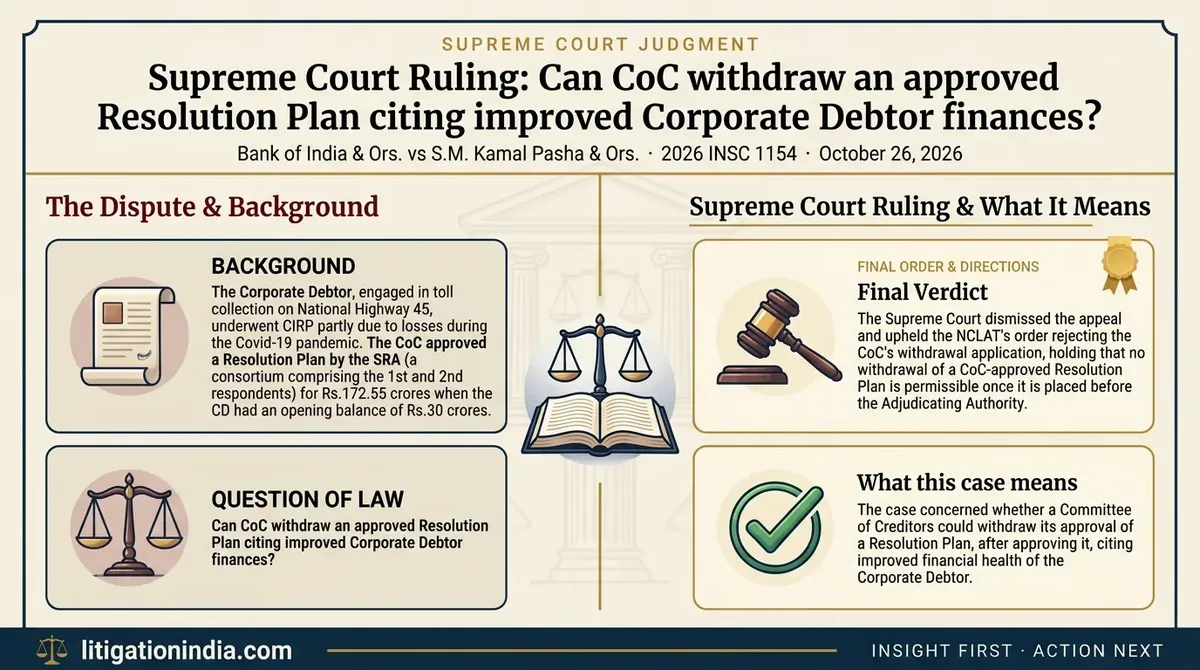
CoC Cannot Withdraw Approved Resolution Plan Once Placed Before NCLT — infographic summary

What this case means

The case concerned whether a Committee of Creditors could withdraw its approval of a Resolution Plan, after approving it, citing improved financial health of the Corporate Debtor. The Supreme Court held that once a CoC-approved Resolution Plan is placed before the Adjudicating Authority, neither the CoC nor the Successful Resolution Applicant can withdraw from it. This reinforces the binding and statutory nature of approved Resolution Plans under the IBC.

What the Supreme Court held

The Supreme Court dismissed the appeal and upheld the NCLAT's order rejecting the CoC's withdrawal application, holding that no withdrawal of a CoC-approved Resolution Plan is permissible once it is placed before the Adjudicating Authority. The Court directed the NCLT to take up together and decide expeditiously both the application for confirmation of the Resolution Plan and the holding company's application for an OTS-based exit from CIRP, keeping in mind that improved profitability alone is not a reason to refuse approval if Section 30(2) requirements are satisfied.

Case: Bank of India & Ors. vs S.M. Kamal Pasha & Ors. (2026) Citation: 2026 INSC 1154

Want the full legal reasoning, citations and case documents?

Read the full judgment analysis
Bank of India
S.M. Kamal Pasha
Committee of Creditors
Resolution Plan withdrawal
Insolvency and Bankruptcy Code 2016
CIRP
Successful Resolution Applicant
CoC commercial wisdom
Section 12A IBC
Section 31 IBC
Ebix Singapore
NCLT NCLAT
Section 12-A, Insolvency and Bankruptcy Code, 2016
Section 30(2), Section 30(4), Explanation I and II to Section 30, Insolvency and Bankruptcy Code, 2016