
Full text of the judgment
Text extracted from Bank of India & Ors. vs S.M. Kamal Pasha & Ors.. For the authoritative version refer to the Supreme Court of India's official website.
2026 INSC 1154 Page 1 of 22 Civil Appeal No.12045 of 2026 Reportable
IN THE SUPREME COURT OF INDIA CIVILL APPELLATE JURISDICTION
Civil Appeal No.12045 of 2026
BANK OF INDIA & ORS.
…. APPELLANTS Versus
S.M. KAMAL PASHA & ORS.
…. RESPONDENTS
J U D G M E N T
K. VINOD CHANDRAN, J.
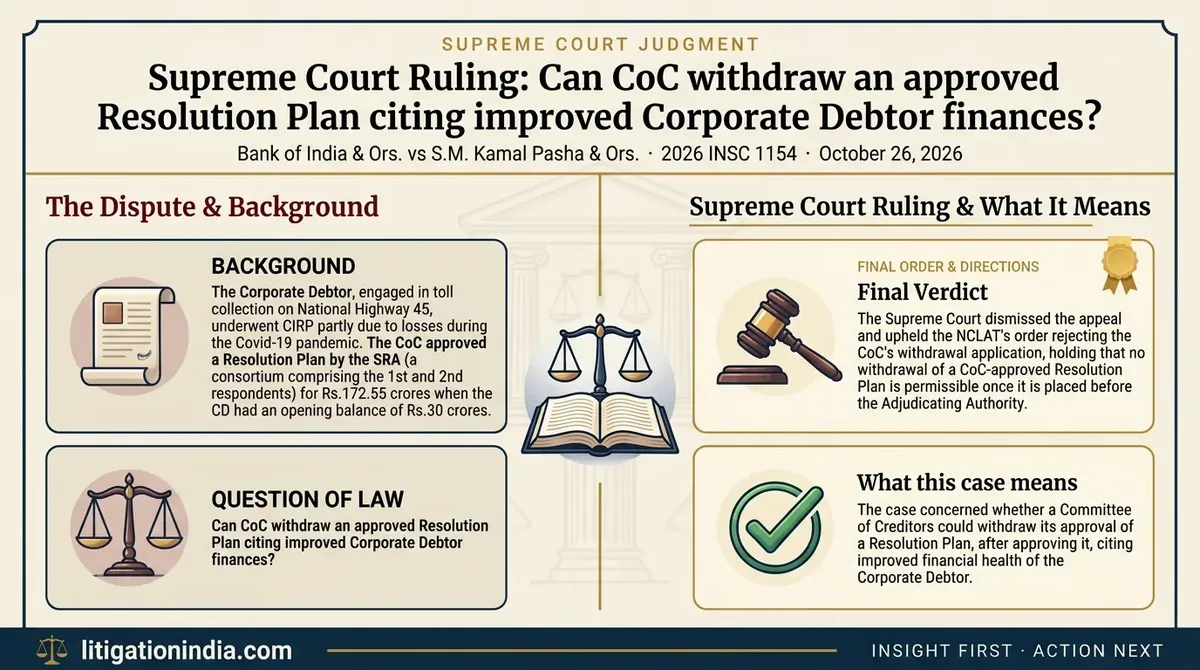
Whether the Committee of Creditors (CoC), after approving the Resolution Plan by a majority, as provided under the Insolvency and Bankruptcy Code, 2016 (IBC), can seek withdrawal of the same before the Adjudicating Authority (AA), the National Company Law Tribunal (NCLT); on grounds of delay, not attributable to the Successful Resolution Applicant (SRA) but on the plea that the financial position of the Corporate Debtor (CD) has improved considerably, is the vexing question posed. 2. The NCLT allowed the withdrawal filed by the Resolution Professional (RP), on it being approved by the CoC unanimously. The plea taken by the CoC before the NCLT was that the CD’s Digitally signed by VISHAL ANAND Date: 2026.10.26 14:09:35 IST Reason: Signature Not Verified
Page 2 of 22 Civil Appeal No.12045 of 2026 financial position having improved in the ensuing years, when the RP was in management, the SRA would have a windfall gain in having to bring in a lot less than that stipulated in the Resolution Plan. The erstwhile promotors of the CD, their holding company, also support the withdrawal of the Resolution Plan; but on different grounds with a different consequence. They seek that the CIRP process itself be abandoned since they are willing to offer a One-Time Settlement (OTS) to the creditors. The members of the CoC along with the RP seeks for issuance of a fresh Form- G; a new invitation of Expression of Interest (EoI). The SRA opposes both prayers referring to the binding nature of the Resolution Plan, insofar as the CoC and the SRA are concerned. 3. The National Company Law Appellate Tribunal (NCLAT) found the withdrawal application to be in violation of the provisions of the IBC, especially referring to Ebix Singapore (P) Ltd. v. Committee of Creditors of Educomp Solutions Ltd. and Another1 and State Bank of India and Others v. Consortium of Murari Lal Jalan and Florian Fritsch and Another2. The NCLAT held that the CoC has no jurisdiction to decide on withdrawal of
1 (2022) 2 SCC 401 2 (2025) 4 SCC 354
Page 3 of 22 Civil Appeal No.12045 of 2026 the Resolution Plan. It was found that the earlier proceedings before this Court; the stay granted in which, occasioned the delay in implementation of the plan, permitted the appellant therein, the erstwhile promoter, the holding company to make all such pleas before the Adjudicating Authority. The NCLAT while rejecting the application filed by the RP on behalf of the CoC to withdraw the approval to the Resolution Plan, revived the application filed by the RP for confirmation of the Resolution Plan; IA No.1505 of 2021 for consideration by the NCLT. IA No.1679 of 2025 filed by the holding company, the 4th respondent herein was also directed to be considered. The SRA too was permitted to raise their contentions. 4. The appeal is filed by the members of the CoC, six in number of which the 1st appellant is the applicant under Section 7 of the IBC; the financial creditor, who initiated the CIRP against the CD. The 1st and 2nd respondents together, as a consortium had submitted the Resolution Plan, which was approved by the CoC, the consortium referred to herein as the SRA. The 3rd respondent is the RP, and the 4th respondent is the holding company of the CD.
Page 4 of 22 Civil Appeal No.12045 of 2026 5. The appellants are represented by Mr.Gopal Sankarnarayan, learned Senior Counsel who points out that the original proposal in the Resolution Plan was of a resolution amount of Rs.172.55 crores, when the CD had an opening balance of Rs.30 crores. However, by the time this Court in the earlier proceedings dismissed the SLP filed by the erstwhile promoter, the opening balance has risen up to Rs.165 crores; which confers a windfall gain on the SRA. Since the fresh infusion of funds by the SRA would be considerably reduced, according to him, this would violate the governing principles of CIRP, under the IBC, which is the maximization of value of the assets of the CD inter alia inuring to the benefit of the creditors. Here, the creditors would be benefited if the Resolution Plan is withdrawn, since they would also be entitled to much more than that offered in the haircut by the Resolution Plan. At the time of submission of the Resolution Plan and its approval by the CoC, the CD’s financial position was tottering since its business of toll collection in the National Highway 45 had taken a beating due to the Covid-19 pandemic. It is trite that the commercial wisdom of the CoC is given primacy under the IBC and this is a fit case where the Resolution Plan
Page 5 of 22 Civil Appeal No.12045 of 2026 should be withdrawn. Reliance is also placed on Kalyani Transco v. Bhushan Power & Steel Ltd.3 to canvass the proposition that the CoC’s existence does not end with the approval of the plan and survives throughout the implementation, till the disbursals as per the plans are fructified. 6. Mr. Nidhesh Gupta, learned Senior Counsel appearing for the SRA, on the other hand, heavily relied on the judgment in Ebix Singapore (P) Ltd.1 to contend that the CoC is bound by the approval granted of the Resolution Plan and neither can the SRA wriggle out of its obligation, for reason of the CD’s financial position having further deteriorated nor can the CoC withdraw from its commitment to abide by an approved Resolution Plan, for reason of the financial position of the CD having improved. It is pointed out that the improvement in the financial position was already contemplated in the Resolution Plan, and in any event, if the SRA was handed over the CD, within the timelines provided under the IBC, the revenue generated would have gone into the coffers of the SRA without any additional benefit being conferred on the members of the CoC. The CoC’s request would go against
3 (2026) 6 SCC 431
Page 6 of 22 Civil Appeal No.12045 of 2026 the basic principles enshrined in IBC and any permission granted for withdrawal of the approved Resolution Plan, at the behest of the CoC would result in shifting stances by the financial creditors only looking at a better settlement; which cannot necessarily be said to be an expression of commercial wisdom. 7. Mr. Nikhhil Nayyar, learned Senior Counsel appearing for the 4th respondent, the holding company and the sole promotor of the CD points out that if the sanctioned OTS, as affirmed by the CoC is implemented, then everybody would gain and, in that circumstance, the CIRP itself can be closed and the CD on its revival would remain a profitable cash surplus going concern. In fact, the submission is that the Company’s present financial position not only supports its exit from the CIRP but there is also a feasible alternative of discharging the admitted creditors’ balance in full, in addition to the OTS. This Court, in the earlier round had specifically directed consideration of the holding company’s request, which is now before the NCLT by IA No.1679 of 2025. 8. Ebix Singapore (P) Ltd.1 considered the request of three SRAs in three different CIRPs. The appeal by Ebix dealt with the
Page 7 of 22 Civil Appeal No.12045 of 2026 withdrawal sought for by the SRA on the ground of investigation initiated against the misconduct in the affairs of Educomp, the CD, prior to the commencement of the CIRP. It was found that the SRA would be immune from any prosecution or punishment and the contention that it is placed in a prejudicial position due to the investigation into the affairs of the CD by CBI and the SFIO, was merely a red herring. Insofar as the Seroco’s appeal is concerned, the contention of frustration of contract due to the economic slowdown, impacting the value of assets, was rejected on the ground of common law remedies not being available to render the Resolution Plan voidable on account of frustration, force majeure, or other such instances. However, in the Kundan Care’s appeal since both the Resolution Applicant and the CoC together requested for modification of the Resolution Plan because of the uncertainty over the Power Purchase Agreement (PPA), cleared by the decision of this Court, a one-time relief under Article 142 of the Constitution was provided. The SRA, in this case specifically argues against the invocation of Article 142 on the facts of this case.
Page 8 of 22 Civil Appeal No.12045 of 2026 9. Ebix Singapore (P) Ltd.1 considered three stages, on an overview of the CIRP procedures; the first, prior to and ending with the approval of the Resolution Plan by the CoC; the second, the interim period between the approval of the CoC and the confirmation by the Adjudicating Authority; and the third, after the Adjudicating Authority approves the Resolution Plan. Therein the period which came up for consideration was the second stage as is the situation in the present case, i.e. between the approval of the CoC and confirmation by the NCLT. Elaborately considering the source of the binding nature of the Resolution Plan; whether it be the IBC or the law of contracts, it was held as under: - 113…… In the pure contractual realm, an agreement binds parties who are privy to the contract. In the context of a resolution plan governed by IBC, the element of privity becomes inapplicable once the adjudicating authority confirms the resolution plan under Section 31(1) and declares it to be binding on all stakeholders, who are not a part of the negotiation stage or parties to the resolution plan. In fact, a commentator has noted that the purpose of Bankruptcy law is to actually solve a specific “contracting failure” that accompanies financial distress……
It was also held that: - 115….
Page 9 of 22 Civil Appeal No.12045 of 2026 …….the resolution plan even prior to the approval of the adjudicating authority is binding inter se the CoC and the successful resolution applicant. The resolution plan cannot be construed purely as a “contract” governed by the Contract Act, in the period intervening its acceptance by the CoC and the approval of the adjudicating authority. Even at that stage, its binding effects are produced by IBC framework.
10. It was categorically held, ‘that ability of the Resolution Plan to bind those who have not consented to it, by way of a statutory procedure, indicates that it is not a typical contract’. Dilating upon Section 30(4) which requires only 66% vote for an approval of the Resolution Plan, it was noticed that even the dissenting creditors are bound by the Resolution Plan, by virtue of the statutory provisions. It was held that: 112…. …. Other elements governing the resolution plan indicate that the entire process from initiation and leading up to its acceptance by the CoC takes place within the framework of IBC. In addition, IBC provides penalties for non-compliance with the resolution plan after its approval under Section 31 and forfeiture of the PBG for failing to implement the resolution plan or contributing to the failure of its implementation. The violation of the terms of the resolution plan does not give rise to a claim of damages, rather it leads to prosecution and imposition of punishment under Section 74 IBC. On the contrary, a CoC's withdrawal of the CIRP under Section 12-A is coupled with a requirement of payment of CIRP costs, but no damages are statutorily payable to the
Page 10 of 22 Civil Appeal No.12045 of 2026 resolution applicant, irrespective of the stage of the withdrawal.
It was categorically held that: - 116…. ….The binding effect of the resolution plan has the consequence of preventing the CoC or the resolution applicant to renege from its terms after the plan has been approved by the CoC through a voting mechanism……
11. Reference was also made to Section 12A and Regulation 30A and it was held so: - 131… ….. Further, in the event that the CoC enters into a settlement with the corporate debtor and withdraws from the CIRP under Section 12-A, Regulation 30-A provides for only payment of insolvency costs and not compensation or damages to the resolution applicant for investing time and money in the process. The parties may resort to invoking principles of frustration or force majeure to evade implementation of the resolution plan leading to unnecessary litigation. This Court in Amtek Auto [Amtek Auto Ltd. (CoC) v. Dinkar T. Venkatasubramanian(2021 )4 SCC 457, had curbed a similar attempt by a successful resolution applicant who had relied on a force majeure clause in its resolution plan to seek a direction compelling the CoC to negotiate a modification to its resolution plan. The Court held that there was no scope for negotiations between the parties once the resolution plan has been approved by the CoC.
12. It is apposite also to refer to paragraph 156.2 which is extracted herein: -
Page 11 of 22 Civil Appeal No.12045 of 2026 156.2. In Uttara Foods [Uttara Foods & Feeds (P) Ltd. v. Mona Pharmachem(2018) 15 SCC 587, this Court had granted a one-time relief under Article 142 of the Constitution since all the parties were present before it and had presented it with signed consent terms. This course of action, in refraining from the exercise of inherent powers to effect procedures and remedies that were not specifically envisaged by the statute, was explicitly affirmed by the Insolvency Law Committee Report dated March 2018 [ Pages 5 and 101, Report of the Insolvency Law Committee, Ministry of Corporate Affairs (March 2018) available at <https://ibbi.gov.in/uploads/resources/ILRReport2603_0304 2018.pdf> last accessed 20-8-2021.] which proceeded to suggest amendments to IBC and recommended a ninety per cent voting threshold by the CoC for withdrawals of a CIRP and a specific amendment to Rule 8 of the then existing CIRP Rules to enable parties to file such applications. This report led to the insertion of Section 12-A which vested the CoC with the power to withdraw the CIRP or vote on such withdrawal, if sought by the corporate debtor. This provision was introduced with retrospective effect on 6-6-2018. Significantly, no such exit routes have been contemplated for the resolution applicant. It is relevant to note that the newly inserted and then unamended Regulation 30-A (w.e.f. 4-7- 2018) of the CIRP Regulations stipulated that withdrawal under Section 12-A can be allowed through submitting an application to the IRP or RP (as the case may be) before the invitation for EoI is issued to the public. The CoC was to consider the application within seven days of its constitution and an approval for such application required approval of the ninety per cent of the voting share of the CoC.
13. As has been reiterated in Ebix Singapore (P). Ltd.1 based on the binding precedents of this Court, the Adjudicating
Page 12 of 22 Civil Appeal No.12045 of 2026 Authority, the NCLT, cannot second guess the commercial wisdom of the parties or direct unilateral modification to the Resolution Plan. When there is no clear legal provision, by a process of interpretation, no power can be conferred on the Adjudicating Authority to direct an unwilling CoC to renegotiate a submitted Resolution Plan or agree to its withdrawal at the behest of the Resolution Applicant. The direction to re-consider has to be only to ensure compliance under Section 30(2) IBC, before exercising its powers of approval or rejection under Section 31 was the categoric finding. 14. We have to observe that Ebix Singapore (P) Ltd.1 though was in the specific context of withdrawal/modification sought of the approved Resolution Plan, by the SRA, which approval was placed before the Adjudicating Authority for confirmation, the dictum applies squarely to the CoC too. It was also noticed in paragraph 223 that, ‘the existing insolvency framework in India provides no scope for effecting further modifications or withdrawals of CoC-approved resolution plans, at the behest of the successful resolution applicant’ (sic) nor does it provide such a framework at the behest of the CoC.
Page 13 of 22 Civil Appeal No.12045 of 2026 15. Section 12-A introduced with retrospective effect, on the face of it, read alone, gives a carte blanche to the applicant, with approval of 90% voting share of the CoC to seek withdrawal of an application. Regulation 30-A of the Insolvency and Bankruptcy Board of India (Insolvency Resolution Process for Corporate Persons) Regulations, 2016 incorporated simultaneous to Section 12A, seemingly restricts the power to withdraw, permitting it only; before the constitution of the CoC, through the IRP or, after the constitution of the CoC, thorough the IRP or the RP, as the case may be. The proviso also makes it abundantly clear that if an application is made under Clause (b) after the issue of invitation for EoI under Regulation 36A, the applicant shall state the reasons justifying withdrawal after issuance of such invitation. Inferentially cannot be deemed to be a curtailment of the power under Section 12-A, which in any case is not within the domain of the rule making authority. 16. Glas Trust Company LLC v. Byju Raveendran & Others4, held that, with the introduction of Section 12-A and Regulation 30- A an exhaustive procedure is laid down for withdrawal of
4 (2024) SCC Online 3032
Page 14 of 22 Civil Appeal No.12045 of 2026 applications under Sections 7/9/10 which could be sought for at four stages; (i) before admission of the application, where the applicant could directly approach the AA, then, (ii) after admission and before the CoC is constituted, when the application to withdraw has to be filed through the IRP and again, (iii) after the CoC is constituted and before the EoI is received, through the IRP or the RP and finally, (iv) after the EoI is received, with the same procedure as at the third instance, however with sufficient reasons for having moved at that belated stage. But the question still remains as to whether the remedy would remain alive after the CoC approves the resolution plan. 17. The legislative scheme does not permit Section 12-A to be read in isolation. Section 31 with the nominal heading, ‘Approval of Resolution Plan’ postulates the satisfaction of the Adjudicating Authority, as to the Resolution Plan approved by the CoC under Section 30(4), meeting the requirements of sub-section (2) of Section 30. Sub-section (2) of Section 30 ensures that the IRP cost is paid in priority to the other debts of the CD in the manner specified by the Board and more importantly, that the creditors of the CD obtain the higher of the amounts, as indicated in sub-
Page 15 of 22 Civil Appeal No.12045 of 2026 clauses (i) and (ii). That is; either the amount to be paid under Section 53 to the creditors in the event of liquidation or the amount specified for distribution under the Resolution Plan in accordance with the order of priority in sub-section (1) of Section 53; whichever is higher. Read together, we are of the opinion that the withdrawal of an application can only be till the CoC approves the plan and after it is placed before the Adjudicating Authority, there can be no withdrawal either of the application or the approved Resolution Plan. 18. We cannot also but notice Explanation I to Section 30 (2), which clearly requires that there should be a fair and equitable distribution to the creditors in accordance with the provisions of this clause which also is a question to be considered while the confirmation of an approved plan is taken up and decided by the Adjudicating Authority, the NCLT. We would further buttress this position with a reference to Explanation II to Section 30 which stipulates that the provisions of sub-section (2) brought in by the IBC (Amendment) Act, 2019 apply to every Resolution Plan which has not been approved or rejected by the Adjudicating Authority; which is the situation in the above case.
Page 16 of 22 Civil Appeal No.12045 of 2026 19. In this context we also extract paragraph 224 of Ebix Singapore (P) Ltd.1 which reckoned the possibility of long delays:- 224. It would also be sobering for us to recognize that whilst this Court has declared the position in law to not enable a withdrawal or modification to a successful Resolution Applicant after its submission to the Adjudicating Authority, long delays in approving the resolution plan by the adjudicating authority affect the subsequent implementation of the plan. These delays, if systemic and frequent, will have an undeniable impact on the commercial assessment that the parties undertake during the course of the negotiation…...
20. Referring to the despondent state of affairs, as revealed from a Report of the Standing Committee on Finance (2020-21) of the Ministry of Corporate Affairs, regarding delay in implementation, it was observed: - The delays were attributable to: (i) the NCLT taking considerable time in admitting CIRPs; (ii) late and unsolicited bids by Resolution Applicants after the original bidder becomes public upon passage of the deadline for submission of the Plan; and (iii) multiplicity of litigation and the appellate process to the NCLAT and the Supreme Court.
Here the delay was occasioned because of the stay granted by this Court.
Page 17 of 22 Civil Appeal No.12045 of 2026 21. Kalyani Transco3 accepted the proposition that CoC has a vital interest in the Resolution Plan, and such an interest would continue till the Resolution Plan is actually implemented, since only on its implementation payments can be made to the creditors in accordance with the Resolution Plan. There, one of the questions raised was the delay in implementation of the Resolution Plan, as permitted by the CoC, challenged by the promoter as beyond the ken of the CoC, especially since it had become functus officio on the plan having been approved by the AA. This Court specifically noticed Regulation 18 of the Insolvency and Bankruptcy Board of India (IBBI) (CIRP) Regulations which by sub-regulation (2) enable the RP to convene a meeting if he considers it necessary on a request received from the Members of the Committee representing at least 33% of the voting rights. While the explanation clarifies that such meetings may be convened under the sub-regulation till the Resolution Plan is approved under sub-section (1) of Section 31 or order on liquidation is passed under Section 33, it also provides a rider that the decision in such meeting shall not affect the Resolution Plan submitted before the AA. This was specifically referred, to find
Page 18 of 22 Civil Appeal No.12045 of 2026 that on approval of the Resolution Plan, the CoC does not become functus officio, and it is empowered to decide all matters, except matters which affect the Resolution Plan submitted before the AA (sic-para 109). It was also held that the CoC has a vital interest in the Resolution Plan which interest would continue till the Resolution Plan stands actually implemented (sic-para 110). 22. In fact, in Kalyani Transco3, the Resolution Plan was approved by the CoC on 15.10.2018 and the RP submitted it for approval to the AA on 14.02.2019. However, there were several impediments in the implementation of the Resolution Plan by the SRA, which included investigation against the erstwhile promoters, attachments of the properties of the CD and so on and so forth. Despite all these on 17.02.2020, the NCLAT approved the Resolution Plan of the SRA by modifying/clarifying some of the conditions imposed by the NCLT and later the CoC by a resolution passed on 26.02.2021 by a majority of 97.25% voters provided that the SRA shall implement the Resolution Plan on or before 31.03.2021 and the SRA implemented the Resolution Plan by paying the amounts due to the financial creditors of the CD. This Court also found that the Resolution Plan by Clause 3.1
Page 19 of 22 Civil Appeal No.12045 of 2026 provided for an effective date, which shall not exceed 30 days from NCLT approval date or such extended period, which may be permitted by 66% majority of the lenders forming part of the CoC. It was held that Clause 3 of the Resolution Plan neither provided modification or withdrawal from the Resolution Plan and it was not an open-ended or indeterminate plan, solely at the discretion of the resolution applicant. There was neither a provision for withdrawal or modification of the Resolution Plan nor was any negotiation emphasized under the said clause. Hence the binding nature of the Resolution Plan was upheld even in Kalyani Transco3 and the finding that the CoC continues to exist till the Resolution Plan is implemented, does not detract from the essential binding nature of a Resolution Plan, approved by the CoC. 23. As of now, two applications are pending before the NCLT, one for the approval of the Resolution Plan and the other filed by the holding company for implementation of an OTS, thus, bringing to an end the very CIRP. As has been held in Ebix Singapore (P) Ltd.1 in considering the said applications, the NCLT would necessarily have to keep in mind that even under Section
Page 20 of 22 Civil Appeal No.12045 of 2026 12A, if the CoC by a 90% majority consents to withdrawal of the plan, the consequence is only the payment of CIRP costs by the CoC. However, the consequences of SRA not implementing an approved plan would be onerous insofar as forfeiture of PBG and prosecution under Section 74 of the IBC. In the present case, the PBG has been furnished by the SRA long back and the same is being continued with considerable expenses which would not be defrayed by the provisions of the IBC if no approval is granted to the Resolution Plan. 24. The compelling contention raised by the appellants is that the authoritative pronouncements of the NCLT, being disabled from second guessing the commercial wisdom of the CoC in approving a plan with 66% majority, squarely applies in the present instance where the CoC unanimously is in favour of a fresh Form-G being issued. The ground of feasibility of revival by itself and the possibility of defeating the very principle of maximisation of assets of the CD, which is the bedrock of IBC, requires a consideration by the NCLT. Insofar as the commercial wisdom, we should also reckon the contention of the SRA that the financial turnabout for the good, was contemplated even in the
Page 21 of 22 Civil Appeal No.12045 of 2026 Resolution Plan and if the SRA was handed over the CD, the future generation of income from the operations of the CD, would have inured to the benefit of the SRA. The SRA’s contention that the CoC has turned turtle not because of its commercial wisdom but only due to a shortsighted opportunism revealing institutionalized rapacity also cannot be ignored. 25. We would not interfere with the impugned order which though found the CoC to have no jurisdiction to withdraw from its approval, but all the same directed every contention raised by the SRA and the CD’s holding company to be considered by the Adjudicating Authority, while deciding the application filed for confirmation of the approval of the CoC and the application filed by the holding company for putting an end to the CIRP itself. The consideration has to be with a satisfaction entered of the Resolution Plan meeting the requirements of Section 30(2), as is mandated by Section 31(1) which shall be after verifying the financial position of the CD, as of now, together with the cash balance juxtaposed with the terms of the resolution plan. The improved profitability alone cannot be a reason to refuse approval if the Resolution Plan meets the requirements under
Page 22 of 22 Civil Appeal No.12045 of 2026 sub-section (2) of Section 30 We make it clear that except on the binding nature of the Resolution Plan, vis-a-vis the CoC and the SRA, as already upheld by this Court, we have only made prima facie observations which need not govern the final adjudication by the NCLT. 26. We hence request the applications directed to be considered by the NCLT to be taken up together and a decision rendered as expeditiously as possible, reckoning the delay already occasioned. 27. The appeal stands disposed of. 28. Pending application(s), if any, shall stand rejected.
.……………………………... J. (J. B. PARDIWALA)
..………….…………………. J. (K. VINOD CHANDRAN) NEW DELHI; OCTOBER 26, 2026.