
All insights

Can an accused be convicted when the circumstantial evidence chain is incomplete?

Accused Acquitted Where Circumstantial Evidence Chain Was Incomplete

The appellant was convicted for rape and murder of a minor under IPC and POCSO based solely on circumstantial evidence. The Supreme Court found the chain of circumstances broken — last seen evidence w

Litigation India Editorial 1 October 2026 1 min read 2026 INSC 1073

Story

Case at a glance1 / 6

Supreme Court of India

Broken Chain of Circumstances Leads to Acquittal in POCSO Murder Case

Santosh Gurung vs State of Sikkim — 2026 INSC 1073

Court: Supreme Court of India; Date: October 1, 2026Bench: Justice Ujjal Bhuyan and Justice Atul S. ChandurkarArea: Criminal Law — Circumstantial Evidence, IPC, POCSO Act 2012Appellant convicted by Sessions Court and High Court; Supreme Court acquitted him
Accused Acquitted Where Circumstantial Evidence Chain Was Incomplete · 2026 INSC 10732026-10-01T13:23:29.172265+00:00
The legal question2 / 6

Was the chain of circumstances sufficient to convict the appellant?

Core legal dispute before the Supreme Court

  • Appellant: Witnesses were not sure appellant was last seen with victim; FIR delayed six months; DNA and FSL reports did not support prosecution.
  • Appellant: Recovery under Section 27 was from a publicly visible place; no material connected appellant to the crime.
  • Respondent: Multiple clinching circumstances pointed only to appellant; Section 313 admissions strengthened the chain.
  • Respondent: Both courts concurrently found guilt; no interference warranted.
Accused Acquitted Where Circumstantial Evidence Chain Was Incomplete · 2026 INSC 10732026-10-01T13:23:29.172265+00:00
Statutory comparison3 / 6

Each Circumstance Examined: What the Evidence Actually Showed

Prosecution's claimed circumstances vs. actual evidence on record

CircumstanceProsecution's ClaimCourt's Finding
Last seen with victimAppellant last seen taking victim awayNo witness confirmed this; two other villagers present; six-month time gap
Section 27 recoveryArticles recovered at appellant's instanceRecovery spot openly visible and frequented; reliability diminished
DNA reportBones and teeth were victim'sBones were of male origin; did not match female victim's relatives
FSL reportBlood on shawl linked to crimeCould not determine if blood was human or animal; inconclusive
Brown shawlAppellant took it from mother's houseAppellant's mother denied ownership; no witness saw appellant take it
Section 313 statementSilence indicates guiltChain not established; silence cannot substitute prosecution evidence
Accused Acquitted Where Circumstantial Evidence Chain Was Incomplete · 2026 INSC 10732026-10-01T13:23:29.172265+00:00
The Court's reasoning4 / 6

How the Court Reached Acquittal: Step-by-Step Reasoning

Applying Hanumant v. State of M.P. and allied precedents

  1. 1Step 1: Restate the rule — every circumstance must be fully established and exclude all hypotheses except guilt.
  2. 2Step 2: Assess last seen theory — no clear witness, six-month gap, other persons present; theory inapplicable.
  3. 3Step 3: Test Section 27 recovery — place was ordinarily visible; reliability of discovery reduced per Jeet Singh.
  4. 4Step 4: Evaluate DNA and FSL — DNA contradicted prosecution (male bones, female victim); FSL inconclusive.
  5. 5Step 5: Find chain broken — Section 313 silence cannot compensate; benefit of doubt granted, appellant acquitted.
Accused Acquitted Where Circumstantial Evidence Chain Was Incomplete · 2026 INSC 10732026-10-01T13:23:29.172265+00:00
The verdict5 / 6

The Verdict: Conviction Set Aside, Appellant Acquitted

Supreme Court — Criminal Appeal No.107 of 2018

  • The Fact: Prosecution relied on six circumstances; none was individually conclusive or collectively complete.
  • The Law: Circumstantial evidence must form an unbroken chain excluding all hypotheses other than guilt; Section 313 statement cannot fill prosecution gaps.
  • The Result: Sessions Court and High Court judgments quashed; appellant acquitted of all charges under IPC and POCSO Act.
Sessions Court judgment in S.T. (POCSO) Case No.20 of 2014 and High Court order in Criminal Appeal No.19 of 2016 are quashed. Appellant acquitted; to be set free forthwith.
Accused Acquitted Where Circumstantial Evidence Chain Was Incomplete · 2026 INSC 10732026-10-01T13:23:29.172265+00:00
Why it matters6 / 6

What This Means for Ordinary People

Practical significance of the judgment

  • Suspicion alone, however strong, is not enough to convict — every link in the chain of evidence must be proved.
  • DNA evidence that contradicts the prosecution cannot be ignored; scientific reports matter decisively.
  • An accused cannot be convicted just because they are unable to explain their whereabouts if the prosecution's own case is weak.
  • Courts must independently scrutinise each piece of circumstantial evidence, even when two lower courts have already convicted.
In circumstantial evidence cases, the chain must be complete and unbroken — no conviction is safe if even one link is missing.
Accused Acquitted Where Circumstantial Evidence Chain Was Incomplete · 2026 INSC 10732026-10-01T13:23:29.172265+00:00
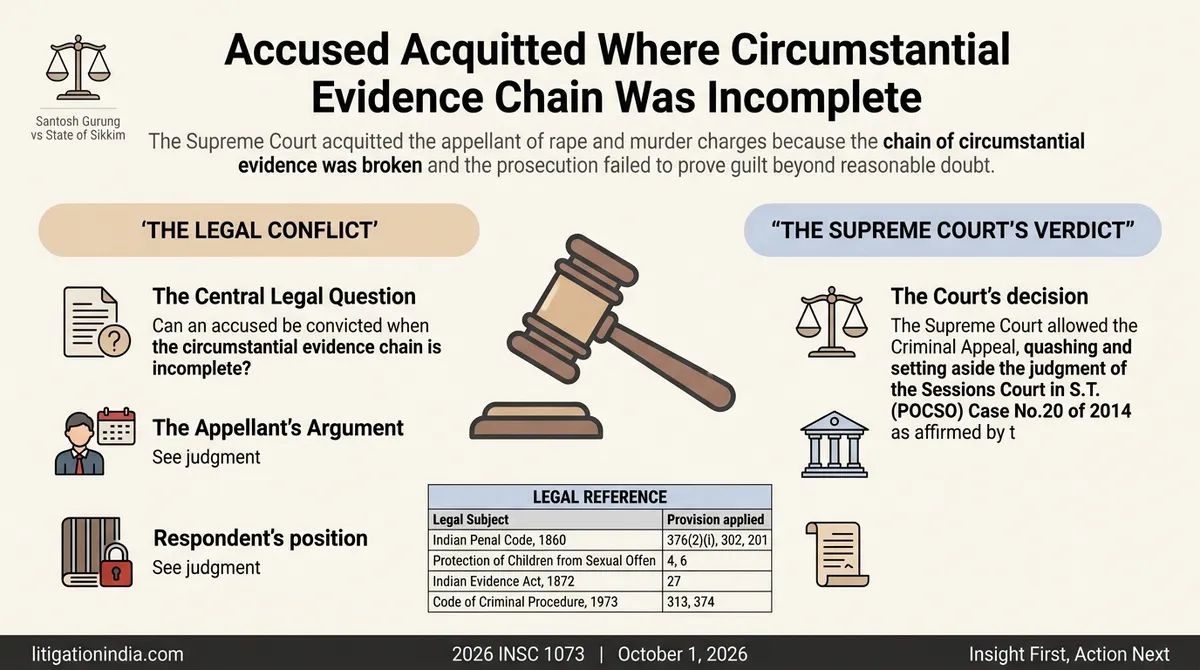
Accused Acquitted Where Circumstantial Evidence Chain Was Incomplete — infographic summary

What this case means

The appellant was convicted for rape and murder of a minor under IPC and POCSO based solely on circumstantial evidence. The Supreme Court found the chain of circumstances broken — last seen evidence was doubtful, DNA did not match the victim, and FSL reports were inconclusive. The Court acquitted him, reinforcing that guilt must be proved beyond reasonable doubt.

What the Supreme Court held

The Supreme Court allowed the Criminal Appeal, quashing and setting aside the judgment of the Sessions Court in S.T. (POCSO) Case No.20 of 2014 as affirmed by the High Court in Criminal Appeal No.19 of 2016. The appellant was acquitted of all charges and directed to be set free forthwith, if not required in any other case.

Case: Santosh Gurung vs State of Sikkim (2026) Citation: 2026 INSC 1073

Want the full legal reasoning, citations and case documents?

Read the full judgment analysis
Santosh Gurung
State of Sikkim
circumstantial evidence
last seen theory
Section 27 Indian Evidence Act
POCSO
DNA report
Section 313 CrPC
acquittal
benefit of doubt
376(2)(i), 302, 201, Indian Penal Code, 1860
4, 6, Protection of Children from Sexual Offences Act, 2012
27, Indian Evidence Act, 1872
313, 374, Code of Criminal Procedure, 1973