
All insights

Can jail remission reduce the 25-year imprisonment cap promised during extradition?

Abu Salem Cannot Claim Jail Remission to Reduce 25-Year Extradition Commitment Period

Abu Salem, convicted for serious offences under TADA, sought release claiming he had completed 25 years of imprisonment including jail remission, as per India's sovereign assurance to Portugal during

Litigation India Editorial 10 September 2026 1 min read 2026 INSC 982

Story

Key points1 / 7

Case at a Glance

  • Appellant: Abu Salem, convicted under TADA for serious offences
  • Extradited from Portugal in 2005 on India's sovereign assurance of max 25 years
  • Sentenced to life imprisonment in two TADA cases, sentences running concurrently
  • Appeal against Bombay High Court dismissal of habeas corpus petition
Abu Salem Cannot Claim Jail Remission to Reduce 25-Year Extradition Commitment Period · 2026 INSC 9822026-09-10T17:46:41.576043+00:00
Key points2 / 7

What Happened

  • India assured Portugal: no death penalty, no imprisonment beyond 25 years
  • Abu Salem extradited November 2005; arrested and tried in two TADA cases
  • Supreme Court in 2022 fixed detention start as 12 October 2005
  • Directed Executive to consider release under Article 72 or CrPC Sections 432/433 after 25 years
Abu Salem Cannot Claim Jail Remission to Reduce 25-Year Extradition Commitment Period · 2026 INSC 9822026-09-10T17:46:41.576043+00:00
Key points3 / 7

The Legal Question

  • Has Abu Salem completed 25 years of detention as directed by the 2022 judgment?
  • Can jail-earned remission be added to advance release under the extradition assurance?
  • Does the 25-year assurance convert his life sentence into a fixed-term sentence?
Abu Salem Cannot Claim Jail Remission to Reduce 25-Year Extradition Commitment Period · 2026 INSC 9822026-09-10T17:46:41.576043+00:00
Key points4 / 7

Arguments Before Court

  • Appellant claimed 26 years 9 months completed including undertrial and post-conviction custody
  • Claimed jail-earned remission of 3 years 6 months and 2 days should be counted
  • Relied on Yovehel, V. Sriharan, Swamy Shraddananda decisions for remission benefit
  • State said computation double-counted overlapping period; probable release date is 31 January 2046
Abu Salem Cannot Claim Jail Remission to Reduce 25-Year Extradition Commitment Period · 2026 INSC 9822026-09-10T17:46:41.576043+00:00
Key points5 / 7

What the Court Decided

  • Appellant's computation was flawed — same period double-counted impermissibly
  • 25-year assurance is only outer limit, does not convert life sentence to fixed term
  • Jail-earned remission cannot be added; no fixed-term sentence exists
  • High Court judgment upheld; appeal dismissed in limine
Abu Salem Cannot Claim Jail Remission to Reduce 25-Year Extradition Commitment Period · 2026 INSC 9822026-09-10T17:46:41.576043+00:00
Key points6 / 7

Why It Matters

  • Sovereign extradition assurances set limits but do not alter judicially imposed sentences
  • Concurrent sentences cannot be used to double-count the same custody period
  • Remission rules for fixed-term sentences do not apply to life imprisonment
  • Separation of powers: executive assurances cannot override judicial sentencing
Abu Salem Cannot Claim Jail Remission to Reduce 25-Year Extradition Commitment Period · 2026 INSC 9822026-09-10T17:46:41.576043+00:00
Key points7 / 7

Key Takeaways

  • Detention period computable from 12 October 2005 only, as directed in 2022
  • Government must act within one month of 25-year completion to consider release
  • Precedents on remission must be read in their specific factual and legal context
  • Offences targeted Mumbai's financial stability — gravity weighed in decision
Abu Salem Cannot Claim Jail Remission to Reduce 25-Year Extradition Commitment Period · 2026 INSC 9822026-09-10T17:46:41.576043+00:00
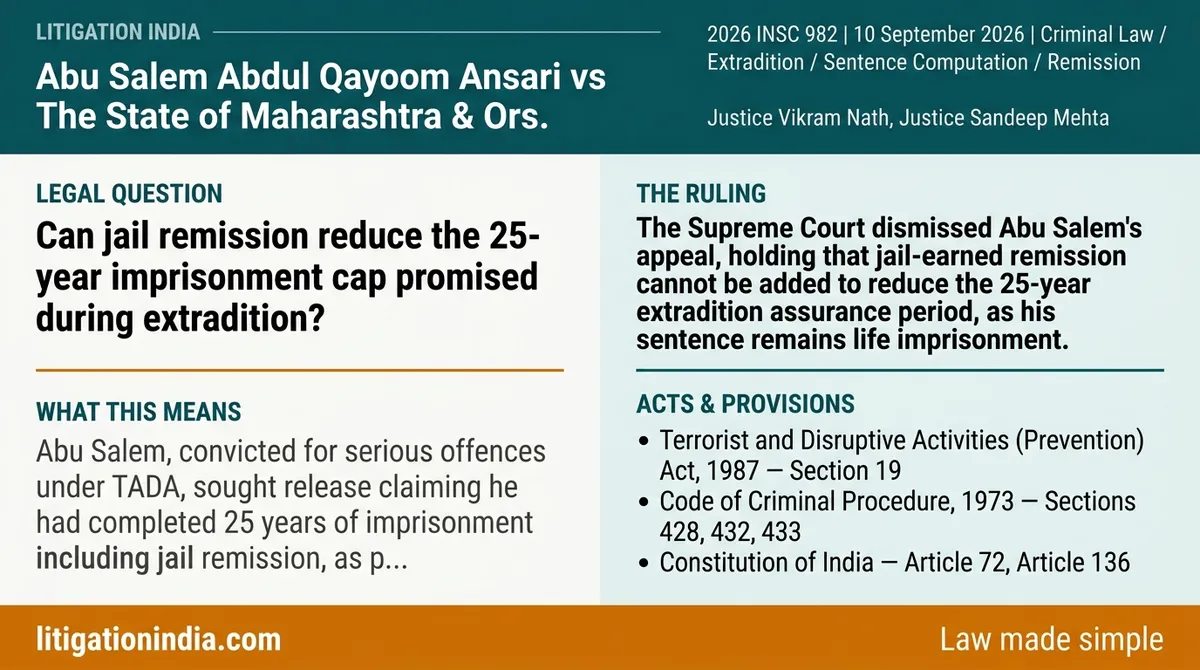
Abu Salem Cannot Claim Jail Remission to Reduce 25-Year Extradition Commitment Period — infographic summary

What this case means

Abu Salem, convicted for serious offences under TADA, sought release claiming he had completed 25 years of imprisonment including jail remission, as per India's sovereign assurance to Portugal during extradition. The Supreme Court dismissed his appeal, holding that his sentence remained life imprisonment and the 25-year cap was only a consequence of the sovereign assurance, not a fixed-term sentence to which remission could be added. This ruling clarifies that sovereign extradition assurances cannot be stretched to grant extra benefits beyond what was promised.

What the Supreme Court held

The Supreme Court dismissed the appeal in limine, upholding the Bombay High Court's judgment. It held that the appellant had not completed 25 years of detention as computed correctly from 12 October 2005, that the double-counting of the overlapping period was impermissible, and that jail-earned remission could not be added since the sentence remained life imprisonment and not a fixed-term sentence of 25 years.

Case: Abu Salem Abdul Qayoom Ansari vs The State of Maharashtra & Ors. (2026) Citation: 2026 INSC 982

Want the full legal reasoning, citations and case documents?

Read the full judgment analysis
Abu Salem
extradition
sovereign assurance
25 years sentence
life imprisonment
remission
TADA
habeas corpus
Portugal
sentence computation
Section 19, Terrorist and Disruptive Activities (Prevention) Act, 1987
Sections 428, 432, 433, Code of Criminal Procedure, 1973
Article 72, Article 136, Constitution of India
Rule 25(iii) of Chapter XXXIX, Maharashtra Prison Manual, 1979