
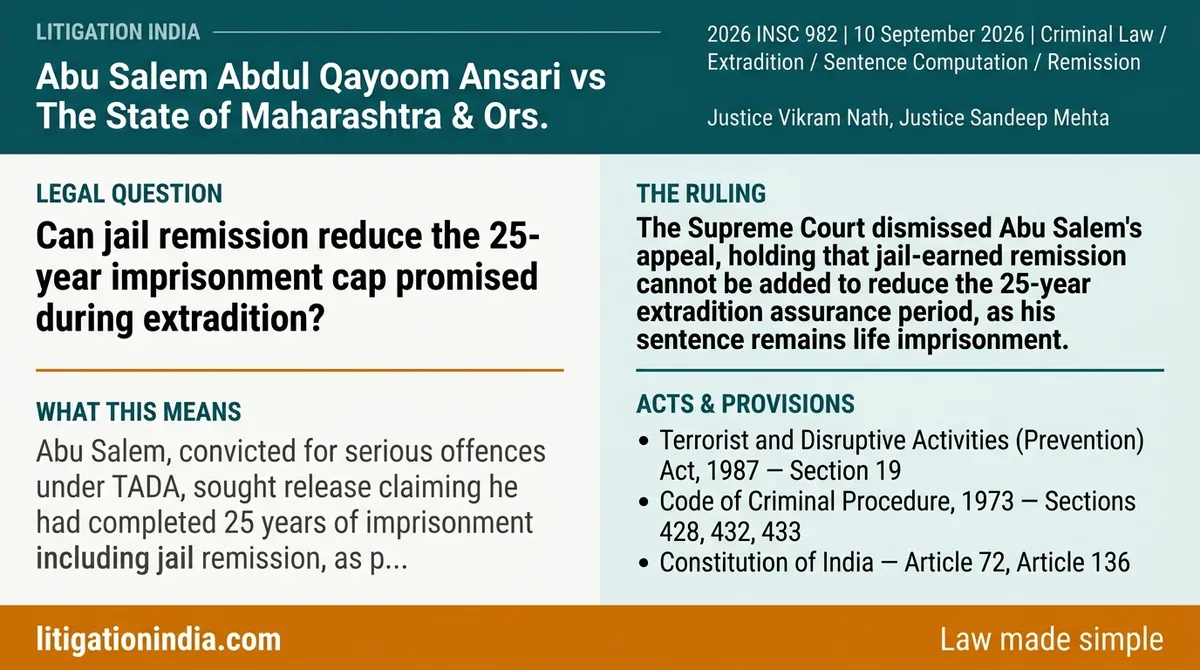
Can jail remission reduce the 25-year imprisonment cap promised during extradition?
Abu Salem Cannot Claim Jail Remission to Reduce 25-Year Extradition Commitment Period
Case: Abu Salem Abdul Qayoom Ansari vs The State of Maharashtra & Ors.Citation: 2026 INSC 982Decided on: 10 September 2026
What this case means
Abu Salem, convicted for serious offences under TADA, sought release claiming he had completed 25 years of imprisonment including jail remission, as per India's sovereign assurance to Portugal during extradition. The Supreme Court dismissed his appeal, holding that his sentence remained life imprisonment and the 25-year cap was only a consequence of the sovereign assurance, not a fixed-term sentence to which remission could be added. This ruling clarifies that sovereign extradition assurances cannot be stretched to grant extra benefits beyond what was promised.
“The Supreme Court dismissed Abu Salem's appeal, holding that jail-earned remission cannot be added to reduce the 25-year extradition assurance period, as his sentence remains life imprisonment.”
Story Slides
In short
Abu Salem Abdul Qayoom Ansari, convicted under TADA for serious offences including those connected to the 1993 Bombay blasts, was extradited from Portugal to India in 2005 after the Indian Government gave a solemn sovereign assurance that he would not face the death penalty or imprisonment exceeding 25 years. He was convicted in two TADA cases and sentenced to rigorous life imprisonment in both, with the sentences directed to run concurrently. In 2022, the Supreme Court held that his detention period would commence from 12 October 2005 and that upon completion of 25 years, the Central Government would be required to consider advising the President under Article 72 or exercise powers under Sections 432 and 433 of the CrPC. The appellant then filed a writ petition before the Bombay High Court seeking release, arguing he had completed over 25 years when undertrial custody, post-conviction custody and jail-earned remission of 3 years, 6 months and 2 days were added together. The High Court dismissed the petition. Before the Supreme Court, the appellant repeated the same arguments. The Court rejected the computation as flawed, finding that the appellant had double-counted the overlapping period from February 2015 to September 2017 — once as undertrial custody for one case and again as post-conviction custody for another. The Court also rejected the claim for jail-earned remission, holding that the 25-year stipulation was only a consequence of the sovereign assurance and did not convert his life sentence into a fixed-term sentence of 25 years. As the sentence remained life imprisonment, the rules on remission applicable to fixed-term sentences could not be applied. The Supreme Court upheld the High Court's judgment and dismissed the appeal in limine.
Need clarity on a similar legal issue?
Request free pro bono guidance from a Supreme Court Advocate.
Background
Abu Salem was extradited from Portugal to India in November 2005 after the Indian Government assured Portugal that he would not face the death penalty or imprisonment beyond 25 years. He was convicted in two TADA cases in 2015 and 2017 and sentenced to life imprisonment in both, with sentences running concurrently. In 2022, the Supreme Court fixed 12 October 2005 as the starting date of his detention and directed the Executive to consider his release upon completion of 25 years.
The Decision
The Supreme Court dismissed the appeal in limine, upholding the Bombay High Court's judgment. It held that the appellant had not completed 25 years of detention as computed correctly from 12 October 2005, that the double-counting of the overlapping period was impermissible, and that jail-earned remission could not be added since the sentence remained life imprisonment and not a fixed-term sentence of 25 years.
Why it matters for you
This judgment clarifies that a sovereign extradition assurance sets only the outer limit of detention and does not convert a life sentence into a fixed-term sentence, preventing any artificial inflation of custody periods. It also establishes that overlapping custody periods cannot be double-counted to advance release. For ordinary citizens, it reinforces that serious offenders cannot use procedural technicalities to circumvent their lawful sentences.
Relevant Legal Provisions
Key Acts and sections cited or relied upon in this judgment
“Provides for appeals to the Supreme Court against orders of TADA courts; the appellant filed appeals under this section against his TADA convictions and sentences of life imprisonment.”
“Section 428 provides set-off of pre-conviction detention against sentence; Sections 432 and 433 deal with suspension, remission and commutation of sentences — the Court held Section 428 set-off was unavailable for foreign detention and directed the Executive to consider Sections 432/433 upon completion of 25 years.”
“Article 72 grants the President power to pardon or commute sentences; the Court directed the Central Government to advise the President under this article upon the appellant completing 25 years. Article 136 is the basis of the present special leave petition before the Supreme Court.”
“Governs premature release of prisoners; the respondent-State considered the appellant's case under this rule, placing him in the 50-year sentence category for computing jail-earned remission.”
AI-assisted summary, reviewed and verified by our editorial team.
In the Court's words
“The assurance fixes the outer limit of imprisonment and it does not permit periods of custody to be counted twice or otherwise contrary to the manner directed by this Court.”
“The stipulation that he cannot be detained beyond twenty-five years is a consequence of the sovereign assurance extended by the Union Government to the Government of Portugal. It does not convert the sentence of life imprisonment into a fixed-term sentence of twenty-five years.”
“The methodology adopted by the appellant, apart from lacking legal foundation, artificially enlarges the period of custody by counting overlapping periods more than once.”
“A precedent cannot be applied divorced from the factual and statutory setting in which it was rendered.”
Need help with your case?
Facing a similar legal challenge in the Supreme Court or High Court? Connect with our pro bono volunteer advocates today.
Request Free Callback