Buyers acting dishonestly and demanding refunds cannot later force a property transfer
V.N.A.S. Chandran vs. S. Venila and Others
What this case means
This case involved a buyer who secretly tried to resell a property and demanded their advance back through police complaints. The Supreme Court decided that the buyer cannot now force the seller to transfer the property due to dishonest conduct and lack of continuous funds. For ordinary people, this means courts will not help buyers who act dishonestly or fail to keep their money ready throughout the dispute.
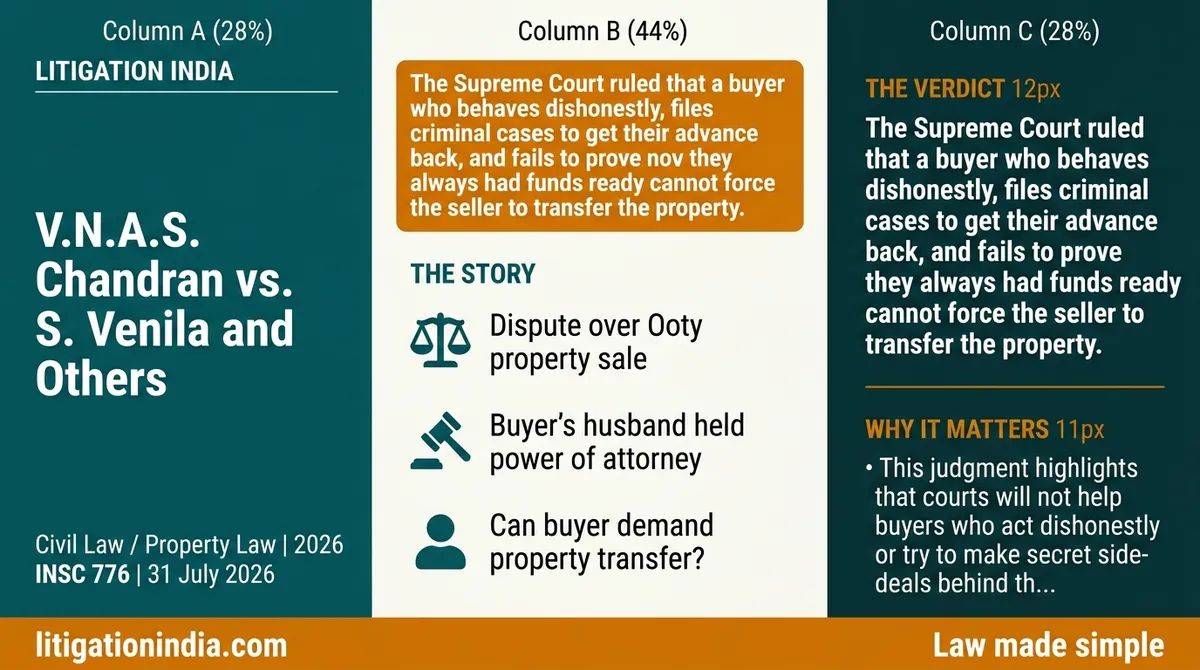
“The Supreme Court ruled that a buyer who behaves dishonestly, files criminal cases to get their advance back, and fails to prove they always had funds ready cannot force the seller to transfer the property.”
Story Slides
In short
This case is about a dispute over buying a property in Ooty. In 2004, the buyer (respondent) agreed to buy land from the owner (appellant) for Rs 2.25 crores and paid Rs 85 lakhs as an advance. However, the buyer's husband, who had a power of attorney, secretly tried to sell the same property to a third party for less money. When the owner found out, he cancelled the agreement. After this, both sides filed criminal cases. Crucially, the buyer's husband filed an FIR demanding his Rs 85 lakhs back, saying they wouldn't have done the deal if they knew about a pending court case on the property. Later, the buyer filed a civil suit demanding that the owner must still transfer the property (specific performance). The Trial Court refused to force the transfer, ordering only a refund of the advance because the buyer was 'blowing hot and cold' by asking for money back in criminal complaints but asking for property in civil court. The High Court reversed this, but the Supreme Court agreed with the Trial Court. The Supreme Court held that specific performance is a special, fair remedy. To get it, the buyer must prove they had the money ready at all times and must act honestly. Since the buyer took contradictory stands, hid facts, had cheques bounce, and over 20 years had passed, forcing the sale now would be unfair.
Background
In 2004, a buyer agreed to purchase a property in Ooty from its owner and paid an advance. Soon after, the buyer's husband misused a power of attorney to secretly arrange a sale of the same property to another person. The owner cancelled the deal, leading to multiple criminal complaints, including one where the buyer demanded their advance money back.
The Decision
The Supreme Court set aside the High Court's order and restored the Trial Court's judgment. The Court ruled that the buyer cannot get the property because of their dishonest conduct, lack of continuous funds, and the fact that over 20 years have passed. The buyer is only entitled to a refund of their Rs 85 lakhs advance with interest.
Why it matters for you
This judgment highlights that courts will not help buyers who act dishonestly or try to make secret side-deals behind the seller's back. It clarifies that to win a property transfer case, a buyer must prove they had the required money ready from the very starting date of the agreement until the end of the case.
Relevant Legal Provisions
Key Acts and sections cited or relied upon in this judgment
“This section states that a buyer cannot force a seller to transfer a property unless the buyer proves they were always ready and willing to pay the remaining money from the date of the agreement until the court case ends. In this judgment, the Court applied this rule to deny the transfer because the buyer did not show they had continuous funds and had actually asked for their advance money back in criminal complaints.”
“This section gives courts the discretionary power to decide whether to force a property transfer, meaning courts are not legally forced to grant the property even if an agreement exists. The Supreme Court relied on this to refuse the transfer, stating that the buyer's dishonest conduct, secret side-deals, and the passage of over twenty years made it unfair to force the seller to hand over the land.”
“This section allows the court to direct the refund of any advance money or earnest money paid by the buyer if the court decides not to grant the main request of transferring the property. The Court used this provision to order the seller to refund the advance amount of eighty-five lakh rupees along with interest to the buyer, as the actual transfer of the Ooty land was rejected.”
AI-assisted summary, reviewed and verified by our editorial team.
Need help with your case?
Facing a property, eviction, or landlord-tenant dispute? Consult our property lawyers for a free initial review.
Related Supreme Court services