You cannot file a regular appeal if first convicted by an appellate court
Vishnu Kumar Gupta vs State of Madhya Pradesh
What this case means
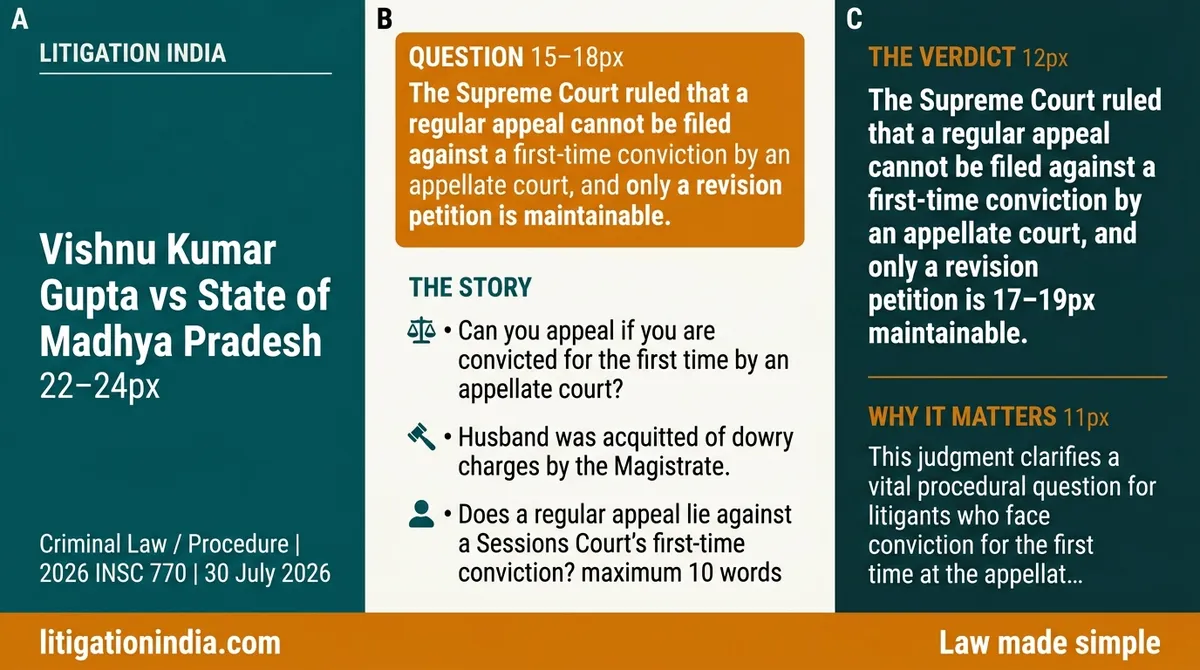
A husband was acquitted of dowry charges, but the appellate Sessions Court reversed it and convicted him. The Supreme Court decided that he cannot file a regular appeal against this first-time conviction in the High Court; he can only file a revision petition. This matters because it clarifies that people in this situation must file a revision, which the High Court must review very carefully.
“The Supreme Court ruled that a regular appeal cannot be filed against a first-time conviction by an appellate court, and only a revision petition is maintainable.”
Story Slides
In short
The Supreme Court of India decided whether an accused has a right to file a regular appeal in the High Court when a Sessions Court reverses a Trial Court's acquittal order and convicts them for the first time. In this case, the husband was acquitted of dowry and cruelty charges by the Magistrate. However, on the wife’s appeal, the Sessions Court reversed the decision and convicted him. When the husband appealed this conviction to the Madhya Pradesh High Court under Section 374 of the CrPC, the High Court dismissed it, stating that only a revision petition, not a regular appeal, was maintainable. The Supreme Court agreed with the High Court and ruled that a regular appeal under Section 374 CrPC is only available against convictions recorded by a court during an original trial, not when an appellate court reverses an acquittal. Since the right to appeal is strictly a creation of the written law (statute), courts cannot create a new right of appeal out of fairness or sympathy. The correct remedy is filing a "Criminal Revision" under Section 397 read with Section 401 of the CrPC. Crucially, the Supreme Court added that since this is the person's first conviction, High Courts must show extra care and adopt a liberal approach while hearing such revision petitions, using their broad supervisory powers to thoroughly examine the evidence to prevent any miscarriage of justice.
Background
The appellant was married to the complainant, and they lived in the USA before she returned to India and filed a dowry harassment and cruelty case. The Trial Court (Magistrate) acquitted the husband and his parents due to lack of reliable evidence. However, on appeal by the wife, the Sessions Court reversed the husband's acquittal and convicted him for the first time, sentencing him to prison.
The Decision
The Supreme Court dismissed the husband's appeal, ruling that no regular criminal appeal lies under Section 374 of the CrPC against a first-time conviction by an appellate Sessions Court. The only legal remedy is to file a Criminal Revision under Section 397/401 of the CrPC, but the High Court must hear such revision petitions with greater care and a liberal approach, examining the evidence closely.
Why it matters for you
This judgment clarifies a vital procedural question for litigants who face conviction for the first time at the appellate stage. It ensures they know the correct legal route (Revision, not Appeal) while protecting their rights by directing High Courts to scrutinize such cases with the depth of an appellate review to prevent injustice.
Relevant Legal Provisions
Key Acts and sections cited or relied upon in this judgment
“This section provides the right to appeal against convictions recorded by a criminal court. The Supreme Court held that this right is strictly limited to convictions handed down during an original trial, and does not apply when an appellate court reverses an acquittal to convict a person for the first time.”
“These sections give High Courts the power of revision to examine the correctness, legality, or propriety of any finding, sentence, or order of lower courts. The Supreme Court ruled that filing a revision petition under these sections is the only correct legal path in this case, and directed High Courts to hear such petitions with the same thoroughness as an appeal.”
“This section states that no appeal shall lie from any judgment or order of a criminal court except as provided by the Code of Criminal Procedure or any other law. The Supreme Court relied on this to emphasize that the right to appeal is a creation of written law, and courts cannot create a right to appeal where the legislature has not explicitly written one.”
AI-assisted summary, reviewed and verified by our editorial team.
Need help with your case?
Facing a similar legal challenge in the Supreme Court or High Court? Connect with our pro bono volunteer advocates today.
Related Supreme Court services