You cannot file a regular appeal if an appellate court convicts you for the first time
Vishnu Kumar Gupta vs State of Madhya Pradesh
The big legal question
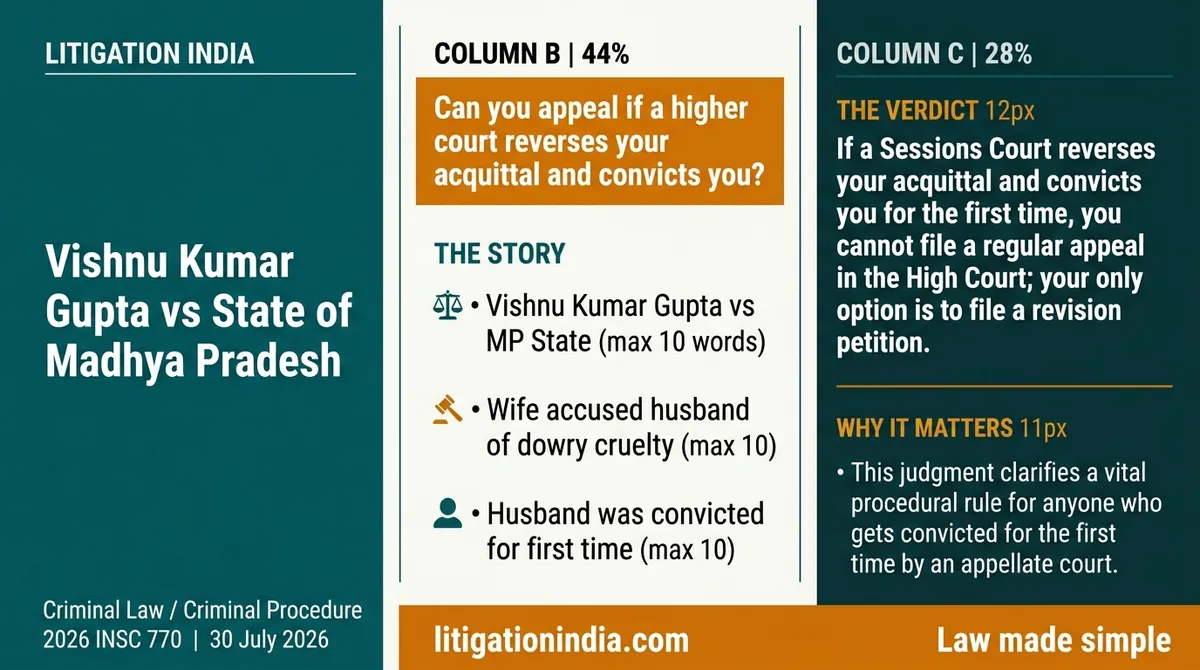
Can you appeal if a higher court reverses your acquittal and convicts you?
What this case means
A husband acquitted of dowry charges was later convicted for the first time by an appeals court. The Supreme Court ruled that a regular appeal cannot be filed against such a conviction. Instead, the correct legal route for the accused is to file a revision petition in the High Court to challenge the decision.
“If a Sessions Court reverses your acquittal and convicts you for the first time, you cannot file a regular appeal in the High Court; your only option is to file a revision petition.”
Story Slides
In short
In this case, the husband was accused of dowry harassment and cruelty by his wife. The local Magistrate Court (Trial Court) acquitted him of all charges. The wife appealed this acquittal in the Sessions Court. The Sessions Judge reversed the decision, found the husband guilty for the first time, and sentenced him to prison. The husband wanted to challenge this conviction, so he filed a regular appeal under Section 374 of the Code of Criminal Procedure (now Section 415 of the Bharatiya Nagarik Suraksha Sanhita) in the Madhya Pradesh High Court. The High Court rejected his appeal, saying it was not maintainable, and told him he should have filed a 'revision petition' instead. The husband then approached the Supreme Court. The Supreme Court agreed with the High Court. It explained that under Indian law, the right to appeal is not automatic; it must be clearly written in the law. A regular appeal is only allowed when a court convicts you after holding a full trial from start to finish. Here, the Sessions Court did not conduct the trial; it only heard an appeal and changed the result. Therefore, a regular appeal is not allowed. Instead, the husband must file a 'Criminal Revision' petition. However, the Supreme Court instructed the High Court to examine such revision petitions very carefully and liberally, as this is the first time the person is being convicted.
Background
A husband was acquitted of dowry harassment charges by a local magistrate court. His wife appealed to the Sessions Court, which reversed the acquittal and convicted him for the first time. The husband tried to file a regular appeal in the High Court, which was dismissed as not legally maintainable.
The Decision
The Supreme Court dismissed the husband's appeal, ruling that no regular criminal appeal lies against a conviction passed by an appellate court reversing an acquittal. The court ruled that the correct legal remedy is filing a Criminal Revision petition, but gave him the freedom to file one now.
Why it matters for you
This judgment clarifies a vital procedural rule for anyone who gets convicted for the first time by an appellate court. It establishes that while you cannot file a second regular appeal, you can still get a detailed and fair review of your case through a Criminal Revision petition in the High Court.
Relevant Legal Provisions
Key Acts and sections cited or relied upon in this judgment
“This section allows a convicted person to file a regular appeal in a higher court against a judgment of guilt passed by a trial court. The Supreme Court clarified that this right to appeal only applies when the conviction is given by a trial court. Since the husband was acquitted by the trial court and convicted only by the appeals court, he could not use this section to file a second regular appeal in the High Court.”
“These sections give High Courts the power of revision, which means they can call for and examine the records of any lower court to check if a decision was legal, correct, and fair. The Supreme Court ruled that when an appeals court reverses an acquittal and convicts someone for the first time, this revision route is the correct legal remedy. The court clarified that while a regular appeal is not allowed, a revision petition ensures the accused still gets a fair review of their conviction.”
“This section sets out the rules for appealing against a decision that clears or acquits an accused person of criminal charges. In this case, the wife successfully used this provision to challenge the husband's acquittal before the Sessions Court. The Supreme Court noted that once this first appeal process was completed and resulted in a conviction, the husband could not claim a legal right to file another regular appeal.”
AI-assisted summary, reviewed and verified by our editorial team.
Need help with your case?
Facing a similar legal challenge in the Supreme Court or High Court? Connect with our pro bono volunteer advocates today.
Related Supreme Court services