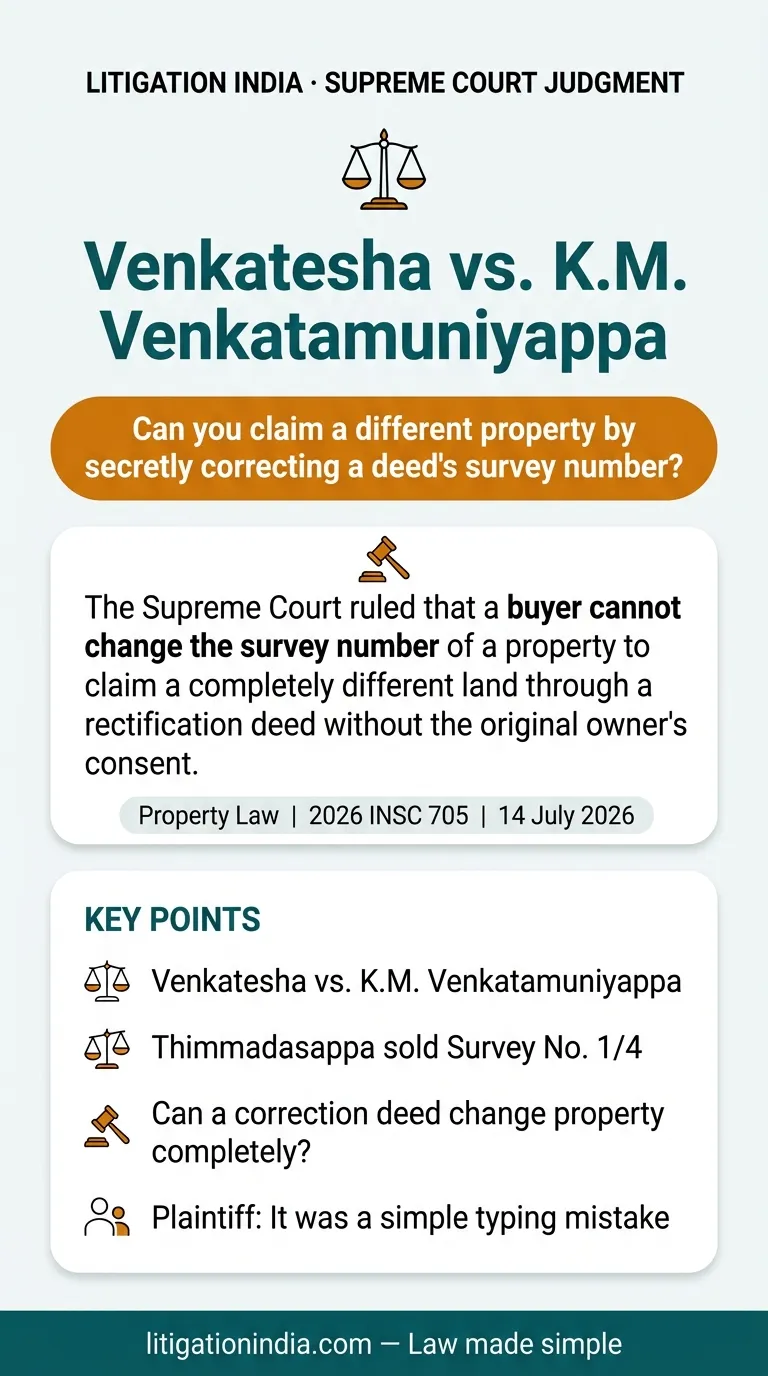
Venkatesha vs. K.M. Venkatamuniyappa
The big legal question
Can you claim a different property by secretly correcting a deed's survey number?
“The Supreme Court ruled that a buyer cannot change the survey number of a property to claim a completely different land through a rectification deed without the original owner's consent.”
Story Slides
In short
This case involved a dispute over a piece of land in Karnataka. The original owner, Thimmadasappa, sold land designated as Survey No. 1/4 to a buyer, who eventually sold it to the plaintiff. Decades later, Thimmadasappa was granted another land, Survey No. 162, by the government. The plaintiff then executed a 'rectification deed' (a document used to correct minor errors in a legal agreement) with his immediate seller to change the survey number in his sale deed from 1/4 to 162, without involving the original owner, Thimmadasappa. Later, Thimmadasappa partitioned Survey No. 162 among his sons. The plaintiff filed a lawsuit claiming ownership of Survey No. 162. While the Trial Court dismissed the lawsuit, the First Appellate Court and the High Court ruled in favor of the plaintiff. The Supreme Court set aside their decisions and restored the Trial Court's order. The Supreme Court explained that a rectification deed is meant to fix minor clerical mistakes, not to swap one property for an entirely different one. Since the original owner was not a party to this correction, the change was illegal. Crucially, the plaintiff had admitted during cross-examination that Survey No. 1/4 and Survey No. 162 were completely different lands. The Court also emphasized that judges cannot decide cases based on guesses or points that were never written in the original lawsuit papers (pleadings).
Background
A landowner sold a plot with Survey No. 1/4, which changed hands multiple times. Years later, the final buyer secretly corrected his sale deed's survey number to 162, claiming a completely different property that the original owner had recently received from the government.
The Decision
The Supreme Court dismissed the buyer's claim and restored the trial court's order. It ruled that a rectification deed cannot unilaterally swap one property for another, especially without the original owner's participation.
Why it matters for you
This judgment protects landowners from fraudulent attempts by buyers to grab different, more valuable lands by secretly altering survey numbers in old sale deeds. It also reinforces that courts must only decide cases based on clear written pleadings and solid evidence, not on assumptions.
AI-assisted summary, reviewed and verified by our editorial team.
Need help with your case?
Facing a property, eviction, or landlord-tenant dispute? Consult our property lawyers for a free initial review.
Related Supreme Court services