Partnership land must be sold at current market value, not old dissolution-date value
V. Sumitra Reddy & Anr. vs. K. Ranganadha Reddy & Ors.
The big legal question
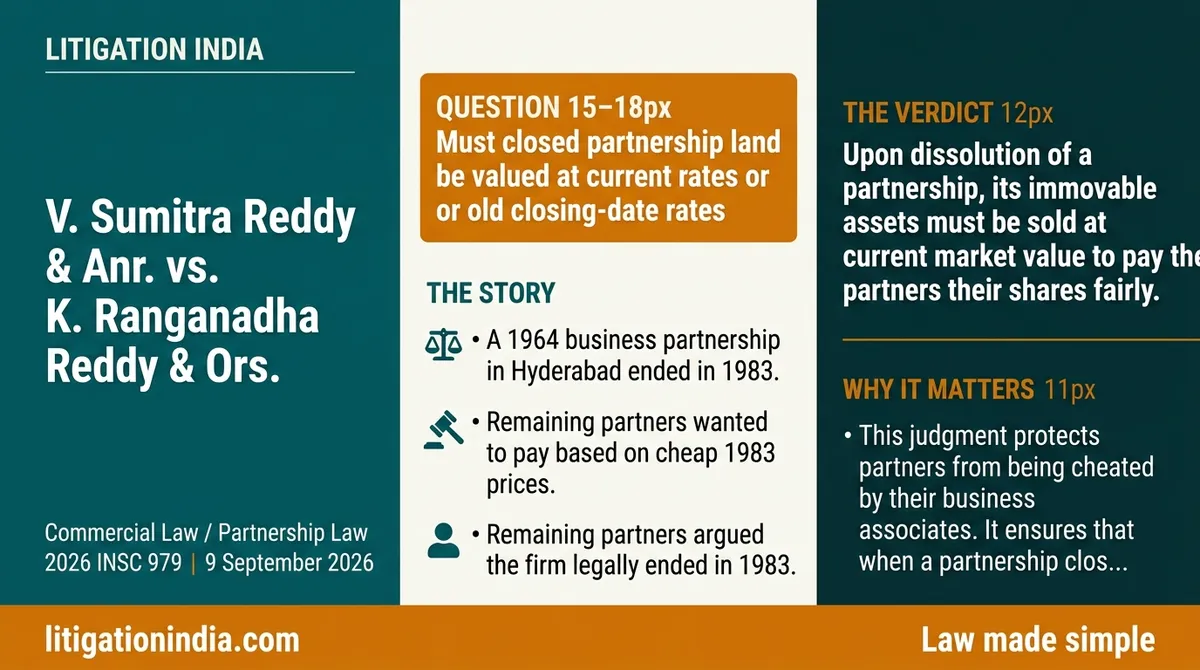
Must closed partnership land be valued at current rates or old closing-date rates
What this case means
When a business partnership ends, its land and properties must be sold at today's market rates to distribute the money. Other partners cannot keep the land and pay the outgoing partner based on decades-old historical prices. This ensures everyone gets a fair share of the property's real growth over time.
“Upon dissolution of a partnership, its immovable assets must be sold at current market value to pay the partners their shares fairly.”
Story Slides
In short
This case involved M/s Viraj Constructions, a construction partnership firm formed in Hyderabad in 1964. One of the founding partners, Kasireddy Lakshmi Narayana Reddy, sent a legal notice in October 1983 to dissolve the firm, which was a partnership at will. The firm owned a prime 3.27-acre plot of land in Begumpet, Hyderabad. After he dissolved the firm, the other partners continued to use the land and run a new business without settling his accounts or paying his 25 percent share. The outgoing partner filed a lawsuit in 1983 to get his accounts settled and receive his share of the assets. A long legal battle followed over the next few decades. The core dispute was about how to value the 3.27-acre land for paying the outgoing partner’s 25 percent share. The remaining partners argued that since the firm was legally dissolved on October 18, 1983, the land must be valued at the price that existed in 1983. They wanted to pay the outgoing partner based on that 1983 value. On the other hand, the outgoing partner (and later his son, after his death) argued that the land must be sold at a public auction at today's market rates, and he should get 25 percent of the actual money received from the sale. The Supreme Court agreed with the High Court and ruled in favor of the outgoing partner. The Court explained that when a partnership is closed, all its properties must be sold (liquidated) to clear debts and distribute the leftover money fairly. The other partners had no right to keep the land illegally and pay the outgoing partner using forty-year-old prices. Doing so would be highly unfair and impractical, as land values have risen tremendously. The Court ordered that the land be sold through a public auction at current market rates to distribute the shares.
Background
In 1964, a partnership firm bought 3.27 acres of land in Hyderabad. In 1983, one partner gave notice to close the firm, but the other partners kept using the land and refused to pay him his 25 percent share at today's market rates.
The Decision
The Supreme Court dismissed the appeal and ordered that the land must be sold through a public auction at current market rates. The legal heir of the deceased partner will receive 25 percent of the actual sale proceeds after clearing the firm's liabilities.
Why it matters for you
This judgment protects partners from being cheated by their business associates. It ensures that when a partnership closes, everyone gets a fair share of the property's real, updated market value, rather than being forced to accept outdated prices from decades ago.
Relevant Legal Provisions
Key Acts and sections cited or relied upon in this judgment
“Allows any partner to end a partnership that has no fixed time limit simply by giving a written notice.”
“Gives every partner the right to have the firm's assets sold and the profits divided fairly after it closes down.”
“Lays down the step-by-step rules on how to clear a closed firm's debts and distribute the remaining money among partners.”
AI-assisted summary, reviewed and verified by our editorial team.
In the Court's words
“liquidation of the assets of the partnership firm is, therefore, a necessary step towards payment of the shares of each partner in the partnership assets.”
“if the same has to be sold today at the value which prevailed as on 18.10.1983, it will cause serious prejudice to the plaintiff and would be grossly unfair to him”
Need help with your case?
Facing a similar legal challenge in the Supreme Court or High Court? Connect with our pro bono volunteer advocates today.
Related Supreme Court services