
Full text of the judgment
Text extracted from V. Pon. Paneerselvam vs S. Regupathy and Others. For the authoritative version refer to the Supreme Court of India's official website.
2026 INSC 1092
SLP (C) No.30538/2026
Page 1 of 11
IN THE SUPREME COURT OF INDIA EXTRA-ORDINARY APPELLATE JURISDICTION SPECIAL LEAVE PETITION (CIVIL) NO.30538 OF 2026
V. PON. PANEERSELVAM
….PETITIONER(S) VERSUS S. REGUPATHY AND OTHERS
….RESPONDENT(S)
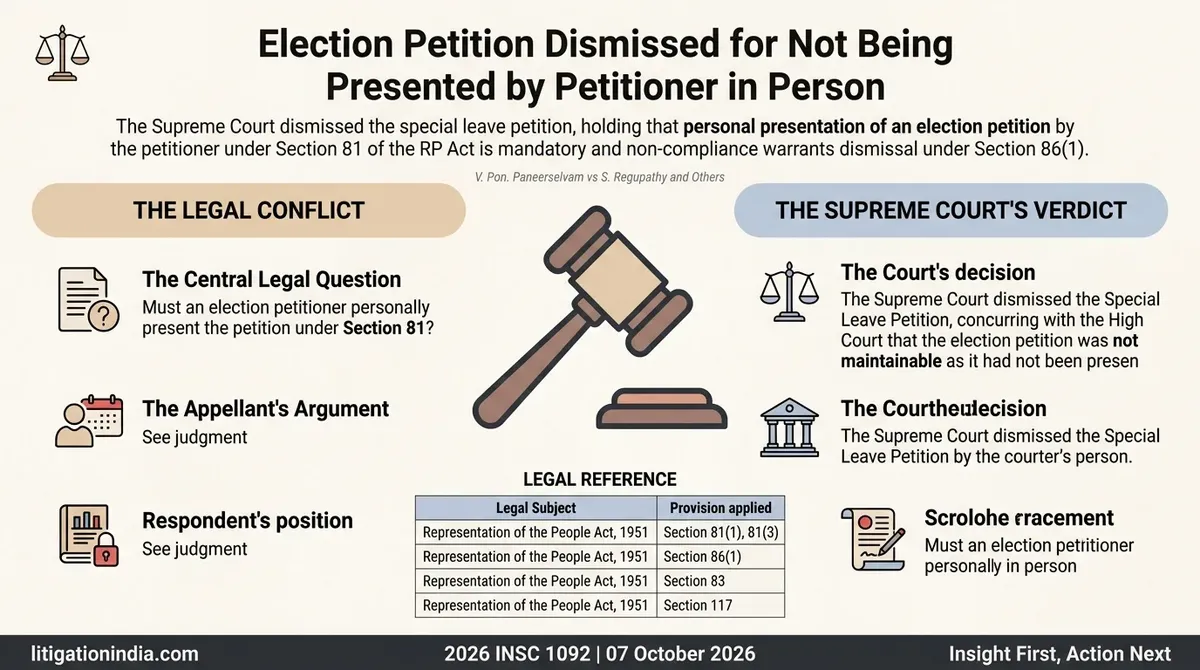
J U D G M E N T PRASHANT KUMAR MISHRA, J. 1) The question arising in the present petition is whether presentation of an election petition by the petitioner in person is a mandatory requirement under Section 81 of the Representation of the People Act, 19511, and whether non-compliance with such a requirement, if any, renders the election petition liable to dismissal at the threshold under Section 86(1) of the RP Act. 2) The lis stems from an election petition filed by the petitioner under Sections 80, 80A, 81, 83,100(1)(b), 100(1)(d)(i) & (iv) read with Section 123(2) of the RP Act and Rule 2 of the Rules of the Madras High Court Election Petitions, 1967 r/w Order II Rule 3 of the Rules of the High Court, Madras Original Side,1994, seeking the following reliefs : A. To declare the election of the Respondent No.1, Mr. S. Regupathy from 181- Thirumayam Assembly Constituency in the 2026 Tamil Nadu Legislative Assembly Elections declared on 04.05.2026 as
1 For short, ‘RP Act’ Digitally signed by NISHA KHULBEY Date: 2026.10.07 17:02:31 IST Reason: Signature Not Verified
SLP (C) No.30538/2026
Page 2 of 11
null and void under Section 100(1)(b) and Section 100(1)(d)(i) and (iv) of the RP Act; B. To hold that the Respondent No.1 is guilty of committing the corrupt practice of undue influence under Section 123(2) of the RP Act, for the deliberate suppression and false declaration of his spouse’s assets and income anomalies in the statutory Form 26 Affidavit; C. To award the exemplary costs of this election petition in his favour. 3) The grouse of the petitioner arises from the impugned judgment and order dated 22.07.2026 in ELP No.36/2026, whereby the High Court dismissed the petitioner’s election petition as not maintainable, predicating on the ground that the election petition had been presented by the petitioner’s counsel. The High Court referred to Rule 7 of the Madras High Court Election Petitions Rules, 1967, which mandated that every election petition shall be presented by the petitioner in person before the II Assistant Registrar, Original Side, High Court or, in his absence, before such officer of the Court as the Registrar of the High Court may direct. 4) Aggrieved by the above, the petitioner is at this Court’s threshold. 5) The present controversy needs to be examined in the light of Sections 81 and 86 of the RP Act, which respectively deal with the presentation of an election petition and the consequence of non-compliance with the statutory requirements. The relevant provisions are extracted below for reference : “81. Presentation of petitions.— (1) An election petition calling in question any election may be presented on one or more of the grounds specified in sub-section (1) of section 100 and section 101 to the High Court by any candidate at such election or any elector within forty-five days from, but not earlier than the date of election of the returned candidate or if there are more than
SLP (C) No.30538/2026
Page 3 of 11
one returned candidate at the election and dates of their election are different, the later of those two dates.
Explanation.—In this sub-section, “elector” means a person who was entitled to vote at the election to which the election petition relates, whether he has voted at such election or not.
(3) Every election petition shall be accompanied by as many copies thereof as there are respondents mentioned in the petition and every such copy shall be attested by the petitioner under his own signature to be a true copy of the petition.
86. Trial of election petitions.— (1) The High Court shall dismiss an election petition which does not comply with the provisions of section 81 or section 82 or section 117.
Explanation.— An order of the High Court dismissing an election petition under this sub-section shall be deemed to be an order made under clause (a) of section 98.”
6) A plain reading of section 81(1) of the RP Act reveals that the provision is cast in precise terms and prescribes the essential conditions governing the presentation of an election petition. In G.V. Sreerama Reddy and Another v. Returning Officer and Others2, this Court, while examining the scope of and import of Section 81(1), identified five distinct components embedded in the provision which read thus : “14. A close look at Section 81 reveals that the two remaining sub-sections after the amendment introduced by Act 47 of 1966 i.e. (1) and (3) deal with two distinct, but interrelated issues. Sub-section (1) deals with the necessary requirements of any petition challenging an election, and sub-section (3) deals with additional requirements as to the petition presented. Sub-section (1) has five components: (i) the qualification of the petitioner i.e. he/she must be either “a candidate at such election” or an “elector”; (ii) the petition must be presented “by” the petitioner; (iii) the petition must be based “on one or more of the grounds specified in sub-section (1) of Section 100 and Section 101; (iv) it must be presented in the High Court; and (v) it must be presented within 45 days from, but not earlier than the date of election of the returned candidate, or if there are more than one returned candidate at the election
2 (2009) 8 SCC 736
SLP (C) No.30538/2026
Page 4 of 11
and dates of their election are different, the later of those two dates. Therefore, all these five requirements are extremely specific and clear. This inference is further strengthened by Section 86(1) which provides that the “High Court shall dismiss an election petition which does not comply with the provisions of Section 81”. (emphasis supplied)
7) The significance attached to these requisites is further borne out by Section 86(1) of the RP Act, 1951, which mandates that the High Court shall dismiss an election petition which does not comply with the provisions of Section 81 of the Act. Thus, the requirement of presentation under Section 81 cannot be viewed as a mere procedural formality divorced from the statutory scheme, as its compliance bears direct nexus with the maintainability of the election petition and a defect, if any, shall not be curable. 8) The aforesaid requisites need to be understood in the context of the nature of the enactment itself. The RP Act is a special and self-contained code governing the disputes relating to elections. In K. Venkateswara Rao and Anr. v. Bekkam Narasimha Reddi & Ors.3, this Court, while considering whether the period prescribed under Section 81(1) could be enlarged by recourse to the Limitation Act, held that the RP Act, constituted a complete and self-contained code which did not admit of the introduction of the provisions or principles contained in the Limitation Act. The same approach was reiterated in Hukumdev Narain Yadav v. Lalit Narain Mishra4, wherein this Court emphasised the special character of the RP Act and the need for strict adherence to the requirements prescribed therein.
3 (1969) 1 SCR 679 4 (1974) 2 SCC 133
SLP (C) No.30538/2026
Page 5 of 11
9) It is also pertinent to emphasize the significance and the usage of the expression “by” occurring in Section 81(1) of the RP Act. In G.V. Sreerama Reddy (supra), this Court considered the underlying legislative insistence upon presentation by the election petitioner himself. This Court observed that an election petition is a serious proceeding which may result in the vitiation of an electoral process and that the procedure prescribed by an election statute must, therefore, be strictly followed. The requirement that the petition be presented “by” the petitioner enables the High Court, at the stage of presentation itself, to undertake a preliminary verification so as to ensure that the proceeding is not frivolous or vexatious. 10) The legislative history of Section 81 of the RP Act also assumes significance. As originally enacted, sub-section (2) of Section 81 expressly prescribed the manner in which an election petition could be presented to the Election Commission. The provision, as it stood then, reads thus : “81. Presentation of petitions.—(1) An election petition calling in question any election may be presented on one or more of the grounds specified in sub-section (1) of Section 100 and section 101 to the Election Commission by any candidate at such election or any elector within forty-five days from, but not earlier than, the date of election of the returned candidate, or if there are more than one returned candidate at the election and the dates of their election are different, the later of those two dates.
Explanation.—In this sub-section, ‘elector’ means a person who was entitled to vote at the election to which the election petition relates, whether he has voted at such election or not.
(2) An election petition shall be deemed to have been presented to the Election Commission- (a) when it is delivered to the Secretary to the Commission or to such officer as may be appointed by the Election Commission in this behalf- (i) by the person making the petition, or (ii) by a person authorized in writing in this behalf by the person making the petition; or
SLP (C) No.30538/2026
Page 6 of 11
(b) when it is sent by registered post and is delivered to the Secretary to the Commission or the officer so appointed.
(3) Every election petition shall be accompanied by as many copies thereof as there are respondents mentioned in the petition and one more copy for the use of the Election Commission, and every such copy shall be attested by the petitioner under his own signature to be a true copy of the petition.”
11) The aforesaid sub-section (2) was omitted by the Representation of the People (Amendment) Act, 1966. By the same amendment, the words “Election Commission” occurring in sub-section (1) were substituted by “High Court”. The statutory scheme which presently obtains is thus materially different from that which prevailed under the unamended provision. While the earlier Section 81(2) expressly recognised presentation through a person authorised in writing by the election petitioner and also by registered post, no such modes of presentation find recognition in the provision as it now stands. 12) The next facet of the present lis lies in question as to whether the High Court can prescribe rules for the presentation of an election petition, and if so, would such an act amount to non–conformity with the provisions of the RP Act. 13) This very question fell for consideration before this Court in the case of Jamal Uddin Ahmad v. Abu Saleh Najmuddin and Another5, therein the challenge was to the competence of the Gauhati High Court to frame rules providing for the receipt of an election petition by an officer of the Registry, in the absence of any corresponding provision in the RP Act. In particular, Chapter VIII-A, Rule 1 of the Gauhati High Court Rules permitted
5 (2003) 4 SCC 257
SLP (C) No.30538/2026
Page 7 of 11
an election petition under Section 80-A of the Act to be presented before the Stamp Reporter of the Court. The challenge proceeded, inter alia, on the basis that having regard to Section 169 of the RP Act, the power to frame rules for carrying out the purposes of the Act vested in the Central Government. The contention was also examined in the context of Articles 214, 216 and 329(b) of the Constitution of India. The Court, however, held that the controversy was devoid of merit and proceeded to examine the competence of the High Court to regulate the receipt of election petitions as an incident of the jurisdiction conferred upon it. 14) In this context, this Court reiterated the settled principle that the conferment of a statutory power carries with it, by necessary implication, the authority to employ all reasonable means to make that power effective. The express grant of jurisdiction thus carries with it such incidental and ancillary powers as may fairly and reasonably be regarded as consequential to, and necessary for the exercise of the substantive power. At the same time, the rule of implied power remains subject to the legislative intent and does not permit a procedure to be supplemented in a manner which would frustrate the purpose of the enactment. The Court, accordingly, recognised that where the statute confers jurisdiction but does not provide for some detail necessary for its proper and effectual exercise, the power to regulate such incidental matters may be inferred. 15) Furthermore, this Court distinguished between the judicial functions entrusted to Judges of the High Court and the administrative and ministerial functions which attend the exercise of that jurisdiction. While the judicial function is inalienable, administrative or ministerial functions
SLP (C) No.30538/2026
Page 8 of 11
may, in the absence of any rule of law to the contrary, be entrusted to or performed through the officers of the High Court. The receipt of a document presented to the Court, its preliminary scrutiny and the steps necessary to place it before the Judge were recognised as functions of an administrative or ministerial character, capable of being entrusted to the Registry. Such authorisation does not constitute a delegation of the judicial function and is an incident of the administration of the jurisdiction vested in the Court. 16) It was further held that the position was not altered by the omission, from the amended Section 81, of the provision which had earlier specified the officers through whom an election petition could be presented. The High Court, unlike the Election Commission under the unamended provision, was a pre-existing constitutional institution, a court of record exercising plenary jurisdiction, and possessed its own rules, directions and practice governing the reception of documents presented to it. The absence of an express statutory provision identifying the officer competent to receive an election petition, therefore, did not render such reception impermissible. The Court invoked the principle cursus curiae est lex curiae—the practice of the Court is the law of the Court, and observed that even in the absence of Chapter VIII-A of the Gauhati High Court Rules, there would have been nothing impermissible in the High Court or the Chief Justice authorising an officer to receive an election petition so as to facilitate the exercise of the jurisdiction conferred upon the High Court. 17) The Court ultimately observed that the High Court and the Chief Justice, as the case may be, possess the power to frame rules and issue directions regulating the affairs and conduct of business of the High Court.
SLP (C) No.30538/2026
Page 9 of 11
Even where no express rule exists, a prevailing practice concerning an administrative or ministerial function may be sustained where it is incidental and essential to the performance of the Court's judicial functions, unless there is something inherently objectionable or impermissible in it. Thus, where such a rule or practice does not run counter to any rule of law, the High Court is competent to regulate, through its Rules or directions, the ministerial and procedural incidents attending the exercise of the jurisdiction conferred upon it by statute. 18) Approaching the present controversy through the lens of Jamal Uddin Ahmad (supra), Rule 7 of the Madras High Court Election Petitions Rules, 1967 cannot be said to travel beyond the statutory scheme of Section 81 of the RP Act. The rule regulates the manner in which an election petition is to be presented and received before the High Court and, in doing so, operates as an incident of the jurisdiction conferred upon the High Court by the RP Act. The rule does not, by its terms, trench upon or run contrary to any requirement expressly prescribed by Section 81 of the Act. 19) Reverting to factual sphere of the case, the petitioner asserts that he personally presented the Election Petition before the Registry on 16.06.2026. However, this assertion is not supported by any contemporaneous record evidencing the act of presentation itself. The CISF entry pass relied upon by him establishes his entry into the premises of the High Court on 16.06.2026; it does not establish anything remotely suggesting that he personally presented the petition. Significantly, the receipt evidencing the security deposit under Section 117 of the RP Act was issued in the name of the petitioner’s counsel. As regards the CCTV footage, the petitioner asserts
SLP (C) No.30538/2026
Page 10 of 11
that it captured the presentation and his personal verification, the footage itself, can at the highest, establish the petitioner’s presence in the premises and nothing else. 20) As far as the reliance placed on the decision of this Court in Dr. Vijay Laxmi Sadho v. Jagdish6 is concerned, the same is misplaced. The question therein arose in a different factual standing as Rule 2(b) of the Madhya Pradesh High Court Rules therein prescribed that an election petition must be presented in English language, though Section 81 of the RP Act contained no such requirement. It was in that context that this Court held that non-compliance with a requirement originating solely in the High Court rules could not attract Section 86(1) of the Act. 21) The decision, in fact, draws a clear distinction between the requirements of Section 81 and those of Section 83. While considering the consequence of non-compliance with Section 83(1), this Court held that such defect could not entail dismissal under Section 86(1), since Section 83 is not one of the provisions specified in Section 86(1). The Court, however, expressly affirmed that an election petition which does not comply with the requirements of Section 81 is liable to dismissal in limine under Section 86(1). The observation in paragraph 97 of Vijay Laxmi Sadho (supra), upon which reliance is placed, must therefore be understood in that statutory
6 (2001) 2 SCC 247
7 9. An election petition is liable to be dismissed in limine under Section 86(1) of the Act only if the election petition does not comply with either the provisions of “Section 81 or Section 82 or Section 117 of the Act”. The requirement of filing an affidavit along with an election petition in the prescribed form, in support of allegations of corrupt practice is contained in Section 83(1) of the Act. Thus an election petition is not liable to be dismissed in limine under Section 86 of the Act, for alleged non-compliance with the provisions of Section 83(1) of the Act or of its proviso. What other consequences, if any, may follow from an allegedly “defective” affidavit, is to be judged at the trial of an election petition but Section 86(1) of the Act in terms cannot be attracted to such a case.
SLP (C) No.30538/2026
Page 11 of 11
context; it concerns a defect under Section 83 and not a non-compliance with Section 81. The present case, on the contrary, concerns a requirement expressly contained in Section 81(1). 22) It is also not the petitioner’s case that he was present along with his counsel while presenting the election petition, so as to render it substantially compliant with the requirement under Section 81 of the Act as held in Sheo Sadan Singh v. Mohan Lal Gautam8. In that case, the election petition had been presented by the advocate’s clerk in the immediate presence of the petitioner, and this Court affirmed the finding of the High Court, that the requirement of presentation by the petitioner stood satisfied in substance though not in form. 23) In view of the above reasoning and observations, we find ourselves impelled to concur with the view taken by the High Court. 24) Accordingly, the Special Leave Petition is sans merit and stands dismissed.
………………….........................J.
(PRASHANT KUMAR MISHRA)
………………............................J.
(SHREE CHANDRASHEKHAR)
NEW DELHI; OCTOBER 07, 2026.
8 (1969) 1 SCC 408