
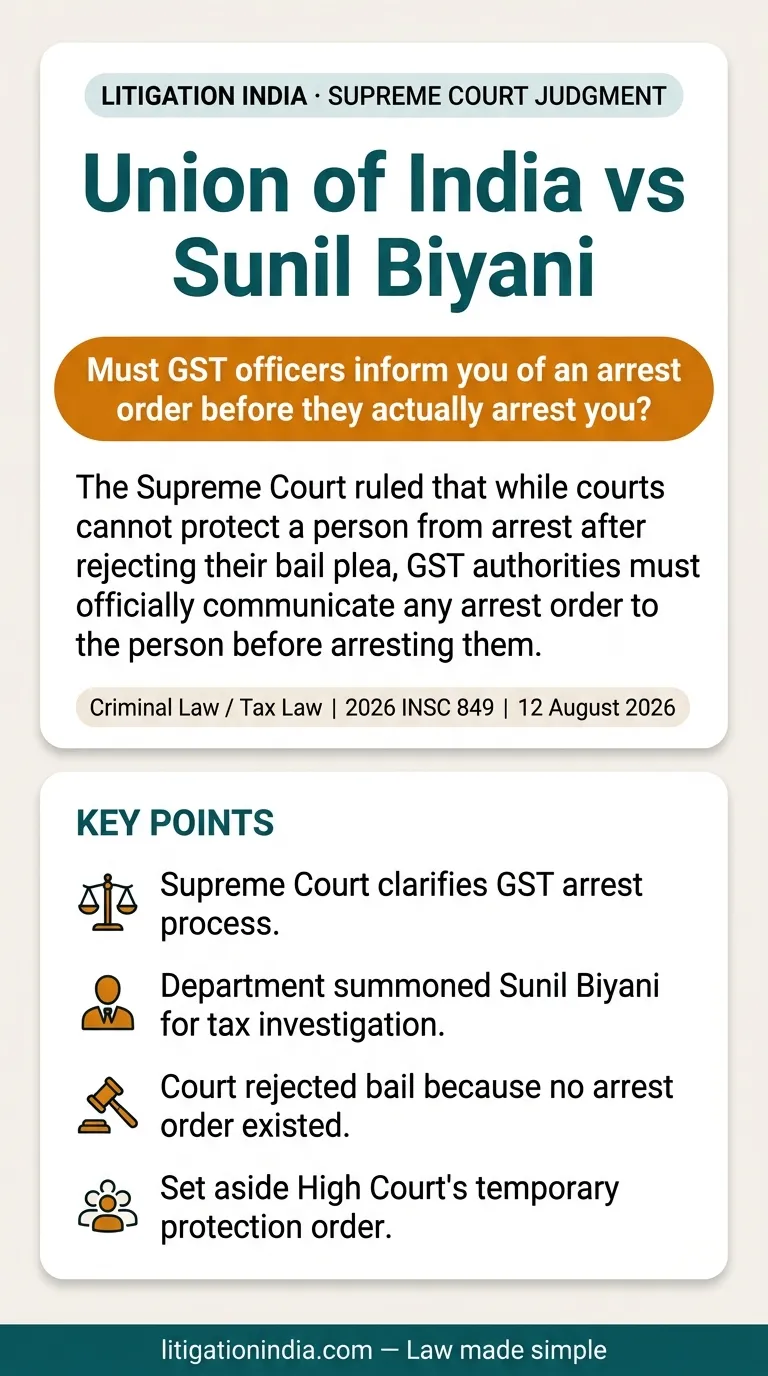
Must GST officers inform you of an arrest order before they actually arrest you?
Union of India vs Sunil Biyani
Case: Union of India vs Sunil BiyaniCitation: 2026 INSC 849Decided on: 12 August 2026
“The Supreme Court ruled that while courts cannot protect a person from arrest after rejecting their bail plea, GST authorities must officially communicate any arrest order to the person before arresting them.”
Story Slides
In short
In this case, the respondent was being investigated for GST tax fraud and received summonses. He applied for anticipatory bail, but the Bombay High Court rejected it because the GST Commissioner had not yet issued a formal arrest order under Section 69 of the CGST Act. However, while dismissing his bail, the High Court ordered that he should not be arrested for one week after being informed of any future arrest order. The Union of India challenged this. The Supreme Court made two major rulings. First, it held that once a court dismisses an anticipatory bail plea or finds it not maintainable, it cannot grant any interim protection from arrest. Interim protection can only exist while a case is pending, not after it is rejected. Therefore, the High Court's one-week protection was invalid and was set aside. Second, the Court addressed a vital rights issue: must the GST Commissioner's arrest order be shared with the person? The Court held that to protect personal liberty and allow a person to seek legal remedies, the arrest order under Section 69 must be communicated to the person (such as via email or mobile phone) before they are arrested. In fact, the Court declared that without communicating this order, the question of arrest does not even arise.
Need clarity on a similar legal issue?
Request free pro bono guidance from a Supreme Court Advocate.
Background
The GST Department was investigating Sunil Biyani for tax fraud and issued him summonses. Biyani applied for anticipatory bail, which the High Court rejected because no formal arrest order had been passed against him yet; however, the High Court still granted him a week's protection from arrest if such an order were issued in the future.
The Decision
The Supreme Court set aside the High Court's order protecting Biyani from arrest, ruling that courts cannot grant interim protection after dismissing a bail application. However, it ordered that the GST Commissioner must communicate any arrest order under Section 69 to the accused before arresting them, failing which they cannot be arrested.
Why it matters for you
This judgment is a landmark shield for personal liberty in tax cases. It ensures that GST departments cannot conduct secret arrests; they must inform citizens of arrest orders beforehand so individuals can exercise their constitutional right to seek bail.
AI-assisted summary, reviewed and verified by our editorial team.
Need help with your case?
Facing a similar legal challenge in the Supreme Court or High Court? Connect with our pro bono volunteer advocates today.
Related Supreme Court services