
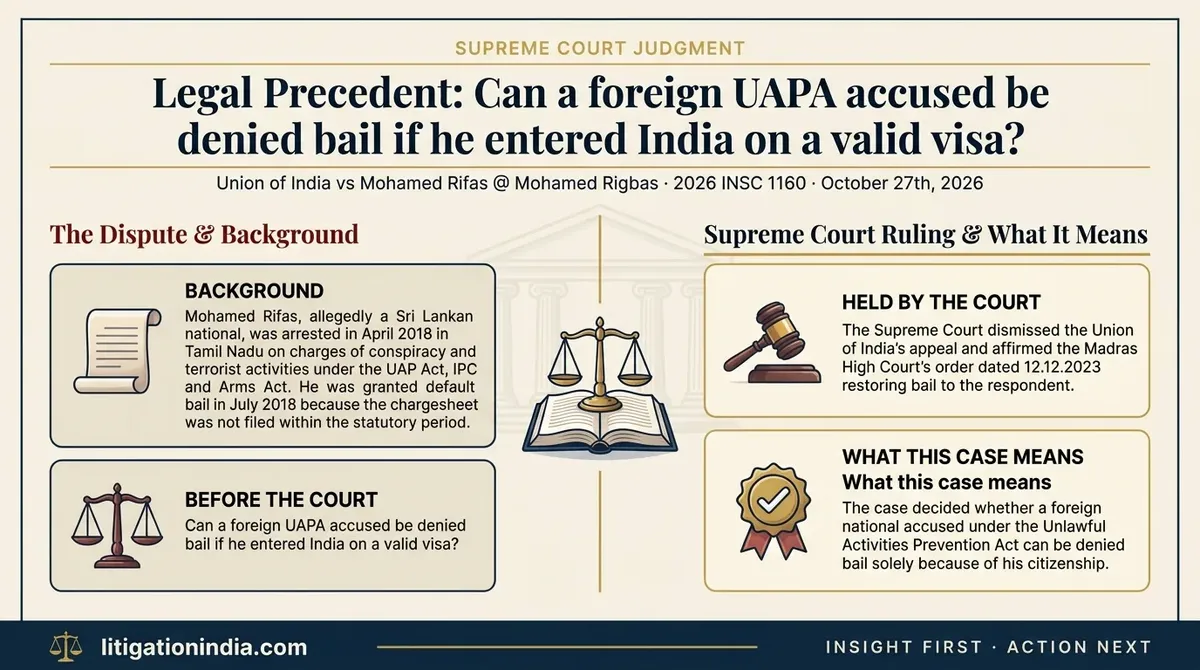
Full text of the judgment
Text extracted from Union of India vs Mohamed Rifas @ Mohamed Rigbas. For the authoritative version refer to the Supreme Court of India's official website.
2026 INSC 1160 SLP (Crl.) No. 7177 of 2024
Page 1 of 34
IN THE SUPREME COURT OF INDIA CRIMINAL APPELLATE JURISDICTION
CRIMINAL APPEAL NO(S). OF 2026 Arising out of SLP (Criminal) No(s). 7177 of 2024
UNION OF INDIA … APPELLANT(S)
MOHAMED RIFAS @ MOHAMED RIGBAS … RESPONDENT(S)
J U D G M E N T
“The issue of bail is one of liberty, justice, public safety and burden of the public treasury, all of which insist that a developed jurisprudence of bail is integral to socially sensitized judicial process.”
Justice V.R. Krishna Iyer ARAVIND KUMAR J.
1. Heard. 2. Leave Granted. 3. IA No(s). 78440 of 2025 and 203232 of 2026 are allowed. Digitally signed by RASHI GUPTA Date: 2026.10.27 17:48:41 IST Reason: Signature Not Verified
SLP (Crl.) No. 7177 of 2024
Page 2 of 34
4. The present appeal raises a substantial question of law, that is: whether a foreign citizen, accused of offence punishable under Unlawful Activities Prevention Act, 1967 (for short “UAP Act”), is entitled for grant of bail in the light of restriction under Section 43D(7) of the UAP Act, falls for our consideration by way of challenge to the Judgement and Order dated 12.12.2023 passed by the Madras High Court in Criminal Appeal No. 1000 of 2022 (for Short “Impugned Order”) whereby the Division Bench of the High Court has allowed the appeal preferred by the respondent herein and set aside the order dated 05.07.2022 passed by the Learned Special Court under the National Investigation Agency Act, 2008 (Sessions Court for Exclusive Trial of Bomb Blast Cases) at Chennai in Crl. M.P. No. 213 of 2022 (for short “Learned Trial Court”) which had allowed the cancellation of bail granted to respondent vide order dated 05.07.2018 by the court of Principal District and Sessions Judge, Ramanathpuram (for short “Sessions Court”) in Crl. MP No. 1292 of 2018. FACTUAL MATRIX 5. Succinctly, the facts are that respondent herein was arrayed as one of the accused in FIR No. 46/2018 dated 02.04.2018 registered at PS Keelakarai, Tamil Nadu for offences
SLP (Crl.) No. 7177 of 2024
Page 3 of 34
punishable under Section(s) 153A and 120B of Indian Penal Code, 1860 (for short “IPC”), Section(s) 15, 17, 18, 19 and 20 of UAP Act and Section 25(1)(a) of the Arms Act, 1959 on the allegation of hatching a conspiracy to bring disharmony amongst the religious communities and against the government and was arrested. On 03.07.2018, the respondent preferred petition under Section 439 of the Code of Criminal Procedure, 1973 (for short “Cr.P.C.”) seeking regular bail before the Sessions Court. On 05.07.2018, the Sessions Court after considering the material on record granted default bail under Section 167(2) of Cr.P.C. since the prosecution had not filed the chargesheet within the prescribed statutory limit. 6. On 09.01.2019 an order came to be passed by the Ministry of Home Affairs whereby considering the gravity of the offence in Crime No. 46 of 2018, the National Investigation Agency (for short “NIA”) was directed to conduct thorough investigation to unearth a larger conspiracy in accordance with provisions of National Investigation Agency Act, 2008 (for short “NIA Act”). As such, on 10.01.2019, the NIA took over the investigation of Crime No. 46 of 2018 and re-registered the FIR as RC-01/2019/NIA/DLI in NIA PS New Delhi under the same penal provisions. The said FIR alleged that the
SLP (Crl.) No. 7177 of 2024
Page 4 of 34
respondent knowingly and intentionally organized besides participated along with other accused persons in criminal conspiracy and met at different places in Tamil Nadu with intent of inciting the co-accused persons and others for disrupting communal harmony, to cause enmity and hatred between religious groups and to cause dissatisfaction against Government of India by waging armed struggle to liberate their associates who are lodged in prisons, as such, committing terrorist act under UAP Act. It is also alleged that respondent possessed sharp edged weapon collected as part of preparations to commit unlawful activity and terrorist acts. 7. Meanwhile, on 29.11.2019, another FIR No. 188 of 2019 came to be lodged under Section(s) 468 and 471 of the IPC, Section 14 of the Foreigners Act, 1946, Section 3(a) and 6(a) of the Passport (Entry into India) Rules, 1950, Section 6(c) of the Passport Act, 1967 and Section 2(1)(b)(I) of the Citizenship Act, 1955 against the respondent herein on his alleged confession to a Village Administrative Officer, complainant in the said FIR, on 28.11.2019, that respondent is a Sri Lankan national holding passport no. M1 103657, who entered into India in 2009 and overstated his visa and thereafter illegally obtained Indian Voter ID Card, Aadhar Card and Ration Card
SLP (Crl.) No. 7177 of 2024
Page 5 of 34
and got married in 2011 to one Rosen Salma and has four children with whom he resides at Keejakarai. 8. On 23.01.2021, the NIA filed the chargesheet against 10 accused persons including the respondent herein under various provisions of IPC, UAP Act and Arms Act in connection with FIR No. RC-01/2019/NIA/DLI to which the trial court took cognizance and the same was registered as CC No. 01 of 2021. 9. On 29.04.2022, the appellant moved an application under Section 439(2) of Cr.P.C. bearing Crl. MP No. 213 of 2022 seeking cancellation of bail granted to the respondent vide order dated 05.07.2018 while relying upon FIR No. 188 of 2019 on the ground that respondent suppressed the material fact that he is Sri Lankan citizen and intentionally misrepresented in his bail petition at Para no. 5 that he is a law abiding citizen to bypass the mandate of Section 43D(7) of UAP Act which restricts grant of bail to a foreign citizen accused of offences punishable under the UAP Act. 10. On 05.07.2022, the Learned Trial Court after considering the grounds urged by the appellant and the counter affidavit filed by the respondent, allowed the application and cancelled the bail granted to the respondent vide order dated 05.07.2018 relying upon Section 43D(7) of UAP Act.
SLP (Crl.) No. 7177 of 2024
Page 6 of 34
11. Aggrieved by the order of the learned Trial Court, the respondent preferred Criminal Appeal no. 1000 of 2022 before the Madras High Court wherein the present Impugned Order came to be passed by allowing the appeal and setting aside the order dated 05.07.2022 which cancelled the bail. Hence, the present appeal.
FINDINGS OF THE IMPUGNED ORDER
12. The High Court considered Section 43D(7) of the UAP Act and held that the said provision does not take away the discretion of the court and even if such restriction is mandated, the court can still grant bail to a person who is not a citizen of India under extraordinary circumstances. 13. The High Court further held that the learned Trial Court had no power to review its own order in terms of judgement in Abdul Basit Alias Raju and Others v. Mohd. Abdul Kadir Chaudhary and Another1, as such, appellant herein ought to have filed an appeal against order dated 05.07.2018 rather than seeking cancellation of bail before the same court. The High Court did not accept the explanation tendered by the appellant herein that since the statutory period of limitation had expired
1 (2014) 10 SCC 754
SLP (Crl.) No. 7177 of 2024
Page 7 of 34
for filing an appeal, appellant was constrained to file a petition for cancellation of bail. 14. The High Court further observed that apart from the FIR No. 188 of 2019 based on the alleged confession given by respondent to the Village Administrative Officer, the appellant had no other independent material to establish that respondent is a Sri Lankan National and he had entered the Indian territory illegally. The High Court further observed that even if it is assumed that respondent is a Sri Lankan national, he was granted bail in 2018, as such, his liberty cannot be curtailed after four years, merely because there is an FIR registered in 2019. The High Court also took note of the fact that petition seeking cancellation of bail was not filed by the appellant immediately after the registration of FIR but rather three years after the registration of FIR in Crime No. 188 of 2019, therefore, liberty could not have been curtailed especially in the light of non-explanation of any reason for the delay seeking in cancellation of bail. As such, the High Court was inclined to allow the appeal preferred by the respondent herein and quash the order dated 05.07.2022 which cancelled the bail granted to the respondent vide order dated 05.07.2018.
SLP (Crl.) No. 7177 of 2024
Page 8 of 34
SUBMISSIONS ON BEHALF OF THE APPELLANTS 15. We have heard Ms. Aishwarya Bhati, Learned Additional Solicitor General of India appearing on behalf of the appellant. 16. It is contended that Sessions Court did not become functus officio under Section 362 of the Cr.P.C. as it is well settled principle of law that same court which granted the bail is entitled to cancel the bail on finding “new material or circumstances” at any point of time. To buttress the said contention, Learned ASG placed reliance upon the decision of this court in Bhadresh Bipinbhai Sheth v. State of Gujarat and Another2. Learned ASG has also placed reliance on Abdul Basit (supra) to contend that the said decision which has been relied by the High Court under the Impugned Order to allow the appeal, itself holds before a Court of Session which has admitted an accused person to bail, the state has two options. It may move to the Sessions Judge if certain new circumstances have arisen which were not earlier known to the State to seek cancellation to the same court and the State may as well approach the High Court being the superior court under Section 439(2) to commit the accused to custody.
2 (2016) 1 SCC 152
SLP (Crl.) No. 7177 of 2024
Page 9 of 34
17. It is further submitted that there has been suppression of fact that respondent was a Sri Lankan national which is a supervening factor justifiable for seeking cancellation of bail since such suppression is a clear attempt on the part of respondent to avoid rigor of Section 43D (7) of UAP Act. Reliance has been placed on Kusha Duruka v. State of Odisha3, whereby petitioner therein had obtained bail from High Court without disclosing the fact that Special Leave Petition for the same relief was pending before the Supreme Court, as such, this court observed that “court is not a laboratory where children come to play”, as such, in case of suppression of material fact which was well within the special knowledge of accused, he cannot be allowed to gain advantage of the same in court of law and the order cannot be allowed to stand. 18. It is also submitted that where a strong case for commission of a non-bailable offence is made out from the chargesheet, default bail granted under Section 167(2) can be cancelled. Reliance has been placed on State through Central Bureau of Investigation v. T Gangi Reddy Alias Yerra Gangi Reddy4.
3 Criminal Appeal No. 303 of 2024 4 (2023) 4 SCC 253
SLP (Crl.) No. 7177 of 2024
Page 10 of 34
19. It is further submitted that respondent possesses a Sri Lankan Passport bearing number MI 103657 is sufficient prima facie evidence to establish that he is not an Indian National, as such, the fact that respondent was earlier enjoying the benefit of bail for four years cannot by itself be a ground for the High Court to set aside the order of Sessions Court which had rightly cancelled the bail upon finding that respondent was a foreign national. As such, appellant has prayed for setting aside of the Impugned Order. SUBMISSIONS ON BEHALF OF THE RESPONDENT 20. Per contra, Shri A Velan, learned counsel appearing on behalf of the respondent vehemently opposed the appellant’s prayer and submitted that trial court vide order dated 05.07.2018 granted statutory bail to the respondent as the chargesheet was not filed within the prescribed period by the investigating agency. The appellants had not filed an appeal against the grant of statutory bail as such same had attained finality. 21. He has contended that High Court rightly observed that appellant did not produce any independent material to establish that respondent is a Sri Lankan national and he had entered the country illegally. The respondent has placed reliance upon the
SLP (Crl.) No. 7177 of 2024
Page 11 of 34
documents such as voter ID issued by Election Commission of India, Birth certificates issued by the Govt of Tamil Nadu, Family Card and Aadhar Card of himself, his wife and their children to content that he is a citizen of India. 22. He has placed reliance upon the decision of High Court dated 16.12.2024 in W.P. (MD) No. 19538 of 2021 whereby the respondent was allowed to reside with his wife at his residence, to contend that there exists no prima facie case that respondent is a foreign national. It is further contended that said order has also not been challenged in appeal, which has attained finality and as such there is no merit in the contention raised by appellant. 23. On Section 43D(7) UAP Act, it has been submitted that stringent requirements for grant of bail to a foreign national has to be strictly construed and burden of prima facie proof is on the prosecution. However, in the present case, appellant did not produce a speck of material to establish the factum of nationality of the respondent. The claim of the appellant rests on a pending proceeding in FIR No. 188 of 2019 solely on the alleged confession of the respondent to the Village Administrative Officer, which has no evidentiary value in the
SLP (Crl.) No. 7177 of 2024
Page 12 of 34
light of Section 25 of the Indian Evidence Act, 1872 (for short “Evidence Act”). 24. It is also submitted that non-obstante clause in Section 43D(7) of the UAP Act is restricted to sub-clause (5) and (6) of Section 43D and does not exclude the mandate of grant of default bail as modified by Section 43D(2). 25. It is further submitted that bail cancellation must be based on valid legal grounds such as the accused’s misconduct, violation of bail conditions, or intimidation of witnesses, rather than on premature and prejudicial findings on factual issues that are yet to be adjudicated during trial, i.e., nationality of Respondent, in the present case. To buttress the said contention, reliance is placed on Samarendra Nath Bhattacharjee v. State of W.B. and Another5, whereunder it has been categorically held that while considering bail conditions, court should refrain from making premature factual determinations that may prejudice the fair trial process. 26. It is also submitted that the cancellation of bail is not equivalent to the initial rejection of bail, as it necessitates a review of an already reasoned judicial determination. To buttress the said
5 (2004) 11 SCC 165
SLP (Crl.) No. 7177 of 2024
Page 13 of 34
contention, learned counsel has relied upon the law laid down by this Court in State (Delhi Administration) v. Sanjay Gandhi6. 27. Lastly, it has been contended that three grounds that appellant predominantly relies upon are alleged suppression of Sri Lankan Nationality, reviewability of bail orders by the granting court and mandate of Section 43D(7) UAP Act which are legally untenable. As such, he has prayed to dismiss the present appeal. FINDINGS AND REASONINGS On interpretation and application of Section(s) 43D(2) and 43D(7) of UAP Act 28. As stated at the outset, the adjudication of present appeal directly pertains to interpretation of Section 43D(7) UAP Act and collaterally Section 43D(2). Hence, we deem it is apt and appropriate to refer Section 43D of UAP Act and the same is extracted hereinbelow for reference: 43D. Modified application of certain provisions of the Code. — (1) Notwithstanding anything contained in the Code or any other law, every offence punishable under this Act shall be deemed to be a cognizable offence within the meaning of clause (c) of section 2 of the Code, and
6 (1978) 2 SCC 411
SLP (Crl.) No. 7177 of 2024
Page 14 of 34
“cognizable case” as defined in that clause shall be construed accordingly. (2) Section 167 of the Code shall apply in relation to a case involving an offence punishable under this Act subject to the modification that in sub-section (2),— (a) the references to “fifteen days”, “ninety days” and “sixty days”, wherever they occur, shall be construed as references to “thirty days”, “ninety days” and “ninety days” respectively; and (b) after the proviso, the following provisos shall be inserted, namely: “Provided further that if it is not possible to complete the investigation within the said period of ninety days, the Court may if it is satisfied with the report of the Public Prosecutor indicating the progress of the investigation and the specific reasons for the detention of the accused beyond the said period of ninety days, extend the said period up to one hundred and eighty days: Provided also that if the police officer making the investigation under this Act, requests, for the purposes of investigation, for police custody from judicial custody of any person in judicial custody, he shall file an affidavit stating the reasons for doing so and shall also explain the delay, if any, for requesting such police custody.
(3) Section 268 of the Code shall apply in relation to a case involving an offence punishable under this Act subject to the modification that— (a) the reference in sub-section (1) thereof—
SLP (Crl.) No. 7177 of 2024
Page 15 of 34
(i) to “the State Government” shall be construed as a reference to “the Central Government or the State Government.”; (ii) to “order of the State Government” shall be construed as a reference to “order of the Central Government or the State Government, as the case may be”; and (b) the reference in sub-section (2) thereof, to “the State Government” shall be construed as a reference to “the Central Government or the State Government, as the case may be”. (4) Nothing in section 438 of the Code shall apply in relation to any case involving the arrest of any person accused of having committed an offence punishable under this Act. (5) Notwithstanding anything contained in the Code, no person accused of an offence punishable under Chapters IV and VI of this Act shall, if in custody, be released on bail or on his own bond unless the Public Prosecutor has been given an opportunity of being heard on the application for such release: Provided that such accused person shall not be released on bail or on his own bond if the Court, on a perusal of the case diary or the report made under section 173 of the Code is of the opinion that there are reasonable grounds for believing that the accusation against such person is prima facie true. (6) The restrictions on granting of bail specified in sub-section (5) is in addition to the restrictions under the Code or any other law for the time being in force on granting of bail. (7) Notwithstanding anything contained in subsections (5) and (6), no bail shall be granted to a person accused of an offence punishable under this Act, if he
SLP (Crl.) No. 7177 of 2024
Page 16 of 34
is not an Indian citizen and has entered the country unauthorisedly or illegally except in very exceptional circumstances and for reasons to be recorded in writing.
29. A bare perusal of the Section 43D reveals that it pertains to modified application of certain provisions of Cr.P.C. Subsection (2) of Section 43D clearly mandates that Section 167 of Cr.P.C. will be applicable to offences punishable under the UAP Act provided with modification that is, enhancement of number of days required for completion of investigation, as such, the maximum period mandated by the said sub-section for completion of investigation pertaining to an offence punishable under UAP Act is 90 days which is extendable to the maximum period of 180 days subject to report of public prosecutor and specific reason assigned for continuation of detention as envisaged in the proviso, as such, undoubtedly Section 167(2) of Cr.P.C. which pertains to default bail is applicable to investigation of offences punishable under UAP Act. It is trite law that where bail is granted under Section 167(2) Cr.P.C., it acts as deeming fiction whereby the release of the accused person is equated to his release under Chapter XXXIII of Cr.P.C. empowering the Courts to cancel the bail.
SLP (Crl.) No. 7177 of 2024
Page 17 of 34
30. Sub-section 43D(7) commences with a non-obstante clause overriding the mandate envisaged under sub-sections (5) and (6) of Section 43D and provides that “no bail shall be granted to a person accused of an offence punishable under UAP Act, if he is not an Indian Citizen and has entered the country unauthorizedly or illegally”. This happens to be the initial part of sub-section (7) of Section 43D which indicates the ingredients for its application, as such, it is pertinent to enumerate these ingredients at the outset, which in our considered view, are sine qua non for application of the said sub-section: a. First, the person needs to be an accused of an offence punishable under the UAP Act; b. Second, such person must not be an Indian Citizen; and c. Third, he must have entered India unauthorizedly or illegally.
31. Thus, if these three conditions stand satisfied by the prosecution prima facie, it appears that the court would be barred from exercising jurisdiction in favour of grant of bail. However, there is more to the said sub-section than meets the eye. Pertinently, the legislature has explicitly used the conjunction “and” between second and third condition as
SLP (Crl.) No. 7177 of 2024
Page 18 of 34
envisaged under the said sub-section, mandating a conjunctive reading, therefore, merely because a person is not an Indian Citizen will not suffice to trigger the rigors of sub-section (7) of Section 43D rather the condition mandating “at the time he entered India”, such entry must be either unauthorized or illegal must also co-exist, therefore, a probable inference that can be drawn herein is that where a foreign national enters India under an authorization or through a legal process such as a valid visa, mere fact that subsequently, such authorization is revoked or the stay becomes illegal will not retroactively convert a lawful entry into an “unauthorized or illegal entry” warranting invocation of sub-section (7) of Section 43D and what is required and necessary is that when such person entered India initially such entrance itself was unauthorized or illegal. Unless, these conditions are satisfied, the statutory bar under Section 43D(7) cannot be invoked. Therefore, the prosecuting agency will have to establish prima facie the aforesaid three conditions to restrain the courts from exercising its jurisdiction to grant bail to an accused of an offence punishable under UAP Act who is a foreign national. 32. Though it appears that judicial discretion, once all conditions are prima facie established, is absolutely barred by use of the
SLP (Crl.) No. 7177 of 2024
Page 19 of 34
expression “no bail shall be granted” by the legislature, the latter part of sub-section (7) channels a narrow scope for exercise of judicial discretion even when all the condition discussed above stand fulfilled. The relevant part opening such narrow window of judicial discretion is discernible through the expressions “except in very exceptional circumstances and reasons to be recorded in writing” occurring in the latter part of said sub-section. The said expression makes it apparent that the exception for grant of bail to a foreign national even when the above three conditions stand satisfied can be carved out but again such carving out has an extremely high threshold which is inherent therein itself by use of two expressions “very exceptional circumstances” and “reasons to be recorded in writing”. By the usage of said two expressions, again the legislative intent is explicitly apparent that even though the court is of the considered opinion that a foreign national, who is an accused of an offence punishable under UAP Act, is entitled for grant of bail unless there is an “exceptional circumstances” that too is qualified by the word “very” which warrants a standard extremely high showing a strong exceptional circumstance, the court shall not exercise its judicial discretion in favour of the accused person but even
SLP (Crl.) No. 7177 of 2024
Page 20 of 34
then where the court is of considered opinion to exercise such discretion, it has to record reasons in writing explaining such circumstances which warrants such exercise of judicial discretion for grant of bail in favour of the accused person. The burden of showing such “very exceptional circumstances” will solely lie on the shoulders of the accused person which may impel the courts to exercise the judicial discretion in favour of grant of bail. What can be a “very exceptional circumstances” would depend upon the facts and circumstances of each case and there cannot be straight jacket formula or a pigeonhole to exhaustively lay down those circumstances herein. Therefore, we are of the considered view, that Section 43D(7) creates a very high bar to be satisfied by the accused person once the prosecution establishes prima facie ingredients of sub-section (7) of Section 43D exists. The legislative intent warranting such high threshold is primarily backed by considerations of national security, larger public interest and sovereignty of India. Relevancy of Confession allegedly made by the respondent to Village Administrative Officer, the complainant in FIR No. 188 of 2019 33. The High Court under the impugned order has recorded that FIR No. 188 of 2019 alleging Sri Lankan nationality of the
SLP (Crl.) No. 7177 of 2024
Page 21 of 34
respondent was based on alleged confession given by the respondent to the Village Administrative Officer and there was no other independent material to establish that the respondent was a Sri Lankan National. The relevant portion of the impugned order is extracted herein below for reference: That apart, the version of the respondent that the appellant is a Sri Lankan national and had entered the country illegally is based on an FIR registered by Keelakarai Police Station in Crime No. 188 of 2019, which in turn was registered on the alleged confession given by the appellant to the Village Administrative Officer. Admittedly, there is no Final Report in the said FIR. The respondent also has no other independent material to establish that the appellant is a Sri Lankan national, and that he entered the country illegally.
34. The respondent has also submitted the claim of the appellant rests on a pending proceeding in FIR No. 188 of 2019 solely on the alleged confession of the respondent to the Village Administrative Officer, which has no evidentiary value in the light of Section 25 of the Evidence Act. 35. We are conscious of the fact that at stage consideration for grant or cancellation of bail, the courts cannot conduct a mini trial to appreciate the evidentiary value of each factual matrix, and the exercise is confined to prima facie satisfaction which makes the grant or cancellation of bail probable or improbable.
SLP (Crl.) No. 7177 of 2024
Page 22 of 34
36. Keeping the said principle in mind, when we consider the prima facie veracity of the alleged confession made by the respondent herein to the Village Administrative Officer, the complainant in FIR No. 188 of 2019, we are of the considered view that both the reasoning rendered by the High Court under the impugned order and the submission of the respondent lack merit. We say so because it is settled position of law by this court through catena of decisions including Sivakumar v. State by Inspector of Police7, R. Kuppusamy v. State represented by Inspector of Police, Ambeiligai8, Baskaran and Another v. State of Tamil Nadu9 and Kadamanian Alias Manikandan v. State represented by Inspector of Police10, that an extrajudicial confession made to the Village Administrative Officer who is not acting under the authority of a police officer is not inadmissible under Section 25 of the Evidence Act (corresponding to Section 23(1) of Bharatiya Sakshya Adhiniyam, 2023) since a Village Administrative officer is not a police officer for the purpose of Section 25 of Evidence Act. Therefore, such confession is not hit by embargo contained
7 (2006) 1 SCC 714 8 (2013) 3 SCC 322 9 (2014) 5 SCC 765 10 (2016) 9 SCC 325
SLP (Crl.) No. 7177 of 2024
Page 23 of 34
under Section 25 subject to the court being satisfied as to its voluntariness, truthfulness and credibility. 37. As such, prima facie we are of the considered view that alleged confession tendered by the respondent to the complainant in FIR No. 188 of 2019 holds some veracity and cannot be brushed aside altogether. However, it is suffice to say that probative value of such alleged confession has to be considered by the trial court at relevant stage of appreciation of evidence and our view is merely based on the prima facie satisfaction. LEGAL PRINCIPLES ON CANCELLATION OF BAIL 38. It is settled principle of law that parameters of setting aside a perverse or illegal order of grant of bail are different than those of cancellation of bail. The scope of power of High Court to cancel bail has been discussed by this Court in Gurcharan Singh and Others v. State (Delhi Administration)11, wherein this court observed: “16. Section 439 of the new code confers special powers on the High Court or Court of Session regarding bail. This was also the position under section 498 CrPC of the old Code. That is to say, even if a Magistrate refuses to grant bail to an accused person, the High Court or the Court of Session may order for grant of bail in
11 (1978) 1 SCC 118
SLP (Crl.) No. 7177 of 2024
Page 24 of 34
appropriate cases. Similarly under Section 439(2) of the new Code, the High Court or the Court of Session may direct any person who has been released on bail to be arrested and committed to custody. In the old Code, Section 498(2) was worded in somewhat different language when it said that a High Court or Court of Session may cause any person who has been admitted to bail under sub-section (1) to be arrested and may commit him to custody. In other words, under Section 498(2) of the old Code, a person who had been admitted to bail by the High Court could be committed to custody only by the High Court. Similarly, if a person was admitted to bail by a Court of Session, it was only the Court of Session that could commit him to custody. This restriction upon the power of entertainment of an application for committing a person, already admitted to bail, to custody, is lifted in the new Code under Section 439(2). Under Section 439(2) of the new Code a High Court may commit a person released on bail under Chapter XXXIII by any court including the Court of Session to custody, if it thinks appropriate to do so. It must, however, be made clear that a Court of Session cannot cancel a bail which has already been granted by the High Court unless new circumstances arise during the progress of the trial after an accused person has been admitted to bail by the High Court. If, however, a Court of Session had admitted an accused person to bail, the State has two options. It may move the Session Judge if certain new circumstances have arisen which were not earlier known to the State and necessarily, therefore, to that Court. The State may as well approach the High Court being the superior court under section 439(2) to commit the accused to custody. When, however, the State is aggrieved by the order of the Sessions Judge granting bail and there are no new circumstances that
SLP (Crl.) No. 7177 of 2024
Page 25 of 34
have cropped up except those already existed, it is futile for the State to move the Sessions Judge again and it is competent in law to move the High Court for cancellation of the bail. This position follows from the subordinate position of the Court of Session vis-à-vis the High Court.”
39. A two-Judge bench of this Court in Dolat Ram and Others v. State of Haryana12, laid down the grounds for cancellation of bail as follows: i. Interference or attempt to interfere with the due course of administration of Justice. ii. Evasion or attempt to evade the due course of justice. iii. Abuse of the concession granted to the accused in any manner. iv. Possibility of accused absconding v. Likelihood of/actual misuse of bail vi. Likelihood of the accused tampering with the evidence or threatening witnesses.
40. This Court in Prakash Kadam and Others v. Ram Prasad Vishwanath Gupta and Another13, held that gravity of the offence would also be taken into consideration and has further held that: “18. In considering whether to cancel the bail, the court has also to consider the gravity and nature of the offence, prima facie case against the accused, the position and standing of the accused, etc. if there are serious
12 (1995) 1 SCC 349 13 (2011) 6 SCC 189
SLP (Crl.) No. 7177 of 2024
Page 26 of 34
allegations against the accused, his bail may be cancelled even if he has not misused the bail granted to him.
19. In our opinion, there is no absolute rule that once bail is granted to the accused then it can only be cancelled if there is likelihood of misuse of bail. That factor, though no doubt important, is not the only factor. There are several other factors also which may be seen while deciding to cancel the bail”
41. This Court in Abdul Basit v. Mohd. Kadir Chaudhary14, while relying upon Gurcharan Singh (supra) has observed that: “19. Therefore, the concept of setting aside an unjustified, illegal or perverse order is different from the concept of cancellation of a bail on the ground of accused’s misconduct or new adverse facts having surfaced after the grant of bail which require such cancellation and a perusal of the aforesaid decisions would present before us that an order granting bail can only be set aside on grounds of being illegal or contrary to law by the court superior to the court which granted the bail and not by the same court.”
42. This Court again in Neeru Yadav v. State of Uttar Pradesh and Another15, examined the precedents pertaining to principles on cancellation of bail and observed that: “12….It is well settled in law that cancellation of bail after it is granted because the accused has misconducted himself or of some supervening circumstances warranting
14 (2014) 10 SCC 754 15 (2014) 16 SCC 508
SLP (Crl.) No. 7177 of 2024
Page 27 of 34
such cancellation have occurred is in a different compartment altogether than an order granting bail which is unjustified, illegal and perverse. If in a case, the relevant factors which should have been taken into consideration while dealing with the application for bail and have not been taken note of bail or it is founded on irrelevant considerations, indisputably the superior court can be set aside the order of such a grant of bail. While dealing with a case of second nature, the court does not dwell upon the violation of conditions by the accused or the supervening circumstances that have happened subsequently. It, on the contrary, delves into the justifiability and the soundness of the order passed by the Court”
43. A three-Judge bench of this Court in Deepak Yadav v. State of Uttar Pradesh and Another16, held that cancellation of bail cannot be limited to the occurrence of supervening circumstances and observed: “33. It is no doubt true that cancellation of bail cannot be limited to the occurrence of supervening circumstances. This Court certainly has the inherent powers and discretion to cancel the bail of an accused even in the absence of supervening circumstances. Following are the illustrative circumstances where the bail can be cancelled: 33.1. Where the court granting bail takes into account irrelevant material of substantial nature and not trivial nature while ignoring relevant material on record. 33.2. Where the court granting bail overlooks the influential position of the accused in comparison to the
16 (2022) 8 SCC 559
SLP (Crl.) No. 7177 of 2024
Page 28 of 34
victim of abuse or the witnesses especially when there is prima facie misuse of position and power over the victim. 33.3. Where the past criminal record and conduct of the accused is completely ignored while granting bail. 33.4. Where bail has been granted on untenable grounds. 33.5. Where serious discrepancies are found in the order granting bail thereby causing prejudice to justice. 33.6. Where the grant of bail was not appropriate in the first place given the very serious nature of the charges against the accused which disentitles him for bail and thus cannot be justified. 33.7. When the order granting bail is apparently whimsical, capricious and perverse in the facts of the given case.”
44. In State of Karnataka v. Sri Darshan and Others17, and Yogendra Pal Singh v. Raghvendra Singh alias Prince and Another18, this Court authoritatively held that cancellation of bail on account of post-bail misconduct stands on a fundamentally different footing from annulment of a bail order which is itself unjustified or legally unsustainable at its inception. An order granting bail is liable to be interfered with where it reveals reliance on irrelevant considerations, ignores relevant material, or suffers from perversity without the necessity of waiting for supervening circumstances.
17 (2025) SCC OnLine SC 1702 18 (2025) SCC OnLine SC 2580
SLP (Crl.) No. 7177 of 2024
Page 29 of 34
45. In Zeba Khan v. State of U.P. & Others19, this Court again while considering the legal principles of governing annulment/cancellation of bail observed: “18.Equally well-settled is the distinction between an appeal against an order granting bail and an application seeking cancellation of bail founded on post-bail conduct or supervening circumstances. In an appeal against the grant of bail, the focus of judicial scrutiny is the legality, propriety, and sustainability of the bail order as it stood at the time of its grant. Where such an order is shown to suffer from non-application of mind, reliance on disputed or prima facie suspect material forming the subjectmatter of trial, suppression or non-consideration of material facts, or disregard of binding legal principles, annulment of the bail order is not only permissible but warranted in order to avert a miscarriage of justice.
19. Accordingly, where a bail order is demonstrated to be legally untenable or fundamentally perverse, interference by the appellate court is not an exception, but a judicial imperative. Such interference does not trench upon the sanctity of personal liberty; rather, it subserves the rule of law by ensuring that discretionary relief is granted in conformity with settled legal standards and that the administration of criminal justice is not undermined by arbitrary or capricious orders.”
46. Through the catena of decisions discussed above, it is apt and appropriate to note that it is well-settled proposition of law that
19 (2026) SCC OnLine SC 188
SLP (Crl.) No. 7177 of 2024
Page 30 of 34
there is distinction between the consideration of factors while adjudicating an appeal against the order of grant of bail and an application for cancellation of bail. In an appeal, the Courts have to see whether the order granting bail suffers from any perversity or has been passed without due application of mind or on irrelevant considerations and in such a case the appellate court would be justified to interfere with the order of grant of bail. Whereas in an application for cancellation of bail, the considerations are entirely different, namely the Courts will have to bear in mind that bail has already been granted, the judicial discretion has been exercised in favour of accused’s liberty which holds substantial constitutional value, the courts will have to be cautious while subsequently exercising the discretion cancelling the bail and where the Courts form an opinion that such discretion ought to be exercised it necessarily has to be based on some supervening circumstance which demands that if such discretion is not exercised it would tend to impair a fair trial. Such circumstances may include the violation of bail conditions through post-bail conduct of the accused person or discovery of some material fact which was suppressed during the time of grant of bail of such nature which would have refrained the court from exercising its imprimatur
SLP (Crl.) No. 7177 of 2024
Page 31 of 34
in favour grant of bail to the accused person. Even when there is no such supervening circumstance, this court has held in Deepak Yadav (supra) that courts have inherent power to cancel the bail. Though this court expanded the scope of power of courts while considering grant of bail even in absence of supervening circumstances, however, such power must be based on plausible reasoning and should not be exercised capriciously but with caution since the matter pertains to liberty of an individual and prosecution cannot be allowed to trifle with such liberty unless of paramount consideration for a fair trial was likely to jeopardise. 47. As such, when we consider the submissions made by the learned counsel on behalf of the appellant, in the light of settled position of law, we do not find merit on the contention that Section 43D(7) of UAP would be applicable to the respondent. At the cost of repetition, we are of the considered view that subsequent revocation of authorization or stay becoming illegal won’t attract the rigors of sub-section (7) of Section 43D and it is apposite that initially entry itself should’ve been unauthorized or illegal. The appellant has failed to place any material on record to prima facie establish the entry as unauthorized or illegal. Even the allegations in subsequent FIR
SLP (Crl.) No. 7177 of 2024
Page 32 of 34
No. 188 of 2019 records that respondent had entered India through a valid visa and it was subsequent to the expiry of his visa that his stay became illegal, as such, necessary prosecution under the Foreigner Act has been invoked for the same. We do not propose to enter into further discussion on this issue, as said issue is pending adjudication. 48. The appellant has contended that conduct of the respondent in not disclosing the fact of his nationality amounts to suppression of material fact which would have refrained the Sessions Court from granting the bail vide order dated 05.07.2018. We are not convinced by the said submission, since we cannot lose sight of the fact that respondent was granted statutory bail under Section 167(2) Cr.P.C. due to non-filing of the chargesheet. Therefore, bail was granted to respondent as a matter of right and in the light of Section 43D(2) which enables the application of Section 167(2) Cr.P.C. to UAP Act, we fail to understand that even if sub-section (7) of Section 43D would have been attracted how it would whittle down the mandate of Section 43D(2) since the overriding effect of sub-section (7) of Section 43D is confined to sub-sections (5) and (6) of Section 43D and not sub-section (2), as such, it does not bar the grant of statutory bail.
SLP (Crl.) No. 7177 of 2024
Page 33 of 34
49. The appellant relied upon State v. T Ganga Reddy (supra) to contend that even when a statutory bail is granted since such bail is not granted on merit, the courts have power to cancel the bail subsequently on filing of chargesheet. We fail to agree with said contention. What State v. T Ganga Reddy (supra) mandated was not a mechanical exercise of cancellation of bail after filing of chargesheet rather it was held that such cancellation can be made on making out a special and strong ground that commission of non-bailable crime is disclosed from the chargesheet. No special and strong ground has been made out for cancellation of bail. Rather, the bail was granted in 05.07.2018 under Section 167(2) Cr.P.C., the chargesheet in the subject case was filed on 23.01.2021 and application seeking cancellation of bail was moved on 29.04.2022. Even condoning the period from 06.07.2018 to 23.01.2021, nothing has been placed on record to explain the delay in approaching the court seeking cancellation of bail from 24.01.2021 to 28.04.2022. If the appellant was of the view that chargesheet disclosed commission of non-bailable offence against the respondent which demanded cancellation of bail granted on 05.07.2018, what prompted the appellant not to approach the court for approximately a year seeking cancellation of bail has
SLP (Crl.) No. 7177 of 2024
Page 34 of 34
remained unanswered. The appellant in IA No. 203232/2026 though attempted to explain that from 29.11.2019 to 25.01.2022 they were occupied in verification of respondent’s nationality from official immigration records to invoke Section 43D(7) of UAP, we are not satisfied with said reasoning or explanation. CONCLUSION 50. In the light of aforesaid discussion, we are of the considered view that present appeal is devoid of merit and hence stands dismissed. Consequently, the Impugned Order dated 12.12.2023 passed by the Madras High Court in Criminal Appeal No. 1000 of 2022 stands affirmed. 51. Pending Applications, if any, stand consigned to record.
………...........................................J. [ARAVIND KUMAR]
.………...........................................J. [VIPUL M. PANCHOLI]
NEW DELHI; OCTOBER 27th, 2026.