Union of India vs Chidiebere Kingsley Nawchara
The big legal question
How will courts stop foreign drug-accused from escaping using fake guarantees?
“The Supreme Court cancelled the bail of a foreign national who used fake documents and laid down strict guidelines to stop accused foreigners from escaping using fake guarantees.”
Story Slides
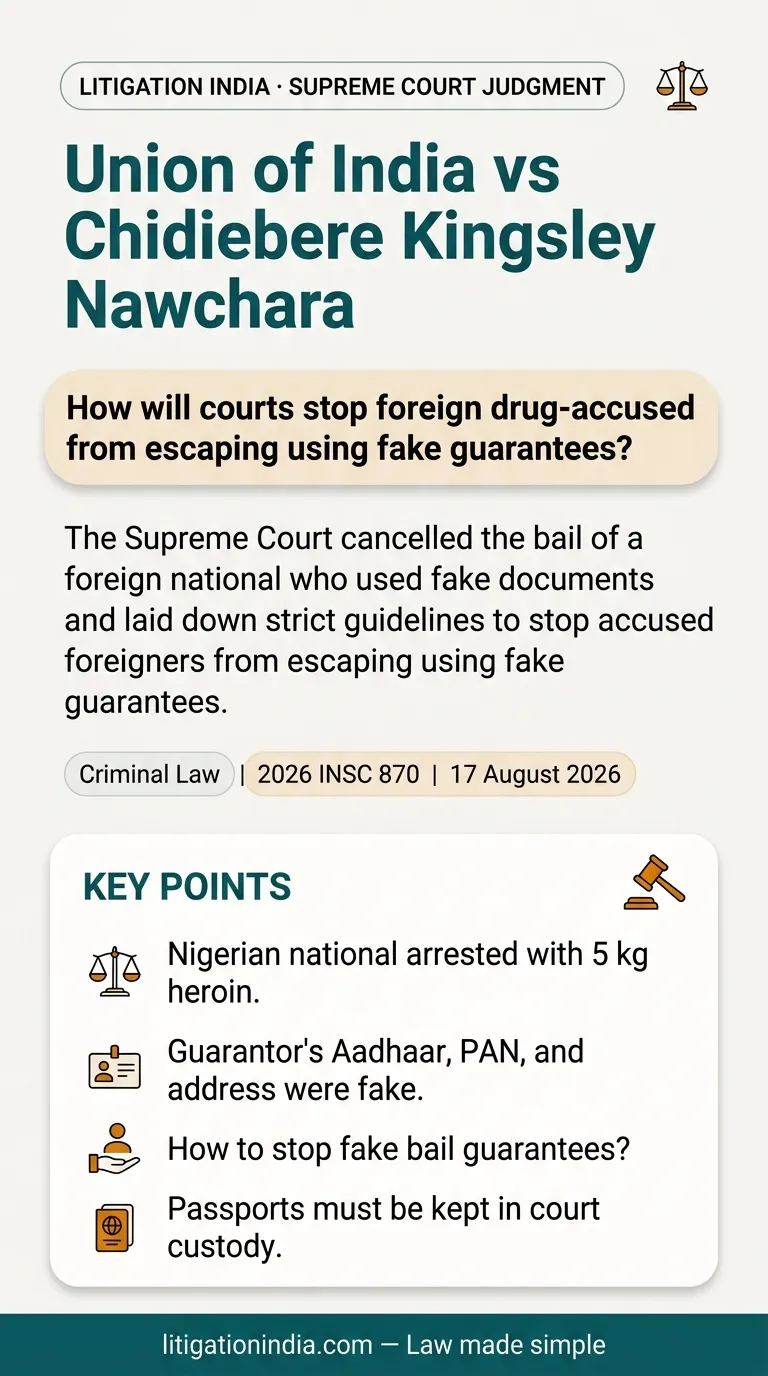
In short
The Supreme Court of India was dealing with an appeal by the Government of India against the bail granted to a Nigerian national, Chidiebere Kingsley Nawchara, accused of smuggling nearly 5 kilograms of heroin. After being released, the accused vanished. When the police tried to track him down, they discovered that his guarantor (surety), who had promised to ensure his presence in court, did not exist. The guarantor's address, employer details, bank account, PAN, and Aadhaar card were completely fake and forged. Shocked by this systemic loophole, the court noted that dozens of foreign nationals in drug cases have escaped India using fake guarantors. To tackle this, the Supreme Court used its special powers under Article 142 of the Constitution to issue strict nationwide rules. Under the new rules, courts must mandatorily take the passport of a foreign accused in large-scale drug cases. The accused must register with the Foreigners Regional Registration Office (FRRO) within a week of release. Crucially, the police must physically verify the address of both the accused and their guarantors within three days before release. If any officer verifies fake details carelessly, they will face departmental inquiry. A legal lien will also be created on the guarantor's property to ensure accountability.
Background
A Nigerian man arrested for smuggling 5 kilograms of heroin was granted bail. He soon ran away, and a police check revealed his guarantor's identity, bank account, and Aadhaar card were entirely fake.
The Decision
The Supreme Court cancelled the accused's bail and ordered his arrest. It also set up strict new checks, including mandatory passport deposit, double guarantors, and fast 3-day police verification of addresses, to stop such escapes.
Why it matters for you
This judgment protects India's security by closing a massive loophole where dangerous foreign criminals easily escaped trial using fake identities. It forces courts and police to be extremely careful and transparent when accepting bail guarantees.
AI-assisted summary, reviewed and verified by our editorial team.
Need help with your case?
Facing a similar legal challenge in the Supreme Court or High Court? Connect with our pro bono volunteer advocates today.
Related Supreme Court services