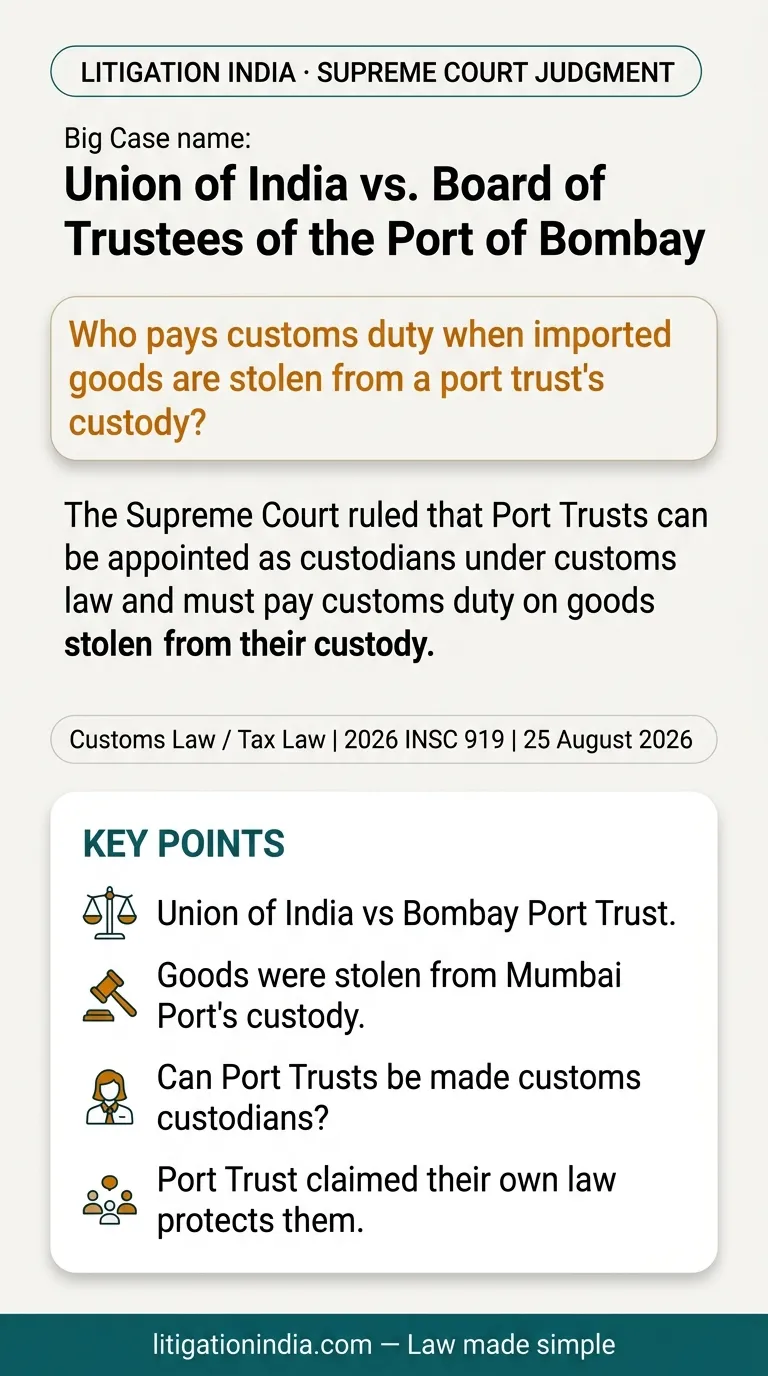
Union of India vs. Board of Trustees of the Port of Bombay
The big legal question
Who pays customs duty when imported goods are stolen from a port trust's custody?
“The Supreme Court ruled that Port Trusts can be appointed as custodians under customs law and must pay customs duty on goods stolen from their custody.”
Story Slides
In short
When goods are imported into India, they are kept at ports before clearance. If goods are stolen ('pilfered') from the port, the law says the importer does not have to pay customs duty. Instead, under Section 45(3) of the Customs Act, the approved 'custodian' of the area must pay this duty to the government. In this case, the Mumbai Port Trust argued that since it was created under a separate law (the Major Port Trusts Act), the Customs Commissioner could not declare it a 'custodian' or force it to pay duty for stolen goods. The Bombay High Court agreed with the Port Trust and cancelled the government's notification. However, the Supreme Court reversed this decision. The Supreme Court explained that there is a big difference between two types of liabilities. The Port Trust has a civil duty to compensate cargo owners for loss under the Port Trusts Act, but it also has a tax duty under the Customs Act to pay the government for stolen goods. Since Section 45(3) of the Customs Act overrides other laws, the Customs Commissioner has full authority to appoint the Port Trust as a custodian. Therefore, the Port Trust is legally responsible for customs duty on any goods stolen after it was officially declared a custodian.
Background
Imported goods were stolen from the Mumbai Port Trust's custody between 1996 and 2000. The government demanded customs duty on these stolen goods from the Port Trust, which challenged both the tax demands and the official notification appointing it as a custodian.
The Decision
The Supreme Court declared that the government's notification appointing the Mumbai Port Trust as a custodian is fully valid. However, the Port Trust does not have to pay for thefts that occurred before this official appointment in October 2000.
Why it matters for you
This judgment ensures that public port authorities take cargo safety seriously. It protects government tax revenue by making sure that if imported goods are stolen, the agency responsible for their custody pays the tax.
AI-assisted summary, reviewed and verified by our editorial team.
Need help with your case?
Facing a similar legal challenge in the Supreme Court or High Court? Connect with our pro bono volunteer advocates today.
Related Supreme Court services