
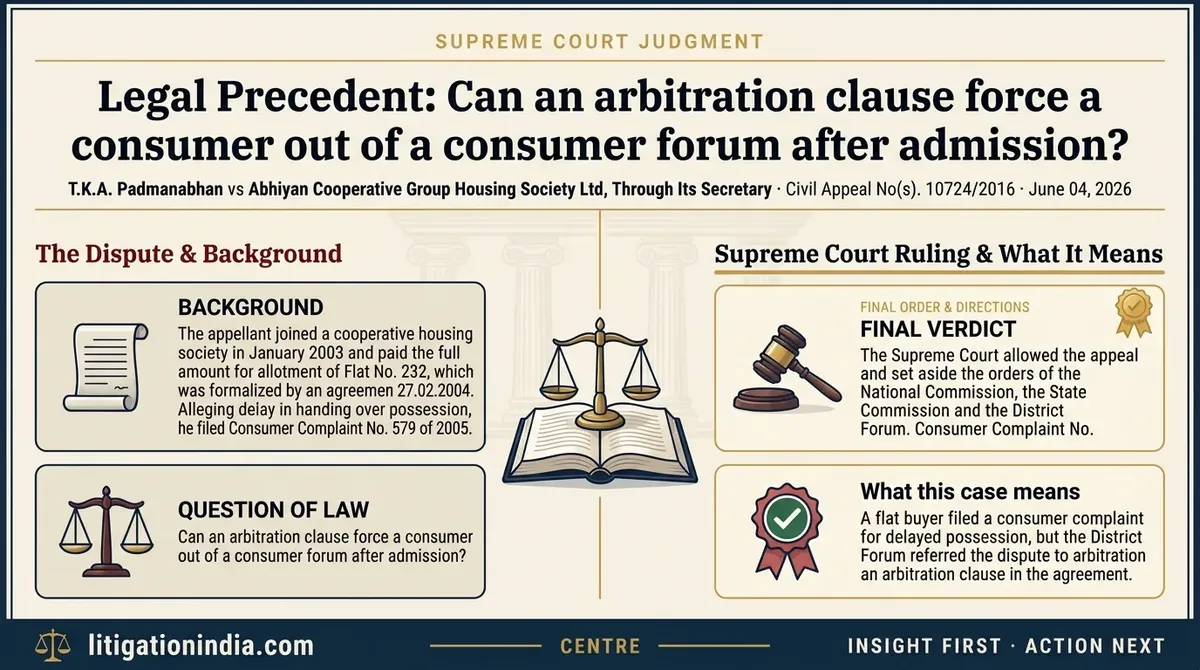
Full text of the judgment
Text extracted from T.K.A. Padmanabhan vs Abhiyan Cooperative Group Housing Society Ltd, Through Its Secretary. For the authoritative version refer to the Supreme Court of India's official website.
Civil Appeal No(s). 10724/2016
REPORTABLE IN THE SUPREME COURT OF INDIA CIVIL APPELLATE JURISDICTION CIVIL APPEAL NO(S). 10724/2016 T.K.A. PADMANABHAN
ABHIYAN COOPERATIVE GROUP HOUSING SOCIETY LTD, THROUGH ITS SECRETARY …RESPONDENT
O R D E R VIKRAM NATH, J.
1. Permission to appear and argue in person is granted to the appellant. 2. The present civil appeal arises from the judgment and order dated 04.01.2016 passed by the National Consumer Disputes Redressal Commission, New Delhi1 in Revision Petition No. 1942 of 2013. 3. The appellant, T.K.A. Padmanabhan, had instituted Consumer Complaint No. 579 of 2005 before the District Consumer Forum-VII, New Delhi2 against the respondent, Abhiyan Cooperative Group Housing Society Limited, alleging deficiency in service on account of delay in handing over possession of Flat No. 232.
1 In short “National Commission” 2 In short “District Forum”
Civil Appeal No(s). 10724/2016
4. The District Forum, by order dated 27.07.2009, referred the parties to arbitration. The said order was affirmed by the Delhi State Consumer Disputes Redressal Commission3 by order dated 26.02.2013. The appellant’s revision petition against the same came to be dismissed by the National Commission by the impugned order dated 04.01.2016. 5. The facts giving rise to the present appeal are as follows: 5.1. The appellant became a member of the respondent society in January 2003. He claims to have paid the full amount towards allotment of a flat in the respondent society. 5.2. Flat No. 232 was allotted to the appellant and an agreement was entered into between the parties on 27.02.2004. 5.3. On 08.08.2005, the appellant filed Consumer Complaint No. 579 of 2005 before the District Forum claiming compensation for the alleged delay in handing over possession of the flat. 5.4. The complaint was admitted and notice was issued to the respondent. Thereafter, the respondent filed an application under Section 8 of the Arbitration and Conciliation Act, 1996, seeking reference of the dispute to arbitration.
3 In short “State Commission”
Civil Appeal No(s). 10724/2016
5.5. By order dated 21.09.2005, the District Forum rejected the said application, inter alia, on the ground that the remedy under the Consumer Protection Act, 1986, was in addition to any other remedy available to an aggrieved party. 5.6. The respondent challenged the said order before the High Court of Delhi in C.M.(M) No. 2405 of 2005. By order dated 30.03.2007, the High Court set aside the order dated 21.09.2005 and directed the District Forum to reconsider the issue by passing a reasoned order. 5.7. The respondent thereafter approached this Court in Special Leave Petition (Civil) No. 9962 of 2007, which was dismissed on 28.07.2008. 5.8. Upon reconsideration, the District Forum, by order dated 27.07.2009, allowed the respondent’s application under Section 8 of the Arbitration and Conciliation Act, 1996, and referred the parties to arbitration. 5.9. The appellant challenged the said order before the State Commission in First Appeal No. 680 of 2009. By order dated 26.02.2013, the State Commission dismissed the appeal and affirmed the order passed by the District Forum.
Civil Appeal No(s). 10724/2016
5.10. The appellant then filed Revision Petition No. 1942 of 2013 before the National Commission. By the impugned order dated 04.01.2016, the National Commission dismissed the revision petition. Hence, the present appeal.
6. We have heard the appellant, who appears in person, and learned counsel appearing for the respondent society. 7. The appellant has submitted that the consumer complaint could not have been referred to arbitration merely on the basis of an arbitration clause in the agreement between the parties. According to him, the complaint had already been admitted and notice had been issued to the respondent. It is therefore submitted that the District Forum ought to have decided the complaint on merits in accordance with the Consumer Protection Act, 1986. 8. Learned counsel for the respondent, on the other hand, has supported the orders passed by the District Forum, the State Commission and the National Commission. It is submitted that the agreement between the parties contained an arbitration clause and, therefore, the consumer fora committed no error in relegating the parties to arbitration. 9. In view of the above, the question which arises for our consideration is whether the consumer complaint filed by the appellant could have been referred to arbitration
Civil Appeal No(s). 10724/2016
without adjudication on merits, and whether the National Commission was justified in dismissing the revision petition on the ground that the appellant was not a consumer.
RELEVANT STATUTORY FRAMEWORK
10. Before we examine the correctness of the orders passed by the consumer fora, it is necessary to state the relevant provisions of the Consumer Protection Act, 19864 applicable to the present case. 11. Section 2(1)(d) of the 1986 Act defines the term “consumer”. Insofar as the present case is concerned, the relevant part of the provision reads as under:
““consumer” means any person who hires or avails of any services for a consideration which has been paid or promised or partly paid and partly promised, or under any system of deferred payment, and includes any beneficiary of such services other than the person who hires or avails of the services for consideration paid or promised, or partly paid and partly promised, or under any system of deferred payment, when such services are availed of with the approval of the first mentioned person.”
4 In short “the 1986 Act”
Civil Appeal No(s). 10724/2016
12. Section 2(1)(o) of the 1986 Act defines the term “service”. The said provision, insofar as relevant, has been reproduced hereunder:
““service” means service of any description which is made available to potential users and includes, but is not limited to, the provision of facilities in connection with banking, financing, insurance, transport, processing, supply of electrical or other energy, board or lodging or both, housing construction, entertainment, amusement or the purveying of news or other information, but does not include the rendering of any service free of charge or under a contract of personal service.”
13. Section 3 of the 1986 Act expressly declares the nature of the remedy under the Act. It reads as follows: “Act not in derogation of any other law.—The provisions of this Act shall be in addition to and not in derogation of the provisions of any other law for the time being in force.”
14. Section 12 of the 1986 Act assumes particular significance in the present case. It deals with the manner in which a complaint may be made before the District Forum. Subsection (4) thereof is material and reads as under:
“Where a complaint is allowed to be proceeded with under sub-section (3), the District Forum may proceed with the complaint in the manner provided under this Act.
Civil Appeal No(s). 10724/2016
Provided that where a complaint has been admitted by the District Forum, it shall not be transferred to any other court or tribunal or any authority set up by or under any other law for the time being in force.”
15. The respondent had invoked Section 8 of the Arbitration and Conciliation Act, 1996, on the ground that the agreement between the parties contained an arbitration clause. The question, therefore, is whether the existence of such an arbitration clause could have displaced the statutory jurisdiction of the consumer forum in the facts of the present case.
16. At the outset, we must emphasize that the 1986 Act is a beneficial legislation intended to provide a simple, inexpensive and expeditious remedy to a consumer who complains of defect in goods or deficiency in service. Section 3 of the 1986 Act makes the position explicit by providing that the remedy under the Act is in addition to and not in derogation of any other remedy available under law. The existence of another forum or another mode of adjudication, therefore, does not by itself exclude the jurisdiction of the consumer fora.
Civil Appeal No(s). 10724/2016
17. This principle has been consistently recognised by this Court. In Fair Air Engineers Pvt. Ltd. v. N.K. Modi5, this Court held that the remedy under the 1986 Act is an additional remedy and that the existence of an arbitration clause would not automatically oust the jurisdiction of the consumer forum. The same principle was reiterated in Secretary, Thirumurugan Cooperative Agricultural Credit Society v. M. Lalitha6, where this Court held that the remedy under the 1986 Act is available notwithstanding the existence of remedies under the cooperative societies law. Again, in National Seeds Corporation Ltd. v. M. Madhusudhan Reddy7, this Court emphasised that the availability of an alternative statutory remedy is not a bar to the maintainability of a consumer complaint. 18. The position has been put beyond doubt in Emaar MGF Land Ltd. v. Aftab Singh8. In the said decision, this Court held that even where an agreement contains an arbitration clause, the consumer forum is not denuded of its jurisdiction to entertain and decide a consumer complaint. The reason is that the 1986 Act creates a special and additional remedy for consumers and the
5 (1996) 6 SCC 385 6 (2004) 1 SCC 305 7 (2012) 2 SCC 506 8 (2019) 12 SCC 751
Civil Appeal No(s). 10724/2016
jurisdiction so conferred cannot be displaced merely by reference to an arbitration agreement between the parties. 19. The legal position upheld in the precedents above is of direct relevance in the present case. The appellant’s complaint was not a civil suit simpliciter. It was a complaint under the 1986 Act alleging deficiency in service on account of delay in handing over possession of a flat. The fact that the agreement between the parties contained an arbitration clause could not, by itself, be treated as sufficient to non-suit the appellant before the consumer forum. 20. The matter must also be examined in the light of Section 12(4) of the 1986 Act. Section 12 of the 1986 Act contemplates a statutory sequence. At the threshold, the District Forum is required to consider whether the complaint deserves to be admitted or rejected. Once the complaint is admitted and allowed to be proceeded with, the forum is required to deal with it in the manner provided under the Act. The proviso to Section 12(4) contains a clear legislative restraint. It provides that where a complaint has been admitted by the District Forum, it shall not be transferred to any other court, tribunal or authority set up by or under any other law for the time being in force.
Civil Appeal No(s). 10724/2016
21. The significance of the proviso lies not merely in its text, but also in the statutory policy which it reflects. The 1986 Act creates a special adjudicatory mechanism for consumer disputes. Once that mechanism is validly invoked and the complaint is admitted, the consumer cannot be driven out of that forum merely because the agreement between the parties contains an arbitration clause. A private contractual clause cannot be permitted to defeat the continued operation of a statutory remedy which Parliament has expressly made additional to other remedies under Section 3 of the 1986 Act. 22. Section 12(4) therefore has to be read harmoniously with Section 3 of the 1986 Act. Section 3 preserves the additional character of the consumer remedy. Section 12(4), after admission of the complaint, gives procedural effect to that protection by requiring the consumer forum to proceed under the Act and by preventing diversion of the complaint to another forum. The provision is intended to ensure that a consumer complaint, once admitted, is not rendered illusory by compelling the consumer to begin afresh before another forum or authority. 23. In the present case, the complaint had been admitted and notice had been issued to the respondent. The respondent thereafter filed an application under Section 8 of the Arbitration and Conciliation Act, 1996. The District Forum
Civil Appeal No(s). 10724/2016
initially rejected the application by noticing that the remedy under the 1986 Act is in addition to other remedies. However, after the matter was remitted by the High Court for reconsideration, the District Forum referred the parties to arbitration. The State Commission affirmed that view. In our opinion, this approach did not give due effect to the scheme of the 1986 Act and to the settled principle that an arbitration clause does not, by itself, oust the jurisdiction of the consumer forum. 24. The order of the National Commission suffers from an additional infirmity. The principal issue before the National Commission was whether the District Forum and the State Commission were justified in referring the complaint to arbitration. The National Commission, however, dismissed the revision petition on the ground that the appellant was not a consumer at the time of filing of the complaint, since he had already taken possession of the flat without protest. In doing so, the National Commission failed to address the central jurisdictional question arising from the orders passed by the District Forum and the State Commission. 25. The reasoning adopted by the National Commission cannot be sustained. The appellant’s complaint was not for delivery of possession simpliciter. His grievance was that there had been delay in handing over possession of
Civil Appeal No(s). 10724/2016
the flat and that he was entitled to compensation for such delay. A claim for compensation for delayed possession necessarily arises from the period prior to the actual delivery of possession. The subsequent receipt of possession cannot, by itself, extinguish the right of the allottee to seek adjudication of a claim for compensation for the alleged delay. 26. Whether there was in fact any delay, whether such delay was attributable to the respondent, whether the appellant had accepted possession unconditionally, and whether any compensation is payable are all matters which require adjudication on merits. The consumer complaint has not been adjudicated on merits at any stage. The claim of the appellant for compensation on account of alleged delay in handing over possession has neither been accepted nor rejected after evidence. Equally, the defence of the respondent society has also not been examined on merits. These issues could not have been concluded at the threshold by holding that the appellant ceased to be a consumer merely because possession had been delivered before the complaint was filed. In such circumstances, it would not be appropriate for this Court to record any finding on the factual controversy between the parties. 27. The proper course, therefore, is to restore the consumer complaint for adjudication on merits. The parties must be
Civil Appeal No(s). 10724/2016
afforded due opportunity of hearing and of leading evidence. All questions relating to deficiency in service, delay, waiver, acceptance of possession, entitlement to compensation, and all other issues on merits shall remain open to be considered by the competent consumer forum in accordance with law. 28. During the intermediary period, the District Consumer Disputes Redressal Commission has been set up at Dwarka. It is also stated before us that both parties are staying in Dwarka. In view of the same, and in order to avoid any further inconvenience and delay, it would be appropriate to direct that the complaint be placed before the District Consumer Disputes Redressal Commission, Dwarka.
29. For the reasons recorded above, the appeal is allowed. 30. The judgment and order dated 04.01.2016 passed by the National Commission in Revision Petition No. 1942 of 2013, the order dated 26.02.2013 passed by the State Commission in First Appeal No. 680 of 2009, and the order dated 27.07.2009 passed by the District Forum are set aside. 31. Consumer Complaint No. 579 of 2005, stated to have been renumbered as Complaint No. 712 of 2007, is restored and
Civil Appeal No(s). 10724/2016
shall be placed before the District Consumer Disputes Redressal Commission, Dwarka, for decision on merits. 32. The District Consumer Disputes Redressal Commission, Dwarka, shall decide the complaint after affording due opportunity of hearing and of leading evidence to both parties. 33. Since the complaint is of the year 2005, the District Consumer Disputes Redressal Commission, Dwarka, shall make an endeavour to decide the same preferably within a period of one year from the date of receipt of a copy of this order. 34. Pending application(s), if any, shall stand disposed of.
…………………………….J. [VIKRAM NATH]
……………………………..J. [V. MOHANA]
NEW DELHI; JUNE 04, 2026