
Full text of the judgment
Text extracted from The Muppathadam Service Co-Operative Bank Ltd. vs The State Chief Information Commissioner & Ors.. For the authoritative version refer to the Supreme Court of India's official website.
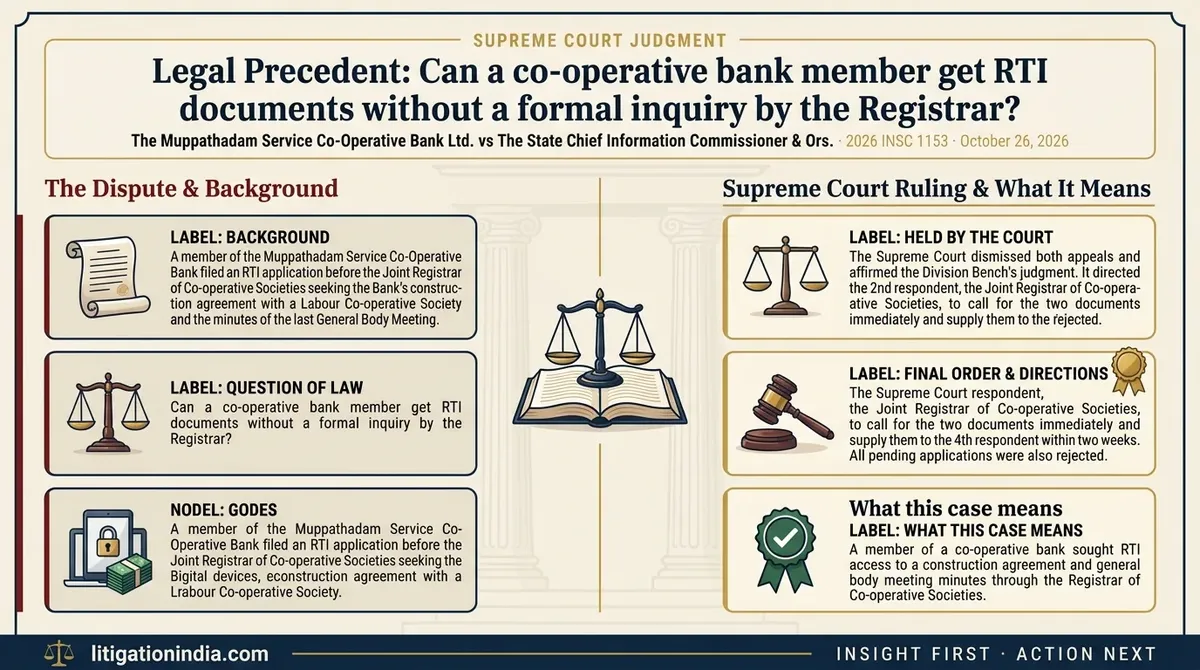
2026 INSC 1153 Reportable IN THE SUPREME COURT OF INDIA CIVIL APPELLATE JURISDICTION Civil Appeal No.13906 of 2026 [ @ Special Leave Petition (C) No.12283 of 2025 ] The Muppathadam Service Co-Operative Bank Ltd. …. Appellant Versus The State Chief Information Commissioner & Ors. …. Respondents W I T H Civil Appeal No.13907 of 2026 [ @ Special Leave Petition (C) No.12846 of 2025 ] J U D G M E N T K. VINOD CHANDRAN, J. Leave granted. 2. The 4th respondent who appeared as party-inperson had been persistently pursuing his application under the Right to Information Act, 2005 before the 2nd respondent, Joint Registrar (General) of the Cooperative Societies. The request made was for two documents: a copy of the construction agreement Page 1 of 14 CA@SLP (C) No.12283 of 2025 Etc. Digitally signed by VISHAL ANAND Date: 2026.10.26 14:09:35 IST Reason: Signature Not Verified
between the appellant/Co-operative Bank and a Labour Co-operative Society, which was entrusted with the construction of a building, and a copy of the minutes of the last General Body Meeting of the appellant-Bank. The 4th respondent is a Member of the appellant-Bank. His first application was rejected consistently upto the 1st respondent, the State Information Commissioner, the challenge to which before the learned Single Judge failed but the Division Bench directed reconsideration. On the second round consistently the 1st respondent, the learned Single Judge as also the Division Bench of the High Court affirmed the right of the 4th respondent to the documents. The judgment of the Division Bench is challenged before us. 3. Sh. S.P. Chaly, learned Senior Counsel appearing for the appellant-Bank, placed reliance on Thalappalam Service Cooperative Bank Limited and Others v. State of Kerala and Others1. It was argued that the appellant-Bank is not a ‘public authority’ and this Court in Central Public 1 (2013) 16 SCC 82 Page 2 of 14 CA@SLP (C) No.12283 of 2025 Etc.
Information Officer, Supreme Court of India v. Subhash Chandra Agarwal2 held that the access by a public authority to the information relating to a private body, as provided under the RTI Act, should not be shackled by restrictions or pre-imposed conditions. Section 65 and 66 of the Kerala Co-operative Societies Act, 1969 is relied on to find that such access is available to the Registrar only after he enters a subjective satisfaction to conduct an inquiry. There being no such satisfaction entered into, nor called for in considering the application filed by 4th respondent, the 2nd respondent-Registrar should be deemed to have no access to the documents of the appellant-Bank, which for the purposes of the RTI Act, is a private entity as distinguished from the public authority. 4. Sri Abhilash M.R., learned Counsel appearing for the 1st respondent points out that the impugned judgment clearly sustains the access through the competent public authority, which does not require the Society to be treated as a public authority, under 2 (2020) 5 SCC 481 Page 3 of 14 CA@SLP (C) No.12283 of 2025 Etc.
Section 2(h) of the RTI Act. According to him, absence of a pending inquiry under Section 65 is inconsequential, when the statutory power permits access. The statutory authority to supervise the functioning of the Society, under Section 66 supplies a distinct route of access and the two documents sought for clearly come within the ambit of such supervisory powers. The lawful custody of the documents by a public authority vis-à-vis the existence of a power on the public authority to access such documents from a private entity are distinct in its application and the latter would not require prior physical custody by the public authority. 5. The 4th respondent points out that after the RTI Act, amendments were made to the Kerala Cooperative Societies Act, enlarging the scope of Section 66 by insertion of sub-sections (4A) and (11) to Section 66. Sub-section (11) is a non-obstante Clause, which overrides sub-sections (1) & (2) and confers the Registrar the power to hold an inquiry, with the necessary records of the Society and to inspect the office of the Society periodically. Thalappalam SCB Page 4 of 14 CA@SLP (C) No.12283 of 2025 Etc.
Limited1 is not at all applicable, since the dictum was of a Co-operative Society not being a public authority under the RTI Act. Subhash Chandra Agarwal2 a Constitution Bench decision puts beyond any cavil a citizen’s right under Section 3 of the RTI Act corresponding to the statutory obligation of the public authority to perform the duties entrusted with it under the Kerala Co-operative Societies Act. 6. The Division Bench after a detailed examination of the law as coming out from the decisions and after extracting the relevant provisions, found that Section 2(f) of the RTI Act; defining ‘information’, by use of the words ‘can access’ emphasises the entitlement of the Registrar to obtain documents from the private body and this extends beyond mere physical custody of the documents. The statutory power to access the documents kept in the records of a Co-operative Society, as conferred to the Registrar under Section 65, cannot be curtailed to apply only when an inquiry is already in progress. Sans these documents, the Registrar would be unable to determine whether an Page 5 of 14 CA@SLP (C) No.12283 of 2025 Etc.
inquiry is necessary in the first place was the finding. 7. The contention of the appellant-society, as we see from the records also extends to clauses (d) and (j) of Section 8(1) of the RTI Act. For better understanding we extract paragraph 24 and 25 from CBSE v. Aditya Bandopadhyay3 : “24. Section 3 of the RTI Act provides that subject to the provisions of this Act all the citizens shall have the right to information. The term “right to information” is defined in Section 2(j) as the right to information accessible under the Act which is held by or under the control of any public authority. Having regard to Section 3, the citizens have the right to access all the information held by or under the control of any public authority except those excluded or exempted under the Act. The object of the Act is to empower the citizens to fight against corruption and hold the Government and their instrumentalities accountable to the citizens, by providing them access to information regarding functioning of every public authority. 25. Certain safeguards have been built into the Act so that the revelation of information will not conflict with other public interests which include efficient operation of the Governments, optimum use of limited fiscal resources and preservation of confidential and sensitive information. The RTI Act provides access 3 (2011) 8 SCC 497 Page 6 of 14 CA@SLP (C) No.12283 of 2025 Etc.
to information held by or under the control of public authorities and not in regard to information held by any private person. The Act provides for the following exclusions by way of exemptions and exceptions (under Sections 8, 9 and 24) in regard to information held by the public authorities:” 8. Clause (d) of Section 8(1) refers to injury caused to the competitive position of a third party, when the information involves a commercial confidence, trade secret or intellectual property. The documents as referred to hereinabove neither encompasses any aspect of trade secret or intellectual property nor of a commercial confidence affecting a competitive position; since already the bid is over and one Labour Contract Society has obtained the contract, the terms of which any Member of the Society would be concerned with. As far as clause (j) is concerned the information sought cannot be termed to be a personal information, since the details of the contract sought for, entered into by the appellant-Bank and the Minutes of the General Body Meeting, are sought for by a Member of the Society. That it does not have any relation to any public activity Page 7 of 14 CA@SLP (C) No.12283 of 2025 Etc.
or interest, in that context, is not significant enough to decline the request, if the documents are otherwise accessible. 9. The position would definitely be different if a third party not connected with the Society raises an identical request. Every citizen would not have the right to ask for the documents since the concept of personal information cannot be restricted to a ‘person’ in flesh and blood and even applies to a private entity, with whose affairs every citizen cannot be found to have an interest, unless it has a relationship to a public activity (Section 8(1)(j). Neither the building contract nor the General Body Meeting concerns a party, totally unconnected with the Society. However, a Member of the Society cannot be denied such information on the ground that it is personal to the Society or that it does not involve any public activity or interest. 10. Thalappalam Service Cooperative Bank Limited1 preserves the right of the Registrar of the Cooperative Societies to seek information from an entity which is not a public authority, from societies too, Page 8 of 14 CA@SLP (C) No.12283 of 2025 Etc.
to the extent law permits. Especially from societies registered under the Cooperative Societies Act, over which he has supervision or administrative control under the Act to divulge such information to an applicant under the RTI Act, if the information asked for is not barred by clauses (a) to (j) of Section 8(1). Therein the information sought was about the deposits of bank accounts of members, which is exempted under Section 8(1)(j). 11. The question now boils down to whether the Registrar can have unfettered access to the documents and whether on the request of the 4th respondent; a Member of the appellant-Bank, he could access such documents for the purpose of providing information under the RTI Act. Section 2(f) of the RTI Act provides as under: - “2(f) "information" means any material in any form, including records, documents, memos, e-mails, opinions, advices, press releases, circulars, orders, logbooks, contracts, reports, papers, samples, models, data material held in any electronic form and information relating Page 9 of 14 CA@SLP (C) No.12283 of 2025 Etc.
to any private body which can be accessed by a public authority under any other law for the time being in force.” [underlining by us for emphasis] 12. Hence, it is not only the material, physically available with a public authority but also such material relating to a private body, which can be accessed by a public authority, on the strength of statutory powers conferred, would fall under the definition of information. As has been rightly noticed in the impugned judgment, the words ‘can be accessed by a public authority’ refers to access being statutorily provided. The power cannot be fettered at all. In this context, we notice paragraph 21 from Subhash Chandra Agarwal2. “21. What is explicit as well as implicit from the definition of “information” in clause (f) to Section 2 follows and gets affirmation from the definition of “right to information” that the information should be accessible by the public authority and “held by or under the control of any public authority”. The word “hold” as defined in Wharton's Law Lexicon, 15th Edn., means to have the ownership or use of; keep as one's own, but in the context of the present legislation, we would prefer to adopt a broader definition of the word “hold” in Black's Law Dictionary, 6th Edn., as meaning; to keep, to retain, to maintain possession of or authority over. Page 10 of 14 CA@SLP (C) No.12283 of 2025 Etc.
The words “under the control of any public authority” as per their natural meaning would mean the right and power of the public authority to get access to the information. It refers to dominion over the information or the right to any material, document, etc. The words “under the control of any public authority” would include within their ambit and scope information relating to a private body which can be accessed by a public authority under any other law for the time being in force subject to the preimposed conditions and restrictions as applicable to access the information.” [emphasis supplied through underlining] 13. The above extract does not; as would the appellant-Bank argue, fetter the access of the public authority when there is a pre-imposed condition or a restriction to the statutory power conferred on the authority. On the other hand, when the access is made subject to a condition or restriction, any situation in which the condition is satisfied or the restriction stands removed, the access would be enabled. Insofar as Rules 65 and 66 are concerned we need not go that extent. We are of the opinion that there is no such fetter on the statutory authority to have access to the Page 11 of 14 CA@SLP (C) No.12283 of 2025 Etc.
documents and the prior satisfaction required is only to initiate an inquiry. 14. The specific contention raised by the learned Senior Counsel was that only on the satisfaction entered by the Registrar that an inquiry can be initiated and only then, the Registrar is enabled to have access of the documents of a Society. We are unable to agree. The inquiry by the Registrar under Section 65 of the Co-operative Societies Act can be suo motu; on his own motion, or on various contingencies as coming forth from clause (b) to (f) i.e. of a report; by the Vigilance Officer or by the Director of Co-operative Audit or an application; made before the Registrar, either by a majority of the Members or one third of the quorum for a general body meeting or an Apex or Affiliated Society. Trite is the principle that when a suo motu power is conferred on an authority, it can also be exercised when someone brings to the notice of the authority, the need for its invocation, which cannot at all be considered as extraneous to the suo motu power. However, in exercise of such suo motu power either by Page 12 of 14 CA@SLP (C) No.12283 of 2025 Etc.
itself or on a repot or an application by another, the public authority conferred with such powers, herein the Registrar has to enter a satisfaction insofar as the expediency of exercise of such suo motu powers. Such satisfaction cannot be entered into in a vacuum and it is, hence, sub-section (2) of Section 65 provides the Registrar or the person authorized by him to have, at all reasonable times, free access to the books, accounts, documents, securities, cash and other properties belonging to or in the custody of the Society. When something amiss comes to the notice of the Registrar or is brought to his notice through an application, the satisfaction can be entered into only if he has access inter alia to the documents maintained by the Society and only then can he enter into a satisfaction either to initiate or not to initiate an inquiry. Access simpliciter, thus cannot be conditioned with a prior satisfaction, since without such access, the Registrar cannot enter upon a satisfaction. 15. As has been rightly pointed out by the 4th respondent, Section 66 of the Co-operative Societies Page 13 of 14 CA@SLP (C) No.12283 of 2025 Etc.
Act confers supervisory powers and powers of inspection on the Registrar or a person authorized by him. This can be done as per sub-section (1), as frequently as the Registrar may consider it necessary, which supervision includes ‘an inspection of the books of the society’. We are hence, convinced that the judgment of the Division Bench of the High Court is perfectly in order and in accordance with the provisions of law as also in consonance with the decisions cited. We, hence, find absolutely no reason to interfere with the same. The 2nd respondent shall call for the two documents immediately and in any event within two weeks and supply the same to the 4th respondent. 16. The appeals stand dismissed. 17. Pending application(s), if any, shall also stand rejected. .……………………………... J. (J. B. PARDIWALA) ..………….…………………. J. (K. VINOD CHANDRAN) NEW DELHI; OCTOBER 26, 2026. Page 14 of 14 CA@SLP (C) No.12283 of 2025 Etc.