Full court fees must be paid when challenging extra land acquisition benefits in appeal
Tehri Hydro Development Corporation Ltd. vs. S.P. Singh & Ors.
What this case means
This case was about whether a company must pay full percentage-based court fees when challenging only extra benefits like interest and solatium. The Supreme Court decided that these benefits are a core part of the total land compensation, not separate items. This means big corporations cannot use legal loopholes to avoid paying the correct court fees on appeal.
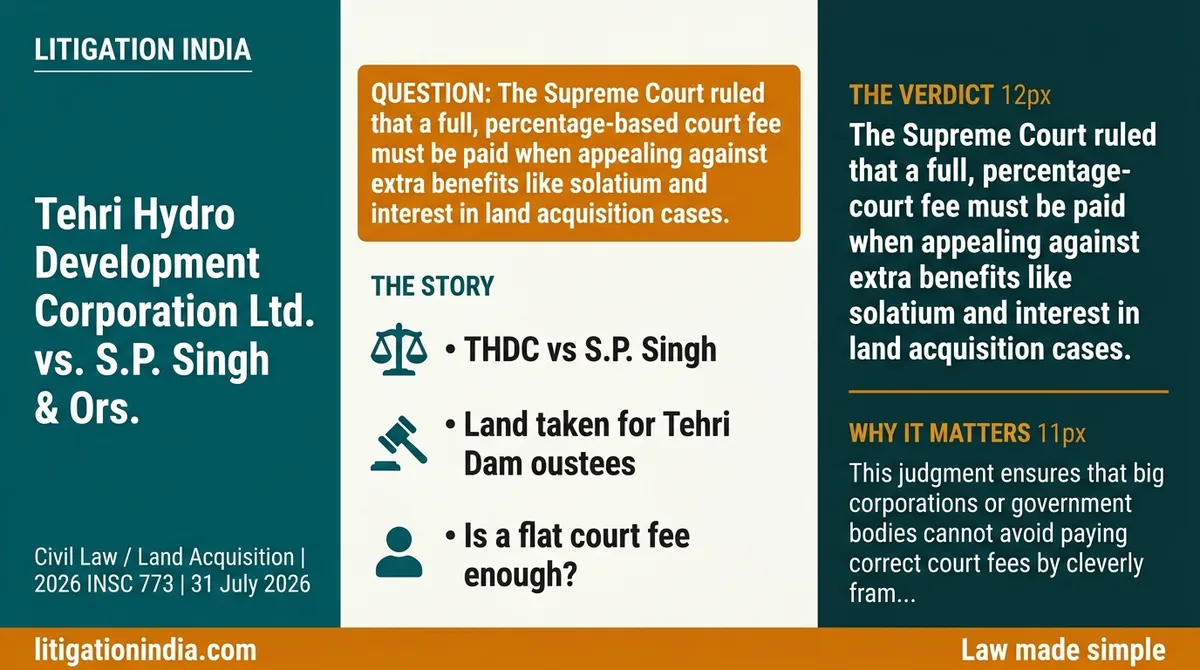
“The Supreme Court ruled that a full, percentage-based court fee must be paid when appealing against extra benefits like solatium and interest in land acquisition cases.”
Story Slides
In short
In this case, the Supreme Court of India dealt with an important question about court fees in land acquisition disputes. The government had acquired land for the rehabilitation of Tehri Dam victims. Dissatisfied with the initial award, the landowners approached the Reference Court. While the court did not increase the basic land price, it granted them statutory benefits: an additional 12 percent annual amount, a 30 percent solatium (extra money for forced land sale), and interest on the delayed payment. The Tehri Hydro Development Corporation appealed this decision in the Uttarakhand High Court. They argued that because they were only challenging the extra benefits and not the basic land value, they only needed to pay a flat court fee of 10 rupees instead of a percentage of the disputed 2.34 crore rupees. The High Court rejected this and ordered them to pay the full percentage-based fee. The Supreme Court agreed with the High Court and dismissed the appeal. It clarified that 'compensation' is a composite package. Extra benefits like solatium and interest are not separate from the land value; they are legally attached to it like a shadow. Therefore, any appeal attempting to reduce or remove these benefits is essentially trying to reduce the final compensation decree, attracting full court fees on the disputed amount under Section 8 of the Court Fees Act.
Background
The government acquired land for the Tehri Dam project. The landowners were awarded extra statutory benefits like solatium and interest by the Reference Court. The acquiring company challenged only these extra benefits in the High Court and paid a flat court fee of just Rs. 10, which the High Court rejected.
The Decision
The Supreme Court dismissed the company's appeal and upheld the High Court's order. It ruled that statutory benefits like solatium and interest are inseparable parts of the total compensation, meaning a full percentage-based court fee must be paid on the disputed amount.
Why it matters for you
This judgment ensures that big corporations or government bodies cannot avoid paying correct court fees by cleverly framing their appeals. It clarifies that 'compensation' is a single package, protecting public revenue and establishing clear rules for court fees in land disputes.
Relevant Legal Provisions
Key Acts and sections cited or relied upon in this judgment
“This section states that the court fee for an appeal against an order relating to compensation is calculated based on the difference between the amount awarded and the amount claimed. The court applied this to rule that any challenge to the component of compensation, including interest and solatium, must be taxed based on the total disputed value rather than a flat nominal fee.”
“This provision mandates that the court must award an additional sum of thirty percent on the market value of the land in consideration of the compulsory nature of the acquisition, commonly known as solatium. The Supreme Court relied on this to clarify that solatium is an integral, inseparable part of the overall compensation package awarded to landowners.”
“This section empowers the court to direct the collector to pay interest on the excess compensation amount from the date of taking possession of the land. The court discussed this to establish that interest on enhanced compensation constitutes a statutory benefit that merges with the final compensation amount, requiring full court fees when challenged.”
AI-assisted summary, reviewed and verified by our editorial team.
Need help with your case?
Facing a property, eviction, or landlord-tenant dispute? Consult our property lawyers for a free initial review.
Related Supreme Court services