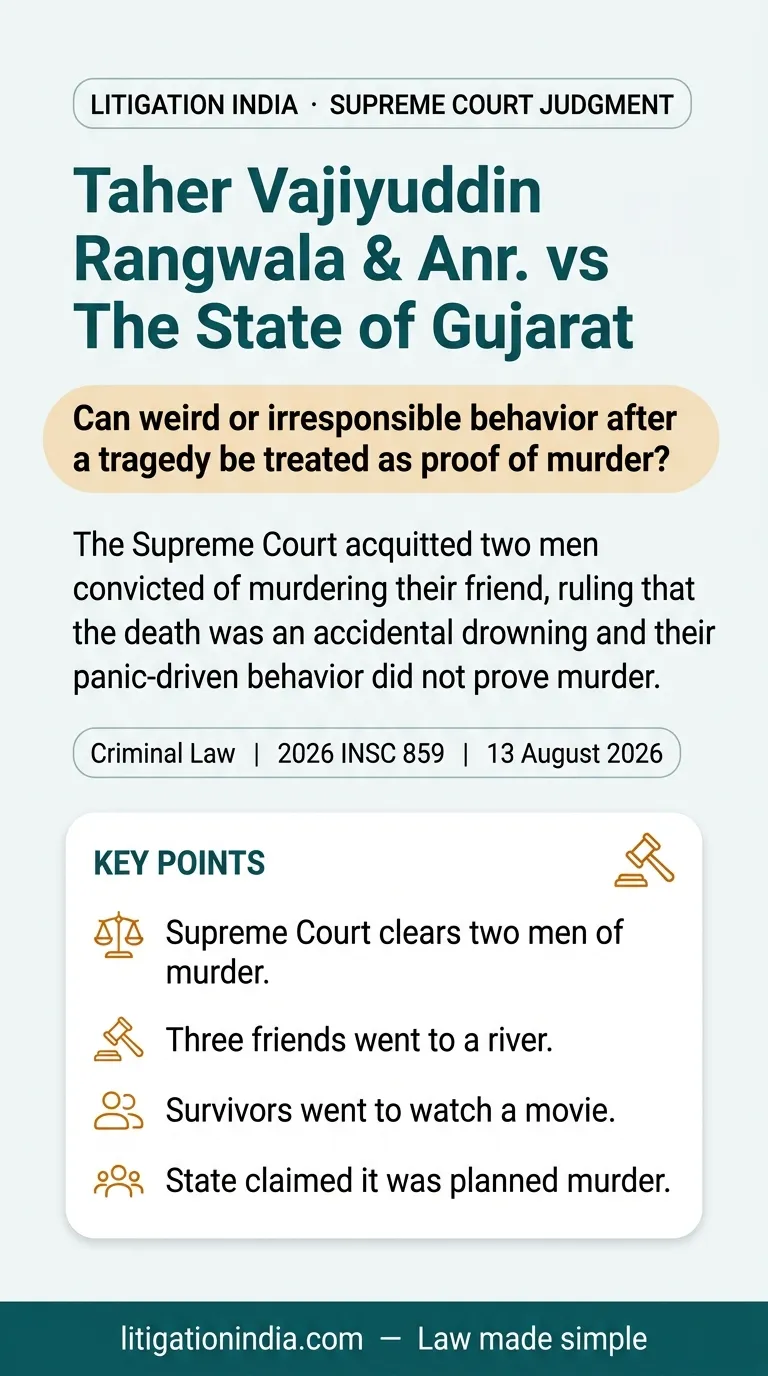
Taher Vajiyuddin Rangwala & Anr. vs The State of Gujarat
The big legal question
Can weird or irresponsible behavior after a tragedy be treated as proof of murder?
“The Supreme Court acquitted two men convicted of murdering their friend, ruling that the death was an accidental drowning and their panic-driven behavior did not prove murder.”
Story Slides
In short
Two friends were convicted of murdering their friend, who drowned in a river in 2006. The prosecution claimed that the accused hit the victim with a soda bottle and drowned him due to a personal dispute. They pointed to the suspects' suspicious behavior: after the incident, the suspects returned empty soda bottles to a shop, went to watch a movie, and lied to the victim's family. However, the Supreme Court overturned the murder convictions. The Court highlighted that the medical report clearly pointed to accidental drowning, not murder. The minor scratches on the body could easily have been caused by river stones. Furthermore, the police failed to find any broken soda bottles at the scene, and there was a massive four-month delay in filing the murder complaint. The Court observed that although the friends' behavior—running away and watching a movie instead of saving their drowning friend—was highly insensitive and foolish, it cannot be used as proof of murder. In criminal cases, the chain of circumstances must prove guilt beyond any doubt. Since accidental drowning was highly likely, the Court set aside the life sentences and ordered the immediate release of the accused.
Background
Two friends took their companion to a river, where he unfortunately drowned. Panicked by the incident, the two friends fled the spot, went to watch a movie, and initially lied to the victim's family, leading to murder charges four months later.
The Decision
The Supreme Court set aside the convictions and life sentences of both accused, declaring that the death was an accidental drowning. The Court ordered their immediate release from custody.
Why it matters for you
This judgment shows that suspicious or bad behavior after an accident is not enough to prove a serious crime like murder. The police must prove their case with solid, scientific evidence rather than relying on delayed assumptions and moral judgment.
AI-assisted summary, reviewed and verified by our editorial team.
Need help with your case?
Facing a similar legal challenge in the Supreme Court or High Court? Connect with our pro bono volunteer advocates today.
Related Supreme Court services