
Full text of the judgment
Text extracted from T. Akon Phom and Others vs State of Nagaland and Others. For the authoritative version refer to the Supreme Court of India's official website.
2026 INSC 1211 SLP (C) No.22477/2026
Page 1 of 8
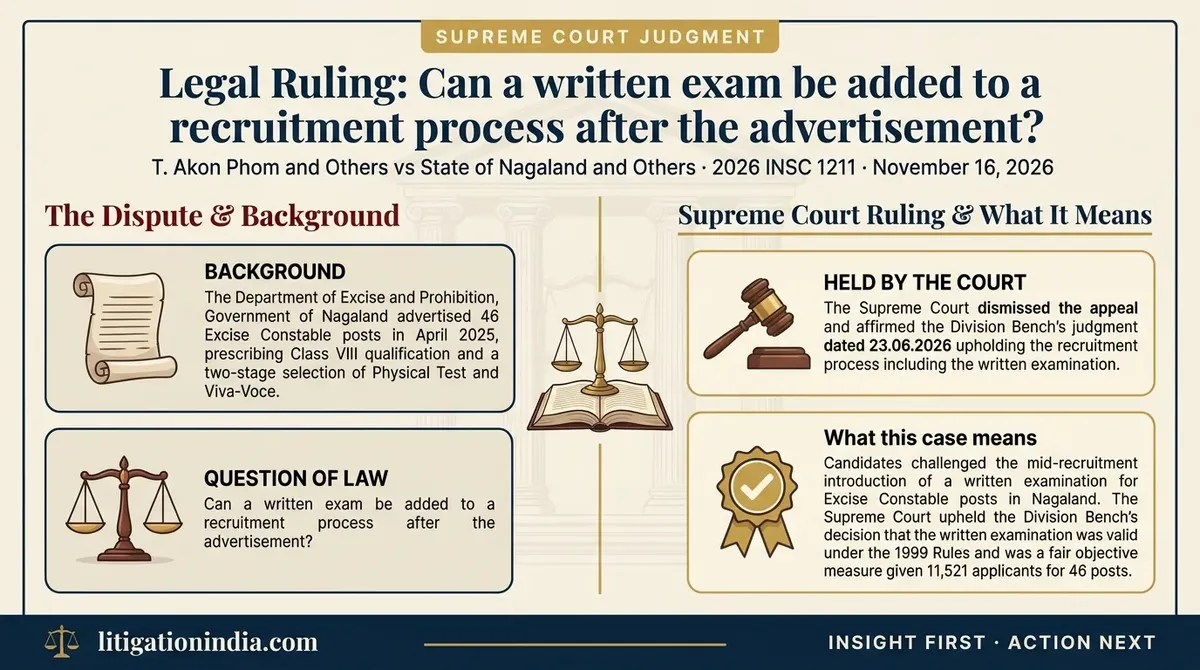
REPORTABLE IN THE SUPREME COURT OF INDIA CIVIL APPELLATE JURISDICTION CIVIL APPEAL NO(S). 14203 OF 2026 (ARISING OUT OF S.L.P. (CIVIL) NO(S).22477 OF 2026) T. AKON PHOM AND OTHERS
…APPELLANT(S) VERSUS
STATE OF NAGALAND AND OTHERS
...RESPONDENT(S) J U D G M E N T
PRASHANT KUMAR MISHRA, J. 1. Leave granted. 2. This Appeal assails the judgment and order dated 23.06.2026 of the Division Bench of the Gauhati High Court, Kohima Bench. By way of the impugned judgment, the High Court had allowed Writ Appeal No.39/2025 preferred by the respondent-State and set aside the judgment and order dated 16.10.2025 of the learned Single Judge in Writ Petition (Civil) No. 128/2025. 3. The dispute arises out of a recruitment process undertaken by the respondent-Department of Excise and Prohibition, Government of Nagaland, for filling the posts of Excise Constable. The recruitment was governed by the extant Nagaland Excise Service (Revised) Rules, 19991, framed under the proviso to
1 For short, ‘the 1999 Rules’ Digitally signed by NISHA KHULBEY Date: 2026.11.16 17:23:08 IST Reason: Signature Not Verified
SLP (C) No.22477/2026
Page 2 of 8
Article 309 of the Constitution of India. By way of context, earlier, a meeting chaired by the Chief Minister and attended by other senior functionaries of the State had been held on 16.09.2024 to consider recruitment to uniformed services. Inter alia, it was resolved that departments would duly constitute their Departmental Recruitment Boards; that vacancies would be advertised in at least two local newspapers and the respective Departmental websites; that the constituted Departmental Recruitment Boards would maintain transparency and fairness while carrying out the recruitment process, etc. 4. On 04.03.2025 and 25.03.2025, approval was accorded by the State Government for the draft Advertisement and constitution of a Departmental Recruitment Board for recruitment to the posts of Excise Constable. The said Board of the respondent-Department was formally notified on 23.04.2025. An Advertisement No. EX.1/ESTT/1/2022/62-63 dated 07.04.2025 was issued inviting applications from indigenous inhabitants of Nagaland for 40 Excise Constable posts, prescribing Class VIII as the required educational qualification. Six additional posts were subsequently notified by an Addendum Order No. Ex.l/ESTT/1/2022/404-06 dated 14.05.2025, taking the total number of posts to 46. 5. Subsequently, in continuation of the original advertisement, the Board issued a Corrigendum dated 04.06.2025, notifying the inclusion of a written examination in the recruitment process, in line with other uninformed services. Candidates were asked to prepare accordingly. The Physical Test was conducted between 14.07.2025 and 24.07.2025. A Notification dated 25.07.2025 notified
SLP (C) No.22477/2026
Page 3 of 8
the release of names of candidates who had qualified for the written examination and further stated that the examination would carry 100 marks, consist of Multiple-Choice Questions, based on the Class VIII standard; have no negative marking; and was scheduled to be conducted between 10:00 am and 12:00 pm on 09.08.2025. 6. Ms. Diksha Rai, learned counsel for the appellants, contended that Clause 4 of the Advertisement dated 07.04.2025 stipulated that the recruitment process would consist of two stages: (a) Physical Test; and (b) Suitability Test/Viva-Voce. Therefore, introduction of a written examination was contrary to the terms notified in the initial advertisement. Relying on the 1999 Rules and a Memorandum No. EX-5/3/2000/6036 dated 19.07.2016 issued by the Commissioner of Excise and Prohibition, the appellants contend that the selection criteria could not be altered after the recruitment process had commenced. 7. Per contra, Mr. K.N. Balgopal, learned Advocate General for the State of Nagaland, would submit that the scale of the recruitment is relevant to the dispute at hand. The State has received as many as 11,521 applications against 46 posts, out of which, 5,985 candidates appeared in the Physical Test, and 2,297 candidates cleared it and became eligible to proceed to the next stage. It is, thus, argued that, in these circumstances, an objective written screening examination was necessary to reduce the large field of candidates and to ensure that the subsequent stage of selection was conducted fairly and objectively. It is also highlighted by the learned Advocate General that all the appellants, except
SLP (C) No.22477/2026
Page 4 of 8
appellant No. 4, participated in the Physical Test, and ten of the sixteen appellants herein, being appellant Nos. 1, 2, 3, 4, 6, 7, 8, 12, 15 & 16, further participated in the written examination as admitted before the High Court. Therefore, it is argued that once having participated in the recruitment process, the appellants cannot challenge the same. 8. The learned Single Judge allowed the appellants’ writ petition on 16.10.2025, reasoning that although the Government could prescribe an appropriate selection method where the Rules were silent, the method had to be specified in the original advertisement and could not be introduced midway through recruitment. Further, the learned Single Judge found that though there was no illegality in the constitution of the Departmental Recruitment Board, given Government approval had preceded the advertisement and no prejudice was shown on that account, the Board lacked authority to independently prescribe a change in the selection procedure. The respondent-Department was bound by the terms of the Memorandum dated 19.07.2016 regarding the applicable physical and medical standards. Accordingly, the Corrigendum dated 04.06.2025 and the Physical Test were quashed, and the State was directed to conduct recruitment in accordance with the original advertisement and the Memorandum or issue a fresh advertisement if it wished to introduce a written examination. 9. Aggrieved, the State preferred Writ Appeal No. 39/2025. The Division Bench on 03.12.2025 permitted the recruitment process to continue in the meantime, subject to the outcome of the writ appeal viz. the results would not
SLP (C) No.22477/2026
Page 5 of 8
be declared without the leave of the Court. Ultimately, vide the impugned judgment dated 23.06.2026, the Division Bench allowed the State’s appeal and set aside the judgment and order of the learned Single Judge. 10. The State has drawn our attention to the fact that thereafter, the recruitment process continued and came to a conclusion on 30.06.2026, well before notice was issued and stay was granted by this Court on 07.07.2026. Specifically, medical tests were conducted on 29.01.2026 and 30.02.2026. Of the 2297 candidates, who passed the written examination, 211 were called for interview on 10.02.2026 (in an approximate ratio of 5:1) and interviews were conducted from 19.02.2026 to 21.02.2026. Finally, the Departmental Recruitment Board held a meeting on 24.06.2026 to complete the requisite formalities. Administrative approval was secured on 26.06.2026 and the list of the 46 selected candidates was notified on 29.06.2026. All the candidates so selected conveyed their acceptance between 01.07.2026 and 08.07.2026. The State has objected that said fact was not disclosed by the appellants before this Court and the successful candidates have also erroneously not been impleaded in the present Appeal. Owing solely to the pendency of this litigation, entire process has been kept in abeyance and status quo has been maintained. 11. In response, the appellants have pointed out that three of forty-six acceptance letters were only received on 08.07.2026 and mere publication of select-list does not render the instant Appeal infructuous, given candidates have yet to be appointed against the posts.
SLP (C) No.22477/2026
Page 6 of 8
12. We have perused the record and are satisfied that there is no reason to interfere with the well-reasoned judgment of the Division Bench of the High Court, particularly that the various contentions raised by the appellants have already been considered and rejected by the court below. The recruitment was governed by the 1999 Rules, Rule 5(i)(a) of which provides for direct recruitment through “competitive examination/selection” and Rule 7(1) provides for a Selection Board for direct recruitment to the relevant posts. Schedule II prescribes direct recruitment as the method of recruitment to the Group C (Non- Gazetted) post of Excise Constable and Schedule III prescribes Class VIII as the requisite educational qualification for the same. Nothing in the recruitment process, therefore, contravened the 1999 Rules. We may add that the written examination, based on the Class VIII syllabus, falls under “competitive examination/selection” within the meaning of Rule 5(i)(a) and, therefore, Rule 5(ii), which requires the Government to consult with the Commission to adopt a different method of recruitment, is not attracted at all. 13. The appellants have vehemently contended that since 1999 Rules do not prescribe the detailed procedure for conducting the selection, the Memorandum dated 19.07.2016 held the field in this regard. However, we opine that the Division Bench had rightly accepted the State’s contention that the Memorandum had neither been confirmed by the Selection Board nor notified by the State Government and had not been strictly enforced in previous recruitment processes, and at its highest, merely prescribes certain minimum physical and medical standards for various athletic activities. The Departmental Recruitment
SLP (C) No.22477/2026
Page 7 of 8
Board, on the other hand, was constituted for purpose of recruitment to the posts of Excise Constable, consistent with the decision taken in the meeting dated 16.09.2024. The learned Single Judge, too, had accepted that the Departmental Recruitment Board was validly constituted under Rule 7 of the 1999 Rules and negatived the appellants’ contention that the constitution of the Board was irregular and caused prejudice to them. 14. The Advertisement empowered this Departmental Recruitment Board to rectify any omission or commission through notifications and addenda under Clause 15 and expressly vested in it the authority to take a final and binding decision in any dispute concerning the recruitment process under Clause 16. 15. Given these circumstances, we are unable to accept the appellants’ contention that the introduction of the written examination rendered the selection process arbitrary because it was introduced after the original Advertisement, or because it carried greater weightage of 100 marks than the Viva-Voce of 12 marks (as disclosed by respondent in response to an RTI query). In fact, our considered view is that an objective written examination, based on the already-prescribed Class VIII standard, provides a means of assessing candidates on a common basis and avoids placing disproportionate reliance on the comparatively subjective assessment inherent in a Viva-Voce. The policy decision to introduce the written examination was taken in the context of the exceptionally large number of applicants for the 46 posts, and the Corrigendum dated 04.06.2025 was widely publicised, including in the local newspapers Nagaland Post and Eastern Mirror, as previously resolved by the respondent-
SLP (C) No.22477/2026
Page 8 of 8
Department. Further, the Division Bench had correctly appreciated that all candidates who qualified in the Physical Test were subjected to the same requirement and afforded an equal opportunity to participate in the recruitment process. The appellants have not been able to demonstrate how the process operated discriminatorily or caused any prejudice to them as admittedly having participated in the selection process despite being aware of the revised procedure. 16. In these circumstances, and having regard to the discretion available to the competent recruiting authority in devising selection/shortlisting procedures where the applicable Rules do not prescribe a detailed method, we find no ground to interfere with the judgment and order dated 23.06.2026 passed by the Division Bench of the High Court. 17. The Appeal is, accordingly, dismissed.
………………………………………J. (PRASHANT KUMAR MISHRA)
………………………………………J. (SHREE CHANDRASHEKHAR)
NEW DELHI; NOVEMBER 16, 2026.