Full text of the judgment
Text extracted from Surinder Ahuja & Anr. vs State of Punjab & Anr.. For the authoritative version refer to the Supreme Court of India's official website.
2026 INSC 1068 Page 1 of 50
IN THE SUPREME COURT OF INDIA CIVIL APPELLATE JURISDICTION
CIVIL APPEAL NOS.3800-3803 OF 2026
SURINDER AHUJA & ANR.
...APPELLANTS VERSUS STATE OF PUNJAB & ANR.
…RESPONDENTS WITH CIVIL APPEAL NOS.3804-3820 OF 2026 CIVIL APPEAL NOS.3821-3827 OF 2026 CIVIL APPEAL NOS.3828-3834 OF 2026 CIVIL APPEAL NOS.3835-3840 OF 2026 CIVIL APPEAL NOS.3841-3846 OF 2026
J U D G M E N T SHEEL NAGU, J. 1. These civil appeals filed under Article 136 of the Constitution of India assail common order passed by Single Bench of the High Court of Punjab and Haryana at Chandigarh, rendered on 29.03.2019, whereby the High Court changed the quantum of compensation from the award of Reference Court in the manner shown in Table 1.3. (infra). Digitally signed by JATINDER KAUR Date: 2026.09.29 17:39:21 IST Reason: Signature Not Verified
Page 2 of 50
1.1 We have heard Sh. Ajay Tewari, Senior Advocate for the appellants and Sh. Sanjay Hedge, Sr. Advocate on behalf of respondents. Though 195 appeals and 5 crossobjections were filed by landowners as well as State before the High Court, but limited number of landowners are before this Court in these 47 appeals. The details of which are given below: - CA No.3800-03/2026 RFA Nos. 3133, 3134 of 2008; RFA Nos.203, 204 of 2009 (qua village Karni Khera) (Distt – Fazilka – Punjab) CA No.3821-27/2026 RFA Nos.3821 to 3827 of 2008 (qua village Odian) (Distt – Fazilka – Punjab) CA No.3828-34/2026 RFA Nos.3256 to 3262 of 2008 (qua village Odian) (Distt – Fazilka – Punjab) CA No.3841-46/2026 RFA Nos.2691, 2695, 2696, 2698 to 2700 of 2007 (qua village Alamshah) (Distt – Fazilka – Punjab) CA No.3835-40/2026 RFA Nos.3660-62, 3664-66 of 2008 (qua village Alamshah) (Distt – Fazilka – Punjab) CA No.3804-20/2026 RFA Nos.224, 226, 230, 234, 235, 2742 of 2007 RFA Nos.610 to 618, 759, 3663 of 2008 (qua village Odian, Kotha, Awa, Salem Shah, Alamshah) (Distt – Fazilka – Punjab)
1.2 Further, these 47 civil appeals pertain to parcels of land acquired in Village Karni Khera, Village Odian, Village Awa, Village Kotha, Village Alamshah, and Village Salem Shah, all in Distt–Fazilka (Punjab), for the public
Page 3 of 50
purpose of constructing Aspal Extension Drain (Ditch Canal), comprising length of 18.42 Kms. and width ranging from 264 to 340 feet. 1.3 The acquisition proceedings commenced with issuance of notifications under Section 4 of Land Acquisition Act, 1894 (herein after referred to as “the Act of 1894”), on November 14, 2000, and November 24, 2000, followed by a declaration under Section 6 of the Act of 1894 on March 2, 2001. Subsequently, the Land Acquisition Collector (SDM), Fazilka, announced the final award on August 6, 2001, fixing uniform market rates across the project area but awarding nil compensation for severance charges. This inter alia became a point of dispute as landowners contended that the drain bifurcated their holdings into unusable fragments.
Different heads of compensation given to six villages as per LAC, Reference Court and High Court are detailed in tabular illustration as follows: - [Table 1.3] S. No. Village Name Land Acquired LAC Award (06.08.2001) for Chahi Reference Court Award (Enhancement High Court Award (29.03.2019) (In respect to
Page 4 of 50
(in Acres) Nehri Land (Irrigated Land) (per acre) in respect to Irrigated Land & Severance Charges) Irrigated Land and Severance Charges)
• No Severance Charges • Severance charges were awarded at different rates as shown below • Solatium @30% (for fruits, kothas and tubewells) • Fixed Severance charges @40% • Tubewell Compensation for displacement @ Rs. 50,000/- • Solatium @30% on market value 1. Karni Khera 50.21 Rs. 2,25,000/-
13.11.2007: Enhanced to Rs. 5,00,000/- + Severance charges @ 50% Rs. 3,19,000/-
Fruit Bearing Trees Damage Award: Receipt: Surinder Ahuja & Vikramaditya (C.A. 3800-3803 of 2026) – Land Acquisition Collector Award – Rs. 1,01,139.50/- to each; Reference Court Award – Rs. 9 lakh (946 trees) while High Court reduced it to Rs. 5,38,300/- (for 280 trees as pleaded before Reference Court) 2. Odian 51.01 Rs. 2,25,000/-
17.12.2007: Enhanced to Rs. 5,00,000/- + Severance charges @50% Rs. 2,99,000/-
3. Awa 33.14 Rs. 2,25,000/-
11.10.2007: Rs. 3.0 lac (Highway) / Rs. 2.56 lac (Interior). + Severance charges @10% Rs. 3,39,000/-
4. Kotha (Katha) 15.76 Rs. 2,25,000/-
11.10.2007: Enhanced to Rs. 2,56,000/- + Severance charges @10% Rs. 3,39,000/-
5. Alamshah 31.88 Rs. 2,25,000/-
10.01.2008: Enhanced to Rs. 5,00,000/- + Severance charges @50% Rs. 3,19,000/-
Page 5 of 50
6. Salem Shah 46.26 Rs. 2,25,000/-
18.07.2007: Sustained LAC rate (No Enhancement) + Severance charges @10% Rs. 2,99,000/-
2. We have heard the learned counsel for rival parties at length and have perused the records in detail. 3. We would first like to discuss the reasons assigned for award of various components of compensation by Land Acquisition Collector, the Reference Courts and thereafter the High Court, as follows: - 3.1. Land Acquisition Collector award dated 06.08.2001 A. Market Value: The market value of irrigated land acquired in respect of the six above-said villages was assessed by the Land Acquisition Collector to be Rs.2,25,000/- per acre based on recommendation of the Committee constituted by Irrigation Department of Punjab vide letter dated 17.07.2001. The LAC rejected the landowners’ objection and demands for enhanced compensation as they failed to produce any documentary evidence to substantiate their claims.
Page 6 of 50
B. Compensation for fruit-bearing trees: Fruit-bearing trees were standing only on acquired land at village Karni Khera. The LAC adopted and relied entirely on the assessment report submitted by the field staff of the State Horticulture Department and awarded Rs.1,01,139.50/- each to Sh. Surinder Kumar and Sh. Vikram Aditya, without specifying the material for arriving at the said figure. C. Severance charges: The LAC did not award any compensation for severance. D. Solatium: Solatium was awarded @ 30% on market value as per the statutory mandate under Section 23(2) of the Act of 1894. E. Tubewell compensation: The LAC awarded varied sums for tubewells and hand pumps physically standing within the acquired channel boundary. In Village Karni Khera, Surinder Ahuja was awarded Rs. 5,643/- under drip spray infrastructure. In Village Odian, landowners received Rs. 4,559/- per tubewell. In Alam Shah, it varied from 4848/- to 10567/- per tubewell. In Awa, it
Page 7 of 50
varied from 4559/- to 12320/- per tubewell. The LAC relied on the field staff report in Form Nos. 1 and 2 while granting tubewell compensation. 3.2 The award of the Reference Court dated 13.11.2007:- A. Market Value: The market value of the abovementioned six villages as determined by the Reference Court is as follows: a) Karni Khera: The market value was enhanced to Rs.5,00,000/- per acre. b) Odian: The market value was enhanced to Rs.5,00,000/- per acre. c) Awa: The market value was enhanced to Rs.3,00,000/- per acre (for lands adjacent to the highway) and Rs.2,56,000/- per acre (for lands situated in the interior portion). d) Kotha: The market value was enhanced to Rs.2,56,000/- per acre. e) Alamshah: The market value was enhanced to Rs.5,00,000/- per acre.
Page 8 of 50
f) Salem Shah: The market value was maintained at Rs.2,25,000/- per acre. Reason assigned by the Reference Court for awarding the above compensation was based on the collective suburban potential, strategic geographic location, and demonstrable commercial value of the acquired lands. To justify the enhancement of the market value, the Reference Court vide different orders for different villages, structured its reasoning under three primary heads: i. Expansion of Urban Limits and Strategic Infrastructure Proximity
The Reference Court observed that the boundaries of the acquired villages lay in immediate proximity to the municipal limits of Fazilka (ranging between 2 to 2.5 km), with key city hubs such as the main marketplace. The urban expansion of Fazilka was spreading directly toward these lands. Additionally, the lands lie directly along or near presentday National Highway 7 (Highway connecting Fazilka
Page 9 of 50
(Punjab) to Mana (Uttarakhand)), which was historically designated as National Highway No.10 (the main Delhito-Sulemanki Road), and key railway tracks, placing them in the immediate vicinity of prominent regional landmarks like BSF Headquarters and M.R. College. This strategic geographical layout proved the lands possessed clear, undeniable suburban potential. ii. Official “Special Village” Classification and Enhanced Registration Rates
The Court placed significant reliance on testimony of Tehsil Registration Clerk (PW - 2) and official Collector records that proved that these lands fell within a 5 km radius of the municipal limits and were formally classified under the District Collector’s list of "Special Villages". Due to this prime classification, the State itself levied an urban registration rate of 9% stamp duty on land transactions in these villages, as opposed to the standard rural rate of only 5% to 6% applied to distant agricultural lands.
Page 10 of 50
iii. Evidentiary Parity and Temporal Appreciation from Sultanpur Benchmark
Reference Court highlighted that for adjoining lands in Village Sultanpur acquired in May 1996 for the similar project i.e. Sludge Drain, the Deputy Commissioner of Ferozepur had fixed a market value of Rs. 5,00,000/- per acre via letter Ex. PW - 7/1. As these neighboring lands sat on the same road, only 1 km away, and shared identical agricultural potential, the Reference Court ruled that landowners could not be discriminated against by receiving a rate lower than Rs. 5,00,000/- per acre. B. Compensation for fruit-bearing trees: Reference Court awarded Rs. 9,00,000/- to co-owners Sh. Surinder Kumar and Sh. Vikram Aditya, placing its reliance on the expert scientific evaluation report (Ex. P-18) proved by Horticulture Consultant Prem Nath Babbar (PW - 4), determining the per tree rate at Rs. 1,922.50 for a cumulative total of 946 fruit trees (comprising 464 Malta orange trees physically uprooted during the initial
Page 11 of 50
construction of the drain in 2002, alongside 482 Malta trees subsequently lost in 2005 due to the complete disruption of the Israeli-pattern drip irrigation system and subsequent soil alkalinity caused by forced reliance on unsuitable tubewell water). However, for this purpose a ceiling of Rs. 9,00,000/- as a lump-sum compensation was quantified to avoid burdening the State exchequer. The Reference Court reasoned that because the ordinary land valuation had already been enhanced from the Land Acquisition Collector's uniform rate of Rs. 2,25,000/- per acre to Rs. 5,00,000/- per acre, the progressive growers of Village Karni Khera, whose highyielding orchard land possessed exceptional commercial potential, were justly entitled for enhanced orchard damages far exceeding the meager Rs. 1,01,139.50 each initially awarded by the Land Acquisition Collector based on report of field staff vide Form Nos. 1 and 2. C. Severance charges: Severance charges qua village Karni Khera, Alamshah and Odian were awarded @ 50% of market value, while for villages Awa, Kotha and Salem
Page 12 of 50
Shah @ 10% of market value. Reason assigned by the Reference Court for award of severance charges was based on the Deposition of Sub Divisional Officers of the Drainage and Irrigation Departments which revealed that the drain in question is at least 100 feet wide with depth of 10 to 15 feet (extending up to 20 feet in certain reaches) and the side banks being 10-12 feet high (approx.) with no accessibility to cross the drain except by 7 to 8 feet wide bridges situate 2 kms. apart which could not bear the weight of combine harvesters or loaded agricultural trolleys. The Reference Court observed that this massive manmade (Ditch Canal) barrier cut the landowners' contiguous holdings into small, fragmented, and isolated parcels, leaving large portions of their unacquired land on the opposite bank of the canal completely inaccessible for cultivation. Applying established High Court precedents such as State of Punjab v. Mohan Lal1 and Smt. Bindu Garg v. State
1 (1997) 3 PLR 845
Page 13 of 50
of Haryana,2 which mandate compensation when acquisition renders remaining land unviable for cultivation, the Reference Court held that the landowners were entitled to substantial damages on account of severance, awarding 50% of the market value of the unacquired land in villages like Karni Khera, Odian, and Alam Shah, and 10% to 20% in other village batches to mitigate this permanent agricultural hardship. D. Solatium: Reference Court awarded statutory solatium @ 30% on the enhanced market value of the land as well as on auxiliary assets such as tubewells, kothas, and standing trees considering the reason that trees and structures are legally attached to the earth and thus fall within the statutory definition of 'land' under Section 3(a) of the Act of 1894, making them eligible for statutory benefits. E. Tube well Compensation: The Reference Court Award dated 13.11.2007 (Karni Khera), 17.12.2007 (Odian),
2 1999 (2) PLR 794
Page 14 of 50
and 10.01.2008 (Alam Shah), enhanced tubewell compensation to a uniform sum of Rs. 1,00,000/- per tubewell. Reference Court relied upon official demand letter Ex. P-33 (SDO, PSEB requiring Om Parkash to deposit Rs. 18,689/- as electrical line-shifting fees) and electricity passbooks (Ex. P 8–P 10). And in the Reference Court Award dated 22.09.2006 (Odian), 20.02.2007 (Alam Shah), and 11.10.2007 (Awa & Kotha), the Court rejected private valuer reports (Ex. – P 37–P 39 estimating tubewells at Rs. 70,000/- to Rs. 75,000/-) as biased. Reference Court held that electric motors and diesel engines are reusable assets that can be uninstalled and shifted to other plots. It enhanced compensation to a modest Rs. 10,000/- per tubewell and for some landowners, upheld the LAC field valuation forms. 3.3. The impugned order of the High Court dated 29.03.2019 was as follows: - A. Market Value: The market value of the irrigated land acquired in respect of the six above-said villages was
Page 15 of 50
modified by the High Court in a standardized but graded manner as follows: a. Karni Khera: The market value was reduced from Rs. 5,00,000/- per acre to Rs. 3,19,000/- per acre. b. Odian: The market value was reduced from Rs. 5,00,000/- per acre to Rs. 2,99,000/- per acre. c. Awa: The market value was enhanced from Rs. 3,00,000/- (for highway-facing) and Rs. 2,56,000/- (for interior portion) to a standardized rate of Rs. 3,39,000/- per acre. d. Kotha: The market value was enhanced from Rs. 2,56,000/- per acre to Rs. 3,39,000/- per acre. e. Alamshah: The market value was reduced from Rs. 5,00,000/- per acre to Rs. 3,19,000/- per acre. f. Salem Shah: The market value was enhanced from Rs. 2,25,000/- per acre (maintaining the LAC rate) to Rs. 2,99,000/- per acre. Reason assigned by the High Court for modifying the market value was founded upon a radial spatial pricing model, which rejected the flat-rate enhancements made
Page 16 of 50
by the Reference Court and recognized that agricultural land potentiality decreases proportionally with distance from urban growth hubs and proximity to the international border. The High Court structured its reasoning under these primary heads: i. Adoption of the Radial "Hub-and-Spoke" Spatial Model and Median Formula
The High Court designated Village Awa and Village Kotha as the central hub of the acquisition project because of their proximity to the municipal limits of Fazilka town. To determine the base market rate at this central hub, the Court adopted a balanced median formula: • First Component (Ex. P1): It took Karni Khera sale deed Ex. P1 (9 marlas sold for Rs. 20,000/- in July 1998, working out to Rs. 3,55,520/- per acre). It applied a 5% cumulative annual increase for the two-year lag to the November 2000 Section 4 notification under the Act of 1894 (yielding Rs. 3,91,960/- per acre) and applied a
Page 17 of 50
20% cut for smallness, resulting in Rs. 3,13,568/- per acre. • Second Component (Awa Collector Rate): It took the 1996 Collector rate of Rs. 3,00,000/- per acre fixed for Village Awa's sludge carrier project. Applying a 5% cumulative annual increase over the four-year lag, the value worked out to Rs. 3,64,651/- per acre. • The Median Base: The High Court took the average median of these two components (Rs. 3,13,568/- + Rs. 3,64,651/- divided by 2), which yielded Rs. 3,39,109/-, rounded off to Rs. 3,39,000/- per acre as the peak rate for Awa and Kotha. • The Radial Step-Down: Moving away from the Awa- Kotha central hub, the Court applied a flat Rs. 20,000/per acre reduction per village tier to reflect the diminishing commercial and urban potential of the interior lands.
Page 18 of 50
ii. Rejection of the Sultanpur Municipal Landmark and Indo-Pak Border Security Discount
The High Court rejected the Reference Court’s reliance on the 1996 Sultanpur benchmark (Rs. 5,00,000/- per acre under Ex. PW - 7/1). It held that Sultanpur sat entirely within the municipal limits of Fazilka and was highly urbanized, whereas the acquired lands were strictly rural agricultural holdings. Furthermore, the Court highlighted that villages like Salem Shah, Mauzam, and Alamshah lay in close proximity to the Indo-Pak international border, which historically suffered from the installation of military landmines, wartime shelling, and Pakistani blockages of watercourses, thereby justifying a lower baseline market value due to security-depressed agricultural pricing. B. Compensation on fruit- bearing trees: The High Court reduced the compensation for fruit-bearing trees from the Reference Court's Rs. 9,00,000/- lump sum to Rs. 5,38,300/- strictly limited to the orchard in Village Karni Khera.
Page 19 of 50
The reasoning assigned by the High Court was that the Reference Court committed a grave legal error by expanding the compensation scope to 946 trees. The High Court held that in their original reference petition under Section 18 of the Act of 1894, the landowners had explicitly claimed damage for only 280 trees (246 Malta orange plants and 34 Guava plants) standing on the acquired strip. No amendment to the claim petition was ever sought. It is settled in law that evidence cannot be led beyond pleadings and therefore, making oral claims as regards 482 trees lost on unacquired land in 2005 due to drip-irrigation damage, was held to be legally inadmissible. Applying the rate of Rs. 1,922.50 per tree strictly to the pleaded 280 trees, High Court reduced the quantum of compensation from Rs. 9,00,000/- to Rs. 5,38,300/under this head. C. Severance Charges: The High Court modified the severance charges, awarding a uniform rate of 40% of the market value of the acquired land across all villages.
Page 20 of 50
The reasoning assigned by the High Court was that while the Aspal Extension Drain (measuring 130 to 150 feet in width with banks rising up to 12 feet) physically split and bifurcated the agricultural holdings, the site plans proved that the drain alignment ran at a "considerable distance" from the village settlements (abadis). The Court rejected the erratic and inconsistent severance rates awarded by the Reference Courts (ranging from 10% to 50%) and corrected a major legal error: severance charges must be calculated as a percentage of the acquired land’s value, not on the value of the remaining unacquired land. Placing direct reliance on the Division Bench judgment in Tehal Singh v. State of Punjab through Collector Land Acquisition Drainage Circle Patiala,3 the High Court ruled that since the severed land was not on the abadi side and the drain was constructed beyond it,
3 1987 RRR 495
Page 21 of 50
Clause (2) of the Tehal Singh (supra) formula applied, which mandates 40% compensation. D. Solatium: The High Court reduced the solatium benefits, restricting them strictly to 30% on the enhanced market value of the land only under Section 23(2) of the Act of 1894. The reasoning assigned by the High Court was twofold: i. Correction of Clerical Error: The High Court set aside the Reference Court's erroneous direction in the relief clauses of Karni Khera, Odian, and Alamshah awarding "50% solatium" on the unacquired land. It clarified that this was a clerical and typographical slip where the word "solatium" was mistakenly substituted for "severance charges” which the Reference Court had intended to grant at 50%. ii. No Solatium on Auxiliary Assets: The High Court set aside the Reference Court's award of 30% solatium and 12% additional interest on auxiliary
Page 22 of 50
structures (kothas, tubewells) and fruit-bearing trees.
Placing reliance on the landmark Supreme Court ruling in State of Punjab v. Amarjit Singh,4 the High Court held that additional amounts under Section 23(1A) and solatium under Section 23(2) of the Act of 1894 are payable only on the market value of the land determined under the first factor of Section 23(1) of the Act of 1894. They are strictly not payable on damages or expenses awarded under the second to sixth factors of Section 23(1) of the Act of 1894 (which explicitly covers trees, crops, structures, and severance damages). E. Tubewell Compensation: The High Court modified all Reference Court awards across the 11 acquired villages. The High Court set aside the Rs. 1,00,000/- per tubewell enhancement granted by ADJ Sodhi as well as the lower Rs. 10,000/- rates, standardizing tubewell displacement compensation across the board to a flat sum of Rs. 50,000/- per tubewell. Furthermore, the High Court
4 (2011) 4 SCC 734
Page 23 of 50
held that landowners are not entitled to statutory benefits under Section 23(1A) (12% p.a. additional interest) or Section 23(2) (30% solatium) of the Act of 1894 on tubewell, structure, tree, or severance awards, restricting solatium and Section 23(1A) of the Act of 1894 benefits strictly to the bare land market value. 4. FINDINGS For the sake of adjudication, this Court frames 5 substantial issues, which are: Issue 1 – Whether the High Court was justified in modifying the market value of the acquired land to graded radial rates ranging from Rs. 2,99,000/- to Rs. 3,39,000/- per acre based on distance from the municipal limits and proximity to the international border? Issue 2 - Whether the High Court was correct in restricting the compensation for fruit-bearing trees strictly to the 280 standing trees located on the acquired land portion and declining compensation under Section
Page 24 of 50
23(1) of the Act of 1894, for the 482 fruit-bearing trees lost on the remaining unacquired land? Issue 3 – Whether the High Court was correct in reducing the severance charges from 50% of the value of the unacquired land to a uniform rate of 40% of the value of the acquired land by applying Clause (2) of the Tehal Singh (supra) formula? Issue 4 - Whether statutory solatium under Section 23(2) and additional interest under Section 23(1A) of the Act of 1894 are legally payable on auxiliary assets, such as standing fruit-bearing trees, tubewells, and kothas, or if such benefits are strictly restricted to the market value of the bare land only? Issue 5 – Whether the High Court was legally right, correct, and justified in modifying the tubewell compensation to a standardized flat displacement sum of Rs. 50,000/- per tubewell across all contiguous villages, and in strictly excluding statutory solatium [30% u/s 23(2) of the Act of 1894] and additional interest [12% p.a. u/s 23(1A) of the Act of 1894] from
Page 25 of 50
being calculated on tubewell and auxiliary asset compensation? 5. DETERMINATION ON ISSUE 1: MARKET VALUE 5.1. The statutory mandate of Section 23(1) of the Act of 1894 states that the Court must determine compensation based on: “First the market-value of the land at the date of the publication of the notification under section 4, sub-section (1)”.
To ascertain fair market value under this section, the Court must evaluate both positive potentiality factors— such as proximity to developed urban centers, access to national highways, and surrounding institutional expansions—and also negative factors, while ensuring that contiguous tracts of land acquired for a unified public purpose under the same scheme are awarded consistent, non-discriminatory compensation. 5.2. Spatial Contiguity, Project-Wide Parity, and the Erroneous Rejection of the Sultanpur Benchmark (Ex. PW - 7/1)
Page 26 of 50
5.2.1. We find that the Reference Court, in Para 15 of its award, correctly relied upon the Village Sultanpur baseline (Ex. PW - 7/1). Reference Court’s reasoning was well- founded and are reproduced below: “The perusal of the file shows that the Collector did not consider the fact that the land of village Sultanpur was acquired for sludge carrier water and the land acquired vide that award was of the same quality and situated on the same road and the compensation at the rate of Rs. 5 lacs were awarded vide letter dated 24.5.1996 Ex. PW - 7/1. The present land has been acquired on 6.8.2001 after gap of five years from the date of earlier award. It is well known fact that prices of the land appreciate every year considerable and during the five years and prices of the land situated on the same road might have increased many-folds. So, the Collector vide impugned award in the present case dated 6.8.2001 should not have granted compensation at the rate below Rs. 5 lacs per acre, though the prices of the land in the year 2001 might have increased at least above Rs. 8 lacs per acre. ... Hence the compensation is enhanced from Rs. 2,25,000/- per acre to Rs. 5 lacs per acre which is reasonable, fair and just compensation.”
5.2.2. The High Court, however, rejected this baseline under Para 50 of its impugned judgment on the grounds that Sultanpur was within municipal limits of Fazilka town while Karni Khera was essentially rural in nature. This classification ignores the land acquisition jurisprudence regarding project – wide parity. The acquired lands in Karni Khera are located a mere 1.5 km from Sultanpur
Page 27 of 50
on the exact same road, acquired for identical public purpose of integrated drainage project. 5.2.3. In Ali Mohammad Beigh and Others v. State of Jammu & Kashmir,5 the Supreme Court established the doctrine of parity in project-wide acquisitions, when the lands are more or less situated nearby and when the acquired lands are identical and similar and the acquisition is for the same purpose, it would be improper to discriminate between the landowners unless there are strong reasons, which are missing herein. Moreover, the High Court disregarded the deposition of the State's own witness, SDO Irrigation (RW-1), who conceded that the urban abadi of Fazilka town was actively expanding directly toward the acquired land of Karni Khera. In Union of India v. Harinder Pal Singh and Others,6 this Court reinforced this contiguity principle: “15. We have carefully considered the submissions made on behalf of the respective parties and we see no justification to interfere with the decision of the Division Bench of the Punjab and Haryana High Court which, in our view, took a pragmatic approach in fixing the market value
5 (2017) 4 SCC 717 6 (2005) 12 SCC 564
Page 28 of 50
of the lands forming the subject-matter of the acquisition proceedings at a uniform rate. From the sketch plan of the area in question, it appears to us that while the lands in question are situated in five different villages, they can be consolidated into one single unit with little to choose between one stretch of land and another. The entire area is in a stage of development and the different villages are capable of being developed in the same manner as the lands comprised in Kala Ghanu Pur where the market value of the acquired lands was fixed at a uniform rate of Rs 40,000 per acre. The Division Bench of the Punjab and Haryana High Court discarded the belting method of valuation having regard to the local circumstances and features and no cogent ground has been made out to interfere with the same. 16. In our view, in the absence of any contemporaneous document, the market value of the acquired lands of Village Kala Ghanu Pur which were acquired at the same time as the lands in the other five villages was correctly taken to be a comparative unit for determination of the market value of the lands comprising the lands forming the subjectmatter of the acquisition proceedings under consideration…….”
5.3. Strategic Highway Frontage (NH-10), Suburban Development Potential, and the Misapplication of the "Smallness Cut" 5.3.1. The High Court also erred in applying a 20% deduction for "smallness" on the rural sale exemplar (Ex. P-1) under Para 45 of its judgment: “There is also a difference of two years between the sale deed and the notification dated 14.11.2000 and therefore even if the benefit of cumulative increase is given for the period of two years @ 5%. The market value would work out to ₹ 3,91,960/- per acre on which a cut would have to be applied for smallness also. The market value would come to ₹ 3,13,568/- after giving a 20% cut.”
Page 29 of 50
This mechanical reduction directly overlooked the Reference Court’s factual findings regarding the suburban potential of the land as recorded in Para 15: “As per site plan Ex. P29, the land of the present petitioners is situated at a distance of half kilometer from the land earlier acquired vide award dated 24.5.1996; secondly, the land of the petitioners is towards the abadi of the Fazilka and this fact has been admitted by RW1 Bakhshish who has also admitted that the Abadi of Fazilka is extended towards the acquired land. It is well settled that the land situated near the Abadi of town fetches more price than the agricultural land situated in rural area. ... So the acquired land has potentiality being developed as urban land being used for commercial and industries purposes.”
The acquired tracts in Karni Khera directly abut present-day National Highway 7 (NH 7- Highway connecting Fazilka (Punjab) to Mana (Uttarakhand)) – historically designated and referred to in Annexure P-7 of IA 145497 of 2019 as National Highway 10 (the Delhito-Sulemanki Road), making them premium, highyielding, and fully developed suburban orchard plots. In Udho Dass v. State of Haryana and Others,7 this Court pointed out that, while dealing with the question of the potential value of land, the existence of highways, public roads, layouts of building plots or developed
7 (2010) 12 SCC 51
Page 30 of 50
residential extensions in the vicinity or proximity of the acquired land must be taken into consideration. This Court in Udho Dass (supra) also recognized that cumulative annual increases in prime northern areas often vastly exceed nominal rates: “18. ….The 12% per annum increase which had often been found to be adequate in matters relating to compensation, hardly did justice to those land owners whose lands had been taken away and the increase was even at times up to 100% a year for land which had the potential of being urbanized and commercialized….”
5.3.2. Furthermore, the record reveals that major institutions, including the BSF Headquarters and M.R. College, were operating in the immediate vicinity. In Bhagwathula Samanna and Others v. Special Tahsildar and Land Acquisition Officer, Visakhapatnam,8 this Court has held that where the acquired area is already surrounded by fully functional institutional and commercial establishments, the imposition of a development cut is legally impermissible as the land has already achieved its suburban potential and even in the vast area there may be land which is fully developed having all
8 AIR 1992 SC 666; (1991) 4 SCC 506
Page 31 of 50
amenities and situated in an advantageous position. If a smaller area within the large tract is already developed and suitable for building purposes and has in its vicinity roads, drainage, electricity, communications, etc., then the principle of deduction simply for the reason that it is part of the large tract acquired may not be justified. 5.4. Arbitrary Nature of the Radial "Hub-and-Distance" step-down pricing model and Internal Spatial Contradictions 5.4.1. The High Court implemented an abstract mathematical step-down formula under Paras 43 and 51 of its impugned judgment that are reproduced below: “43….Though the Land Acquisition Collector has granted a uniform rate of compensation but it would be apparent that the distances as such from Fazilka town are different and therefore the land which is situated in the villages away from the town would not command the same amount of potential of market value... It is but natural that the land which is falling closer to the border would be cheaper in comparison to the land which is situated closer to the municipal limits of Fazilka and similarly, the land which is away from the municipal limits of Fazilka on the other side would also not command the same amount of premium.”
“51…..Resultantly, this Court reduces the market value @ ₹ 20,000/- per acre for each village as it goes away from the center from village Awa and Kotha as the potentiality decreases.”
Page 32 of 50
5.4.2. By contrast, the Reference Court relied on transactionbased local evidence. In Para 12 (page 103), the Reference Court observed: “PW - 2 Subash Arora, Registration Clerk Tehsil Office Fazilka has proved the copies of the rates for the year 2004-2005 fixed by the Deputy Commissioner, Ferozepur for registration of the sale deeds for the Sub Division Fazilka as Ex. P11 and Ex. P12. He has deposed that as per Ex.P12 village Karni Khera falls in the list of Special villages. He has further deposed that the land of village Karni Khera falls within 5 km Radius of Municipal areas of Fazilka and as such registration charges are being charged at the rate of 9% which are urban rate of registration.”
5.4.3. By ignoring this transaction-based local evidence and imposing an abstract mathematical reduction, the High Court’s radial step-down model created an artificial, legally unsustainable disparity between a contiguous tract of land acquired under a single notification. This mechanical fragmentation directly violates the landmark principle reaffirmed by this Court in Krishan Kumar v. State of Haryana,9 which held: “18. a) A fundamental principle in land acquisition jurisprudence is that lands with similar locational and developmental potential must be compensated equitably unless clear, objective distinctions justify otherwise... … Arbitrary differentiation in compensation, based on superficial considerations, necessarily violates settled constitutional principles of fairness and equality.”
9 (2025) 5 SCR 2853: (2025 INSC 638)
Page 33 of 50
This Court in Krishan Kumar (supra) further cautioned against letting administrative or revenue classifications dictate different valuations, for contiguous tracts: “19…..Artificial boundaries created for administrative convenience cannot be allowed to obstruct the application of the fundamental principle of fairness.”
5.4.4. Pertinently, the High Court's reliance on General Manager, ONGC Ltd. v. Rameshbhai Jivanbhai Patel10 and Manoj Kumar v. State of Haryana11 was misplaced. In Manoj Kumar (supra), this Court noted: “The awards and judgment in the cases of others not being inter parties are not binding as precedents. Recently, we have seen the trend of the Courts to follow them blindly probably under the misconception of the concept of equality and fair treatment. ... As per situation of a village, nature of land its value differ from the distance to distance even two to three-kilometer distance may also make the material difference in value. Land abutting Highway may fetch higher value but not land situated in interior villages.”
5.4.5. Some of the acquired lands here were not interior agricultural lands but prime highway-facing orchards with immense urban potential. Additionally, the radial model created severe physical anomalies. Under this formula, Village Sabuana (10 km away from the border) was penalized with a depressed rate of Rs. 2,79,000/-
10 (2008) 14 SCC 745 11 (2018) 2 RCR (Civil) 815
Page 34 of 50
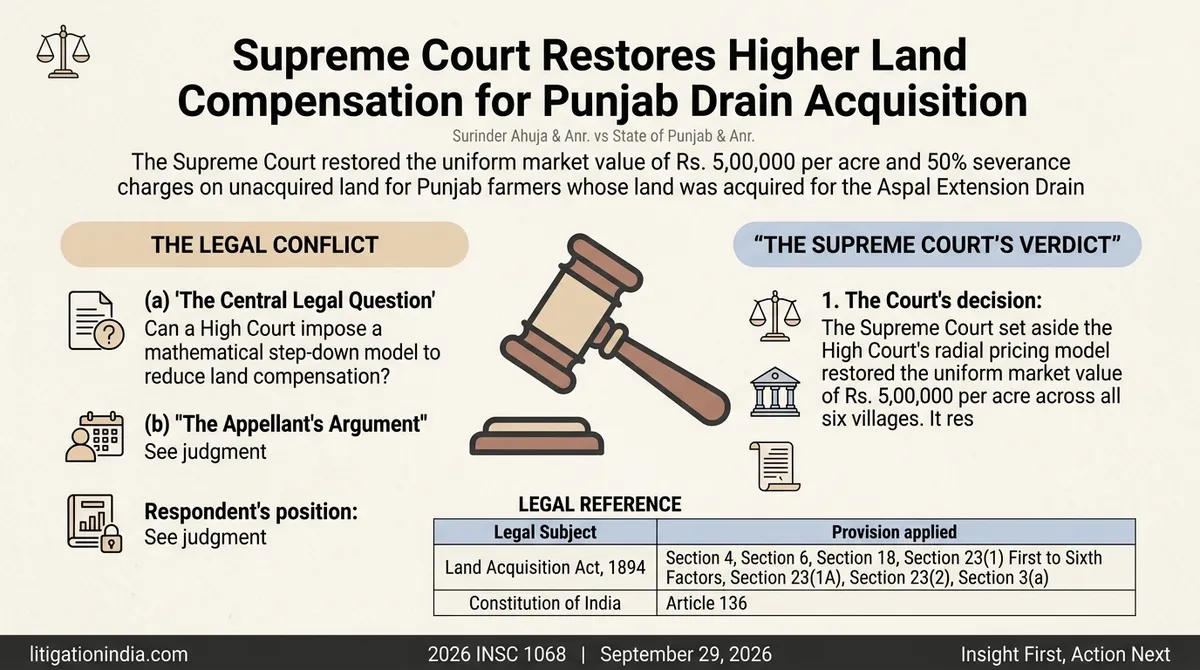
per acre, whereas Village Alam Shah (directly on the border at 1.5 km) was awarded Rs. 3,19,000/- per acre. This highlights the arbitrary nature of the radial model. 5.4.6. In the light of these findings, we hold that the High Court misdirected itself in modifying the market value of the acquired lands to graded radial rates ranging from Rs. 2,99,000/- to Rs. 3,39,000/- per acre. To maintain full constitutional parity and non-discrimination as mandated in Krishna Kumar (supra) the Reference Court’s determination of Rs. 5,00,000/- per acre was legally and factually correct, as it was grounded in project-wide contiguity, suburban potentiality (validated by the 9% urban stamp duty rate), and established 1996 Sultanpur benchmark (Ex. PW - 7/1). Accordingly, the uniform market value of Rs. 5,00,000/- per acre across all contiguous villages under challenge stands fully restored. 6. DETERMINATION ON ISSUE 2: COMPENSATION FOR FRUIT-BEARING TREES
Page 35 of 50
6.1. We now turn to the question of whether the High Court was correct in restricting the compensation for fruitbearing trees strictly to the 280 standing trees (246 Malta orange and 34 Guava plants) physically located on the acquired land portion. 6.2. We find that the High Court's restriction of orchard compensation to the 280 pleaded trees is legally and procedurally correct. In reference under Section 18 of the Act of 1894, the reference petition stands as the "plaint" and strictly defines the scope of the dispute. In their original reference petition instituted on September 20, 2002 (LA Case No. 70), the landowners explicitly pleaded orchard damages strictly limited to 280 trees standing on the acquired strip. Although the claimants subsequently led oral evidence to allege that an additional 482 Malta trees on the unacquired land dried up in 2005 due to the destruction of the Israeli-pattern drip irrigation system. However, the landowners never amended their petition filed under Section 18 of the Act
Page 36 of 50
of 1894 to include these additional 482 trees for claiming damages. 6.3. It is a settled principle of civil law that evidence cannot be led beyond pleadings. As established by this Court in Bachhaj Nahar vs. Nilima Mandal,12 a Court cannot make out a new case, decide an issue that does not arise from pleadings. The Reference Court thus committed a grave error in awarding lump-sum compensation of Rs.9,00,000/- for 946 trees. In the absence of a formal amendment to the reference petition, the claimants' compensation must be restricted to the 280 pleaded trees. Using the scientifically accepted "Nijjar Formula" rate of Rs.1,922.50/- per tree, the compensation qua trees is thus correctly restricted to Rs.5,38,300/- by the High Court in the impugned order. 7. DETERMINATION ON ISSUE 3 – SEVERANCE AND DAMAGES FOR PHYSICAL BIFURCATION
12 (2008) 17 SCC 491
Page 37 of 50
7.1. We now divert towards the issue as to whether the High Court was correct in reducing severance charges from 50% to 40% of the value of acquired lands. 7.2. Under Section 23(1) of the Act of 1894, the Court is statutorily mandated to determine the compensation amount based inter alia on: “...thirdly, the damage (if any) sustained by the person interested, at the time of the Collector's taking possession of the land, by reason of severing such land from his other land;”.
7.3. We find that the High Court committed a fundamental legal error under Section 23(1) Thirdly of the Act of 1894, by shifting the baseline of calculation from the unacquired remaining land to the acquired land portion. In the case of lead claimant Surinder Ahuja in Village Karni Khera, the State physically acquired 79 Kanals and 2 Marlas of land for the construction of the Aspal Extension Drain. This narrow acquisition, in a strip, severely impacted and bifurcated the remaining 249 Kanals and 17 Marlas of unacquired land of the same claimant. By calculating the 40% severance charges on the narrow-acquired strip rather than on the extensive
Page 38 of 50
unacquired remaining holdings, the High Court's formula considerably reduced the compensation due, leaving the landowners uncompensated for the permanent loss of utility across the vast majority of their fragmented estate. This directly violates the rule laid down in Smt. Tribeni Devi v. Collector of Ranchi,13 where this Court held that when a portion of land is acquired and a large portion is left behind, the physical separation inherently causes a severe diminution in the value of the land that is left out, for which separate, robust severance compensation must be allowed. 7.4. Moreover, the High Court mechanically applied Tehal Singh v. State of Punjab through Collector Land Acquisition Drainage Circle Patiala,14 which states: “11…. (2)Where the severed land is not the abadi side of the village, and S.Y.L. Canal is being constructed beyond it and it is two acres or less in area, compensation for severance shall be 40% of the market value of the land so acquired. … ”
The High Court erred in treating it as a geometric rule of thumb based on distance from the village abadi. In doing
13 (1972) 1 SCC 480 14 1987 RRR 495
Page 39 of 50
so, the High Court herein completely ignored the physical reality of the infrastructure on record. The State's own witness, SDO Irrigation (RW-1), admitted in cross-examination that: “...the width of the drain is about 100 feet, and its depth is 10 to 15 feet and the side banks of the drain are 10 to 12 feet high approximately and it is not possible to cross the drain without the bridge.”.
In Para 52 of its judgment, the High Court itself recorded the SDO's admissions: “The SDO's evidence who appeared as RW 1 in the cases would show that the width of drain is 130 ft. and the sides of the banks are also between 15 to 30 ft and the height was of 50ft average. Resultantly, the landowners would but obviously, feel difficulty in approaching the other side, though it has come on record that bridges had also been provided which are also at a distance of 2 km apart. The bridges also are not of those capacity which would allow the heavy machinery to cross over as it has come on record that the bridge leading to village Odian was 7 ft. width the capacity of 9 tonnes and combine harvester etc. could not cross the same.”
7.5. The physical barrier of the Aspal Extension Drain— measuring 100 to 130 feet in width with banks up to a minimum of 10 feet extending to 30 feet constitutes an insurmountable gap, because modern mechanized farming machinery (such as tractors and combine harvesters) cannot physically cross a 7-feet bridge, the
Page 40 of 50
unacquired remaining land on the opposite bank was left in a state of absolute, practical isolation. 7.6. This Court has long recognized that rendering unacquired land inaccessible constitutes a constructive total loss of its agricultural utility. In Walchandnagar Industries Ltd. v. State of Maharashtra and Another,15 this Court considered that when an acquisition destroys the functional integrity of a landowner's remaining system, the State is liable to compensate for the actual loss of utility of the remaining, unacquired infrastructure. 7.7. By ignoring facts, the High Court misapplied the Tehal Singh (supra) precedent. The drain's massive physical barrier and the inaccessibility of the severed piece of land rendered the unacquired land partially unusable. 7.8. The High Court’s decision to reduce severance charges to a flat 40% of the acquired land’s value is legally and factually unsustainable. Under Section 23(1) of the Act of 1894 the damage caused due to severance damage is
15 (2022) 5 SCC 71
Page 41 of 50
explicitly designed to compensate for the diminution in value of the unacquired remaining land. The Reference Court’s award of 50% of the value of the unacquired land was fully justified. Accordingly, the Reference Court's 50% severance award on the unacquired land is hereby restored. 7.9. Accordingly, to uphold the constitutional mandate of Krishan Kumar (supra) and restore project-wide parity across all contiguous revenue estates, the High Court’s decision to reduce severance charges to a flat 40% of the acquired lands’ value is set aside. The Reference Court’s award of 50% severance charges calculated on the market value of the unacquired remaining land is hereby fully restored across all villages under challenge. 8. DETERMINATION ON ISSUE 4: ENTITLEMENT TO STATUTORY SOLATIUM AND ADDITIONAL BENEFITS ON AUXILIARY ASSETS 8.1. We now move to the issue of whether statutory solatium under Section 23(2) and additional interest under Section 23(1A) of the Act of 1894 are legally payable on
Page 42 of 50
auxiliary assets (standing trees, tubewells, kothas, and severance charges). The statutory scheme of Section 23 provides that additional interest under Section 23(1A) and solatium under Section 23(2) of the Act of 1894 are related strictly to the market value of the land determined under Section 23(1) First Clause of the Act of 1894. 8.2. The Reference Court, in Para 19 of its award, erred by treating auxiliary assets as equivalent to primary land value for the purpose of granting statutory benefits. The Reference Court relied on the High Court precedent of Improvement Trust, Jind v. Narinder Kumar,16 to hold that: “Claimants are entitled to 30% solatium on compensation amount of trees etc.—Trees are included in the definition of land as defined under Section 3 (a)—Compensation amount for trees will be deemed to be market value of land.”
This approach directly contravenes the definitive ruling of this Court in State of Punjab v. Amarjit Singh,17 which inter alia lays down thus: -
16 1990 (1) RRR 437 17 (2011) 4 SCC 734
Page 43 of 50
“The additional amount under Section 23(1-A) and solatium under Section 23(2) are both payable only on the market value determined under Section 23(1) of the Act and not on any other amount. Solatium under Section 23(2) is not payable on the additional amount nor additional amount under Section 23(1-A) payable on solatium. Solatium and additional amount are also not payable on the damages/expenses that may be awarded under second to sixth factors under Section 23(1) of the Act.”
8.3. The standing trees fall under Section 23(1) second factor of the Act of 1894, severance damages fall under third factor, and tubewells/kothas fall under fourth or fifth factors. Thus, these factors constitute separate and independent auxiliary heads of damage rather than land market value under the first factor. As per ratio laid down in Amarjit Singh (supra), these factors are strictly excluded from attracting statutory solatium and additional interest. 8.4. The High Court was therefore correct and legally justified in Para 62 of its judgment, where it held: “It is made clear that landowners would not be entitled for benefits of Section 23(1A) and 23(2) on account of the amount awarded for severance, fruit trees, tubewells and structures in view of the judgment of the Apex Court in State of Punjab vs. Amarjit Singh (2011) 4 SCC 734. In the same, it was held that Section 23(1) refers to the market value of the land on the date of publication of the notification which is the relevant factor. Additional amounts are payable only on the market value determined and not on the other amounts which are to be kept in mind while determining the compensation which pertained to
Page 44 of 50
the damage sustained to taking of any standing trees or crops on the land or severance etc. Resultantly, the second to the sixth factors were excluded as such for the abovesaid benefits.”
8.5. Consequently, the High Court was correct in applying the ratio laid down in State of Punjab v. Amarjit Singh (supra) under prevailing land acquisition law. The precedent of the Punjab & Haryana High Court in Improvement Trust, Jind (supra) cannot override the subsequent ruling of the Apex Court in Amarjit Singh (supra). 8.6. We therefore affirm this portion of the High Court’s judgment. 9. DETERMINATION ON ISSUE 5: COMPENSATION FOR TUBEWELLS 9.1. We now turn to the last issue of compensation for the tubewell. Upon an exhaustive review of the evidence on record and applicable land acquisition jurisprudence, the High Court's determination to standardize tubewell compensation at Rs. 50,000/- flat and excluding the statutory additions under Sections 23(1A) and 23(2) of the Act of 1894 is legally correct.
Page 45 of 50
9.2. The Reference Court in Karni Khera committed error in blindly adopting private valuation reports produced by PW - 1 Manhool Ram (Ex. P4 to P8) to enhance tubewell compensation to Rs. 1,00,000/- per tubewell, as the expert engineer who authored those reports was never produced in the witness box to depose, prove his reports, or face cross-examination by the State. 9.3. It is settled that mere marking or tendering of a private document as an exhibit does not prove the truth of its contents without examining its author. This Court in S. Sangeetha & ORS. v. TMT. P. Ponni18 reiterated LIC v. Ram Pal Singh Bisen19 where it observed: “25. We are of the firm opinion that mere admission of a document in evidence does not amount to its proof. In other words, mere marking of exhibit on a document does not dispense with its proof, which is required to be done in accordance with law. 31. Under the law of evidence also, it is necessary that contents of documents are required to be proved either by primary or by secondary evidence. At the most, admission of documents may amount to admission of contents but not its truth. Documents having not been produced and marked as required under the Evidence Act cannot be relied upon by the Court. Contents of the document cannot be proved by merely filing in a Court.”
18 (2026 INSC 813) 19 (2010) 4 SCC 491
Page 46 of 50
9.4. Furthermore, mechanical components such as electric motors, diesel engines, and surface pumps represent movable property that are not destroyed during acquisition and thus can be uninstalled, shifted, and reused on remaining holdings. Standardizing compensation at a flat rate of Rs. 50,000/- appropriately balances private inflation against government underestimation to arrive at a realistic, uniform displacement figure across all contiguous revenue estates. 9.5. Additionally, the High Court correctly set aside the Reference Court's direction granting 30% solatium under Section 23(2) and 12% per annum additional interest under Section 23(1A) of the Act of 1894 on top of the tubewell awards. As discussed in the previous issue, it is squarely governed by the binding precedent of this Court in State of Punjab v. Amarjit Singh (supra), which laid down that statutory solatium and additional amounts are not payable on damages or
Page 47 of 50
expenses assessed for standing structures, tubewells, or severance. 9.6. Accordingly, the High Court’s order standardizing tubewell compensation at Rs. 50,000/- per tubewell and denying Section 23(1A) and Section 23(2) of the Act of 1894 statutory additions thereon stand fully affirmed. 10. Before concluding we would like to briefly discuss the extent of interference permissible under Article 136 of the Constitution of India. Since Article 136 has been invoked in all the instant 47 civil appeals, it would be appropriate to discuss the scope and ambit under the said Article. 10.1. The landmark decisions of this Court dealing with scope and ambit of Article 136, especially Pritam Singh vs. State,20 Dhakeshwari Cotton Mills Limited vs. Commissioner of Income Tax,21 Delhi Judicial Services Association vs. State of Gujarat22 and Kunhayammed and Ors. vs. State of Kerala,23 in one
20 1950 SCC 189 21 AIR 1955 SC 65 22 (1991) 4 SCC 406 23 (2000) 6 SCC 359
Page 48 of 50
voice, lay down that the remedy under Article 136 cannot be sought as a matter of right, but is highly discretionary in nature. This Article strikes to eliminate miscarriage of justice rather than to do justice. This remedy can be denied for various reasons, especially when only executive action is assailed. This remedy is also supervisory in nature, and due to non-obstante clause, it prevails over all other articles in Chapter IV of the Constitution. 10.2. We have no manner of doubt that the window of interference under Article 136 is extremely limited and restrictive; however, in the attending facts and circumstances herein, we have attempted to remove injustice or institutional high-handedness wherever it was found. 11. CONCLUSION All these 47 Civil Appeals are disposed of in the following terms: - 11.1. On Market Value (Issue 1): We set aside the High Court’s radial step-down model and restore the uniform market
Page 49 of 50
value of Rs. 5,00,000/- per acre across the villages involved in these 47 civil appeals. 11.2. On Fruit-Bearing Trees (Issue 2): We affirm and uphold the High Court’s restriction of tree compensation strictly to the 280 pleaded trees (totaling Rs. 5,38,300/-). 11.3. On Severance Charges (Issue 3): We set aside the High Court’s cap on acquired land and restore the Reference Court’s award of 50% severance charges calculated on the market value of the remaining unacquired land. 11.4. On Statutory Benefits (Issue 4): We affirm and uphold the High Court’s denial of Section 23(1A) and Section 23(2) of the Act of 1894 benefits on auxiliary assets and thus restrict the payment of solatium interest @ 30% calculated exclusively on market value. 11.5. On Tube well Compensation (Issue 5): We affirm and uphold the High Court’s award of Rs. 50,000/- flat per tube well on account of displacement across all six villages. 11.6. Let additional compensation be worked out and paid within six (6) months from the date of communication of
Page 50 of 50
this order, by the official respondents to the landowners in these 47 civil appeals. 11.7. In case, from any landowners, after re-working the compensation amount as per this order, any amount becomes recoverable, then due intimation in writing shall be given to the respective landowners in these 47 civil appeals, and after affording due and sufficient opportunity to all concerned, the recovery shall be made within a period of nine (09) months, from the date of communication of this order. 11.8. No orders as to costs.
……………………………...J. (DIPANKAR DATTA)
…...………………………...J. (SHEEL NAGU)
NEW DELHI; SEPTEMBER 29, 2026