
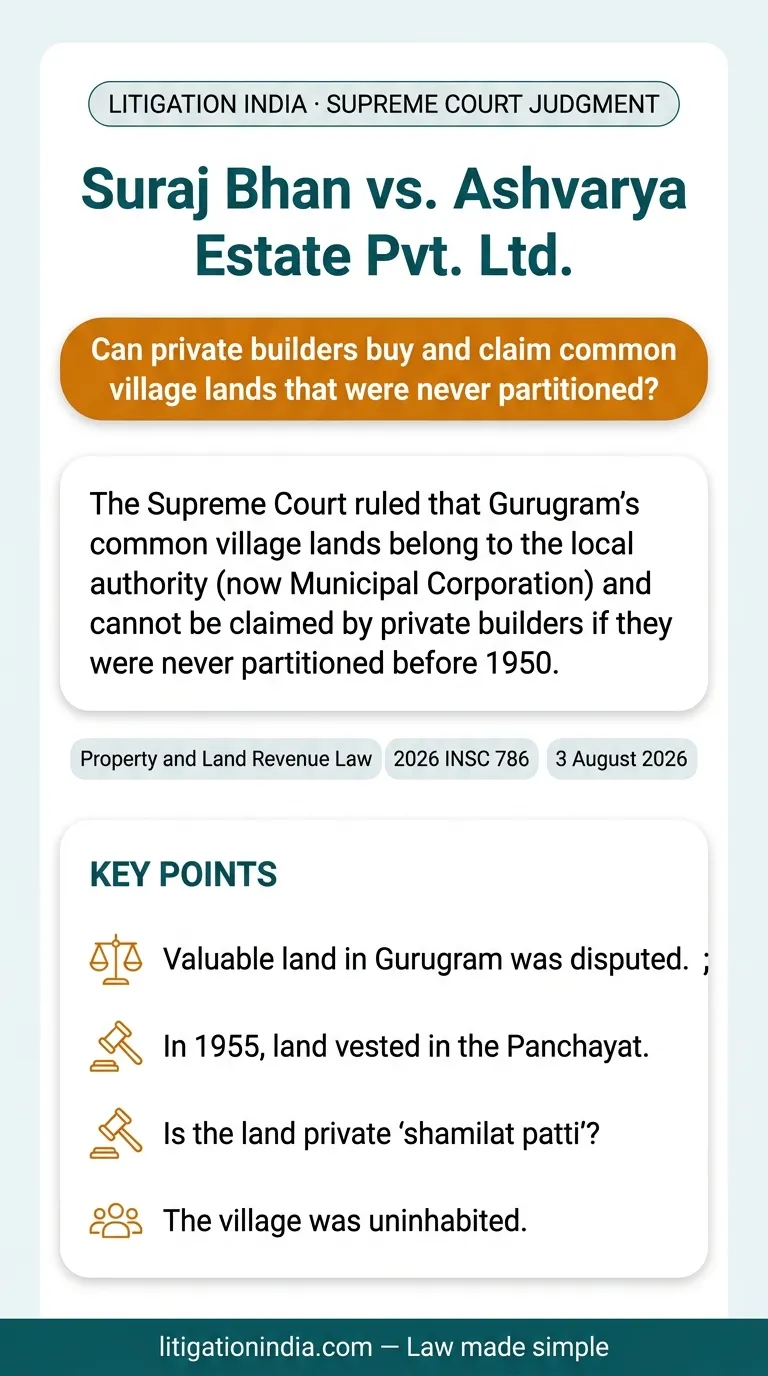
Can private builders buy and claim common village lands that were never partitioned?
Suraj Bhan vs. Ashvarya Estate Pvt. Ltd.
Case: Suraj Bhan vs. Ashvarya Estate Pvt. Ltd.Citation: 2026 INSC 786Decided on: 3 August 2026
“The Supreme Court ruled that Gurugram's common village lands belong to the local authority (now Municipal Corporation) and cannot be claimed by private builders if they were never partitioned before 1950.”
Story Slides
In short
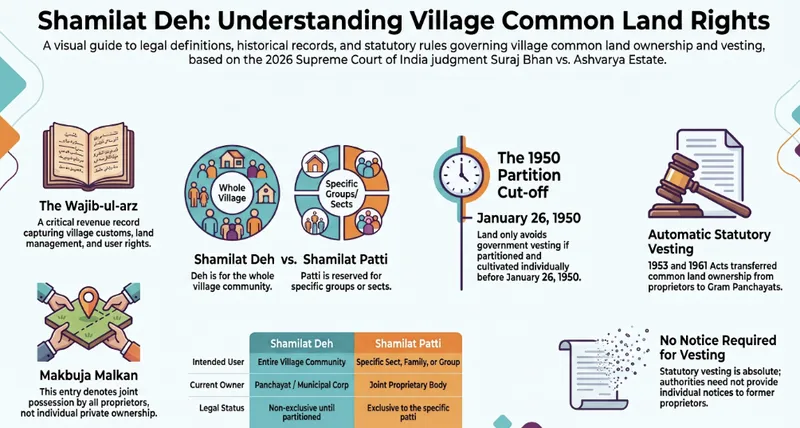
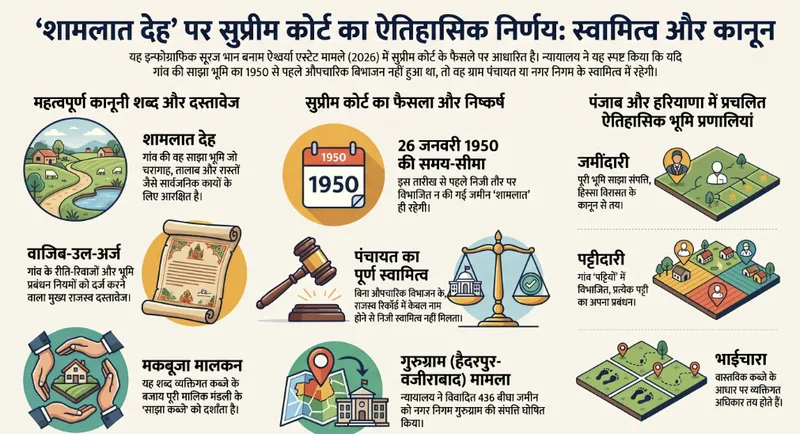
In this major land dispute from Gurugram, Haryana, the Supreme Court decided who owns a valuable stretch of 436 bighas of land in Haiderpur village. Private builders and developers had bought portions of this land from village groups ('pattis'), claiming it was private property. The Punjab and Haryana High Court had ruled in favor of the builders, stating that the village was uninhabited and the land wasn't being used for common public purposes. However, the Supreme Court completely reversed this decision. The Court explained that ancient revenue records clearly marked this land as 'shamilat deh' (common village land). Under Haryana law, once land is recorded as common village land, it automatically belongs to the Gram Panchayat (and now its successor, the Municipal Corporation of Gurugram). For any individual to claim private ownership over such land, they must prove that it was legally divided (partitioned) and brought under separate individual cultivation before January 26, 1950. Since the records showed 'makbuja malkan' (joint possession of all owners) and no partition had ever occurred, the land remains public property. The Court ruled that the builders' purchases were invalid and the land belongs entirely to the Gurugram Municipal Corporation for public welfare.
Need clarity on a similar legal issue?
Request free pro bono guidance from a Supreme Court Advocate.
Background
A large stretch of land in Gurugram's Haiderpur village was transferred to the local Gram Panchayat in 1955 as common village land. Decades later, private builders bought these lands from individual villagers, arguing that since the village was uninhabited and the land was not actively used for common purposes, it was private property.
The Decision
The Supreme Court set aside the High Court's order and declared the Gram Panchayat (now Gurugram Municipal Corporation) as the absolute owner. The Court held that unless common land was partitioned and cultivated individually before 1950, it belongs to the public authority.
Why it matters for you
This judgment prevents private developers from grabbing precious village common lands under the pretext that they are empty or unused. It protects community assets like ponds, paths, and hills for public welfare and ensures local municipalities retain lands meant for development.
Photos
AI-assisted summary, reviewed and verified by our editorial team.
Need help with your case?
Facing a property, eviction, or landlord-tenant dispute? Consult our property lawyers for a free initial review.
Related Supreme Court services