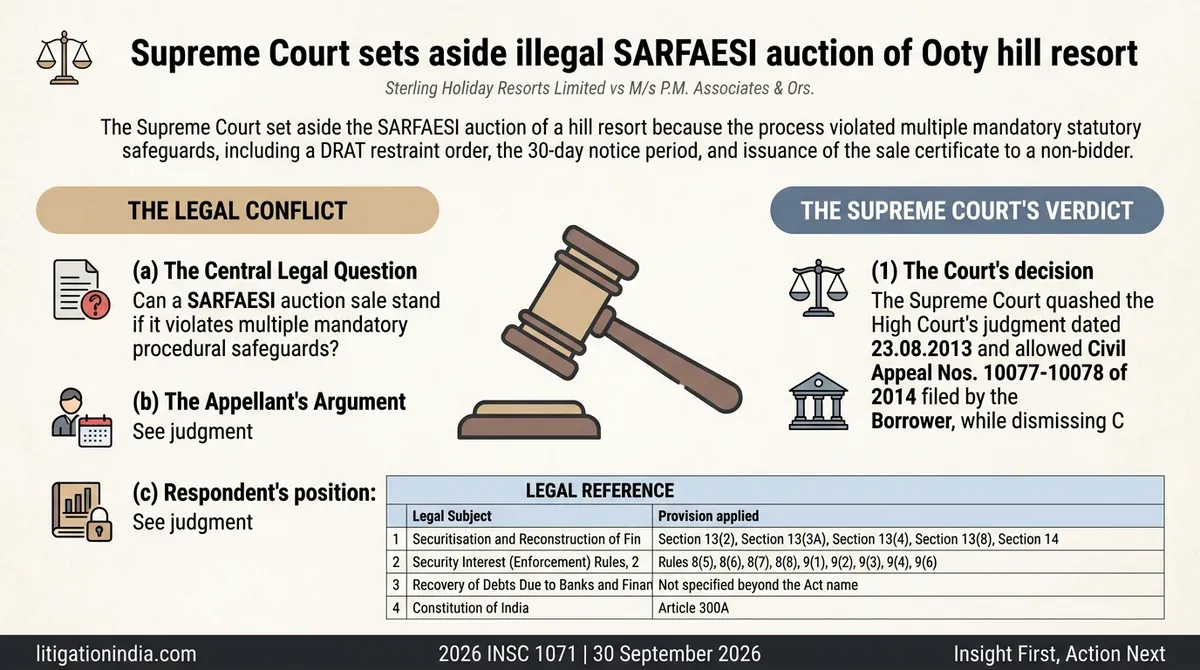
Full text of the judgment
Text extracted from Sterling Holiday Resorts Limited vs M/s P.M. Associates & Ors.. For the authoritative version refer to the Supreme Court of India's official website.
2026 INSC 1071 1 NON-REPORTABLE
IN THE SUPREME COURT OF INDIA CIVIL APPELLATE/INHERENT JURISDICTION
CIVIL APPEAL NOS. 10077-10078 OF 2014 STERLING HOLIDAY RESORTS LIMITED …APPELLANT VERSUS M/S P.M. ASSOCIATES & ORS. …RESPONDENTS WITH CIVIL APPEAL NOS. 10246-10247 OF 2014 CONTEMPT PETITION (C) NOS. 834-835 OF 2015 IN CIVIL APPEAL NOS. 10077-10078 OF 2014 AND SPECIAL LEAVE PETITION (C) NO. 508 OF 2016
J U D G M E N T ALOK ARADHE, J. 1. This batch of matters concerns the fate of a hill resort which has been the subject of litigation for well over a decade. The central issue in this batch of appeals is whether the process culminating in issuance of sale certificate, was conducted in conformity with the statutory framework governing such sale. 2. The Civil Appeal Nos. 10077-10078 of 2014, preferred by Sterling Holiday Resorts Limited (“the Borrower”), and Civil Appeal Nos. Digitally signed by KAPIL TANDON Date: 2026.09.30 17:40:49 IST Reason: Signature Not Verified
2 10246-10247 of 2014, preferred by M/s P.M. Associates (“the Purchaser”), arise out of the common judgment dated 23.08.2013 passed by the High Court1. The Special Leave Petition (Civil) No. 508 of 2016 has been filed by the Purchaser against the order dated 13.04.2015 of the High Court in a Company Petition, which sanctioned a modified composite scheme of arrangement and amalgamation between the Borrower, Thomas Cook Insurance Services (India) Limited and Thomas Cook (India) Limited, subject to approval of the scheme by the High Court of Bombay. The Purchaser has also instituted Contempt Petition (C) Nos. 834-835 of 2015 alleging violation of the interim order dated 16.09.2013 passed by this Court. 3. Since the appeals turn substantially upon the chronology of events, it is necessary to set out the facts in some detail. FACTS 4. The Borrower has, since 1987, been engaged in the business of developing and marketing resorts on a timeshare basis. In 1991, it obtained a loan of Rs.2.06 crores from the Industrial Finance Corporation of India Limited (“IFCI”) and a term loan of Rs.3.24
1 High Court of Judicature at Madras
3 crores from the Tourism Finance Corporation of India Limited (TFCI) on a consortium basis. As security, the Borrower created, by way of a joint equitable mortgage in favour of IFCI and TFCI, a first charge over its resort property known as ‘The Fernhill’, situated at Ooty, District Nilgiris, Tamil Nadu (“the Resort”). 5. Upon default by the Borrower, IFCI and TFCI jointly instituted O.A. No. 277 of 2000 on 02.06.2000 before the Debts Recovery Tribunal, New Delhi (“DRT, Delhi”) under the Recovery of Debts Due to Banks and Financial Institutions Act, 1993 (“the 1993 Act”), claiming a sum of Rs. 8,87,36,938/- (Rupees Eight Crore Eighty Seven Lakh Thirty-Six Thousand Nine Hundred Thirty Eight only) as on 30.05.2000, of which the claim of IFCI was Rs. 3,64,60,434/- (Rupees Three Crore Sixty Four Lakh Sixty Thousand Four Hundred Thirty-Four only). During the pendency of those proceedings, IFCI, on 30.10.2007, issued a demand notice under Section 13(2) of the Securitisation and Reconstruction of Financial Assets and Enforcement of Security Interest Act, 2002 (“the SARFAESI Act”) demanding a sum of Rs.17,71,78,482/- (Rupees Seventeen Crore Seventy One Lakh Seventy Eight Thousand Four Hundred Eighty Two Only). The
4 representation submitted by the Borrower on 26.12.2007 under Section 13(3A) evoked no response. 6. On 21.08.2009, the Authorised Officer of IFCI (“the AO”) issued a notice under Section 13(4) of the SARFAESI Act stating that symbolic possession of the Resort had been taken and that physical possession would follow. The Borrower assailed this action in S.A. No. 189 of 2009 before the Debts Recovery Tribunal, Chennai (“DRT, Chennai”), which, by an interim order dated 08.09.2009, restrained the AO from taking physical possession subject to the Borrower depositing Rs. 3.40 crores on or before 26.10.2009. In appeal, the amount was enhanced to Rs. 4 crores, which the Borrower duly deposited. 7. On 23.10.2009, the DRT, Delhi decreed O.A. No. 277 of 2000, quantifying the Borrower’s liability towards TFCI at Rs.5,08,46,131/- (Rupees Five Crore Eight Lakh Forty-Six Thousand One Hundred Thirty-One only) and towards IFCI at Rs.3,52,53,263/- (Rupees Three Crore Fifty-Two Lakh Fifty- Three Thousand Two Hundred Sixty Three only), together with interest at 13.5% per annum (the Debts Recovery Appellate Tribunal, by its order dated 06.08.2010, modified the decree to provide for pendente lite and future interest at 16% per annum).
5 The Borrower settled the claim of TFCI in full by paying Rs. 6.03 crores under a One-Time Settlement scheme. 8. By its order dated 05.03.2010, the DRT, Chennai partly allowed S.A. No. 189 of 2009, set aside the action of IFCI insofar as it related to taking physical possession of the Resort, and permitted IFCI to proceed from the stage of symbolic possession. Acting upon this liberty, IFCI issued an auction notice dated 25.03.2010 fixing the reserve price of the Resort at Rs. 20 crores and scheduling the auction for 28.04.2010. 9. The Borrower carried the matter in appeal to the Debts Recovery Appellate Tribunal, Chennai (“DRAT”). By an order dated 07.04.2010, the DRAT directed the Borrower to deposit Rs. 1 crore on or before 09.04.2010 and, subject to such deposit, restrained the AO from proceeding further under the SARFAESI Act. The operative portion of the order reads thus: “Accordingly, the petitioner company is directed to deposit a sum of Rs. 1.00 crore with the Registrar of this Tribunal on or before 09.04.2010 and on the petitioner company depositing the said sum, the Authorised Officer shall stand restrained from in any way proceeding further under the provisions of the SARFAESI Act till further orders and in the event of the petitioner company’s failure to deposit the said amount, the Authorised Officer shall be at liberty to proceed against the petitioner company under the provisions of the SARFAESI Act from 10.04.2010 onwards.” (emphasis supplied)
6 The Borrower deposited the sum of Rs. 1 crore on 08.04.2010, i.e., a day before the stipulated date. The restraint thus became operative. 10. Notwithstanding the restraint, IFCI, in pursuance of the auction notice dated 25.03.2010, received bids, though it did not open them on account of the order dated 07.04.2010. On 09.03.2011, the DRAT allowed the Borrower’s appeal and set aside the order dated 05.03.2010 of the DRT, Chennai. IFCI challenged the DRAT’s order before the High Court, which, by its judgment dated 06.09.2011, allowed the writ petition, observing as under: “We hold that there was substantial compliance of Section 13(3-A) of the Act and Rule 3-A(c) of the Rules by the petitioners. The above facts were not taken into consideration by the DRAT while setting aside the order of the DRT. Hence, for our own reasons, the order of the DRAT in quashing the entire proceedings cannot be sustained and is liable to be set aside.” “44. For all the above reasons, the order dated 9th March 2011 on the file of the DRAT is set aside and the writ petition is allowed. No costs.”
11. Within six days thereafter, on 12.09.2011, IFCI opened the bids and declared one Ms. Rukmani Khemchand as the successful bidder. On the very same day, the full sale consideration of Rs. 20,00,10,000/- (Rupees Twenty Crore Ten Thousand only) was remitted, not by the declared bidder, but by M/s P.M. Associates,
7 the Purchaser herein. A sale certificate came to be issued in favour of the Purchaser, which, as recorded by the High Court, bears the date 16.09.2011. 12. On 21.09.2011, the Borrower challenged the judgment dated 06.09.2011 before this Court in SLP (C) No. 27587 of 2011. Meanwhile, in Writ Petition No. 21820 of 2011 instituted by the Borrower, the High Court, by an interim order dated 22.09.2011, directed IFCI not to precipitate matters by moving the Chief Judicial Magistrate under Section 14 of the SARFAESI Act for appointment of an Advocate Commissioner to take physical possession of the Resort till 27.09.2011; the interim protection was continued on 27.09.2011. On 25.11.2011, the High Court directed IFCI to produce the entire records relating to the sale, which was then understood to be one by private treaty. On 10.12.2011, the High Court recorded as follows: “By order dated 25.11.2011, this court directed the respondent bank to produce the records relating to the sale by private treaty. It is now represented by the learned counsel appearing for the respondent that the sale has been made only by auction by inviting tenders and not by private treaty, which fact is also disputed by the learned counsel for the petitioner. Be that as it may, the fact remains that the respondent has not produced the original records relating to the sale and had chosen only to produce Xerox copies, which we are not entertaining. At the request of the learned counsel on either side, call this matter
8 on 15.12.2011. In the meantime the respondent Bank shall produce the original file relating to the sale before the registry.”
13. By an order dated 05.01.2012 passed in SLP (C) No. 27587 of 2011, this Court permitted the Borrower to deposit the balance dues with IFCI in terms of the decree dated 23.10.2009 of the DRT, Delhi, as modified by the DRAT, Delhi, after adjusting the amounts already deposited. In compliance thereof, the Borrower deposited a sum of Rs. 8,80,00,000/- (Rupees Eight Crore Eighty Lakh only). 14. In the meantime, the Borrower instituted Writ Petition No. 22837 of 2011 challenging the auction notice dated 25.03.2010, whereas the Purchaser filed Writ Petition No. 1937 of 2012 seeking a direction for registration of the sale certificate. 15. On an intimation sent by IFCI on 03.02.2012, the Borrower, paid a further sum of Rs. 3,72,00,000/- (Rupees Three Crore Seventy Lakh only) in full and final settlement of the dues of IFCI. On 08.02.2012, IFCI cancelled the sale certificate issued in favour of the Purchaser and refunded the sum of Rs. 20,00,10,000/- (Rupees Twenty Crore Ten Thousand only) together with interest of Rs. 61,34,554/- (Rs. 55,21,099/- net of tax deducted at
9 source), by two cheques, which the Purchaser encashed. The Purchaser thereafter filed Writ Petition No. 4088 of 2012 seeking to quash the communication dated 08.02.2012 cancelling the sale certificate. 16. On 14.02.2012, in view of the settlement arrived at between the Borrower and IFCI, the High Court permitted the Borrower to withdraw the writ petitions filed by it challenging the auction notice and the proceedings under the SARFAESI Act, with liberty to seek impleadment in the writ petitions filed by the Purchaser and defend itself therein. On 25.04.2012, on a miscellaneous petition moved by the Purchaser, the High Court permitted the Purchaser to deposit the amount refunded to it. 17. By the impugned judgment dated 23.08.2013 rendered in W.P. Nos. 1937 and 4088 of 2012, a Division Bench of the High Court held that: (i) the sale certificate dated 16.09.2011 in favour of the Purchaser had been validly issued; (ii) the AO had no power under the SARFAESI Act or the Security Interest (Enforcement) Rules, 2002 (“the Rules”) framed thereunder to unilaterally cancel a sale certificate once issued, such power vesting only in the competent Court or Tribunal; (iii) the acceptance of a settlement amount of about Rs. 12.5 crores from the Borrower
10 was impermissible in law; (iv) the Borrower, having withdrawn its writ petition challenging the auction notice, could not question the validity of the sale; and (v) the sale certificate required registration under Section 17(2)(xii) of the Registration Act, 1908, but since the Purchaser had never been put to notice of its liability towards stamp duty, it could not be blamed for non-registration, and AOs were accordingly directed to disclose such liability at the stage of the sale notice itself. Consequently, the cancellation letter dated 08.02.2012 was set aside, and the Purchaser was held entitled to physical possession and registration of the sale certificate upon re-payment of the refunded bid amount within two weeks. W.P. No. 4088 of 2012 was allowed, and W.P. No. 1937 of 2012 was disposed of with liberty to the Purchaser to approach the appropriate authorities for mutation of revenue entries. 18. Both the Borrower and the Purchaser are in appeal against the impugned judgment. While issuing notice in the Borrower’s appeals, this Court, by an interim order dated 16.09.2013, directed the parties to maintain status quo in all respects in relation to the subject property. During the pendency of these appeals, the High Court, by order dated 13.04.2015 in Company
11 Petition No. 352 of 2014, sanctioned the merger of the Borrower with Thomas Cook (India) Limited, overruling the objections of the Purchaser. That order is the subject matter of the SLP (C) No. 508 of 2016. The Purchaser has also filed Contempt Petition (C) Nos. 834-835 of 2015 alleging breach of the interim order dated 16.09.2013. SUBMISSIONS 19. Dr. Abhishek Manu Singhvi, learned senior counsel for the Borrower, submitted that the Purchaser is a stranger to the auction. The bid was submitted by Ms. Rukmani Khemchand in her individual capacity, while the Purchaser, a partnership firm constituted on 12.09.2011 between her and her brother Mr. Murli Khemchand, was not even in existence on the last date for submission of bids. The sale certificate was issued to the Purchaser merely as her nominee, which neither the auction notice nor the Rules permit. It was contended that IFCI proceeded with the auction and accepted bids despite the DRAT’s restraint order dated 07.04.2010. It was submitted that under Section 13(8) of the SARFAESI Act, as it stood prior to its amendment with effect from 01.09.2016, the Borrower’s right of redemption subsisted until registration of the sale, and that the
12 sale certificate in the present case has neither been registered nor survived, having been cancelled. 20. It was further submitted that possession of the Resort has at all times remained with the Borrower, which has been running it successfully for over two decades. He contended that a consummated redemption cannot be reversed; and that a sale can be set aside even after confirmation where illegality in the SARFAESI proceedings is demonstrated. It was pointed out that the amount deposited by the Purchaser was refunded to it with interest and was encashed by it, and that the interest so received was never offered back. Reliance was placed upon several decisions of this Court.2 21. Mr. Rakesh Dwivedi, learned senior counsel, also appearing for the Borrower, submitted that the Borrower having been permitted to defend the writ petitions of the Purchaser, was fully entitled to demonstrate the illegalities in the sale. Even if it is assumed that there was more than one bidder, Clause 2.10 of
2Narandas Karsondas v. S.A. Kamtam & Anr., (1977) 3 SCC 247, paras 34-37; Transcore v. Union of India & Anr., (2008) 1 SCC 125; J. Rajiv Subramaniyan & Anr. v. Pandiyas & Ors., (2014) 5 SCC 651; Vasu P. Shetty v. Hotel Vandana Palace & Ors., (2014) 5 SCC 660; M.D. Frozen Foods Exports (P) Ltd. & Ors. v. Hero Fincorp Ltd., (2017) 16 SCC 741; Mathew Varghese v. M. Amritha Kumar & Ors., (2014) 5 SCC 610, paras 38-39; Celir LLP v. Bafna Motors (Mumbai) (P) Ltd. & Ors., (2024) 2 SCC 1, paras 50, 67, 77.3, 77.4, 110.3; M. Rajendran & Ors. v. KPK Oils and Proteins India (P) Ltd., (2026) 3 SCC 505; M.R. Vasumathi v. Authorised Officer & Ors., 2026 SCC OnLine SC 1103, paras 28, 35, 36; E. Muthurathinasabathy & Ors. v. Sri International & Ors., 2026 SCC OnLine SC 508, paras 4(o), 23, 25, 27, 28, 30, 35 and Shree Sidhbali Steels Ltd. & Ors. v. State of U.P. & Ors., (2011) 3 SCC 193.
13 the auction notice mandated inter se bidding, and no details of any other bidder have ever been placed on record. It was urged that once the High Court decided IFCI’s writ petition on 06.09.2011, a fresh sale notice ought to have been issued, and no further step could have been taken on a notice issued nearly one and a half years earlier. It was also contended that there was no confirmation of sale as contemplated by Rule 9 of the Rules, and that registration of the sale certificate was mandatory3. 22. Per contra, Mr. R. Guru Krishna Kumar, learned senior counsel for the Purchaser, submitted that the AO had no authority in law to cancel the sale certificate, particularly when neither the sale nor the certificate was under challenge. It was contended that the Borrower’s right of redemption stood extinguished upon issuance of the sale certificate on 16.09.2011, and no fresh notice was required. It was argued that the Borrower and IFCI acted in collusion, which disentitles the Borrower to any relief. It was contended that the plea that the Purchaser was a stranger to the auction was never raised before the High Court; and that no prejudice was caused to the Borrower merely because a
3Mathew Varghese (supra); Manohar Lal (Dead) by LRs v. Ugrasen (Dead) by LRs & Ors., (2010) 11 SCC 557, paras 27-29 and Dwarika Prasad v. State of U.P. & Ors., (2018) 5 SCC 491, para 8.
14 partnership firm, and not an individual, acquired the Resort. It was pointed out that the Purchaser, of its own accord, sought and obtained permission from the High Court on 25.04.2012 to deposit the refunded amount. Reliance was placed on various decisions of this Court4. 23. Mr. Kush Chaturvedi, learned counsel for IFCI, submitted that the validity of the auction was not the subject matter of the writ petitions before the High Court, both of which were filed by the Purchaser. He contended that IFCI cancelled the sale certificate because the Borrower tendered the dues in terms of the decree of the DRT. ANALYSIS 24. We have heard learned counsel for the parties at length and perused the record. Although the parties have addressed us on a range of issues, including the power of the AO to cancel a sale certificate, the requirement of its registration, and the scope of
4Valji Khimji and Company v. Official Liquidator of Hindustan Nitro Product (Gujarat) Limited & Ors., (2008) 9 SCC 299, para 28; Celir LLP (supra), paras 88-92; IDBI Bank Ltd. v. Ramswaroop Daliya & Ors., 2024 SCC OnLine SC 2878, para 20; Mathew Varghese (supra); Allokam Peddabbayya v. Allahabad Bank & Ors., (2017) 8 SCC 272; Pegasus Assets Reconstruction (P) Ltd. v. Haryana Concast Ltd. & Anr., (2016) 4 SCC 47; Esjaypee Impex (P) Ltd. v. Assistant General Manager & Authorised Officer, Canara Bank, (2021) 11 SCC 537; Inspector General of Registration & Anr. v. G. Madhurambal & Anr., 2022 SCC OnLine SC 2079; Haldiram Incorporation (P) Ltd. v. Amrit Hatcheries Pvt. Ltd. & Ors., 2023 SCC OnLine SC 1706; State of Punjab & Anr. v. Ferrous Alloy Forgings (P) Ltd., 2024 SCC OnLine SC 3372 and B. Arvind Kumar v. Govt. of India & Ors., (2007) 5 SCC 745.
15 the right of redemption, the pivotal question which goes to the root of the controversy, and which, in our view, is determinative of these appeals, is this: whether the auction process initiated by the notice dated 25.03.2010 and culminating in the issuance of the sale certificate dated 16.09.2011 was conducted in accordance with law. 25. Before examining the question, it is apposite to notice the statutory provisions, as they then stood, governing the sale in question. (A) THE STATUTORY FRAMEWORK 26. Section 13(8) of the SARFAESI Act, as it stood prior to its substitution by Act 44 of 2016 with effect from 01.09.2016, read as under: “13. Enforcement of security interest.— … (8) If the dues of the secured creditor together with all costs, charges and expenses incurred by him are tendered to the secured creditor at any time before the date fixed for sale or transfer, the secured asset shall not be sold or transferred by the secured creditor, and no further step shall be taken by him for transfer or sale of that secured asset.” (emphasis supplied) The relevant provisions of Rules 8 and 9 of the Rules, as then in force, read thus:
16 “8. Sale of immovable secured assets.— … (5) Before effecting sale of the immovable property referred to in sub-rule (1) of rule 9, the authorised officer shall obtain valuation of the property from an approved valuer and in consultation with the secured creditor, fix the reserve price of the property and may sell the whole or any part of such immovable secured asset by any of the following methods:— (a) by obtaining quotations from the persons dealing with similar secured assets or otherwise interested in buying the such assets; or (b) by inviting tenders from the public; (c) by holding public auction; or (d) by private treaty. (6) The authorised officer shall serve to the borrower a notice of thirty days for sale of the immovable secured assets, under sub-rule (5): Provided that if the sale of such secured asset is being effected by either inviting tenders from the public or by holding public auction, the secured creditor shall cause a public notice in two leading newspapers one in vernacular language having sufficient circulation in the locality by setting out the terms of sale, which shall include,— (a) the description of the immovable property to be sold, including the details of the encumbrances known to the secured creditor; (b) the secured debt for recovery of which the property is to be sold; (c) reserve price, below which the property may not be sold; (d) time and place of public auction or the time after which sale by any other mode shall be completed; (e) depositing earnest money as may be stipulated by the secured creditor; (f) any other thing which the authorised officer considers it material for a purchaser to know in order to judge the nature and value of the property. (7) Every notice of sale shall be affixed on a conspicuous part of the immovable property and may, if the authorised officer deems it fit, put on the web-site of the secured creditor on the Internet.
17 (8) Sale by any methods other than public auction or public tender, shall be on such terms as may be settled between the parties in writing. 9. Time of sale, issue of sale certificate and delivery of possession, etc.— (1) No sale of immovable property under these rules shall take place before the expiry of thirty days from the date on which the public notice of sale is published in newspapers as referred to in the proviso to sub-rule (6) or notice of sale has been served to the borrower. (2) The sale shall be confirmed in favour of the purchaser who has offered the highest sale price in his bid or tender or quotation or offer to the authorised officer and shall be subject to confirmation by the secured creditor: Provided that no sale under this rule shall be confirmed, if the amount offered by sale price is less than the reserve price, specified under sub-rule (5) of rule 9. Provided further that if the authorised officer fails to obtain a price higher than the reserve price, he may, with the consent of the borrower and the secured creditor effect the sale at such price. (3) On every sale of immovable property, the purchaser shall immediately pay a deposit of twenty-five per cent of the amount of the sale price, to the authorised officer conducting the sale and in default of such deposit, the property shall forthwith be sold again. (4) The balance amount of purchase price payable shall be paid by the purchaser to the authorised officer on or before the fifteenth day of confirmation of sale of the immovable property or such extended period as may be agreed upon in writing between the parties. (5) In default of payment within the period mentioned in sub-rule (4), the deposit shall be forfeited and the property shall be resold and the defaulting purchaser shall forfeit all claim to the property or to any part of the sum for which it may be subsequently sold. (6) On confirmation of sale by the secured creditor and if the terms of payment have been complied with, the authorised officer exercising the power of sale shall issue a certificate of sale of the immovable property in favour of the purchaser in the Form given in Appendix V to these rules. …” (emphasis supplied)
18 27. The relevant clauses of the auction notice issued by IFCI for the sale of the Resort may also be noticed: “2.1 IFCI Limited as a secured creditor to SHRIL and having right/power to sell the assets after their acquisition under the provisions of the [SARFAESI Act] shall be referred to as the seller and the successful tenderer/bidder, (i.e. the tenderer/bidder in whose favour the sale may be awarded) shall be hereinafter referred to as the Purchaser. 2.7 The Reserve Price has been fixed at Rs. 2000.00 lakh. Any tender with a bid lower than the Reserve Price shall not be considered under any circumstances. 2.10 Inter-se bidding shall be held amongst eligible bidders. The highest bidder amongst them after inter-se bidding shall be declared as successful bidder and the “Letter of Confirmation” will be issued to him. 3.1 The tenderer/bidder should: (a) be any person, registered trust, registered firm, registered cooperative society, private limited company, public limited company, partnership firm registered in India. (b) be legally competent to enter into contract as per prevailing laws. 10.1 After receipt of full and final payment in lieu of the total sale consideration of the assets, IFCI Ltd. will issue Certificate of Sale as provided under the Rules to SRFA & ESI Act, 2002, in favour of the purchaser … ANNEXURE-I — TENDER/BID … 2. Constitution of Bidder (Tick whichever is applicable): Public Limited Company / Private Limited Company / Partnership / Individual/Sole Proprietorship / Others (specify) (Furnish documents in Support).” (emphasis supplied) 28. A conjoint reading of the Rules and the auction notice yields the following scheme for the sale of an immovable secured asset: (i) Before effecting a sale, the AO must obtain a valuation of the property from an approved valuer and, in
19 consultation with the secured creditor, fix the reserve price [Rule 8(5) of the Rules]. (ii) The AO must serve upon the borrower a thirty days’ notice of sale and, where the sale is by public tender or public auction, cause a public notice to be published in two leading newspapers setting out the terms of sale, and affix the notice on a conspicuous part of the property [Rules 8(6) and 8(7) of the Rules]. A sale by any mode other than public auction or public tender must be on terms settled between the parties in writing [Rule 8(8) of the Rules]. (iii) No sale can take place before the expiry of thirty days from the date of publication of the public notice or service of notice upon the borrower [Rule 9(1) of the Rules]. (iv) The sale is to be confirmed in favour of the purchaser who has offered the highest price in his bid, subject to confirmation by the secured creditor [Rule 9(2) of the Rules]; the purchaser must deposit twenty-five per cent of the price immediately and the balance within fifteen days of confirmation [Rules 9(3) and 9(4) of the
20 Rules]; and only upon confirmation and compliance with the terms of payment, a sale certificate is to be issued in favour of the purchaser [Rule 9(6)]. (v) Under the auction notice, the “Purchaser” is the successful tenderer/bidder himself (Clause 2.1); a partnership firm, to be eligible, must be one registered in India (Clause 3.1); the bidder must disclose its constitution (Annexure-I); and where there are several eligible bidders, inter se bidding is mandatory (Clause 2.10). (B) PROCEDURE PRESCRIBED IS MANDATORY 29. It is a principle of long standing that where a statute requires a thing to be done in a particular manner, it must be done in that manner or not at all, and other modes of performance are necessarily forbidden5. The principle applies with particular rigour to the SARFAESI Act, which confers upon a secured creditor the extraordinary power to take possession of and sell the property of a borrower without the intervention of a court. The constitutional validity of the SARFAESI Act was upheld
5 Taylor v. Taylor, (1875) 1 Ch D 426 and Ramchandra Keshav Adke v. Govind Joti Chavare, (1975) 1 SCC 559.
21 precisely because the power so conferred is hedged in by procedural safeguards designed to protect the borrower. The safeguards are thus the very condition upon which the power exists6. 30. Rules 8 and 9 of the Rules are mandatory and must be scrupulously followed. The thirty days’ notice under Rules 8(6) and 9(1) is intended to afford the borrower a real and final opportunity to redeem the secured asset under Section 13(8) of the SARFAESI Act. A sale effected in breach of these requirements cannot be sustained7. (C) INFIRMITIES IN THE AUCTION PROCESS 31. A careful scrutiny of the record discloses that the auction process in question suffers from multiple infirmities, each striking at a distinct safeguard in the statutory scheme. We shall deal with them in turn. 31.1 Receipt of bid in the teeth of the restraint order of the DRAT (i) The DRAT, by its order dated 07.04.2010, restrained the AO “from in any way proceeding further under the provisions
6 Mardia Chemicals Ltd. & Ors. v. Union of India & Ors., (2004) 4 SCC 311 7 Mathew Varghese (supra) and J. Rajiv Subramaniyan (supra)
22 of the SARFAESI Act”, subject to the deposit of Rs. 1 crore. The condition was satisfied on 08.04.2010, and the restraint became operative from that date. The language of the restraint is of the widest amplitude. Receiving bids and the earnest money deposit in pursuance of the auction notice is unmistakably a step in the process of sale and, therefore, a step “under the provisions of the SARFAESI Act”. Yet, the bid of Ms. Rukmani Khemchand along with the earnest money was received thereafter, in stark violation of the order. (ii) It is settled law that an act done in violation of an order of a court or tribunal is not merely irregular but is bereft of legal effect, and that the court will not permit a party to retain the advantage secured by such defiance8. The fact that IFCI refrained from opening the bids does not cure the illegality; the solicitation and receipt of the bid was itself the forbidden step. The later judgment of the High Court dated 06.09.2011 in favour of IFCI did not, and could not, retrospectively validate what was done while the restraint was in force. A bid received
8 Surjit Singh & Ors. v. Harbans Singh & Ors., (1995) 6 SCC 50 and Delhi Development Authority v. Skipper Construction Co. Pvt. Ltd. & Anr., (1996) 4 SCC 622
23 in contravention of a subsisting restraint cannot form the foundation of a valid sale. 31.2 Violation of Rule 9(1): sale before expiry of thirty days (i) Rule 9(1) prohibits any sale before the expiry of thirty days from the date of publication of the public notice or service of notice upon the borrower. The auction notice was issued on 25.03.2010. Thirteen days thereafter, on 07.04.2010, the DRAT restrained further proceedings. The embargo was lifted only upon the High Court’s judgment dated 06.09.2011. The period during which the restraint was in operation must necessarily be excluded in computing the thirty days’ period. This follows from the maxim actus curiae neminem gravabit, an act of the court shall prejudice no one. During the currency of the restraint, the Borrower was entitled to proceed on the footing that the sale process stood arrested; to count that period against it would be to convert the protection granted by the Tribunal into an instrument of prejudice. (ii) Upon exclusion of the period of restraint from 07.04.2010 to 06.09.2011, the Borrower was entitled to the balance seventeen days of the thirty days’ window, which would expire
24 on 23.09.2011. The bids, however, were opened and the sale concluded on 12.09.2011, and the sale certificate was issued on 16.09.2011. Both events took place before the expiry of the mandatory period. This is not a technical lapse. The thirty days’ window is the very period in which the borrower may exercise the right of redemption; truncating it strikes at the substantive right that Section 13(8) protects9. 31.3 No notice to the Borrower of the opening of bids on 12.09.2011 It is not in dispute that the Borrower was given no notice of the opening of bids on 12.09.2011, some seventeen months after the date originally fixed for the auction. The Borrower was thus kept entirely in the dark about the revival of a sale process that had remained frozen for over a year. The object of Rules 8(6) and 9(1) is to keep the borrower informed of the sale so as to enable it to tender the dues, to participate, or to bring forth better offers. A sale conducted behind the back of the borrower, after such an interregnum, defeats that object and offends the basic requirement of fairness which must inform the exercise of a statutory power of sale.
9 Mathew Varghese (supra)
25 31.4 Sale certificate issued in favour of a non-bidder “nominee” (i) Rule 9(2) mandates that the sale shall be confirmed in favour of “the purchaser who has offered the highest sale price in his bid”. Rule 9(6) requires the sale certificate to issue in favour of that purchaser. Clause 2.1 of the auction notice identifies the “Purchaser” as the successful tenderer/bidder himself. Neither the Rules nor the auction notice contemplate a nomination by the bidder in favour of a third party. (ii) However, in the instant case, it is admitted that Ms. Rukmani Khemchand participated in the bidding process in her individual capacity and was declared the successful bidder. The sale certificate, however, was issued in favour of M/s P.M. Associates, a partnership firm of Ms. Rukmani Khemchand and her brother, at her request and as her nominee. This is acknowledged by IFCI in its communication dated 08.02.2012. (iii) The infirmity is compounded by the fact that the Purchaser was not in existence on the date fixed for the auction, i.e., 28.04.2010, and came into being only on 12.09.2011, the
26 very date on which the bids were opened. Under Clause 3.1(a), a partnership firm, to be eligible to bid, had to be a firm registered in India, and under Annexure-I every bidder was required to disclose its constitution with supporting documents. An entity which did not exist when bids were invited and received could neither have been assessed for eligibility nor have participated in the auction. To allow the certificate to issue in its favour is to permit, indirectly, what could not have been done directly, a course the law does not countenance. 31.5 Absence of records of the auction and of inter se bidding (i) Before the High Court, IFCI initially described the sale as one by private treaty, and at the next hearing, as one by public tender. Despite specific directions dated 25.11.2011 and 10.12.2011, the original records of the sale were never produced. No details of any other bidder have been furnished at any stage. If there were other eligible bidders, Clause 2.10 of the auction notice required inter se bidding amongst them, and no record of any such exercise exists. If, on the other hand, the sale was by private treaty, Rule 8(8) required its terms to be settled between the parties in
27 writing, of which again there is no trace. Either way, the process adopted cannot be reconciled with the Rules. 32. The cumulative effect of the foregoing infirmities is unmistakable. The bid was received in defiance of a subsisting restraint; the sale was concluded before the expiry of the mandatory thirty days’ period; the certificate was issued to an entity that neither submitted the bid nor existed on the date of the auction; and the record of the auction, if any, was withheld from the court. The sale has thus taken place in violation not only of the Rules but also of the terms and conditions of the auction notice. No sanctity in law can be attached to such an auction process. (D) THE FINALITY OF AUCTION SALES 33. We are conscious that this Court has repeatedly emphasised the sanctity of auction sales and has cautioned against lightly setting aside confirmed sales, lest public confidence in such sales be eroded10. However, the principle of finality presupposes an auction conducted in accordance with law. The same line of authority recognises that a sale vitiated by material irregularity,
10 Valji Khimji (supra) and Celir LLP (supra)
28 fraud, or non-compliance with the mandatory statutory procedure does not attract that protection and may be set aside even after confirmation11. Sanctity is the reward of legality, not a substitute for it. The decisions relied upon by the Purchaser concerned auctions, whose legality was not in doubt and are, therefore, of no assistance to it. 34. The conclusion reached above is fortified by the following considerations, which we notice briefly: (a) Discharge of the entire dues. In view of the settlement arrived at with IFCI, the Borrower paid the entire dues of IFCI in terms of the decree of the DRT by 03.02.2012, while the sale certificate remained unregistered and possession remained with it. The object of Section 13(8) of the SARFAESI Act, as it then stood, was to preserve to the borrower the opportunity of saving the secured asset by tendering the dues12, and it is precisely that opportunity which the
11 Divya Manufacturing Co. Pvt. Ltd. v. Union Bank of India & Ors., (2000) 6 SCC 69 and J. Rajiv Subramaniyan (supra) 12 Mathew Varghese (supra)
29 Borrower has availed of. This circumstance lends further weight to our conclusion. (b) No collusion. The plea of collusion between the Borrower and IFCI is devoid of substance. The settlement between the Borrower and IFCI was brought to the notice of the High Court and the High Court, thus, allowed the writ petitions to be withdrawn. (c) Conduct of the Purchaser and possession. The Purchaser accepted and encashed the refund of the sale consideration along with interest, and the possession of the Resort has at all times remained with the Borrower. The Purchaser’s investment was thus restored to it within five months, whereas the Borrower’s undertaking continues to depend upon the Resort. (d) Article 300A. The right to property, though no longer a fundamental right, remains a constitutional right under Article 300A, and a person can be deprived of
30 property only by the authority of law13. A sale that disregards the procedure mandated by the statute is not a deprivation by the authority of law. 35. We note that learned senior counsel for the Purchaser has advanced submissions with some force on the absence of power in the AO to unilaterally cancel a sale certificate. Learned senior counsel for the Borrower, on the other hand, has placed reliance on Section 21 of the General Clauses Act, 1897, and the parties have debated at length whether the sale certificate required registration and the precise point at which the right of redemption stood extinguished under Section 13(8) of the SARFAESI Act as it then stood. In view of our conclusion that the auction process itself was illegal, and that no right, therefore, accrued in favour of the Purchaser, it is not necessary for us to examine the aforesaid issues as the auction sale itself has been found to be illegal. CONCLUSION 36. For the foregoing reasons, the impugned judgment dated 23.08.2013 is quashed and set aside. Accordingly, Civil Appeal
13 Vidya Devi v. State of Himachal Pradesh & Ors., (2020) 2 SCC 569
31 Nos. 10077-10078 of 2014 filed by the Borrower are allowed whereas Civil Appeal Nos. 10246-10247 of 2014 filed by the Purchaser are dismissed. In view of our conclusion that the auction sale itself was vitiated in law, we are not inclined to proceed with the contempt petitions. As the claim of the Purchaser has failed in its entirety, the issue involved in SLP (C) No. 508 of 2016, regarding sanction of the scheme of amalgamation of the Borrower with Thomas Cook (India) Limited, does not survive for consideration. The same is accordingly dismissed. There shall be no order as to costs. 37. Pending interlocutory application(s), if any, stand disposed of.
………………………………………………J. [PAMIDIGHANTAM SRI NARASIMHA]
…………………………….…………………J. [ALOK ARADHE] NEW DELHI; SEPTEMBER 30, 2026.