
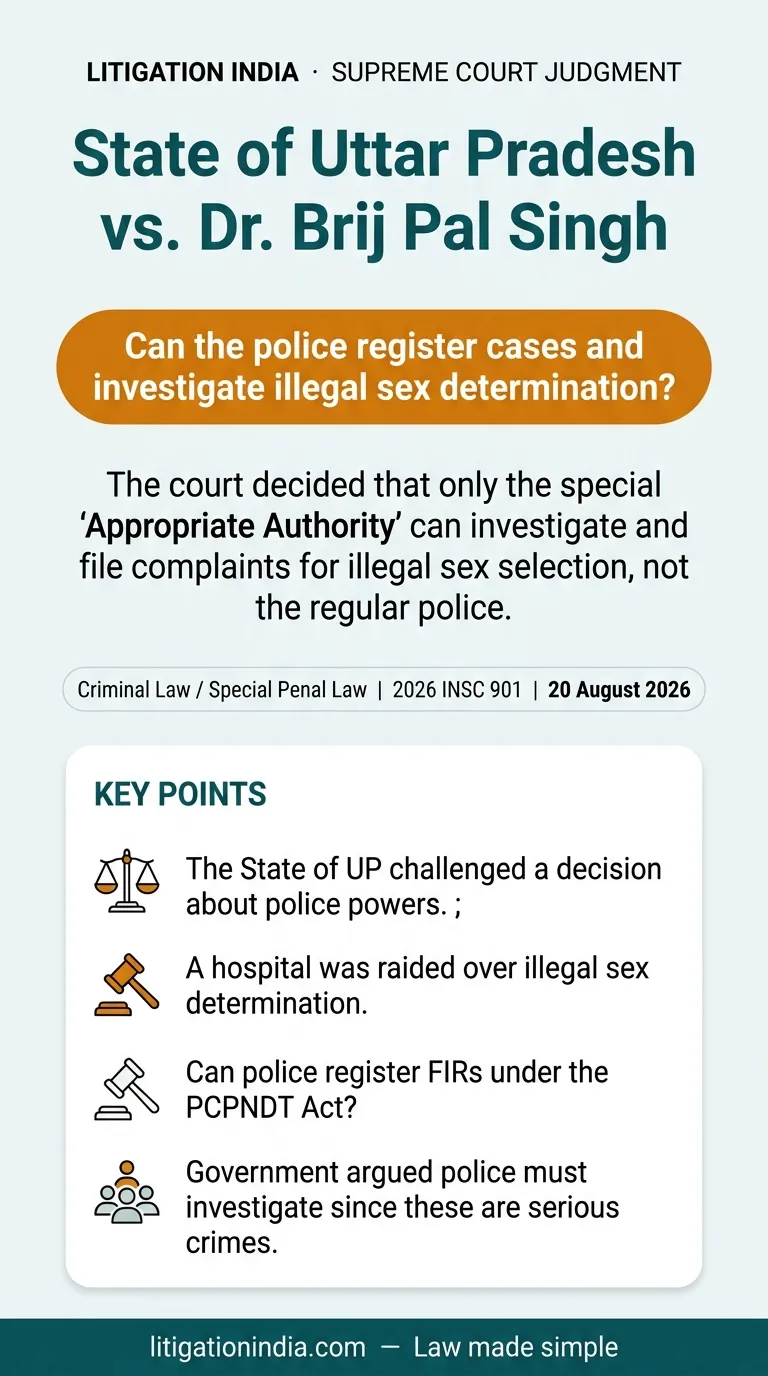
Can the police register cases and investigate illegal sex determination?
State of Uttar Pradesh vs. Dr. Brij Pal Singh
Case: State of Uttar Pradesh vs. Dr. Brij Pal SinghCitation: 2026 INSC 901Decided on: 20 August 2026
“The court decided that only the special 'Appropriate Authority' can investigate and file complaints for illegal sex selection, not the regular police.”
Story Slides
In short
This case clarifies who has the power to investigate and prosecute illegal sex determination (finding out the gender of an unborn baby) under the PCPNDT Act. This special law was made to prevent female feticide. The main conflict was between the role of the regular state police and the 'Appropriate Authority'—a special body of medical and legal experts created by the government. The Supreme Court decided that regular police do not have the power to independently register FIRs, investigate, or file chargesheets for offences under this Act, even though these offences are serious and cognizable. Instead, the power to investigate and file complaints lies exclusively with the Appropriate Authority. If the police receive information about sex selection, they must forward it to the Appropriate Authority. The police can only assist the Authority if specifically asked for help, such as for protection or locating an accused person. Furthermore, a Magistrate cannot start a trial against someone based on a police chargesheet under this special Act. The court can only take action if a formal complaint is filed directly by the Appropriate Authority or a person who gave them a fifteen-day notice. However, if the same incident involves other general crimes like causing death, the police can investigate those separately.
Need clarity on a similar legal issue?
Request free pro bono guidance from a Supreme Court Advocate.
Background
The case started when a raid was conducted at a hospital based on information about illegal sex determination. The High Court was asked to decide if the police had the right to register an FIR and file a chargesheet for such special offences, leading to conflicting views across various states.
The Decision
The Supreme Court ruled that the special Appropriate Authority has the exclusive power to investigate and file complaints under the PCPNDT Act. The police cannot file a chargesheet for these offences, and magistrates cannot start a trial based on a police report. However, the police can still investigate any separate general crimes arising from the same incident.
Why it matters for you
This judgment protects doctors and medical clinics from unnecessary harassment by the regular police under a highly technical law. It ensures that sensitive medical cases are handled by qualified experts while keeping a clear boundary between the police and specialized regulatory authorities.
AI-assisted summary, reviewed and verified by our editorial team.
Need help with your case?
Facing a similar legal challenge in the Supreme Court or High Court? Connect with our pro bono volunteer advocates today.
Request Free Callback